
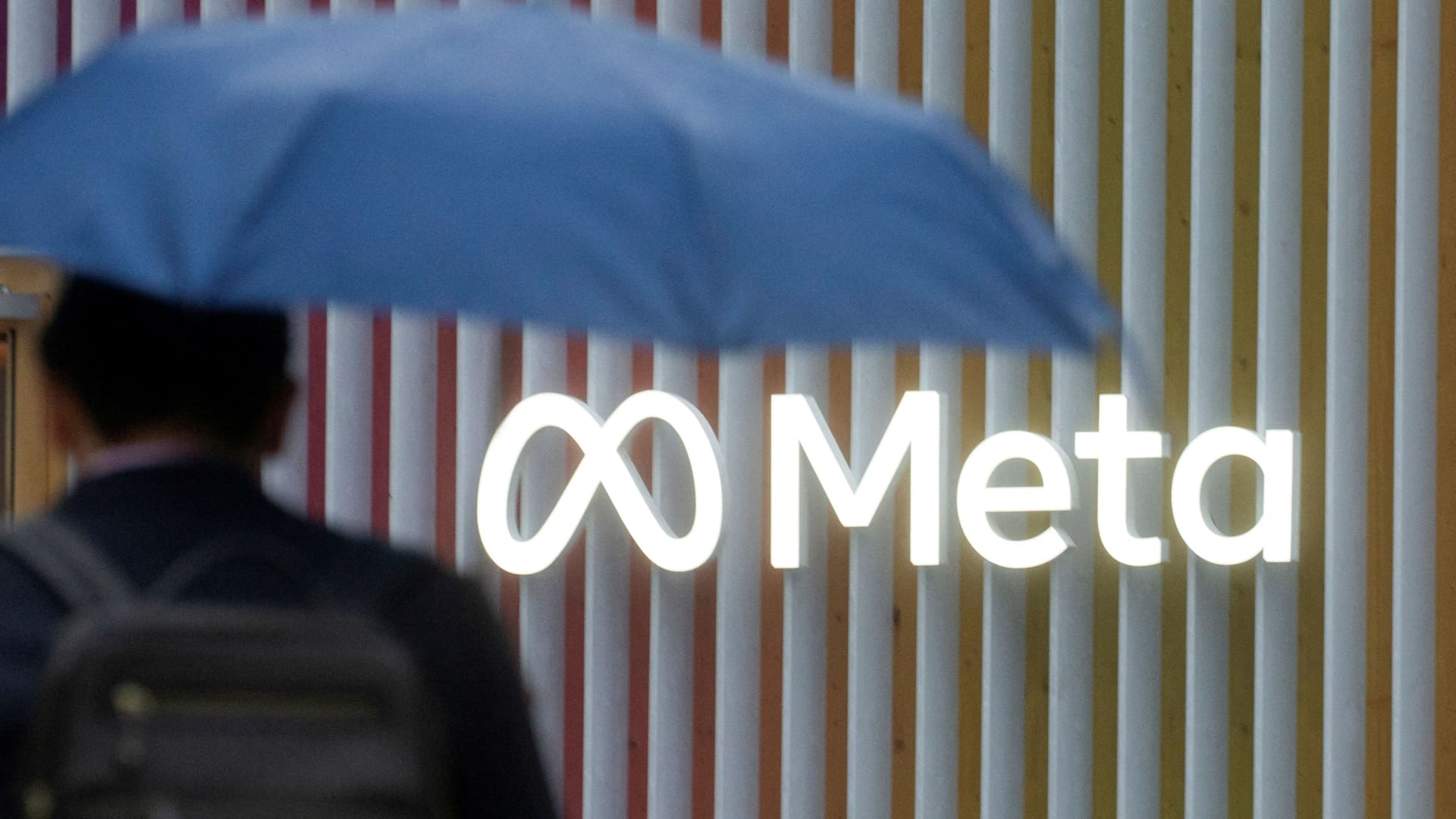
Meta shares pop 15% to 52-week high on guidance, sales increase


Meta shares gained more than 15% on Thursday, reaching a new 52-week high, as analysts and investors digested positive guidance for the upcoming fiscal quarter and an unexpected sales increase for the first quarter of 2023.
The company reported strong results Wednesday, posting a beat on the top and bottom lines. Meta reported first-quarter earnings per share of $2.20, beating the consensus estimate of $2.03, and revenue of $28.65 billion versus the $27.65 billion expected by analysts.
related investing news
Growth in China advertising spend helped lift the company’s first-quarter numbers, with Chief Financial Officer Susan Li telling analysts the bump “was due in part to dropping shipping costs and easing Covid lockdown for those advertisers.”
Mark Zuckerberg told the world in October 2021 that he was rebranding Facebook to Meta as the company pushes toward the metaverse.
Facebook | via Reuters
Meta’s rally was also driven by optimistic guidance for the current quarter. The company expects second-quarter revenue to land between $29.5 billion and $32 billion.
As with other large-cap tech companies, analysts expect that artificial intelligence will be a positive point for Meta.
“Developing more open source models (including LLMs) and helping create an open ecosystem is another area of focus as an open ecosystem should enable META to stay at the forefront and drive infrastructure efficiency over time,” Morgan Stanley’s Brian Nowak wrote Thursday, referring to large language models used for artificial intelligence. Morgan Stanley holds an overweight rating for Meta and upped its price target from $250 to $300.
JPMorgan analyst Doug Anmuth said in a Thursday note that the earnings show the company’s commitment to cost discipline while driving accelerating near-term revenue growth, all while the firm invests in artificial intelligence and the metaverse. JPMorgan reiterated its overweight rating and upped its price target for Meta from $270 to $305.
Meta shares are up 74% year to date.
— CNBC’s Jonathan Vanian and Michael Bloom contributed to this report.


Direxion signage at the New York Stock Exchange (NYSE) in New York, US, on Monday, Dec. 22, 2025. The holiday-shortened week started with gains in stocks amid a broad advance that saw a continuation of the bullish momentum on Wall Street.
Michael Nagle | Bloomberg | Getty Images
Motive, a company with software for managing corporate trucks and drivers, on Tuesday filed for an initial public offering on the New York Stock Exchange under the symbol “MTVE.”
The paperwork puts Motive among a fast-growing group of tech companies looking to go public in 2026. Anthropic, OpenAI and SpaceX have all reportedly considered making their shares widely available for trading next year.
Motive is smaller, reporting a $62.7 million net loss on $115.8 million in revenue in the third quarter. The loss widened from $41.3 million in the same quarter of 2024, while revenue grew about 23% year over year. The company had almost 100,000 clients at the end of September.
Ryan Johns, Obaid Khan and Shoaib Makani started Motive in 2013, originally under the name Keep Truckin. Makani, the CEO, is Khan’s brother-in-law.
Investors include Alphabet’s GV, Base10 Partners, Greenoaks, Index Ventures, Kleiner Perkins and Scale Venture Partners.
Motive’s AI Dashcam device for detecting unsafe driving “has prevented 170,000 collisions and saved 1,500 lives on our roads,” Makani wrote in a letter to investors. Most revenue comes from subscriptions, although Motive does sell replacement hardware and professional services.
The San Francisco company changed its name to Motive in 2022, and as of Sept. 30, it employed 4,508 people. Motive employs 400 full-time data annotators who apply labels that are meant to enhance artificial intelligence models.
Motive has ongoing patent-infringement litigation with competitor Samsara, which went public in 2021 and today has a $22 billion market capitalization.
WATCH: AI IPO boom next year? The changing 2026 IPO landscape
Technology
Why an analyst sees Meta shares getting back to record highs – plus, another tariff reprieve


A silicon wafer with chips etched into is seen as U.S. Vice President Kamala Harris tours a site where Applied Materials plans to build a research facility, in Sunnyvale, California, U.S., May 22, 2023.
Pool | Reuters
The U.S. will increase tariffs on Chinese semiconductor imports in June 2027, at a rate to be determined at least a month in advance, the Trump administration said in a Federal Register filing on Tuesday.
But in the meantime, the initial tariff rate on semiconductor imports from China will be zero for 18 months, according to the filing from the Office of the U.S. Trade Representative.
As part of an investigation that kicked off a year ago, the agency found that China is engaging in unfair trade practices in the industry.
“For decades, China has targeted the semiconductor industry for dominance and has employed increasingly aggressive and sweeping non-market policies and practices in pursuing dominance of the sector,” the office said in the filing.
The decision to delay new tariffs for at least 18 months signals that the Trump administration is seeking to cool any trade hostilities between the U.S. and China.
Additional tariffs could also become a bargaining chip if future talks break down.
U.S. President Donald Trump and Chinese President Xi Jinping reached a truce in the so-called trade war in October, as part of a deal that included the U.S. slashing some tariffs and China allowing exports of rare earth metals.
The USTR’s Tuesday filing states that tariffs will increase on June 23, 2027.
The notice is the next step in a process focusing on older chips that started during the Biden administration under Section 301 of the Trade Act.
The new 2027 date gives clarity to American firms that have said they are closely watching how U.S. tariffs could affect their businesses or supply chains.
The tariffs are separate from other duties threatened by the Trump administration on Chinese chip imports under Section 232 of the law.
-
 Sports2 years ago
Story injured on diving stop, exits Red Sox game
-
 Sports3 years ago
‘Storybook stuff’: Inside the night Bryce Harper sent the Phillies to the World Series
-
 Sports2 years ago
Game 1 of WS least-watched in recorded history
-
 Sports3 years ago
Button battles heat exhaustion in NASCAR debut
-
 Sports3 years ago
MLB Rank 2023: Ranking baseball’s top 100 players
-
Sports4 years ago
Team Europe easily wins 4th straight Laver Cup
-
 Environment3 years ago
Japan and South Korea have a lot at stake in a free and open South China Sea
-
 Environment1 year ago
Here are the best electric bikes you can buy at every price level in October 2024