

This new kit lets you tow an e-bike with another e-bike

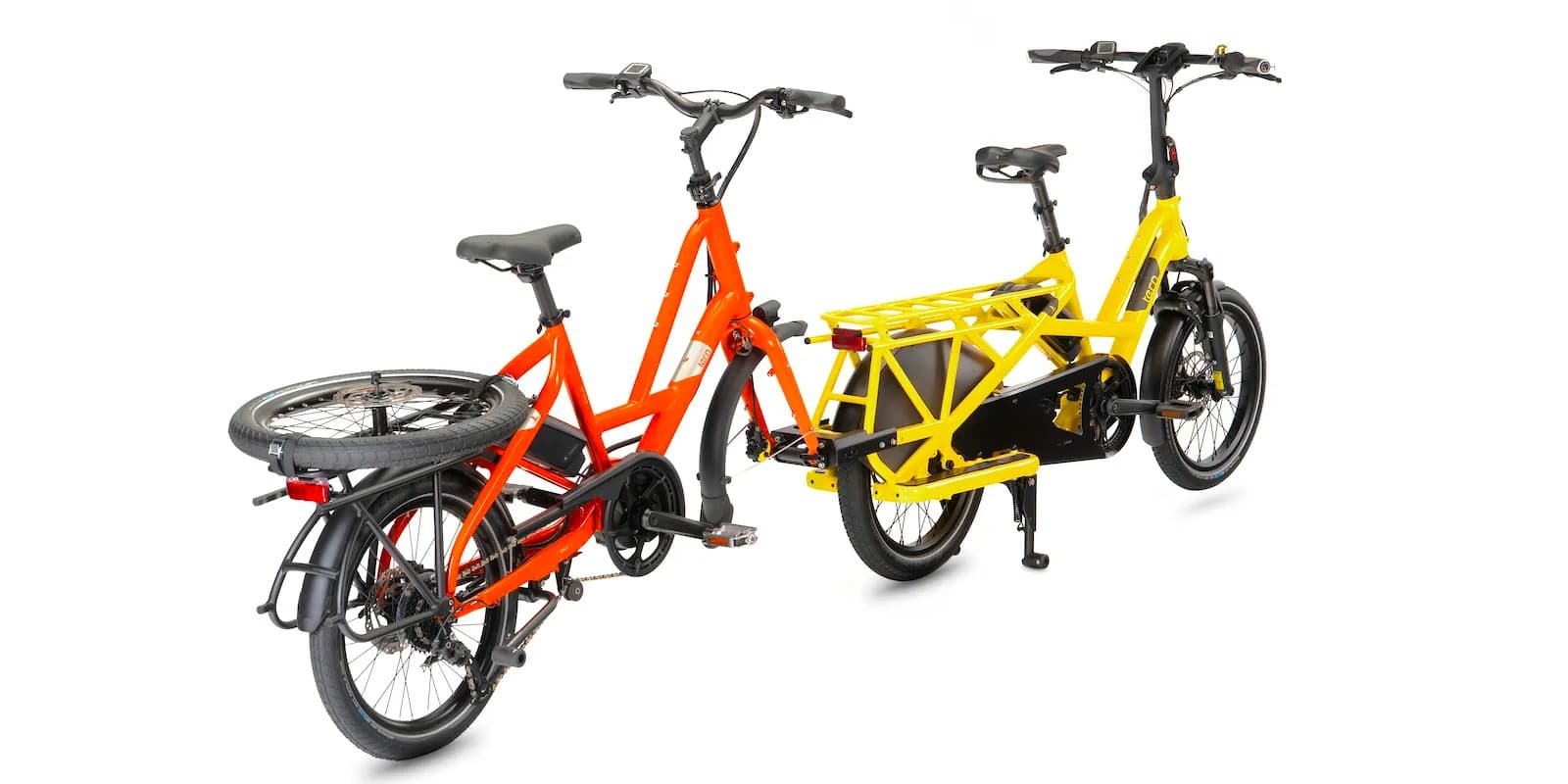
Have you ever wanted to tow an electric bike with your own e-bike? Ok fine, that might be a niche case. But if you ever do in the future, now there’s a kit for you thanks to Tern bikes. And it also works for the somewhat more common case of pulling a trailer behind your e-bike.
Tern is known for having some the heaviest hauling and safest e-bikes in the industry. After testing several models, I can tell you that anyone who wants a cargo bike that can reliably move an apartment or bring home two weeks of groceries would be quite happy with a Tern.
But Tern isn’t resting on its cargo laurels. Now the company is adding to the capabilities of e-bikes with a new towing kit. In fact, the company has just launched two towing kits, one built upon the other.
The first is a more general purpose kit designed to add a trailer tow hitch to the bike. The second upgrades the hitch into a bike-specific tow kit that allows you to tow another bike – or electric bike – behind you.
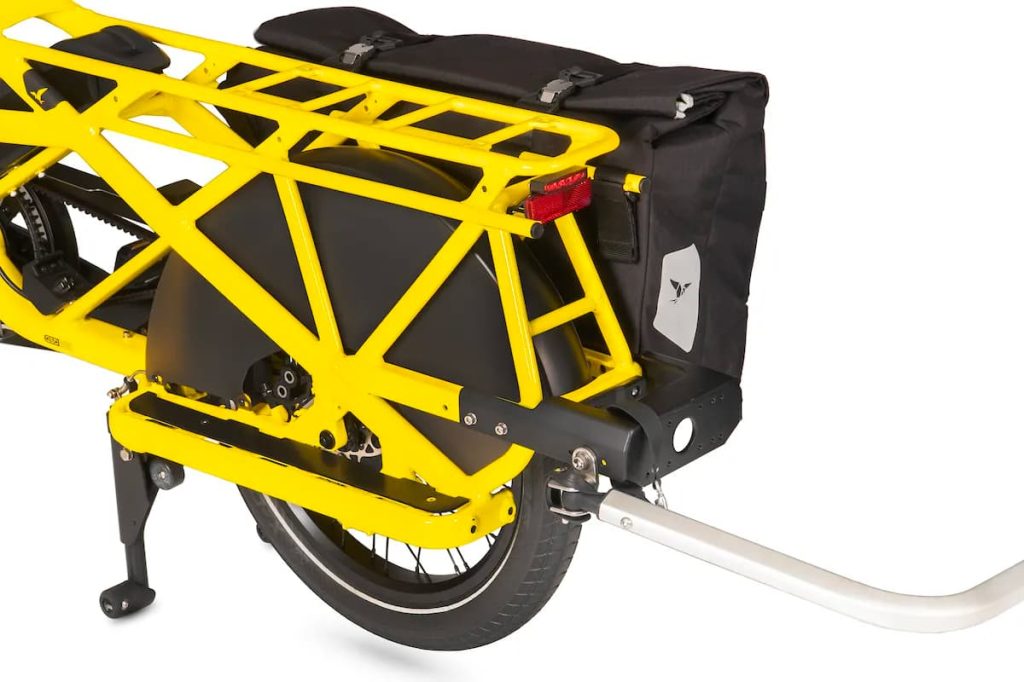
The GSD is Tern’s most impressive hauler, taking the form of a compact cargo bike with one of the heaviest load ratings in the industry. And the new tow kit makes it even more of a cargo beast.
As the company explained:
Ever thought of hauling even more stuff, your kids AND the doggo at the same time? With the Tail Hitch L, you can attach a trailer to the rear of your GSD Gen 2 and still use your trusted panniers or lower deck accessories. This way, you can bring your whole family on any trip, along with everything you want.
The kit fits a range of trailer hitches and also includes protection plates to avoid scratching the bike while towing.
The corrosion resistant design uses stainless steel for durability and keeps it rust-free. The setup is rated for up to 60 kgs (132 lbs) and is safety tested by the leading German certification lab EFBE Prüftechnik.

The Tow Kit can be upgraded into the Bike Tow Kit in order to pull a second bike – or electric bike – behind you. The rear bike isn’t supposed to be ridden while towing, but the second rider can take their place on the GSD’s back seat between the main rider and the towed bike.
As Tern explained:
With the Bike Tow Kit, you can bring an extra bike along for any ride! Bring your mountain or road bike on your camping weekend, or tow your kid’s bike on longer stretches of the trip. Designed for towing a bike without its rider – your riding buddy gets to become everyone’s favorite backseat driver as they chill and take in all the action from your passenger seat. The Kit keeps the towed bike away from the passenger – giving them ample space to travel in comfort, and giving you more space for cargo on your GSD.
Cargo trailers are becoming an increasingly common accessory for electric bikes, especially as more riders begin replacing cars with e-bikes. Rad Power Bikes, a leader in the US e-bike market, recently launched their own trailer designed for the company’s e-bikes.
Pulling a trailer with a pedal bike would normally be a task only for the strongest of riders due to the extra resistance of a heavy load and two more wheels on the ground. But with an e-bike, the additional load isn’t nearly as exhausting (and it barely makes an impact at all if you’re using a throttle-controlled e-bike).
As more riders begin tackling larger cargo jobs with their e-bikes, expect to see more companies following Tern’s lead and hopping on the bandwagon… or the cargo trailer.
FTC: We use income earning auto affiliate links. More.

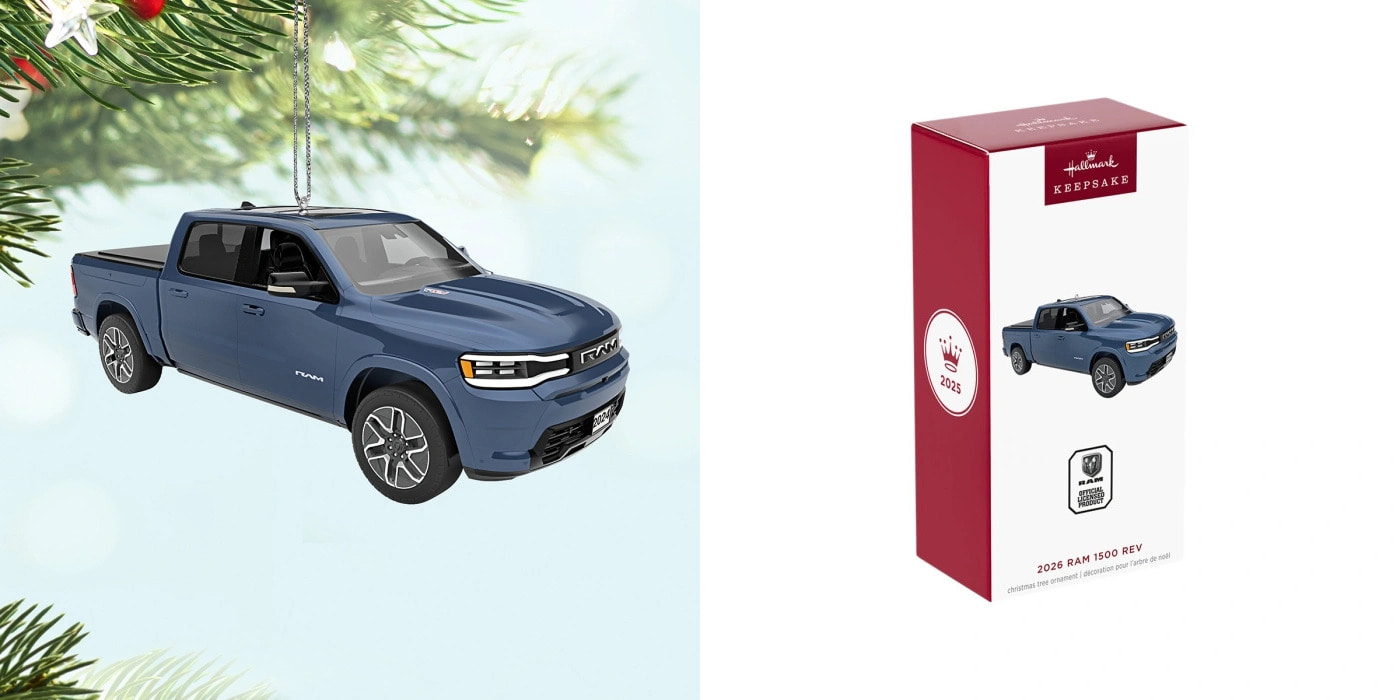
No, Ram is still not planning to launch the all-electric pickup we’ve been waiting for, but it is selling this mini one for $30 for Christmas.
Ram is selling a mini EV pickup for Christmas
Former Stellantis CEO Carlos Tavares promised Ram’s electric pickup would outperform the competition with class-leading range, charging speeds, towing, and more, but it was all just a pipe dream.
After delaying the long-awaited Ram 1500 REV several times, Stellantis made it official in September. Ram’s EV pickup was first expected to launch in 2024, then pushed back to 2025, then 2026, and now it’s canceled altogether.
Development of the all-electric Ram truck has been shut down, and the Ramcharger, a range-extended electric vehicle (REEV), will take its place in the lineup.
Although you won’t be able to get your hands on a full-size model, Ram will sell you a mini version this Christmas.
On its website, Ram is selling a 2026 Ram 1500 REV Hallmark Keepsake ornament for $29.95. It’s made with authentic details based on the all-electric pickup and even includes a 2025/2026 license plate and spinning wheels.


Ram’s range-extended pickup is equipped with dual electric motors, a 92 kWh battery, a 3.6 L V-engine, and a 27-gallon gas tank that CEO Tim Kuniskis claims delivers “unlimited” range of up to 690 miles. The REEV is Ram’s most powerful pickup, packing 647 horsepower and 610 lb-ft of torque.
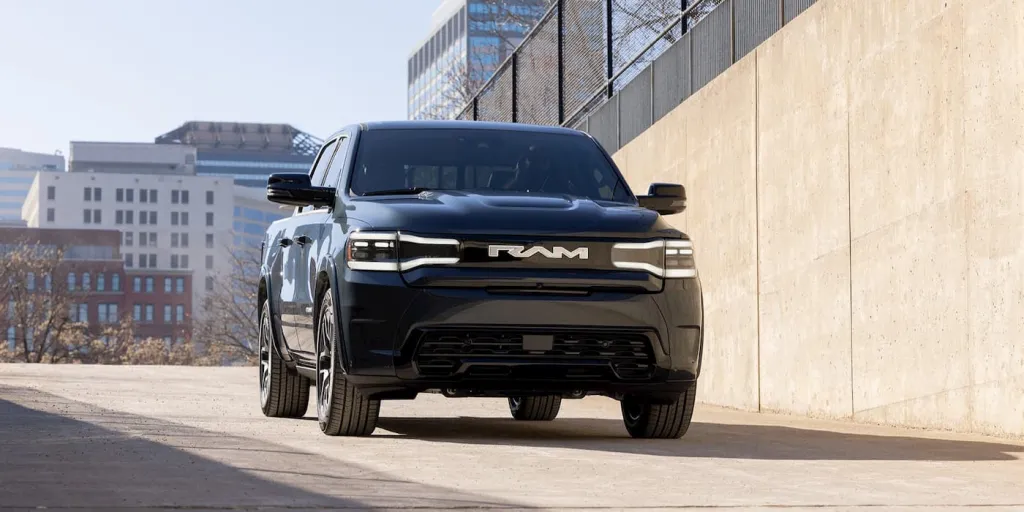
Crosstown rival Ford announced similar plans earlier this week. Ford ended production of the all-electric F-150 Lightning, and plans to replace it with a next-gen EREV version.
So, if Ram has no plans to offer an all-electric pickup, why is it selling a Christmas ornament? Maybe it really was planning to launch it at one point in time.


FTC: We use income earning auto affiliate links. More.

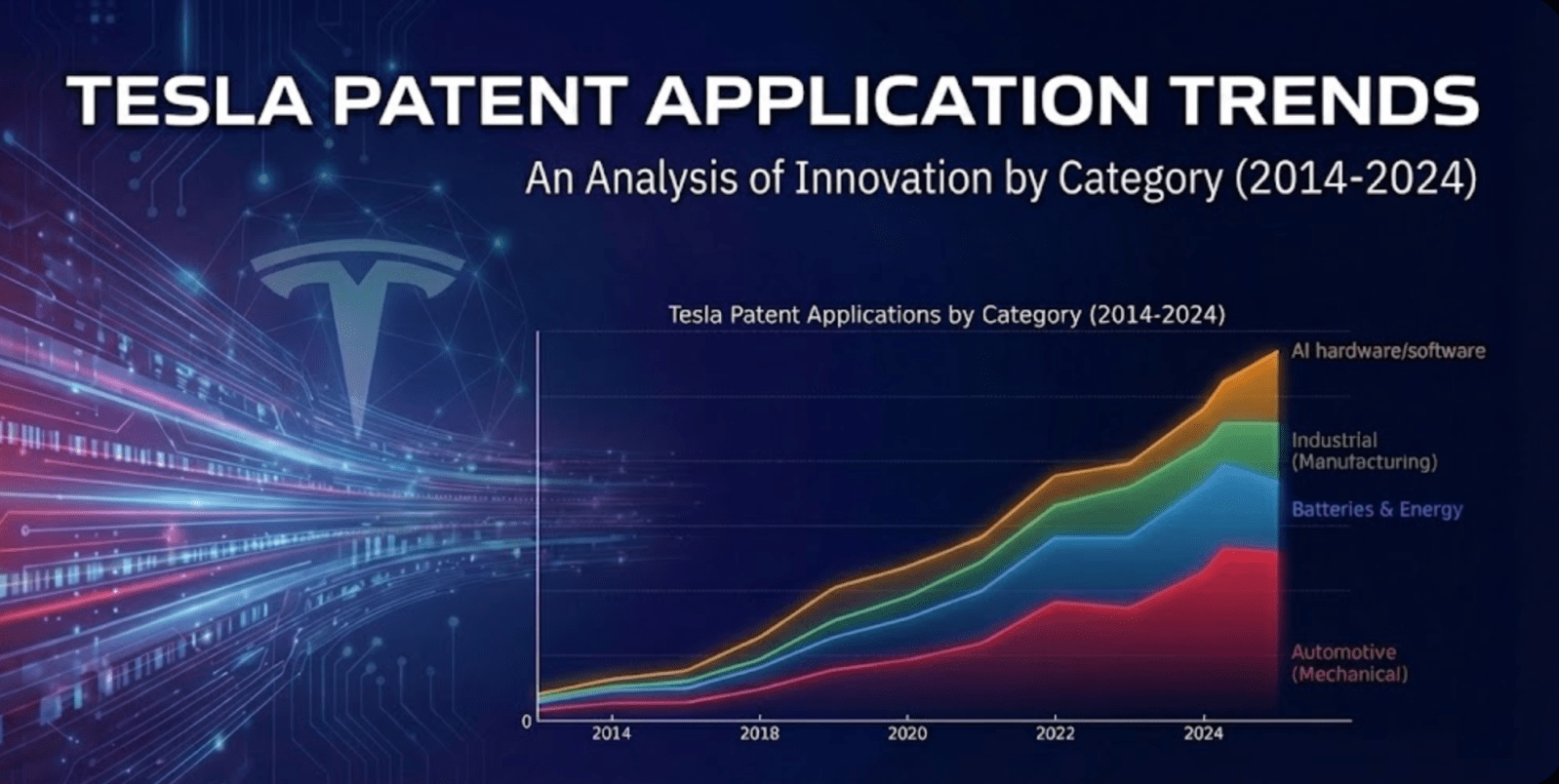
An analysis of Tesla’s patent applications shows a slower pace of innovation in the last 2 years and a shift toward AI hardware and software as Elon Musk is betting the house on autonomous driving and robots.
We have long debated whether Tesla (TSLA) should be valued as an automotive manufacturer or a technology company. While bears point to declining car deliveries and margins, bulls point to autonomous driving and robots as the next phase of growth.
The bears are right. Car sales still account for the majority of Tesla’s revenue and profits, and they have been steadily declining over the past 2 years.
A bullish future in which Tesla’s AI bets replace its declining auto business remains hypothetical, but there is at least some data supporting Tesla’s investments in this shift.
Now, a new analysis of Tesla’s patent filings over the last decade by Electrek gives us perhaps the most objective look yet at where the company is actually putting its R&D efforts.
The data reveals a massive shift. The “car” part of Tesla is shrinking in the patent logs, first replaced by a surge in manufacturing innovations, then by patent applications linked to AI hardware and software.
Here’s a look at the data (important to note that there’s a 12-18 month lag in patent application data and therefore we are not up to 2024 for the most up-to-date data):
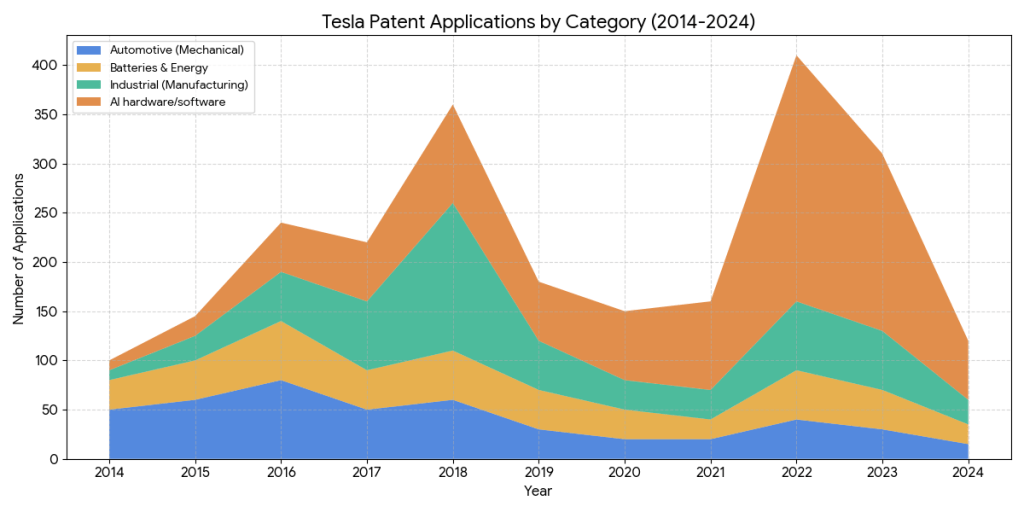
The ‘Twin Peaks’ of Tesla Innovation
We obtained a dataset breaking down Tesla’s ~4,200 patent applications from 2014 through 2024. When you map them out, two distinct peaks emerge, telling the story of the company’s pivot to AI.
The first peak hit in 2018, right in the middle of the “Model 3 Production Hell.” At the time, Elon Musk was supposedly sleeping on the factory floor, and the patent filings reflect that desperation. We saw a massive spike in “Industrial” patents, most of which were related to manufacturing.
Tesla was clearly trying to find ways to build vehicles in high volumes for the first time.
Then, filings dipped as Tesla focused on profitability in 2019/2020.
But look at 2022. We see a second, even larger peak. This time, the composition is entirely different. The “Industrial” slice is still there (thanks to innovations such as gigacasting), but the “Automotive” slice has become a sliver.
The new dominant category: AI hardware and software.
In this category, you have everything from new theories and processes for autonomous driving to new AI computing hardware that became Tesla’s AI4 computer inside its vehicles.
We can see that “AI” contributed to the first peak in 2018 as Tesla was expanding work on Autopilot and FSD, but only started to represent a majority of Tesla’s patent applications in the 2020s.
Tesla is Becoming Less of an Automaker
Here is the wildest stat from the research: Less than 10% of Tesla’s total patents are now classified as “Automotive.”
For comparison, if you look at legacy automakers like Toyota or VW, their portfolios are dominated by mechanical engineering patents: chassis, suspension, and combustion efficiency.
Tesla’s portfolio is now 40% AI-related. We are seeing a flood of filings related to:
- Neural Network training (Dojo).
- Vision-only distance estimation (replacing LiDAR).
- Data labeling and simulation.
This confirms what we have been saying for a while: Tesla CEO Elon Musk has completely shifted the automaker to AI at the detriment of its auto business.
The 2023 and 2024 data (which is still trickling in due to publication lags) show the next pivot.
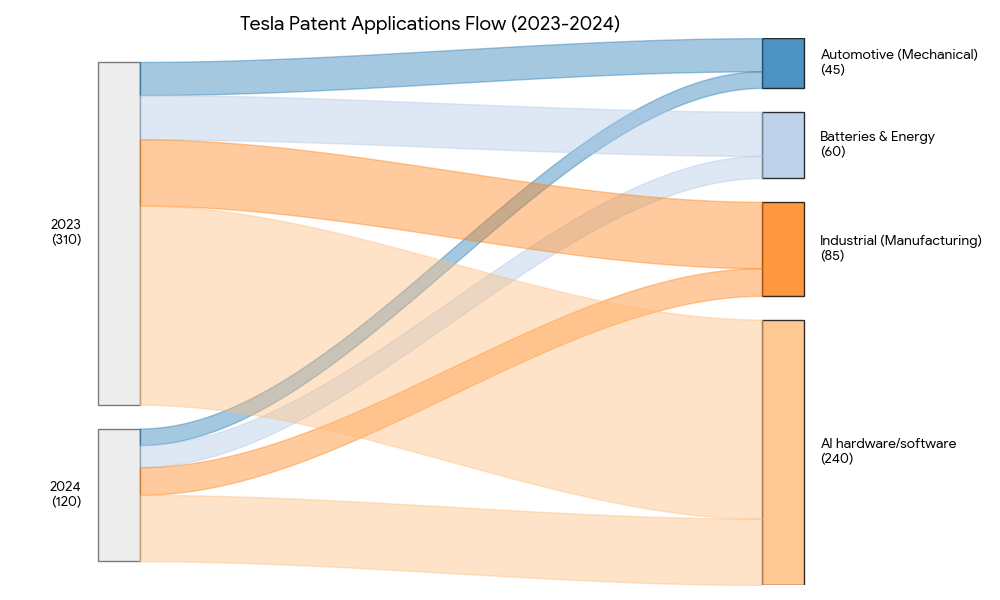
While there are still a few patents related to the auto business, such as regarding wireless charging, they now represent a small minority.
But even then, things like wireless charging for EVs fall into the automotive category; you could argue that Tesla is doing it for the AI category, since the idea is that autonomous vehicles will need wireless charging if there are no humans to plug them in.
As you can see from the chart above, since 2023, the majority of Tesla’s patent applications have been related to AI hardware or software – even though many of them are still in mechanical and electrical engineering, they are no longer about the automotive business.
We are seeing a lot of filings for “electromechanical joints” and “linear actuators,” which are clearly related to humanoid robots.
Electrek’s Take
There’s a little something for both sides of the Tesla spectrum in this one.
Bears can feel vindicated that Tesla’s shift to AI is indeed coming with less spending on automotive R&D. We have seen Tesla’s pace of innovation in EVs slow down in the last few years, and I think we can expect that trend to continue.
Meanwhile, bulls can now visualize Tesla’s shift to AI through these patent application trends.
This reflects a bit of why I sold my Tesla shares last year. I invested in Tesla because I believed in its mission to accelerate the advent of electric transport, and I saw the company as being the most innovative in the space.
It’s no longer the case, and Musk has now unofficially shifted the mission to accelerating the advent of the “age of abundance.”
Call me a skeptic, but my spidey sense always starts tingling when billionaires who buy elections start talking about utopias.
For example, Musk recently said that charity will not be necessary because AI will “end poverty” and deliver “universal high income”:
The most absurd aspect of this statement is the context: it was a criticism of a charitable donation, specifically Dell’s.
Effectively, he is discouraging billionaires from philanthropy under the pretense that AI will eventually ‘end poverty,’ rendering charity obsolete. But the mechanism for this end to poverty is missing.
If AI generates massive wealth, that capital will initially concentrate in the hands of the billionaires who own the models and the data feeding them. How does that wealth translate into ‘Universal High Income’? It won’t magically trickle down. We know that by now.
With the political landscape captured by ultra-high-net-worth individuals who consistently block higher taxation, the only path to redistribution is through the very thing he is dismissing: charity.
If it does happen, and I have serious doubts as you can probably tell, one way or the other, it will go through charity from the ultra-wealthy. Either directly or through allowing their captured political class to increase taxes on themselves or their corporations.
The argument boils down to, ‘There is no need to be generous now; wait until we have accumulated even more wealth.’ It exposes a fundamental contradiction in the promised ‘age of abundance.’
I think AI has a lot of potential to be a positive for humanity, but the risk is also insanely high – hence why it attracts insane risk takers such as Musk.
The way I see it, there are going to be a few winners in this AI race and a lot of losers, and it’s still up for debate whether Tesla will be in the former or latter category.
FTC: We use income earning auto affiliate links. More.

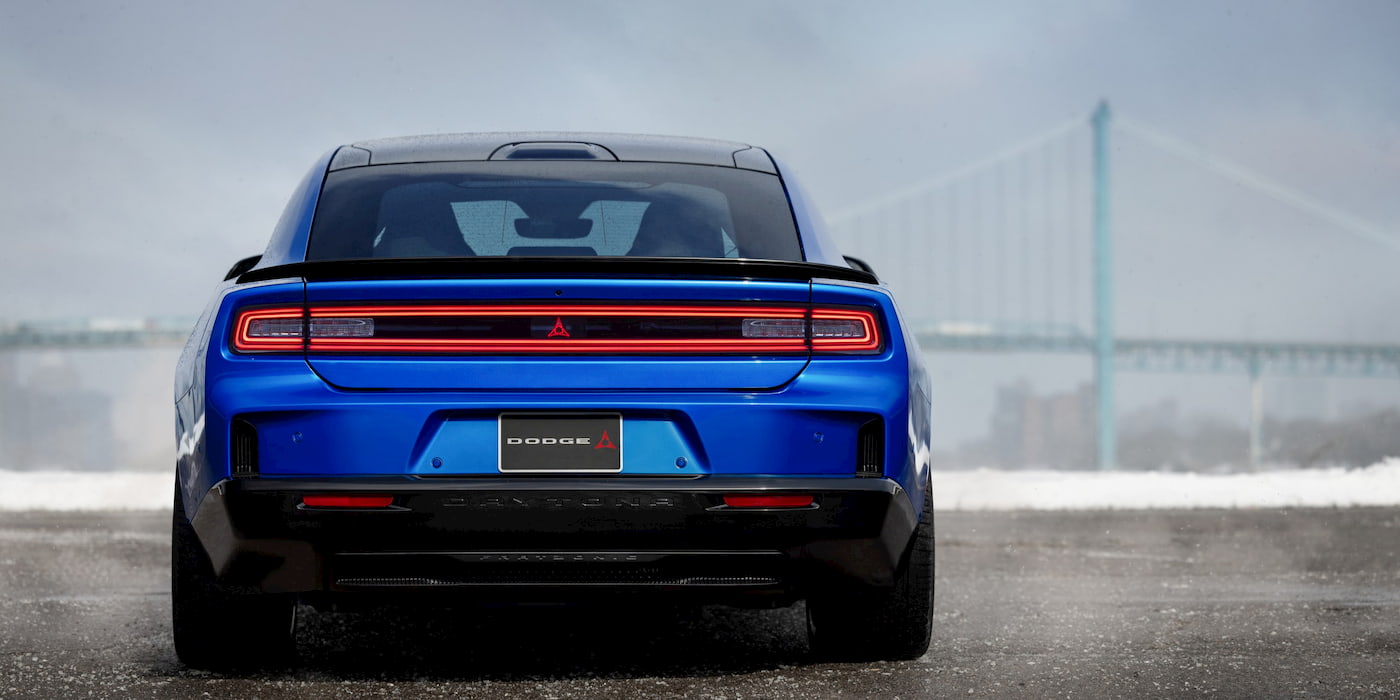
Dodge opened orders for the 2027 Charger Daytona Scat Pack EV, the “world’s quickest and most powerful muscle car.” The 2027 model year gains an NACS port, but is it worth the price?
2027 Dodge Charger Daytona EV price and range
After dropping the base R/T trim last year, the only electric Charger Dodge offered was the high-performance Scat Pack model.
For the 2027 model year, Dodge added a few new standard features to make it a little easier for those looking to go electric.
The 2027 Dodge Charger Daytona Scat Pack now comes with a standard North American Charging System (NACS) port for charging at Tesla Superchargers, unlike last year’s model, which had a CSS port. It will also include a J1772-to-NACS AC adapter.
Although it’s not the most exciting feature, the added NACS port will make it much easier to find and access Level 3 public charging stations.
Dodge and Jeep’s parent company, Stellantis, announced plans last month to adopt NACS ports for its electric vehicles in North America, starting in 2026.
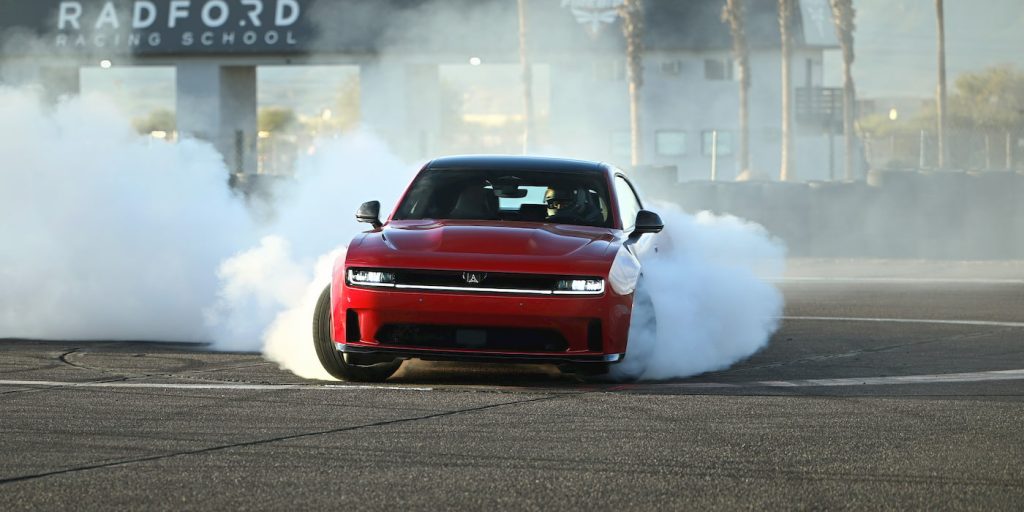
Don’t worry, Dodge still included a few fun features like Drift/Donut Mode, Launch Control, and PowerShot, which unlocks the vehicle’s full power for 10 seconds at the push of a button. The electric Charger also features the “World’s first Fratzonic Chambered Exhaust” system, designed to sound like a classic V-8 engine.
Aside from the added NACS port, the 2027 Dodge Charger Daytona Scat Pack EV remains essentially the same as last year’s model.

It’s powered by an all-wheel-drive (AWD) dual-motor powertrain, packing up to 630 hp. When PowerShot is activated, it delivers 670 hp and 627 lb-ft of torque for 10 seconds.
With a 0-to-60-mph sprint and instant torque, the electric Charger is the quickest of the bunch, even faster than the famed Hurricane engine.
| Driving Range | Starting Price | |
| 2027 Dodge Charger Daytona Scat Pack two-door | 267 miles | $72,495 |
Dodge didn’t reveal battery specs, but said the 2027 electric Charger has a maximum range of 267 miles. Last year’s model was powered by a 100.5 kWh battery, delivering an estimated EPA range of 241 miles.
The 2027 Dodge Charger Scat Pack will start at $72,495, while the four-door model will cost an extra $500. That’s considerably more than the 2026 model year, which starts at $60,690.
Dodge will share more details about NACS charger access and adapters for 2024-2026 Charger Daytona owners in Q1 2026.
To make room for the 2027 models, Dodge is offering up to $12,750 off outgoing Charger Daytona EV models or 0% APR financing for 72 months. If you’re interested in a test drive, you can use our link to find available Dodge Charger Daytona models near you today.
FTC: We use income earning auto affiliate links. More.
-
 Sports2 years ago
Story injured on diving stop, exits Red Sox game
-
 Sports3 years ago
‘Storybook stuff’: Inside the night Bryce Harper sent the Phillies to the World Series
-
 Sports2 years ago
Game 1 of WS least-watched in recorded history
-
 Sports3 years ago
Button battles heat exhaustion in NASCAR debut
-
 Sports3 years ago
MLB Rank 2023: Ranking baseball’s top 100 players
-
Sports4 years ago
Team Europe easily wins 4th straight Laver Cup
-
 Environment3 years ago
Japan and South Korea have a lot at stake in a free and open South China Sea
-
 Environment1 year ago
Here are the best electric bikes you can buy at every price level in October 2024