Connect with us

Published

on

Last year at this time, it was easy for Nick Saban, Ryan Day and Kirby Smart.

Alabama’s Bryce Young, Ohio State’s C.J. Stroud and Georgia’s Stetson Bennett were coming off monster seasons that included a Heisman for Young and a national title for Bennett.

No QB controversies to be found for the top three teams in the 2022 preseason AP poll.

Now all three programs are entering the unknown.

What’s the latest with the Crimson Tide after bringing in Notre Dame transfer Tyler Buchner? Is there any clarity for the Buckeyes or Bulldogs? And what about crowded rooms at Texas, Ole Miss and beyond?

We break down the eight most important quarterback battles to see where things stand following spring practice.


QB contenders: Tyler Buchner, Jalen Milroe, Ty Simpson

Post-spring Week 1 favorite: Tyler Buchner

How the spring affected the race: The fact Alabama brought in Buchner from Notre Dame less than a week after the A-Day spring game tells you the Crimson Tide weren’t content with what they saw from their quarterbacks during spring practice. Now, that doesn’t mean they’re ready to give up on Milroe or Simpson. It just means they wanted another option as they point toward the start of preseason practice in August. Milroe is a dynamic athlete who can give defenses fits running the ball when the play breaks down. His challenge remains cutting down on his turnovers and overall consistency throwing the ball. Simpson also is plenty talented and might end up being the guy, but he just didn’t look ready to lead a football team this spring. So when Buchner hit the transfer portal, given his ties to his former coach at Notre Dame and first-year Alabama offensive coordinator Tommy Rees, the Crimson Tide didn’t hesitate to scoop him up and reunite him with Rees.

Long-term outlook: It’s difficult to believe Buchner would come to Alabama to be a backup. He has three years of eligibility remaining and began last season as the Notre Dame starter before injuring his shoulder in Week 2 and having surgery. He returned for the bowl game and accounted for five touchdowns in a Notre Dame win. Alabama offered Buchner when he was in high school, but he opted for Notre Dame. It says a lot about both Milroe and Simpson and their belief in themselves that they didn’t transfer after Buchner came aboard. Milroe and Simpson, who have combined for 65 college passing attempts, are determined to stay and fight for the starting job. Alabama also has two more scholarship quarterbacks on the roster, freshmen Dylan Lonergan and Eli Holstein. We know this about Nick Saban: He’s going to play the best guy and the guy who wins over the locker room. Buchner’s stats at Notre Dame weren’t eye-popping, but clearly Rees thinks he’s an upgrade over what the Alabama coaches saw this spring. We’re going to find out. — Chris Low

QB contenders: Graham Mertz, Jack Miller III

Post-spring Week 1 favorite: Graham Mertz

How the spring affected the race: It is probably fair to say the spring did not really affect the race much, as Mertz and Miller remain in a quarterback competition headed into fall practice. While we list Mertz as the favorite, based on his experience as a starter at Wisconsin, there is still plenty of work to be done for him to win the job. Especially after neither quarterback impressed in what was the lowest-scoring spring game in Florida history, with 17 total points scored. Mertz went 18-for-29 for 244 yards and a touchdown, while Miller was 10-for-20 for 144 yards and a touchdown as both took turns with the first-team offense. Coach Billy Napier has also said the team will be active in the transfer portal to find another quarterback, so this competition might not even look the same come August.

Long-term outlook: There is no question losing five-star prospect Jaden Rashada, who left after an NIL deal reportedly fell through, has hampered the plan at quarterback. Rashada was supposed to be the future at the position, after Anthony Richardson left school to enter the NFL draft. His signing was hailed as a huge victory for Napier, until it became somewhat of an embarrassment. Now the long-term outlook must be adjusted. The Gators do not have much depth between Mertz, Miller and redshirt freshman Max Brown, which only puts more pressure on the staff to find somebody currently in the portal. Mertz has started 32 games but was never meant to be the long-term answer when he signed; Miller did not play well in the Las Vegas Bowl, and Brown threw only four passes in the spring game. If there is any good news, it’s that Florida already has a huge commitment from five-star QB D.J. Lagway in the class of 2024. Now the Gators just have to hold on to him. — Andrea Adelson


QB contenders: Carson Beck, Brock Vandagriff

Post-spring Week 1 favorite: Carson Beck

How the spring affected the race: Not much, if at all. Kirby Smart talked about Georgia’s ability to give their quarterbacks more reps than anyone in the country, because they almost always have a third unit and sometimes even a fourth. Beck is the quarterback with the most reps given he has been around the longest, and after an impressive performance in the spring game, he looked the part. Smart said, “I was really pleased with all three quarterbacks and what you saw today was some of what we’ve seen all spring. We have three good quarterbacks who can make the throws and do a really good job. I was pleased with those guys.” It should be noted Smart also went out of his way to mention Vandagriff had some passes that were dropped.

Long-term outlook: It’s safe to say Beck is going to be the first to get a shot as the starting quarterback. However, if he were to struggle, Georgia’s schedule allows the Bulldogs to experiment and figure out who really is the best fit for the offense. Georgia’s first four games are at home, against UT-Martin, Ball State, South Carolina and UAB. Smart hasn’t been afraid to switch things up at quarterback when they haven’t worked in the past, so I don’t think people should expect this season to be any different, especially with Georgia feeling like they can get a third consecutive title. — Harry Lyles Jr.


QB contenders: Kyle McCord, Devin Brown

Post-spring Week 1 favorite: Kyle McCord

How the spring affected the race: Both quarterbacks shared first-team reps, but there wasn’t enough separation to name a starter. Brown missed the spring game after undergoing a procedure on a finger on his throwing hand. In his absence, McCord had a rather pedestrian performance, completing 18-of-34 passes for 184 yards and one touchdown. Some of that was a product of a limited wide receivers group and inconsistent offensive line. It’s McCord’s third season in the offense, and he has an edge in experience. Coach Ryan Day told ESPN this spring that McCord “understands how defenses are trying to attack them,” has changed his body this offseason and has a strong, accurate arm. Day said while Brown hasn’t had as much time in the offense, he has learned quickly. “I’ve been very impressed with the amount of information he’s been able to process in a short period of time,” Day said. “Very good athlete, can move and change direction very well.”

Long-term outlook: Ohio State had a hole to fill after Dylan Raiola, the No. 1 overall prospect in the 2024 class, decommitted in December, but last month the Buckeyes lured in quarterback Air Noland for the 2024 season. Noland, a 6-foot-3 pocket passer from Fairburn, Georgia, had interest from Alabama, Arkansas, Clemson, Miami, Oregon and Texas A&M. As a junior, Noland had 4,095 yards passing with 55 touchdowns to four interceptions. He also rushed for 156 yards and five touchdowns. Ohio State also has three-star quarterback Lincoln Kienholz, who flipped from Washington and committed in 2023. — Heather Dinich

QB contenders: Jaxson Dart, Spencer Sanders, Walker Howard

Post-spring Week 1 favorite: Jaxson Dart

How the spring affected the race: The Ole Miss coaches couldn’t have been happier with Dart and the way he performed this spring. In some ways, bringing in Sanders and Howard might have lit a fire under him, as he clearly took it to the next level with his decision-making and consistency in leading the offense on scoring drives. Dart, who started 12 of 13 games last season after transferring from USC, had only one turnover all spring. Sanders was limited by a shoulder injury but made up ground as he became healthier. He saved his best for last and was the Rebels’ most impressive quarterback in the spring game. Sanders, who accounted for 85 career touchdowns at Oklahoma State in four years as a starter, is a perfect fit for what Ole Miss does in its quarterback run game. Howard, a former 5-star recruit at LSU, showcased his ability to throw the deep ball and generated a lot of explosive plays, but he also turned the ball over and is still probably a year away from being a serious candidate for the starting job.

Long-term outlook: Dart was good enough (and consistent enough) in the spring that it’s going to be difficult for anyone to unseat him. What he did better than anybody was get the ball into the end zone, and that’s the ultimate measure of a quarterback. But to say Sanders, especially with all of his experience and athleticism, is too far behind to catch Dart would be premature. And who’s to say both quarterbacks won’t contribute in some form or fashion in 2023? Ole Miss coach Lane Kiffin has been adamant that he’s going to build the most talented roster he can, and he knows as well as anyone you can never have enough good quarterbacks. Ole Miss goes so fast on offense it helps to have as many reps as possible in that system. For Dart, everything seemed to slow down this spring, and his footwork, timing and rhythm were all improved. Ole Miss doesn’t have to name a starter until more than three months from now. But if that decision had to be made today, it would be Dart. — Low


QB contenders: Joe Milton III, Nico Iamaleava

Post-spring Week 1 favorite: Joe Milton III

How the spring affected the race: It was Milton’s job to lose, especially given the way he played when he filled in at the end of last season for the injured Hendon Hooker. Milton was excellent against a talented Clemson defense in Tennessee’s 31-14 Orange Bowl win over the Tigers, and he built on that success this spring. The best news for the Vols is they had an ultratalented freshman pushing Milton all spring in Iamaleava, who arrived in December and went through the bowl practices. There’s a ton of hype surrounding Iamaleava, who has elite arm talent, but Tennessee coach Josh Heupel was impressed with the way Iamaleava came to practice every day determined to get better, never showed any entitlement and soaked up everything he could from Milton. During the early part of his Tennessee career, Milton was prone to overthrowing receivers and getting too amped. He showed this spring he’s capable of playing within the system, making big plays and being a team leader.

Long-term outlook: Heupel and the entire offensive staff are excited to see Milton operate now that he knows (and the team knows) that he’s clearly the man at quarterback. Milton beat out Hooker as the starter when he transferred from Michigan, but it became clear a few games into the 2021 season that Hooker was the better quarterback. Milton knows the 2023 season is his chance to make the kind of jump that Hooker did, and at 6-5, 242 pounds and with an arm that’s one of the strongest in college football, Milton has the tools to blossom into one of the top quarterbacks in the country. He will also be valuable in short-yardage situations with his ability to run but consistency will be the key. He has to prove he can do it over the course of the entire season, and all the while, the Vols know they have their quarterback of the future ready (Iamaleava) if Milton stumbles or experiences injury problems. — Low


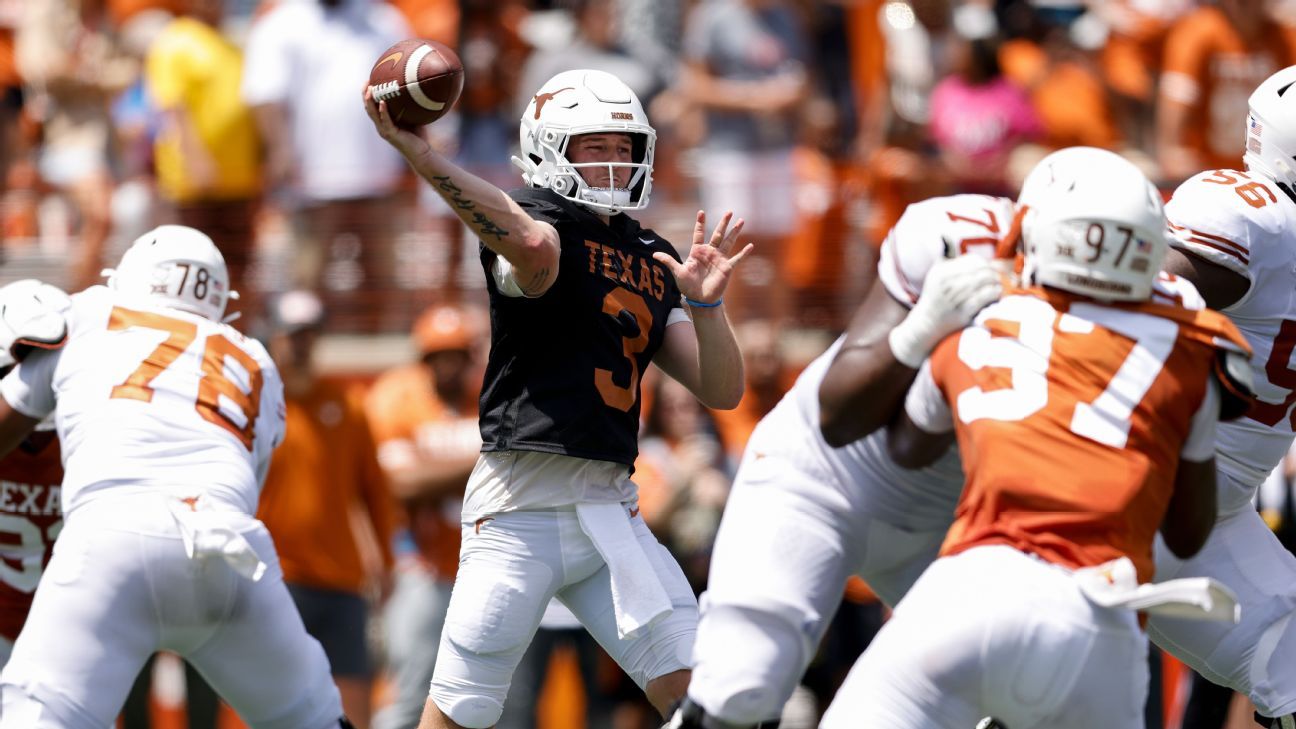
QB contenders: Quinn Ewers, Maalik Murphy, Arch Manning

Post-spring Week 1 favorite: Quinn Ewers

How the spring affected the race: Sophomore Ewers was the favorite after making 10 starts last season, and nothing this spring put any wrinkles into that plan. At the beginning of the spring, with Murphy being held back with a leg injury, much attention was on Manning, the star freshman. Coach Steve Sarkisian said he would give Manning every opportunity to battle for the job and didn’t want to put limits on him. But by the time the spring game rolled around, Ewers (16-for-23, 195 yards, TD) was a solid No. 1, redshirt freshman Murphy (9-for-13, 165 yards, TD) put on show of his own in his first appearance in front of Texas fans, and Manning, who played with freshmen and backups, went 5-for-13 for 30 yards. “I think it’s pretty clear to say that Quinn’s our starting quarterback and we feel very good about that,” Sarkisian said after the game.

play

0:30

Arch Manning receives ovation, throws 1st completion in Texas spring game

Arch Manning receives a loud ovation from the Texas fans, then throws a completion in his first pass attempt during the Longhorns’ spring game.

Long-term outlook: Ewers said he wasn’t where he wanted to be last year, when he ranked 53rd nationally in QBR (64.3), but he will helm a reloaded Texas offense that has a strong supporting cast at wide receiver and tight end. Sarkisian is enamored with Murphy’s arm strength and ability to make all the throws. He has a good problem, with three potential starting quarterbacks in his room, but it could prove to be a challenge to keep all of them in Austin. After redshirting in 2021 at Ohio State before transferring to Texas, Ewers could depart for the NFL with a strong season. The Mannings, meanwhile, knew the transition from a private school to Austin would not be an easy one, so the idea of a redshirt has never been out of the question, which is a luxury for both Manning and the Longhorns. “He’s on the right trajectory he should be on,” Sarkisian told Dallas radio station 105.3 The Fan about Manning after spring practice. “He’s a true freshman in college. He really should still be in high school. He just finished his first semester on the Forty Acres, so there’s a definite transition there. … There’s a lot of room for him to grow this summer. Ultimately, it’s a great room that we have.” — Dave Wilson


QB contenders: Dante Moore, Ethan Garbers, Collin Schlee, Justyn Martin, Chase Griffin

Post-spring Week 1 favorite: Dante Moore

How the spring affected the race: Some separation was created. While the quarterback battle in Westwood appeared to be particularly crowded after the departure of longtime Chip Kelly stalwart Dorian Thompson-Robinson, spring showed that Moore, Garbers and Schlee are the three who are truly fighting for the job. Moore was the most impressive of the bunch, which is no surprise given his five-star rating, but does complicate things given he’s the least experienced of the trio. Garbers has shown himself to be plenty capable in limited play during the past two years and that continued this spring. Schlee, meanwhile, is the wild card. The senior arrives by way of Kent State, and while there were likely no promises made to him about a starting role, there had to have been at least an expectation that he was the favorite. After spring camp, however, it’s a three-person race.

Long-term outlook: This is a true pick-your-poison situation for Kelly, who does not appear to be in a hurry to make a decision. Garbers is the longtime backup who is familiar with the system but whose ceiling isn’t exactly soaring. Schlee is the incoming transfer who combines both talent with experience and should be good enough to keep UCLA afloat should Kelly hand him the ball. Moore, meanwhile, is the potential superstar who has already shown in spring that he is not going to settle for being second fiddle. Kelly knows Moore will be the starter sooner or later. The question is: Can he bring himself to go bold and let the true freshman start from the first snap of the season? Or will he play it safe, start Garbers or Schlee, and then eventually turn to Moore when in need of a spark? — Paolo Uggetti
Continue Reading

Sports

Grading coaching hires: Kiffin to LSU, Sumrall to Florida and more

Published

on

By

Grading coaching hires: Kiffin to LSU, Sumrall to Florida and more

The wildest college football coaching cycle — perhaps ever — has reached the hiring phase.

Schools around the Power 4 that fired their coaches in the first two months of the season — or, in Stanford’s case, way back in late March — are targeting candidates and finalizing deals. Interestingly enough, one of the first major coaches to lose his job, Penn State’s James Franklin, was the first noninterim coach to be hired, as he is headed to Virginia Tech.

New hires always come with hope and optimism, grand proclamations and the chance to get programs on the right track. But not all hiring processes are the same. The financial component with jobs is essential — what schools are willing to spend not just on their head coach, but the assistants and support staff and, perhaps most important, the team roster.

We will be reviewing all of the major coaching hires in the 2025-26 cycle, evaluating how each coach fits in the job, their major challenges and what it will take to be successful. We will also assign an initial letter grade for each hire.

Jump to: LSU | Ole Miss | Florida | Arkansas | Auburn
Stanford | Oklahoma State | Virginia Tech

LSU hires Ole Miss’ Lane Kiffin

Why is this a good fit?

LSU got the coach it wanted ahead of other suitors, further confirming that its coaching job, despite the drama and dysfunction, remains one of the best in college football. Kiffin left a great situation at the height of his powers because he knows that LSU can consistently compete for national titles in ways that other programs simply cannot. In Kiffin, LSU gains a coach accustomed to the bright lights and the big stadiums, who can attract and develop talent and potentially restore the program to national powerhouse status. LSU can offer the big stage Kiffin lacked at Ole Miss, and wanted again.

Kiffin hasn’t worked at LSU but knows the SEC well after stops at Ole Miss, Alabama and Tennessee. Like Kiffin did at Ole Miss, he should put together an excellent staff that can scour Louisiana, Texas and the surrounding areas for top talent. He certainly will try to bring some of Ole Miss’ top players with him. Kiffin brings the offensive chops that LSU lacked at the end of Kelly’s tenure. He’s one of the nation’s best at identifying and developing quarterbacks, and the emergence of running back Kewan Lacy and others underscores that the Kiffin plan works on offense. — Adam Rittenberg

Biggest challenges Kiffin will face

LSU has a reputation as a place where it is possible to win championships, and that expectation will be placed on Kiffin immediately – especially with the money he is being paid. The Tigers pride themselves on this fact as Nick Saban, Les Miles, then Ed Orgeron all won national titles. Brian Kelly was an awkward fit from the start and never truly got the vibe down on the Bayou. Kiffin has his own unique way of running a program, but he has to find a way to work with all the different “cooks in the kitchen” so to speak. The entire state is heavily invested in LSU football, and though Kiffin has an extremely high profile, he is moving to an even bigger spotlight in Baton Rouge — the only Power 4 school in the state. Kiffin must embrace that, and everything that comes with it. As coveted as he was in this cycle, Kiffin has never won a conference title and finding a way to get over the hump at a school like LSU has to happen. This will be his best shot to get it done, and the clock will start ticking as soon as his first press conference ends. — Andrea Adelson

Grade: A-

The fixation around Kiffin the past few weeks would normally be attached to a multi-time national championship winner, or at least a coach who has won a Power 4 conference title. Kiffin did tremendous work at Ole Miss but still needs to show he can win the biggest games consistently. LSU is a national championship-or-bust type of program, and Kiffin will be judged at the very highest level, which he craves. He brings the right ingredients to get it done in Baton Rouge, especially his work with quarterbacks. — Rittenberg


Ole Miss makes DC Pete Golding new head coach

Why is this a good fit?

Under normal circumstances, Ole Miss could run a complete coaching search, thoroughly assess candidates currently in head-coaching roles, and others who might help build on the historic success under Lane Kiffin. But these are the strangest of times in Oxford, as Kiffin exits for LSU, a College Football Playoff first-round game looms for the Rebels, and emotions are running extremely high. Kiffin certainly will try to poach the roster for top pieces, and Ole Miss must do what it can to protect as many players as possible. Golding was the lead recruiter for many of them. He’s well-liked by players and won’t need to familiarize himself with Oxford, the administration and how Ole Miss is set up to compete.

Golding, 41, might not have been on the wish list for other SEC jobs just yet, but Ole Miss found itself in a unique situation. He’s a Louisiana native who has spent his entire career in the region, first at his alma mater Delta State and other smaller programs, and then Southern Miss and UTSA before getting his big break with Nick Saban at Alabama in 2018. Golding spent five seasons as a coordinator under Saban, and helped the Crimson Tide to a national title in 2020, before joining Kiffin at Ole Miss. He gives Ole Miss a chance not only for success in this year’s CFP, but can minimize disruptions during a very bumpy coaching transition.

What will be Golding’s biggest challenge?

Golding should be able to handle the next few weeks, but his true readiness for the enormity of the job is unclear. Again, he didn’t emerge as a candidate for the other SEC openings in this cycle, which suggests some external concern about his ability to handle such a role. Any first-time coaching job brings its challenges and even though Golding knows Ole Miss, he hasn’t been the face of the program. He’s also replacing a coach who put together the team’s most successful run since John Vaught in the late 1950s and early 1960s.

Although Golding has shown his talents in recruiting and with schematics, how will he handle the media? How does he do in front of donors and other key stakeholders with the university? Perhaps he just needed the chance, which he now has, but assistant coaches that are shielded from the media often take some time to get fully comfortable.

Grade: B

Coaching hires can’t be evaluated in a vacuum, and Golding’s ultimate success or failure at Ole Miss will be judged by what he accomplishes beyond the 2025 season. But what happens in Ole Miss’ first CFP appearance, after losing Kiffin to a rival SEC school, absolutely does matter, too, and Golding gives Ole Miss a chance to prolong a really special season. There’s little doubt he will continue to compile strong rosters. He will need a strong supporting staff, especially a talented offensive coordinator hire, to ultimately sustain and even elevate the program. The key question here is whether other SEC programs missed out on a great candidate in Golding, or will Ole Miss suffer for making an in-the-moment decision that could backfire long-term? — Rittenberg


Why is this a good fit?

Florida fans: Sumrall isn’t Billy Napier. Yes, he’s another promising Group of 5 coach from a program in Louisiana, just as Napier was when he came to Gainesville. But Sumrall is a different personality who comes from the opposite side of the ball and has more ties to the SEC, where he both played (Kentucky) and coached (Ole Miss, Kentucky). He’s more comfortable than Napier was in being the face of a major program and will delegate to his coordinators while compiling a strong staff. Although Auburn seemed like a more natural spot for Sumrall because of his connections to the state, Florida gives him an even bigger platform at the lone SEC program in one of the nation’s top talent-producing states.

The other thing Sumrall brings is wins. He won Sun Belt titles in both of his seasons at Troy and went to the American Conference title game in his first year at Tulane. Sumrall has succeeded in different ways and with different types of quarterbacks. He hasn’t won in the Power 4 or at a program like Florida, which is an understandable concern. But Sumrall is ready for the opportunity and should be able to foster the consistency Florida has lacked for far too long. Florida didn’t have a talent problem under Napier, and Sumrall should continue to excel in personnel while translating it better on the field. — Rittenberg

Biggest challenges Sumrall will face

Where do we start? First and foremost, Sumrall has to find a way to win over a fan base that thought it had a shot at landing Lane Kiffin. Whether that was a reality or not, Gators fans had their hopes up that Kiffin would choose them. With that, Sumrall has to convince fans he is not another version of Napier. Once Sumrall has done that, he has to find a way to win at what has proved to be one of the hardest jobs to crack in the SEC. Florida has not won an SEC title since 2008, and while there remains a belief it is one of the best jobs in the country, Florida goes through coaches at a fairly frequent clip. If past is precedent, Sumrall will be given a year or two to find success before the fan base starts to turn on him; four years max to compete for a championship. Expectations are sky high, and Sumrall will be given no leeway to learn on the job. — Adelson

Grade: B+

Sumrall has the ingredients to become the next great SEC coach. He’s an excellent communicator who connects with a range of people and should get Florida fans excited about the future, even if they might be skeptical at first because of his background. Florida isn’t where I initially saw him ending up in a wild coaching cycle, but if the school gives him some time, he should stabilize and elevate the Gators’ on-field performance and start getting more out of very talented rosters there. — Rittenberg


Why is this a good fit?

Silverfield has quietly become a really successful coach in the region, and certainly seems ready for a Power 4 opportunity like Arkansas. Although he hasn’t generated as much buzz as Tulane’s Jon Sumrall and other American Conference coaches, he has beaten many of them in head-to-head matchups and boasts a 29-9 record since the start of the 2023 season, including an AP Top 25 finish last fall. Silverfield led Memphis to a win against Arkansas earlier this season and has beaten four consecutive Power 4 opponents, including West Virginia and Iowa State in bowl games the past two seasons.

He has led Memphis since late 2019 but been at the program since 2016, so he understands the recruiting landscape and where Arkansas must look for players. Arkansas’ location can be a challenge for acquiring talent, but Silverfield shouldn’t be intimidated by it. He also brings a strong background on offense to Fayetteville and should compile a staff that has similar knowledge to the area and possibly the SEC.

What are the biggest challenges for Silverfield?

The SEC is only getting tougher with the additions of Texas and Oklahoma, the emergence of Texas A&M, Ole Miss and Vanderbilt, and the pressure on a traditional heavyweight like Florida to start making the CFP. Where does Arkansas really fit in the SEC pecking order? Silverfield likely will have to do more with less initially and win games against programs that have been on steadier footing. His real challenge will be trying to energize and unite the financial hubs around the Arkansas program, which give the program a chance to accelerate but haven’t always been harnessed.

Athletic director Hunter Yurachek was blunt earlier this year about the increased resources needed to better compete in the SEC. Arkansas seemingly could access those individuals and corporations with the right coach and vision. That’s where Silverfield comes in, as Arkansas can use those relationships to overcome some of its baked-in obstacles. Silverfield will need a strong introductory period, as Arkansas fans might not know him that well and need to embrace his personality and leadership style. The first offseason will be critical to make sure the program doesn’t fall further behind.

Grade: B

Silverfield’s consistency and success tended to go under the radar at a program like Memphis, where people have grown accustomed to really strong seasons. But his steady leadership style, shown in 2023, 2024 and most of this year, should help an Arkansas program that needs clear direction. He hasn’t coached in the SEC, and there could be a learning curve, but he shouldn’t be surprised walking in the door at Arkansas after spending so much time with Memphis. — Rittenberg


Why is this a good fit?

Every SEC school asks its head coaches to be engaged in recruiting, and Auburn is no exception. Although Auburn never got the results it wanted with Hugh Freeze, the school’s approach toward NIL and acquiring talent — a major draw when it tried to lure Lane Kiffin from Ole Miss — showed up on the roster. Golesh is the type of head coach who could harness Auburn’s established personnel apparatus and really maximize things going forward. He’s about as hands-on in the recruiting space as head coaches get. When Golesh was offensive coordinator at Tennessee, I remember sitting in his office and seeing him monitor all the recruiting transactions from social media on a giant screen. Golesh will get after it to upgrade Auburn’s roster and use all the resources available to him. He won’t be intimidated by the SEC recruiting scene and has ties to multiple states, including Florida and Ohio.

Golesh also brings an offensive background that should energize Auburn fans, especially after how poorly things went on that side of the ball under Freeze. He spent time with Matt Campbell early in his career, and then with Josh Heuepel at both UCF and Tennessee. South Florida ranks in the top five nationally in both scoring and total offense this season, and its defense shined in wins against Boise State and Florida.

What will be Golesh’s biggest challenge?

The challenge at Auburn is almost always the same. Can the head coach truly capitalize on the best parts of the place — an advantageous recruiting location, strong financial resources and a large and extremely devoted fan base — while navigating the big donors and other significant forces that have clashed too often over time and ultimately held back the program’s progress? Golesh is a strong communicator and brings a good mix of experience to the Plains, most notably his two seasons as an SEC coordinator at Tennessee.

He hasn’t been an SEC head coach, though, and he will need to show he won’t be pushed around or swayed by the forces that have doomed Auburn in the past. Golesh’s staff hires at Auburn will be especially important on defense, as South Florida made strides on that side this season but also struggled in key losses to Memphis and Navy. The other element worth watching is how Golesh balances the personnel element, undoubtedly his passion, with some of the other key responsibilities that come with managing an exciting but complicated program like Auburn.

Grade: B+

Despite no Power 4 head-coaching experience, Golesh checks a lot of boxes with his background, having worked in the Big Ten, Big 12 and SEC, and in the Midwest, South and Southeast. His time at Tennessee should really help him at a program like Auburn, which has a chance to move up in the SEC pecking order but will need a smart, aggressive approach. Golesh’s record of 23-15 doesn’t really jump off the page, and he hasn’t been part of a conference championship just yet. But his assertive vision as a recruiter gives Auburn a chance to quickly improve its roster and win more in an increasingly difficult SEC. — Rittenberg


Why is this a good fit?

Pritchard understands Stanford — its advantages, limitations and possibilities — better than most. He played quarterback for the Cardinal from 2006 to 2009, ahead of Andrew Luck’s run, and then spent the first 13 years of his coaching career with his alma mater, until joining the Washington Commanders‘ staff in 2023. He won’t be blindsided by what he’s walking into at Stanford. He also has a very close relationship with Luck, who is truly directing the program. There will be no feeling-out period between head coach and general manager.

Pritchard, 38, was part of Stanford’s seismic shift under Jim Harbaugh, quarterbacking the team to a signature win against USC in 2007. He then witnessed Stanford’s rise to a consistent contender and, more importantly, saw how things went downhill so quickly after COVID and in the portal/NIL era. His ability to learn from those difficult times and ensure Stanford avoids them will be important. But again, he’s not doing this alone, as he comes in immediately aligned with Luck. — Rittenberg

What will be Pritchard’s biggest challenge?

Generating momentum. Few people share as close an association with some of the biggest moments in Stanford history as Pritchard, but during those heights, the Cardinal never truly resonated broadly within a competitive San Francisco Bay Area sports market. With the collapse of the Pac-12 and six losing seasons in the past seven years, Stanford football has essentially become irrelevant locally. Building a program under those circumstances is difficult.

The academic side of things will always be a draw and should, in theory, help the program limit excessive outgoing transfers, but there also needs to be a robust NIL program. At Stanford that doesn’t have to be a problem. The university’s alumni base is notably wealthy, but it also has not proved to be a group eager to part with large sums of money to help field a better football team. That’s perhaps more of an issue that Luck will be responsible for dealing with, but it is very much part of the hand Pritchard has been dealt.

Beyond the structural challenges, this is just a team that needs a talent upgrade. They don’t have the players right now to compete at a high level. — Kyle Bonagura

Grade: C+

Luck didn’t make the most imaginative hire here. He went with a close friend who needs no introduction to Stanford and the vision for success there. But Pritchard hasn’t been a head coach before and wasn’t mentioned as being on the radar for many other college or NFL jobs. Stanford is really betting on potential here. He only really knows Stanford, which might work out in this case, but he also must learn from what happened toward the end of David Shaw’s tenure and chart out a new path. — Rittenberg


Why is this a good fit?

Oklahoma State needed a coach who knew the Big 12 and the region, and someone who could bring a clear vision, especially on offense. Quarterback play was central to Oklahoma State’s identity under Mike Gundy, and Morris has become one of the best talent identifiers in recent years. Oklahoma State needs to accelerate its recruiting, but likely won’t have the first choice for players, and Morris has repeatedly shown the ability to find and develop under-the-radar players. Ideally, he can bring quarterback Drew Mestemaker and others to Stillwater, and perhaps more importantly, make Oklahoma State an attractive destination for top offensive performers again.

Morris played and coached in the Big 12 at Texas Tech and spent time at Houston early in his career, so he won’t be unfamiliar with the key characteristics of a program like Oklahoma State. He’s not a Gundy disciple, but he can respect what Gundy did to elevate the program, while implementing his own vision, which worked both at Incarnate Word and at North Texas. — Rittenberg

What will be Morris’ biggest challenge?

The answer here is twofold: 1) Morris must live up to the unprecedented levels of consistent success his predecessor brought Oklahoma State; 2) Morris will also have to figure out exactly how to take the Cowboys’ football program to the future.

On the first point, whomever Oklahoma State chose to hire this cycle was going to be replacing a coach who won more — and more consistently — than any other figure in program history. Before 2023, the Cowboys made 18 consecutive bowl appearances under Gundy, winning eight or more games in 13 of those seasons. Past leading Oklahoma State to the very top of the sport and turning the program into a national brand, Gundy’s greatest achievement was transforming a school that had registered back-to-back 10-win seasons only once before he took over in 2005 into a perennial winner. Morris, who made two playoff appearances at Incarnate Word and has North Texas contending for the American this fall, has a history of producing quick turnarounds. Getting Oklahoma State upright — which will likely require a massive roster and staff overhaul — should be his first objective. From there, Morris will be judged on the expectations set by Gundy before him.

How does Morris take Oklahoma State into the future? Gundy’s initial, outspoken reluctance, then too-little, too-late embrace of college football’s NIL/transfer portal era hurt the Cowboys on the field and laid the groundwork for his unceremonious departure earlier this fall. Oklahoma State has fallen behind in terms of roster budgeting compared to its Big 12 counterparts, and industry sources suggested that the Cowboys’ ability to present improved resources would be a key piece of the hiring process. Morris has built a career on making more out of less, and that will serve him well in Stillwater. He has also proven capable of navigating the transfer portal and the current complexities of the sport. With help from Oklahoma State (and its boosters), Morris must take steps to modernize the program. If he can, a Big 12 conference landscape that remains wide open outside of Texas Tech could once again be Oklahoma State’s for the taking. — Eli Lederman

Grade: A-

Morris is only 40 (cue the Gundy memes), hasn’t been a Power 4 head coach, and before this season had only middling results with North Texas. His quarterback track record is his superpower, though, and Oklahoma State needs a renaissance at the position after things fell off too sharply. Morris can recruit Texas and build up the roster. Time will tell if he has the expertise to win one-score games in a league where programs are extremely similar. — Rittenberg


play

0:32

Paul Finebaum: Is Virginia Tech an upgrade for James Franklin?

Paul Finebaum weighs in on James Franklin reportedly being hired as Virginia Tech’s next coach.

Why is this a good fit?

When Franklin was fired and almost immediately announced his intentions to coach in 2026, Virginia Tech emerged as a natural landing spot for the 53-year-old. He has spent most of his career near the mid-Atlantic region, twice serving as a Maryland assistant, leading programs in Vanderbilt and Penn State and even working within the state at James Madison in 1997.

He understands the key recruiting areas extremely well. Franklin ultimately was fired for not winning the biggest games at Penn State, but he still won a lot of them (104) and understands how to build a consistently successful program. Virginia Tech ultimately had to do more of the selling here and convince a veteran coach that it was financially serious enough to contend in the ACC. Franklin isn’t shy about asking for what he needs, and he wouldn’t take the job if he didn’t feel that Virginia Tech’s investments are sufficient to compete for ACC championships. — Rittenberg

What will be Franklin’s biggest challenge?

This hire would not have happened without the financial investment Virginia Tech is about to make in football. The Hokies have languished behind their ACC counterparts in nearly every area — from staffing to salaries to NIL — and some of that has to do with an outdated way of thinking. The one through line has been the thought that the Hokies could win the way Frank Beamer won. That is a big reason why they hired Brent Pry, who served as Franklin’s defensive coordinator, as head coach in November 2021. That clearly did not work, as Pry never won more than seven games in a season. Virginia Tech pledged to add $229 million to its overall athletics budget over the next four years — a huge concession that the old model no longer works in this new era of college football.

But Franklin has to get the entire athletic department to believe the old Beamer days truly are over and things must be done his way. That is challenge No. 1. The second challenge is to restore Virginia Tech’s prowess in recruiting its home state. Franklin had success taking players out of Virginia Tech’s backyard and turning them into stars at Penn State. Will he be able to do the same now at Virginia Tech, which has lost an enormous amount of ground to powers outside the state? The high school players being recruited now were toddlers the last time Virginia Tech was a nationally respected program playing in BCS games. They don’t remember the Hokies being elite. Convincing players to stay in state will be a challenge, but one that Franklin can achieve given his track record. — Adelson

Grade: A

Virginia Tech’s two post-Frank Beamer hires were a coach who had not led a Power 4 program (Justin Fuente) and a first-time head coach (Brent Pry). In Franklin, Virginia Tech gets a proven winner from the Big Ten and SEC, who knows the region extremely well and will be extremely motivated to compete for league titles and CFP appearances.

Franklin’s big-stage shortcomings are a concern but perhaps not as much for a program like Virginia Tech, which is seeking to become a consistent conference title contender again. — Rittenberg

Continue Reading

Sports

Grading coaching hires: Kiffin to LSU, Sumrall to Florida and more

Published

on

By

Grading coaching hires: Kiffin to LSU, Sumrall to Florida and more

The wildest college football coaching cycle — perhaps ever — has reached the hiring phase.

Schools around the Power 4 that fired their coaches in the first two months of the season — or, in Stanford’s case, way back in late March — are targeting candidates and finalizing deals. Interestingly enough, one of the first major coaches to lose his job, Penn State’s James Franklin, was the first noninterim coach to be hired, as he is headed to Virginia Tech.

New hires always come with hope and optimism, grand proclamations and the chance to get programs on the right track. But not all hiring processes are the same. The financial component with jobs is essential — what schools are willing to spend not just on their head coach, but the assistants and support staff and, perhaps most important, the team roster.

We will be reviewing all of the major coaching hires in the 2025-26 cycle, evaluating how each coach fits in the job, their major challenges and what it will take to be successful. We will also assign an initial letter grade for each hire.

Jump to: LSU | Ole Miss | Florida | Arkansas | Auburn
Stanford | Oklahoma State | Virginia Tech

LSU hires Ole Miss’ Lane Kiffin

Why is this a good fit?

LSU got the coach it wanted ahead of other suitors, further confirming that its coaching job, despite the drama and dysfunction, remains one of the best in college football. Kiffin left a great situation at the height of his powers because he knows that LSU can consistently compete for national titles in ways that other programs simply cannot. In Kiffin, LSU gains a coach accustomed to the bright lights and the big stadiums, who can attract and develop talent and potentially restore the program to national powerhouse status. LSU can offer the big stage Kiffin lacked at Ole Miss, and wanted again.

Kiffin hasn’t worked at LSU but knows the SEC well after stops at Ole Miss, Alabama and Tennessee. Like Kiffin did at Ole Miss, he should put together an excellent staff that can scour Louisiana, Texas and the surrounding areas for top talent. He certainly will try to bring some of Ole Miss’ top players with him. Kiffin brings the offensive chops that LSU lacked at the end of Kelly’s tenure. He’s one of the nation’s best at identifying and developing quarterbacks, and the emergence of running back Kewan Lacy and others underscores that the Kiffin plan works on offense. — Adam Rittenberg

Biggest challenges Kiffin will face

LSU has a reputation as a place where it is possible to win championships, and that expectation will be placed on Kiffin immediately – especially with the money he is being paid. The Tigers pride themselves on this fact as Nick Saban, Les Miles, then Ed Orgeron all won national titles. Brian Kelly was an awkward fit from the start and never truly got the vibe down on the Bayou. Kiffin has his own unique way of running a program, but he has to find a way to work with all the different “cooks in the kitchen” so to speak. The entire state is heavily invested in LSU football, and though Kiffin has an extremely high profile, he is moving to an even bigger spotlight in Baton Rouge — the only Power 4 school in the state. Kiffin must embrace that, and everything that comes with it. As coveted as he was in this cycle, Kiffin has never won a conference title and finding a way to get over the hump at a school like LSU has to happen. This will be his best shot to get it done, and the clock will start ticking as soon as his first press conference ends. — Andrea Adelson

Grade: A-

The fixation around Kiffin the past few weeks would normally be attached to a multi-time national championship winner, or at least a coach who has won a Power 4 conference title. Kiffin did tremendous work at Ole Miss but still needs to show he can win the biggest games consistently. LSU is a national championship-or-bust type of program, and Kiffin will be judged at the very highest level, which he craves. He brings the right ingredients to get it done in Baton Rouge, especially his work with quarterbacks. — Rittenberg


Ole Miss makes DC Pete Golding new head coach

Why is this a good fit?

Under normal circumstances, Ole Miss could run a complete coaching search, thoroughly assess candidates currently in head-coaching roles, and others who might help build on the historic success under Lane Kiffin. But these are the strangest of times in Oxford, as Kiffin exits for LSU, a College Football Playoff first-round game looms for the Rebels, and emotions are running extremely high. Kiffin certainly will try to poach the roster for top pieces, and Ole Miss must do what it can to protect as many players as possible. Golding was the lead recruiter for many of them. He’s well-liked by players and won’t need to familiarize himself with Oxford, the administration and how Ole Miss is set up to compete.

Golding, 41, might not have been on the wish list for other SEC jobs just yet, but Ole Miss found itself in a unique situation. He’s a Louisiana native who has spent his entire career in the region, first at his alma mater Delta State and other smaller programs, and then Southern Miss and UTSA before getting his big break with Nick Saban at Alabama in 2018. Golding spent five seasons as a coordinator under Saban, and helped the Crimson Tide to a national title in 2022, before joining Kiffin at Ole Miss. He gives Ole Miss a chance not only for success in this year’s CFP, but can minimize disruptions during a very bumpy coaching transition.

What will be Golding’s biggest challenge?

Golding should be able to handle the next few weeks, but his true readiness for the enormity of the job is unclear. Again, he didn’t emerge as a candidate for the other SEC openings in this cycle, which suggests some external concern about his ability to handle such a role. Any first-time coaching job brings its challenges and even though Golding knows Ole Miss, he hasn’t been the face of the program. He’s also replacing a coach who put together the team’s most successful run since John Vaught in the late 1950s and early 1960s.

Although Golding has shown his talents in recruiting and with schematics, how will he handle the media? How does he do in front of donors and other key stakeholders with the university? Perhaps he just needed the chance, which he now has, but assistant coaches that are shielded from the media often take some time to get fully comfortable.

Grade: B

Coaching hires can’t be evaluated in a vacuum, and Golding’s ultimate success or failure at Ole Miss will be judged by what he accomplishes beyond the 2025 season. But what happens in Ole Miss’ first CFP appearance, after losing Kiffin to a rival SEC school, absolutely does matter, too, and Golding gives Ole Miss a chance to prolong a really special season. There’s little doubt he will continue to compile strong rosters. He will need a strong supporting staff, especially a talented offensive coordinator hire, to ultimately sustain and even elevate the program. The key question here is whether other SEC programs missed out on a great candidate in Golding, or will Ole Miss suffer for making an in-the-moment decision that could backfire long-term? — Rittenberg


Why is this a good fit?

Florida fans: Sumrall isn’t Billy Napier. Yes, he’s another promising Group of 5 coach from a program in Louisiana, just as Napier was when he came to Gainesville. But Sumrall is a different personality who comes from the opposite side of the ball and has more ties to the SEC, where he both played (Kentucky) and coached (Ole Miss, Kentucky). He’s more comfortable than Napier was in being the face of a major program and will delegate to his coordinators while compiling a strong staff. Although Auburn seemed like a more natural spot for Sumrall because of his connections to the state, Florida gives him an even bigger platform at the lone SEC program in one of the nation’s top talent-producing states.

The other thing Sumrall brings is wins. He won Sun Belt titles in both of his seasons at Troy and went to the American Conference title game in his first year at Tulane. Sumrall has succeeded in different ways and with different types of quarterbacks. He hasn’t won in the Power 4 or at a program like Florida, which is an understandable concern. But Sumrall is ready for the opportunity and should be able to foster the consistency Florida has lacked for far too long. Florida didn’t have a talent problem under Napier, and Sumrall should continue to excel in personnel while translating it better on the field. — Rittenberg

Biggest challenges Sumrall will face

Where do we start? First and foremost, Sumrall has to find a way to win over a fan base that thought it had a shot at landing Lane Kiffin. Whether that was a reality or not, Gators fans had their hopes up that Kiffin would choose them. With that, Sumrall has to convince fans he is not another version of Napier. Once Sumrall has done that, he has to find a way to win at what has proved to be one of the hardest jobs to crack in the SEC. Florida has not won an SEC title since 2008, and while there remains a belief it is one of the best jobs in the country, Florida goes through coaches at a fairly frequent clip. If past is precedent, Sumrall will be given a year or two to find success before the fan base starts to turn on him; four years max to compete for a championship. Expectations are sky high, and Sumrall will be given no leeway to learn on the job. — Adelson

Grade: B+

Sumrall has the ingredients to become the next great SEC coach. He’s an excellent communicator who connects with a range of people and should get Florida fans excited about the future, even if they might be skeptical at first because of his background. Florida isn’t where I initially saw him ending up in a wild coaching cycle, but if the school gives him some time, he should stabilize and elevate the Gators’ on-field performance and start getting more out of very talented rosters there. — Rittenberg


Why is this a good fit?

Silverfield has quietly become a really successful coach in the region, and certainly seems ready for a Power 4 opportunity like Arkansas. Although he hasn’t generated as much buzz as Tulane’s Jon Sumrall and other American Conference coaches, he has beaten many of them in head-to-head matchups and boasts a 29-9 record since the start of the 2023 season, including an AP Top 25 finish last fall. Silverfield led Memphis to a win against Arkansas earlier this season and has beaten four consecutive Power 4 opponents, including West Virginia and Iowa State in bowl games the past two seasons.

He has led Memphis since late 2019 but been at the program since 2016, so he understands the recruiting landscape and where Arkansas must look for players. Arkansas’ location can be a challenge for acquiring talent, but Silverfield shouldn’t be intimidated by it. He also brings a strong background on offense to Fayetteville and should compile a staff that has similar knowledge to the area and possibly the SEC.

What are the biggest challenges for Silverfield?

The SEC is only getting tougher with the additions of Texas and Oklahoma, the emergence of Texas A&M, Ole Miss and Vanderbilt, and the pressure on a traditional heavyweight like Florida to start making the CFP. Where does Arkansas really fit in the SEC pecking order? Silverfield likely will have to do more with less initially and win games against programs that have been on steadier footing. His real challenge will be trying to energize and unite the financial hubs around the Arkansas program, which give the program a chance to accelerate but haven’t always been harnessed.

Athletic director Hunter Yurachek was blunt earlier this year about the increased resources needed to better compete in the SEC. Arkansas seemingly could access those individuals and corporations with the right coach and vision. That’s where Silverfield comes in, as Arkansas can use those relationships to overcome some of its baked-in obstacles. Silverfield will need a strong introductory period, as Arkansas fans might not know him that well and need to embrace his personality and leadership style. The first offseason will be critical to make sure the program doesn’t fall further behind.

Grade: B

Silverfield’s consistency and success tended to go under the radar at a program like Memphis, where people have grown accustomed to really strong seasons. But his steady leadership style, shown in 2023, 2024 and most of this year, should help an Arkansas program that needs clear direction. He hasn’t coached in the SEC, and there could be a learning curve, but he shouldn’t be surprised walking in the door at Arkansas after spending so much time with Memphis. — Rittenberg


Why is this a good fit?

Every SEC school asks its head coaches to be engaged in recruiting, and Auburn is no exception. Although Auburn never got the results it wanted with Hugh Freeze, the school’s approach toward NIL and acquiring talent — a major draw when it tried to lure Lane Kiffin from Ole Miss — showed up on the roster. Golesh is the type of head coach who could harness Auburn’s established personnel apparatus and really maximize things going forward. He’s about as hands-on in the recruiting space as head coaches get. When Golesh was offensive coordinator at Tennessee, I remember sitting in his office and seeing him monitor all the recruiting transactions from social media on a giant screen. Golesh will get after it to upgrade Auburn’s roster and use all the resources available to him. He won’t be intimidated by the SEC recruiting scene and has ties to multiple states, including Florida and Ohio.

Golesh also brings an offensive background that should energize Auburn fans, especially after how poorly things went on that side of the ball under Freeze. He spent time with Matt Campbell early in his career, and then with Josh Heuepel at both UCF and Tennessee. South Florida ranks in the top five nationally in both scoring and total offense this season, and its defense shined in wins against Boise State and Florida.

What will be Golesh’s biggest challenge?

The challenge at Auburn is almost always the same. Can the head coach truly capitalize on the best parts of the place — an advantageous recruiting location, strong financial resources and a large and extremely devoted fan base — while navigating the big donors and other significant forces that have clashed too often over time and ultimately held back the program’s progress? Golesh is a strong communicator and brings a good mix of experience to the Plains, most notably his two seasons as an SEC coordinator at Tennessee.

He hasn’t been an SEC head coach, though, and he will need to show he won’t be pushed around or swayed by the forces that have doomed Auburn in the past. Golesh’s staff hires at Auburn will be especially important on defense, as South Florida made strides on that side this season but also struggled in key losses to Memphis and Navy. The other element worth watching is how Golesh balances the personnel element, undoubtedly his passion, with some of the other key responsibilities that come with managing an exciting but complicated program like Auburn.

Grade: B+

Despite no Power 4 head-coaching experience, Golesh checks a lot of boxes with his background, having worked in the Big Ten, Big 12 and SEC, and in the Midwest, South and Southeast. His time at Tennessee should really help him at a program like Auburn, which has a chance to move up in the SEC pecking order but will need a smart, aggressive approach. Golesh’s record of 23-15 doesn’t really jump off the page, and he hasn’t been part of a conference championship just yet. But his assertive vision as a recruiter gives Auburn a chance to quickly improve its roster and win more in an increasingly difficult SEC. — Rittenberg


Why is this a good fit?

Pritchard understands Stanford — its advantages, limitations and possibilities — better than most. He played quarterback for the Cardinal from 2006 to 2009, ahead of Andrew Luck’s run, and then spent the first 13 years of his coaching career with his alma mater, until joining the Washington Commanders‘ staff in 2023. He won’t be blindsided by what he’s walking into at Stanford. He also has a very close relationship with Luck, who is truly directing the program. There will be no feeling-out period between head coach and general manager.

Pritchard, 38, was part of Stanford’s seismic shift under Jim Harbaugh, quarterbacking the team to a signature win against USC in 2007. He then witnessed Stanford’s rise to a consistent contender and, more importantly, saw how things went downhill so quickly after COVID and in the portal/NIL era. His ability to learn from those difficult times and ensure Stanford avoids them will be important. But again, he’s not doing this alone, as he comes in immediately aligned with Luck. — Rittenberg

What will be Pritchard’s biggest challenge?

Generating momentum. Few people share as close an association with some of the biggest moments in Stanford history as Pritchard, but during those heights, the Cardinal never truly resonated broadly within a competitive San Francisco Bay Area sports market. With the collapse of the Pac-12 and six losing seasons in the past seven years, Stanford football has essentially become irrelevant locally. Building a program under those circumstances is difficult.

The academic side of things will always be a draw and should, in theory, help the program limit excessive outgoing transfers, but there also needs to be a robust NIL program. At Stanford that doesn’t have to be a problem. The university’s alumni base is notably wealthy, but it also has not proved to be a group eager to part with large sums of money to help field a better football team. That’s perhaps more of an issue that Luck will be responsible for dealing with, but it is very much part of the hand Pritchard has been dealt.

Beyond the structural challenges, this is just a team that needs a talent upgrade. They don’t have the players right now to compete at a high level. — Kyle Bonagura

Grade: C+

Luck didn’t make the most imaginative hire here. He went with a close friend who needs no introduction to Stanford and the vision for success there. But Pritchard hasn’t been a head coach before and wasn’t mentioned as being on the radar for many other college or NFL jobs. Stanford is really betting on potential here. He only really knows Stanford, which might work out in this case, but he also must learn from what happened toward the end of David Shaw’s tenure and chart out a new path. — Rittenberg


Why is this a good fit?

Oklahoma State needed a coach who knew the Big 12 and the region, and someone who could bring a clear vision, especially on offense. Quarterback play was central to Oklahoma State’s identity under Mike Gundy, and Morris has become one of the best talent identifiers in recent years. Oklahoma State needs to accelerate its recruiting, but likely won’t have the first choice for players, and Morris has repeatedly shown the ability to find and develop under-the-radar players. Ideally, he can bring quarterback Drew Mestemaker and others to Stillwater, and perhaps more importantly, make Oklahoma State an attractive destination for top offensive performers again.

Morris played and coached in the Big 12 at Texas Tech and spent time at Houston early in his career, so he won’t be unfamiliar with the key characteristics of a program like Oklahoma State. He’s not a Gundy disciple, but he can respect what Gundy did to elevate the program, while implementing his own vision, which worked both at Incarnate Word and at North Texas. — Rittenberg

What will be Morris’ biggest challenge?

The answer here is twofold: 1) Morris must live up to the unprecedented levels of consistent success his predecessor brought Oklahoma State; 2) Morris will also have to figure out exactly how to take the Cowboys’ football program to the future.

On the first point, whomever Oklahoma State chose to hire this cycle was going to be replacing a coach who won more — and more consistently — than any other figure in program history. Before 2023, the Cowboys made 18 consecutive bowl appearances under Gundy, winning eight or more games in 13 of those seasons. Past leading Oklahoma State to the very top of the sport and turning the program into a national brand, Gundy’s greatest achievement was transforming a school that had registered back-to-back 10-win seasons only once before he took over in 2005 into a perennial winner. Morris, who made two playoff appearances at Incarnate Word and has North Texas contending for the American this fall, has a history of producing quick turnarounds. Getting Oklahoma State upright — which will likely require a massive roster and staff overhaul — should be his first objective. From there, Morris will be judged on the expectations set by Gundy before him.

How does Morris take Oklahoma State into the future? Gundy’s initial, outspoken reluctance, then too-little, too-late embrace of college football’s NIL/transfer portal era hurt the Cowboys on the field and laid the groundwork for his unceremonious departure earlier this fall. Oklahoma State has fallen behind in terms of roster budgeting compared to its Big 12 counterparts, and industry sources suggested that the Cowboys’ ability to present improved resources would be a key piece of the hiring process. Morris has built a career on making more out of less, and that will serve him well in Stillwater. He has also proven capable of navigating the transfer portal and the current complexities of the sport. With help from Oklahoma State (and its boosters), Morris must take steps to modernize the program. If he can, a Big 12 conference landscape that remains wide open outside of Texas Tech could once again be Oklahoma State’s for the taking. — Eli Lederman

Grade: A-

Morris is only 40 (cue the Gundy memes), hasn’t been a Power 4 head coach, and before this season had only middling results with North Texas. His quarterback track record is his superpower, though, and Oklahoma State needs a renaissance at the position after things fell off too sharply. Morris can recruit Texas and build up the roster. Time will tell if he has the expertise to win one-score games in a league where programs are extremely similar. — Rittenberg


play

0:32

Paul Finebaum: Is Virginia Tech an upgrade for James Franklin?

Paul Finebaum weighs in on James Franklin reportedly being hired as Virginia Tech’s next coach.

Why is this a good fit?

When Franklin was fired and almost immediately announced his intentions to coach in 2026, Virginia Tech emerged as a natural landing spot for the 53-year-old. He has spent most of his career near the mid-Atlantic region, twice serving as a Maryland assistant, leading programs in Vanderbilt and Penn State and even working within the state at James Madison in 1997.

He understands the key recruiting areas extremely well. Franklin ultimately was fired for not winning the biggest games at Penn State, but he still won a lot of them (104) and understands how to build a consistently successful program. Virginia Tech ultimately had to do more of the selling here and convince a veteran coach that it was financially serious enough to contend in the ACC. Franklin isn’t shy about asking for what he needs, and he wouldn’t take the job if he didn’t feel that Virginia Tech’s investments are sufficient to compete for ACC championships. — Rittenberg

What will be Franklin’s biggest challenge?

This hire would not have happened without the financial investment Virginia Tech is about to make in football. The Hokies have languished behind their ACC counterparts in nearly every area — from staffing to salaries to NIL — and some of that has to do with an outdated way of thinking. The one through line has been the thought that the Hokies could win the way Frank Beamer won. That is a big reason why they hired Brent Pry, who served as Franklin’s defensive coordinator, as head coach in November 2021. That clearly did not work, as Pry never won more than seven games in a season. Virginia Tech pledged to add $229 million to its overall athletics budget over the next four years — a huge concession that the old model no longer works in this new era of college football.

But Franklin has to get the entire athletic department to believe the old Beamer days truly are over and things must be done his way. That is challenge No. 1. The second challenge is to restore Virginia Tech’s prowess in recruiting its home state. Franklin had success taking players out of Virginia Tech’s backyard and turning them into stars at Penn State. Will he be able to do the same now at Virginia Tech, which has lost an enormous amount of ground to powers outside the state? The high school players being recruited now were toddlers the last time Virginia Tech was a nationally respected program playing in BCS games. They don’t remember the Hokies being elite. Convincing players to stay in state will be a challenge, but one that Franklin can achieve given his track record. — Adelson

Grade: A

Virginia Tech’s two post-Frank Beamer hires were a coach who had not led a Power 4 program (Justin Fuente) and a first-time head coach (Brent Pry). In Franklin, Virginia Tech gets a proven winner from the Big Ten and SEC, who knows the region extremely well and will be extremely motivated to compete for league titles and CFP appearances.

Franklin’s big-stage shortcomings are a concern but perhaps not as much for a program like Virginia Tech, which is seeking to become a consistent conference title contender again. — Rittenberg

Continue Reading

Sports

Kiffin takes LSU job, won’t finish year with Rebels

Published

on

By

Kiffin takes LSU job, won't finish year with Rebels

LSU‘s courtship of Lane Kiffin has come to an end, as he’s leaving the school to take the job in Baton Rouge and will not coach Ole Miss in the College Football Playoff.

He announced both things Sunday afternoon, the culmination of a weeks-long saga that hung over the sport, prompted viscous debate and puts Kiffin in the unprecedented position of a head coach leaving his team and not coaching them in the College Football Playoff.

“After a lot of prayer and time spent with family, I made the difficult decision to accept the head coaching position at LSU,” Kiffin said in a statement Sunday.

His deal with LSU is for seven years and is worth approximately $12 million annually, with the potential for bonuses, a source told ESPN’s Pete Thamel. That would make him one of the highest-paid coaches in the sport.

Kiffin, 50, and the Rebels just wrapped up an 11-1 regular season with a 38-19 win over rival Mississippi State, all but assuring them a berth in the 12-team College Football Playoff.

After saying he would decide Saturday whether he’ll coach at Ole Miss or LSU in 2026, Kiffin met with Rebels athletics director Keith Carter and chancellor Glenn Boyce for a couple of hours at the chancellor’s home in Oxford.

He also sought the advice of former Alabama coach Nick Saban and Las Vegas Raiders coach Pete Carroll, his former boss at USC, over the past few weeks.

Kiffin expressed his appreciation for his time at Ole Miss in a statement released on social media. He also took issue with Ole Miss athletic director Keith Carter, who Kiffin said “denied” his request to coach in the College Football Playoff.

“I was hoping to complete a historic six season run with this year’s team by leading Ole Miss through the playoffs, capitalizing on the team’s incredible success and their commitment to finish strong, and investing everything into a playoff run with guardrails in place to protect the program in any areas of concern,” Kiffin said in his statement.

“My request to do so was denied by Keith Carter despite the team also asking him to allow me to keep coaching them so they could better maintain their high level of performance. Unfortunately, that means Friday’s Egg Bowl was my last game coaching the Rebels.”

Ole Miss responded quickly, as sources told ESPN that they’d promoted defensive coordinator Pete Golding to the school’s full-time coach soon after Kiffin left the football building for LSU.

Kiffin’s decision was supposed to come Saturday, and there was a delay in part because the result of the Iron Bowl late Saturday impacted whether or not Ole Miss would have played this week. He met with Rebels athletics director Keith Carter and chancellor Glenn Boyce for a couple of hours at the chancellor’s home in Oxford on Saturday.

Kiffin also met with some players in the football building on Sunday, and he pointed out in his statement that the players wanted him to coach in the CFP.

Part of the drama unfolding Saturday revolved around Ole Miss staff members and who would end up going with Kiffin. The Rebels’ brass wanted to protect their staff to keep things as normal as possible for the postseason. Kiffin would obviously take some of his staff with him, and the timing of those departures came into focus as discussions went on during the day.

Ole Miss officials are being aggressive with staff salaries, as there’s a high focus on retention, sources told ESPN.

On the offensive side for Ole Miss, quarterback coach Joe Judge, a longtime NFL coordinator and head coach, has agreed to stay on staff, sources told ESPN. Judge’s role hasn’t been formalized yet, but Ole Miss officials and Golding made clear early on he was a priority staff member to stay in Oxford. He coached Trinidad Chambliss and Jaxson Dart while in Oxford.

The naming of Golding as the head coach will lead to continuity at Ole Miss in 2026 and beyond, especially on the defensive side of the ball.

A former Ole Miss player himself, Golding is in his third season on the Rebels’ staff after serving five years as a top defensive assistant at Alabama under Saban.

Kiffin’s decision included an only-in-the-SEC drama that ensnared three prominent schools, as Florida had expressed interest in Kiffin earlier in their search. When that wasn’t reciprocated, they hired Tulane coach Jon Sumrall.

Kiffin has guided the Rebels to a 55-19 record in his six seasons — only Alabama (67-12) and Georgia (71-8) have more wins in the SEC since the start of the 2020 season. The Rebels have the eighth-most wins among power-conference teams during that stretch.

LSU has a championship brand in multiple sports; state-of-the-art facilities; a rabid, regional fan following; and a legendary, historic home football venue in Tiger Stadium (nicknamed Death Valley), which towers over the banks of the Mississippi River and holds 102,000 spectators — 38,000 more than Vaught-Hemingway Stadium.

The lone football coach of LSU’s past four who did not win a national championship was Kelly. He was fired in late October during his fourth season — a seismic development that also led then-athletic director Scott Woodward to resign under pressure from Louisiana Gov. Jeff Landry.

The Associated Press contributed to this report.

Continue Reading

Trending