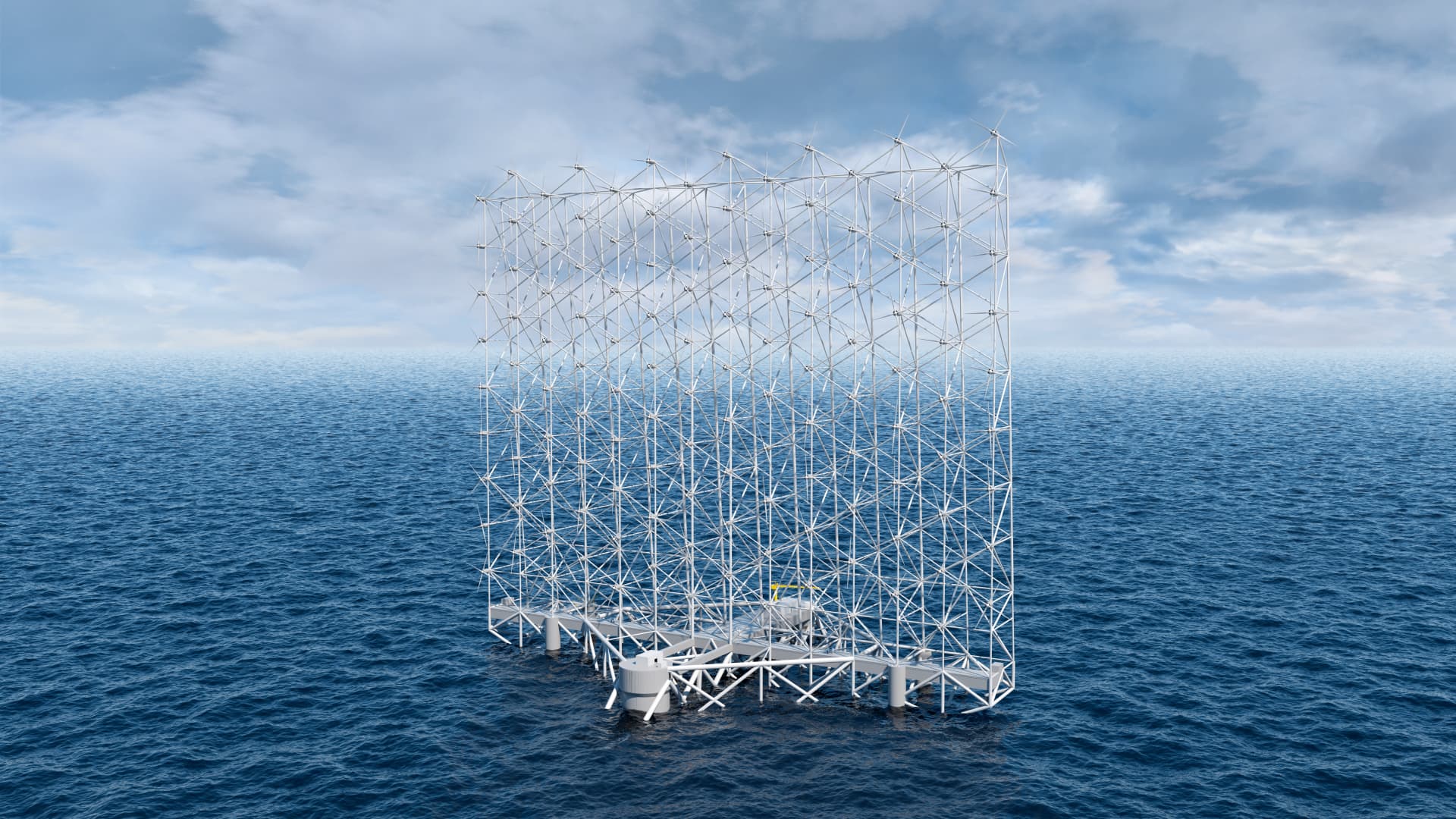
Wind Catching Systems wants to develop a floating, multi-turbine system. This illustration shows what it could look like once deployed.
Wind Catching Systems
With their considerable height and sweeping blades, wind turbines are perhaps the most visually striking sign of the world’s shift to a more sustainable future.
Over the past few years, major players in the sector have developed huge new turbines, with the era of “super-sized” onshore and offshore structures appearing to be just round the corner.
While these massive pieces of kit are based on a familiar design that incorporates a tower, nacelle and blades, some firms are working on new ideas that, if built, would look very different indeed.
Wind Catching Systems is one of them. Established in 2017 and headquartered just outside the Norwegian capital of Oslo, it’s focused on the development of what it calls a “floating wind power plant based on a multi-turbine design.”
The overarching idea behind the Windcatcher system, as it’s known, relates to maximizing “power generation from a concentrated area.” The design also incorporates an elevator-based system for installing turbines and maintenance.
Illustrations of what the Windcatcher would look like are certainly striking, resembling a vast, water-based wall of rotating blades.
The potential scale of it is considerable. CEO Ole Heggheim said the “large model” would have a height of 300 meters (around 984 feet) and a width of 350 meters.
Such an iteration is some way off, however. While the large version of the Windcatcher would use 126 turbines of 1 megawatt, Heggheim said a planned pilot model will have “between seven and 12,” with the exact number to be decided over the next few months.
The plan is for a gradual scale-up. Following the pilot, Heggheim said his firm would “most likely build an intermediate size, probably around 40 megawatts, before we go for the large size.”
Floating tech
Floating offshore wind turbines are different from fixed-bottom offshore wind turbines, which are rooted to the seabed.
One advantage of floating turbines is that they can be installed in far deeper waters than fixed-bottom ones, and in recent years major economies like the U.S. have laid out goals to ramp up floating wind installations.
Firms like Wind Catching Systems are beginning to attract some notable backers as countries and companies around the world look to slash their emissions and hit net-zero goals.
In June 2022, the company said it entered into a strategic agreement with automotive giant General Motors and also secured investment from GM Ventures.
The agreement with GM, Wind Catching Systems said, related to “collaboration covering technology development, project execution, offshore wind policy, and the advancement of sustainable technology applications.”
Read more about energy from CNBC Pro
More recently, in February 2023, the company announced it was awarded a pre-project grant of 9.3 million Norwegian krone (around $872,500) from Enova, which is owned by Norway’s Ministry of Climate and Environment.
Wind Catching Systems said the grant would “support the initial implementation of a full-scale Windcatcher.”
“Through the pre-project, Wind Catching Systems will mature and validate the technology and cost estimates for a full-scale Windcatcher,” it added.
Bird concerns
Over the past few years, the interaction between wind turbines and the natural world has generated a huge amount of discussion and debate, sometimes presenting hurdles to projects.
The effect on birds is a particular concern, with the U.K.-based Royal Society for the Protection of Birds warning that wind farms “can harm birds through disturbance, displacement, acting as barriers, habitat loss and collision.”
It adds that “impacts can arise from a single development and cumulatively multiple projects.”
During his interview with CNBC, Heggheim attempted to highlight how his company’s design might mitigate any risk.
“We have a large structure behind the turbines [and] we hope that that will be a visual for the birds,” he said, explaining that there was also the opportunity to incorporate detection and deterrence systems on the structure.
“We are hopeful that we can make something that is more benign, if you like, for birdlife,” he said.
A crowded field
Designs such as the Windcatcher offer a glimpse into how wind energy could develop, and a range of ideas have been proposed over the past few years.
These include Vortex Bladeless’ system, which has a cylindrical mast and does not use blades, and Kitemill, which has developed a design centered on a kite-like system tethered to the ground. Elsewhere, businesses like SeaTwirl are working on a vertical-axis floating turbine.
There is excitement about the potential of such proposals, but it seems a long road lies ahead when it comes to challenging the dominance of the onshore and offshore turbines of today.
“The role of new turbine models and innovation in turbine design should not be neglected,” Christoph Zipf, press manager at industry body WindEurope, told CNBC via email.
“It is good that the wind industry keeps exploring new paths and innovative solutions,” Zipf said. “But as things stand today the “traditional” wind turbine, the three-bladed, horizontal axis turbines will continue to lead the way.”
He added that such turbines are dominating all “competitive projects” in offshore, floating and onshore wind. “They offer the greatest electricity output at the lowest price.”
Disrupting the wind power industry is a colossal task that will require significant investment, time and patience.
Like other marine-based technologies, floating offshore wind faces a range of challenges, not least the incredibly harsh environment turbines need to operate in.
Wind Catching Systems’ Heggheim was, however, optimistic about the future. “We definitely want to be mainstream,” he said.
Whether the company’s plans bear fruit remains to be seen, but its journey over the next few months and years will be an interesting one to watch.
NextEra Energy is partnering with Exxon Mobil, the country’s largest oil company, to build a large data center site powered by natural gas for a potential tech customer, CEO John Ketchum told investors Monday
The 1.2 gigawatt power plant would combine gas generation with Exxon’s carbon capture technology to reduce emissions, according to NextEra’s presentation to investors.
They plan to market the site to a hyperscaler in the first quarter of 2026. Hyperscalers are the big tech companies that are building data centers to train and run artificial intelligence applications. There is no signed agreement with a hyperscaler yet.
NextEra and Exxon have secured 2,500 acres of land for the facility. The site will be located in the Southeast in close proximity to Exxon’s carbon-dioxide pipeline infrastructure, according to NextEra.
NextEra is the largest renewable energy developer in the U.S., but it is leaning into natural gas to meet the growing demand from data centers. The power company plans to bring as much as eight gigawatts of gas generation online by 2032, and is developing a pipeline of 20 gigwatts of gas generation.
NextEra plans to build 15 gigawatts of power for data center hubs by 2035, Ketchum said. That includes at least three data center campuses that NextEra is developing with Alphabet‘s Google.
“A lot of those will get started with what I call bridge power — renewables, storage,” the CEO said. “We’re also at that same time planning for the gas to come behind it.”
The tech sector has primarily secured renewables and increasingly nuclear power to supply data centers in an effort to meet its climate targets.
Mercedes calls it the “one-liter” car for a reason. The new Mercedes CLA EV has an impressive EPA range of 374 miles, but in real-world driving, it can go even further.
Mercedes CLA EV beats EPA range in real-world driving
The new CLA EV might just be the most critical Mercedes model yet. It’s the first of the luxury brand’s latest generation of electric vehicles, promising to be much more advanced, efficient, and refined than ever before.
Powered by an 85 kWh battery pack, the 2026 Mercedes-Benz CLA 250+ has an EPA-estimated range of 374 miles.
Although that’s already among the highest for any 2026 model-year EV in the US, the electric CLA can drive even further in the real world.
Advertisement – scroll for more content
The folks at Edmunds just got their hands on one to test it out. In the Edmunds EV Range Test, the 2026 Mercedes CLA EV crushed its EPA figures, driving an impressive 434 miles on a single charge, beating its official ratings by 16%.
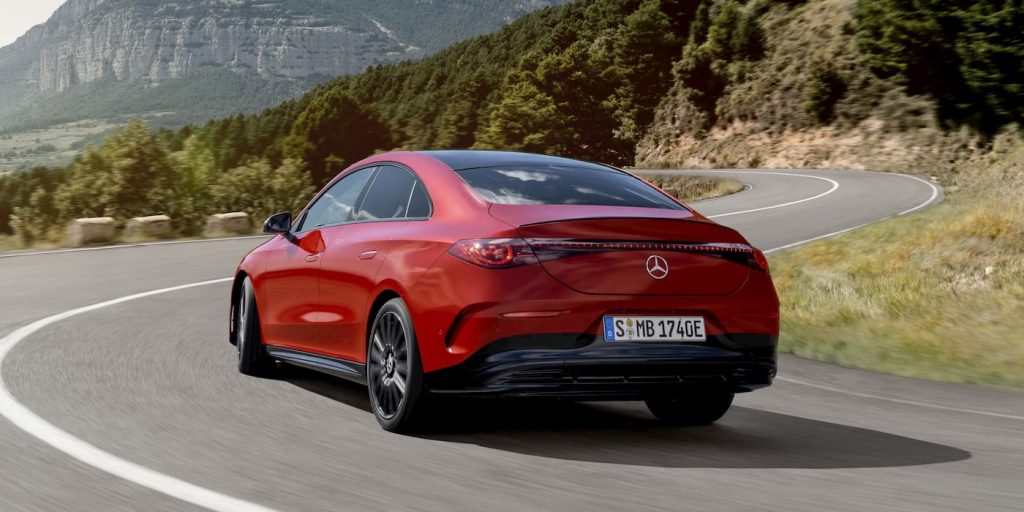
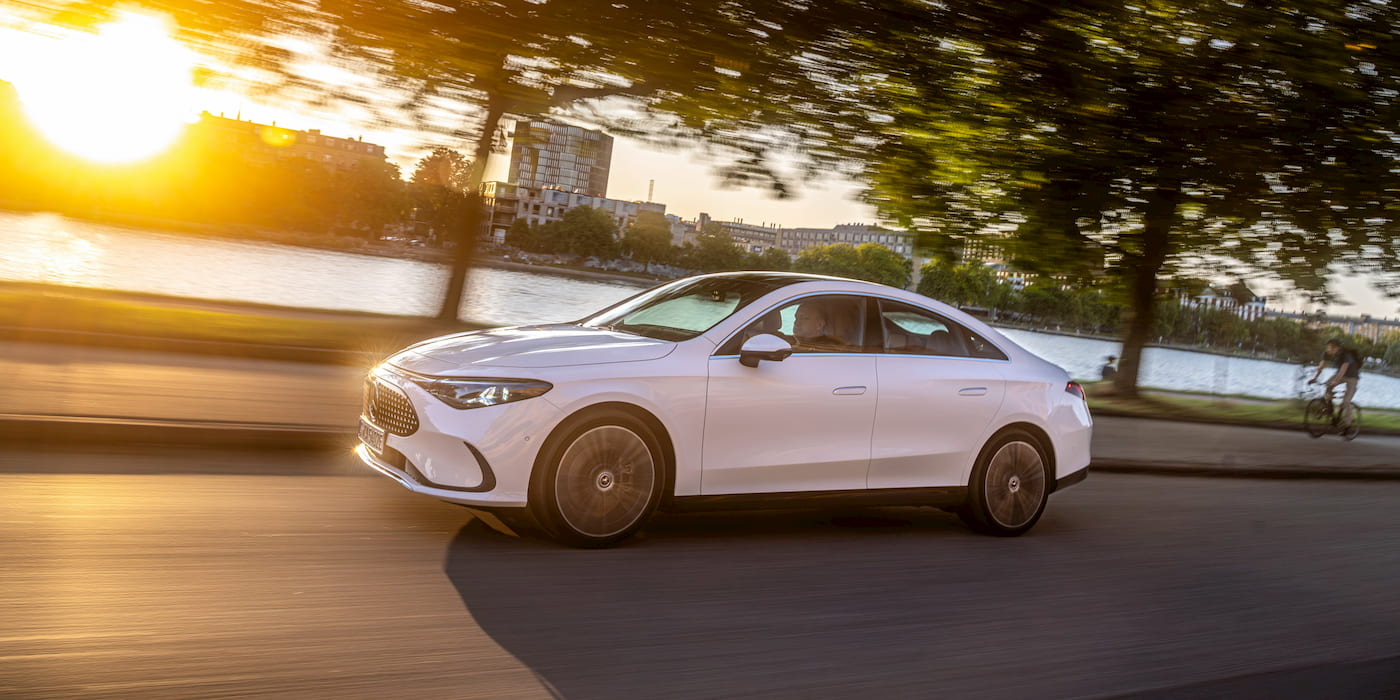
The new Mercedes-Benz CLA EV (Source: Mercedes-Benz)
Out of 13 Mercedes models Edmunds has tested, the new CLA EV had the second-longest driving range, trailing only the EQS 450+. However, given that the EQS is a full-size sedan and significantly more expensive than the CLA, it’s expected.
The 2026 Tesla Model 3 Standard went 339 miles, while the 2026 Audi A6 E-tron drove 402 miles during the EV Range Test.
The new electric Mercedes CLA (Source: Mercedes-Benz)
The Edmunds EV Range Test is 60% city and 40% highway driving with an average speed of 40 mph. Each vehicle is set to the most efficient drive setting, while the climate control is set to 72 degrees to reflect the most accurate real-world driving conditions drivers encounter each day.
During the test, the electric CLA used 23.2 kWh per 100 miles of driving, beating the EPA’s estimates by 16.5%.
On the Edmunds EV Charging Test, it had an average charge rate of 193 kW from 10% to 80%, earning a score of 833 miles per hour. That’s the second-best of those tested, behind the Hyundai IONIQ 6.
2026 Mercedes-Benz CLA trim
Starting Price*
Driving Range
CLA 250+
$47,250
374 miles
CLA 350 4MATIC
$49,800
312 miles
2026 Mercedes-Benz CLA EV prices and driving range by trim (*does not include $1,250 destination fee)
The new Mercedes CLA EV is now the least expensive car they’ve tested, with over 400 miles of range. Last week, Mercedes launched the 2026 CLA 250+ EV, starting at $47,250.
Mercedes said it will begin delivering the first customer models this month, with output ramping up throughout early 2026.
Tesla is pulling every demand lever available as we head into the final weeks of the year. The automaker has launched a new set of aggressive incentives in the US, including free upgrades on inventory vehicles, 0% APR financing, and $0 down leases.
It’s the end of the quarter (and year), and as per usual, Tesla is trying to empty its inventory, but it’s more difficult this year due to the end of the tax credit in Q3 pulling a lot of demand away from Q4.
We have regularly reported on Tesla ramping up incentives at the end of the year, but this new batch is arguably the most aggressive we have seen in a long time.
First off, Tesla is offering one free upgrade on eligible inventory vehicles.
Advertisement – scroll for more content
If you go to Tesla’s inventory page for Model 3 or Model Y, you will see a lot of vehicles listed with a “Free Upgrade” tag. This basically means that if you pick a car that has a paid option, like a premium paint color (Ultra Red or Quicksilver), 20″ Induction wheels, or the White interior, Tesla is waiving the cost of that option.
That’s a value of anywhere from $1,000 to $2,500 depending on the option.
On top of that, Tesla has expanded its financing offers. The company is now offering 0% APR financing for up to 72 months on Model 3 and Model Y purchases.
This is a significant move. We have seen low interest rates before, but 0% for 72 months is basically free money, especially in the current interest rate environment.
But wait, there’s more.
For those looking to lease, Tesla has introduced $0 down leases for the Model Y.
Previously, Tesla required a down payment of at least $3,000 for its best lease rates. Now, you can drive off the lot with a Model Y for $0 down, though the monthly payments will obviously be higher than with a down payment.
Tesla writes on its website regarding the new push:
“Take delivery by December 31, 2025 to take advantage of these limited-time offers. Available on select inventory vehicles while supplies last.”
The automaker is clearly trying to deliver as many cars as possible before the ball drops on 2025.
Electrek’s Take
The end-of-year push is in full swing.
When you see Tesla stacking incentives like this, 0% financing, zero down, and free options, it tells you one thing: they have inventory to move.
With a lot of demand in the US pulled forward into Q3 due to the end of the tax credit for electric vehicles, it was always clear that Tesla would have trouble moving cars in Q4.
These are roughly the best end-of-quarter incentives we have ever seen, and even then, I’d be surprised if Tesla can come close to its record deliveries of last year’s Q4: 495,000 vehicles.
If you drive an electric vehicle, make charging at home fast, safe, and convenient with a Level 2 charger installed by Qmerit. As the nation’s most trusted EV charger installation network, Qmerit connects you with licensed, background-checked electricians who specialize in EV charging. You’ll get a quick online estimate, upfront pricing, and installation backed by Qmerit’s quality guarantee. Their pros follow the highest safety standards so you can plug in at home with total peace of mind. Ready to charge smarter? Get started today with Qmerit.
FTC: We use income earning auto affiliate links.More.