

NHL conference final preview: Goalie Confidence Index, key matchups, predictions


-
Ryan S. Clark
-
Kristen Shilton

The conference final round of the 2023 Stanley Cup Playoffs is upon us, and just as everyone predicted, it’s the Carolina Hurricanes matching up with the Florida Panthers in the Eastern Conference, with the Vegas Golden Knights squaring off against the Dallas Stars in the West.
There is no shortage of superstar wattage on display — with future Hall of Famers skating in each series — nor an absence of captivating storylines.
To help get you up to speed before the puck drops on Game 1 of the East matchup Thursday night, we’re bringing you a mega-preview, breaking down each team in five different categories and offering our predictions on which clubs will head to the Stanley Cup Final.
Note: Kristen Shilton previewed the Eastern Conference teams, while Ryan S. Clark previewed the two clubs from the West.

Eastern Conference

How they got here: Defeated New York Islanders, 4-2; defeated New Jersey Devils, 4-1.
Goalie confidence rating: 8/10
Carolina’s goaltending has been (mostly) superb in the postseason. The lone exception was Game 3 against the Devils, when Frederik Andersen was pulled after giving up four goals on 12 shots.
That blemish aside, the Hurricanes’ crease has been well maintained. Andersen is 5-0 (since his Game 3 replacement — rookie Pyotr Kochetkov — was tagged with the Game 3 loss), with a .931 save percentage, while Antti Raanta is 3-2 with a .906 SV%. Carolina boasts a dialed-in defense (more on them later), which helps the team’s goaltending shine, but the Hurricanes should have no concerns in that area heading into the next round.
What we’ve learned about this team so far
It’s easy to preach about the importance of balance and playing as the coveted “five-man unit” attacking the opposition on all fronts. Well, Carolina actually showcases those exact attributes nightly.
The Hurricanes are no one-trick pony. They don’t solely depend on stars to create their opportunities. Through 11 playoff games, Carolina has 14 different goal scorers — and no one with more than five markers — with contributions spread out evenly on both sides of the puck. The Hurricanes seemingly embrace any style of play — tight-checking or more wide-open — and have found success in both. A team this multifaceted would make any opponent nervous.
Players who will be key to the series
Carolina lost Andrei Svechnikov and Max Pacioretty to injury during the regular season — and Teuvo Teravainen in the first round — which opened the door for other forwards to emerge. Jordan Martinook was spectacular against the Devils, producing 10 points in five games. To think Carolina put him on waivers in October; now he is the team’s co-leader in playoff points. Do-everything forward Sebastian Aho has been strong throughout the postseason, registering five goals and 10 points.
Scoring is at an increasing premium the deeper the playoffs go, and being able to rely on its best players to support its depth contributions gives Carolina an ideal recipe to keep advancing. On the back end, Brent Burns has been leading the way with typically strong defensive play and timely offensive additions (he can still feather a puck from the blue line with flair). This season has been a personal storm surge for the always-interesting veteran.
Player who needs to step up
Jesperi Kotkaniemi began to come alive in the second round. What Carolina must want now is more, please. Kotkaniemi scored three goals in the Hurricanes’ first two games against the Devils, and assisted on Jesper Fast‘s overtime winner in Game 5 that put Carolina into the Eastern Conference final. Those are all positive things. But the Hurricanes will need Kotkaniemi at his defensive best in this next round, too.
Kotkaniemi should also channel that newfound scoring confidence into sending more shots on net (he’s taken only 18 in the postseason thus far) and he’s at just 37.4% in the faceoff circle (despite taking the second-most draws for Carolina in the playoffs). Kotkaniemi can provide more; he’s proven that. Now is the time to take his game over the top.
The Hurricanes aren’t just defensive darlings — they’re downright smothering
Burns? He’s still got it. Jaccob Slavin has been exceptional (and he’s plus-14!). Brett Pesce is making contributions. The Hurricanes are highly effective at turning teams back through the neutral zone and forcing shooters to the outside because of their depth on the back end. It just flows.
Coach Rod Brind’Amour hasn’t had to overwork anyone either, clearly indicative of the trust he has in the six skaters he’s had on patrol there through the postseason. And, the blueliners aren’t afraid to chip in offensively, collecting eight goals and 27 points in 11 postseason games. That’s a scary stat for Florida.

How they got here: Defeated Boston Bruins, 4-3; defeated Toronto Maple Leafs, 4-1
Goalie confidence rating: 9/10
Sergei Bobrovsky is back on the case this postseason — and turning back the clock with some vintage Bobrovsky performances. The Panthers’ netminder is 7-2 in the playoffs, with a .918 save percentage and 2.82 goals-against average.
To think Florida didn’t even start Bobrovsky in Game 1 against the Bruins. Instead, it was Alex Lyon — a late, great regular-season storyline for the Panthers — manning the Panthers’ crease early. But when he began to struggle, Bobrovsky stepped in seamlessly and continues to be Florida’s backbone. He’s also kept improving throughout the playoffs; in the Panthers’ second-round series against Toronto, Bobrovsky was a cool 4-1 with a .943 SV% and 1.89 GAA. Carolina’s shooters should prepare accordingly for Bobrovsky at his best.
What we’ve learned about this team so far
Florida defies the odds, and expectations. The Panthers weren’t supposed to be here — not in the playoffs at all, and then certainly not escaping the first round against Boston or downing the Maple Leafs in Round 2. Whatever label Florida has been given, it has thrown off. Whatever limits have been placed on the Panthers, they have surpassed.
Florida embodies the one-game-at-a-time cliche. This is not a team that appears overwhelmed, panicked or even slightly unsure of itself. The Panthers just play. Their roster is deep across the board, and they’ve proven they can win high-scoring contests as easily as defense-driven ones. No team has matured this year like the Florida Panthers. We’ll learn if they’re ready for the next step against Carolina.
Players who will be key to the series
Carolina plays a tight defensive game. Florida will need to match up well there, which puts Brandon Montour and Aaron Ekblad in the spotlight.
Montour is having an exceptional breakout year, collecting 73 points in the regular season and adding six goals and nine points in 12 postseason tilts — all while maintaining a locked-in focus on his defensive duties. Ditto for Ekblad, who has patrolled the Panthers’ blue line for years hoping for the opportunity the team has right now.
Shutting down the Hurricanes’ top strikers will be priority one for the Panthers, then it will be up to their stable of scorers — from Matthew Tkachuk to Carter Verhaeghe to Sam Bennett — to do what they’ve done all postseason and score the timely goals. But those certainly won’t come easily in the series ahead.
Player who needs to step up
Aleksander Barkov sets the standard in Florida. That distinction has never been more critical than right now. Barkov has had a fine playoffs so far, with two goals and nine points in 12 games. He’s shown a typically strong two-way game, but could pump up a lagging 48.3% success rate in the faceoff dot. Basically, Barkov has to be that No. 1 shutdown center who can do it all for the Panthers for a full series.
It’s felt as though Barkov is building toward a truly dominant run, and Carolina might be a good matchup for him to put all the elite elements of his game on display. Like Ekblad, Barkov has waited a long time for Florida to be in this position; this is his moment to take control.
Can Panthers coach Paul Maurice pull off a storybook season?
When Florida was flailing, it was Maurice — in his first season with the club — who shouldered blame. Why hadn’t the Panthers stuck with Andrew Brunette after their Presidents’ Trophy-winning turn last season? Why bring on Maurice, who voluntarily excused himself from the Winnipeg Jets‘ bench?
It has become clear why Florida wanted the veteran coach. He’s kept the Panthers fresh on both sides of the puck, made the (correct) hard decisions and evolved right along with his players. Now, after Maurice took down one team he formerly coached in Toronto, he faces another franchise with which he has ties — Maurice was the final coach in Hartford Whalers history and the first of the relocated Carolina Hurricanes. Thirty years later, Maurice can reach a Cup Final running through them. Talk about full circle.
Series prediction: Carolina in seven
Betting against Florida? Now? Well, yes. Not because it would be surprising at all to see the Panthers triumph. But top to bottom, the Hurricanes have the potential to be a little bit better, giving them the slightest edge. There’s hard-earned experience throughout Carolina’s lineup. And the Hurricanes’ defense is just so stifling it might be the genuine difference-maker in this series. That said, there should be plenty of fun hockey ahead, and Carolina will have to work for every W to punch its ticket for one more round.
1:00
Oettinger: Stars can win the whole thing
Jake Oettinger likes his team’s chances against the Golden Knights after the Stars defeated the Kraken in Game 7.
Western Conference

How they got here: Defeated Winnipeg Jets 4-1; Defeated Edmonton Oilers 4-2
Goalie(s) confidence rating: 9/10
Adin Hill‘s role in closing out the Oilers reinforces what the NHL has come to learn about the Golden Knights this season: They always have a plan in net. As most teams turn to tandems, the Golden Knights have gone with a platoon.
It all started in response to losing Robin Lehner for the season following offseason hip surgery. The Knights used five goaltenders in the regular season, with rookie Logan Thompson winning a team-high 21 games. Then Thompson sustained an injury that has kept him out since late March. He was replaced by Laurent Brossoit, who won the games that allowed the Golden Knights to earn the West’s No. 1 seed, before he sustained an injury in Game 3 against the Oilers.
That opened the door for Hill, who won 16 games in the regular season. In short, the setbacks that could kill a team’s playoff hopes seem to make the Golden Knights stronger.
What we’ve learned about this team so far
Depth is everything, and the Golden Knights are one of the strongest examples of why front offices place such a premium on that attribute. We know how they’ve handled their goaltending situation through injury. Then there’s the fact that they have a roster that’s not built around any one line or defensive pairing, with the hope that all can contribute.
The Golden Knights have created a balanced approach that has led to them having 13 different goal scorers this postseason. And that’s with the realization they’ve had only two of their defensemen record goals — and those defensemen are not Alex Pietrangelo or Shea Theodore.
Players who will be key to the series
Vegas’ enviable depth means there are several options to fit this category. Yet what the Golden Knights have down the middle in the form of Jack Eichel, Chandler Stephenson and William Karlsson are another example of what makes them dangerous.
Eichel is the all-around offensive threat who can either create for himself or those around him which is why he leads the Golden Knights in goals and points. Meanwhile, Stephenson and Karlsson are the sort of two-way centers who can be trusted to play in every situation with the idea they’re also threats to score at any given time.
Player who needs to step up
It’s not a player, but rather their penalty kill as an entire unit. They were 19th in the regular season, with a 77.4% success rate, and the playoffs have not been any better. But that also comes with the context that they just finished a six-game series against an all-time great power-play unit in the Oilers. The Golden Knights have a 60% success rate this postseason, which is 15th among 16 playoff teams, and the lowest among the four teams remaining.
So … their penalty kill?
Yes, we’re still talking about the penalty kill because it is a concern. The Oilers had the No. 1 power play in the postseason with a 46.2% success rate, while the Jets, who the Golden Knights played in the first round, were second with a 41.7% success rate.
Now that those teams are both out, the strongest active power-play unit in the playoffs is … the Stars. They’re fifth overall, with a 31.7% success rate. Special teams could be a significant factor in this series.

How they got here: Defeated Minnesota Wild 4-2; defeated Seattle Kraken 4-3
Goalie confidence rating: 8.5/10
What the Kraken encountered in Game 7 is the version of Jake Oettinger that makes the Stars such a threat.
Oettinger has had his struggles during this year’s playoffs, and was pulled twice in the second round. But his 22-save performance to close out Seattle was one of his strongest outings of the postseason, reinforcing the notion he will play a monumental role in what happens next.
What we’ve learned about this team so far
Here’s the thing about the teams the Stars have played to this point. They were two of the NHL’s best during the regular season.
In 5-on-5 play during the regular season, Minnesota allowed the third-fewest goals per 60 minutes, the third-fewest high-danger scoring chances per 60 and the eighth-fewest scoring chances per 60, according to Natural Stat Trick. Seattle allowed the second-lowest shots per 60, the fifth-lowest scoring chances per 60 and the eighth-lowest high-danger chances per 60. The end result saw the Stars average 3.5 goals per game in the first round and 3.14 per game in the second round. They can score on anyone.
Players who will be key to the series
Roope Hintz is a point away from being the postseason scoring leader. His performances have made him one of the front-runners for the Conn Smythe Trophy as playoff MVP, and added to the argument that he might be the most underrated forward in the league.
Defenseman Miro Heiskanen leads the playoffs with 28:15 in average ice time, and has shown the versatility to play in every situation. Trade acquisitions Max Domi and Evgenii Dadonov have given the Stars the sort of consistent presence that makes them balanced.
Landlord Joe Pavelski and his tenant, rookie Wyatt Johnston, have scored some of the biggest goals of the Stars’ run. And then there is Oettinger, who will look to succeed against a team that has already won a series against a Vezina Trophy winner Connor Hellebuyck and Calder Trophy finalist Stuart Skinner.
Player who needs to step up
It might seem strange to suggest that a player averaging a point per game in the playoffs would be in the “needs to step up” category. So why is Jason Robertson — who scored 46 goals and 109 points in the regular season — being singled out?
Well, it goes back to the discussion about Robertson as a goal scorer. He scored twice in the first round but did not score in the second, which has led to some questions about how he will perform in the conference final. The Stars have already proven to be formidable without Robertson’s goals. But getting that scoring boost could be the difference between being a conference finalist and reaching the Stanley Cup Final.
Who wins: Pete DeBoer’s old team or his new team?
If you are a team that’s trying to take the next step and you’re looking to make a coaching change, you call DeBoer. He gets instant results. His first year with the New Jersey Devils saw them reach the Stanley Cup Final. He did it again in his first season with the San Jose Sharks. And while he did not reach the Cup Final with the Golden Knights in his first year, he did guide them to consecutive conference finals appearances.
But his third and final season with the Golden Knights saw the club miss the playoffs for the first time in franchise history, which led to the two sides parting ways. A month later, the Stars were in need of a new coach and they hired DeBoer.
So what will it be? Will the Stars be one of those DeBoer teams that gets to the Stanley Cup Final in his first season? Or will the conference finals be the end of the road while his old team marches closer to winning it all?
Series prediction: Vegas in seven
For all the reasons to pick the Golden Knights, those same arguments can be used to pick the Stars. Sure, the Golden Knights have depth. But so do the Stars, as every player who has played at least one game has recorded a point for them. The Golden Knights have found answers when faced with a goaltending challenge. So have the Stars, with the responses they have seen from Oettinger after losses. It’s the narrowest of margins, but we’re leaning to the Knights’ side.

-
Mark Schlabach
Indiana quarterback Fernando Mendoza, who led the No. 1 Hoosiers to a perfect 13-0 record and their first Big Ten title since 1967, captured the 91st Heisman Trophy on Saturday night.
Mendoza beat out quarterbacks Diego Pavia (Vanderbilt) and Julian Sayin (Ohio State) and running back Jeremiyah Love (Notre Dame) to take home the trophy during a ceremony in New York.
Mendoza, who played two seasons at California before joining the Hoosiers this season, completed 71.5% of his pass attempts for 2,980 yards with 39 total touchdowns.
He was only the second Heisman Trophy finalist from Indiana. Running back Anthony Thompson was runner-up to Houston quarterback Andre Ware in one of the closest votes in 1989.
With Mendoza, Pavia and Love expected to move on to the NFL after this season, who are the top returning Heisman Trophy candidates for 2026?
In compiling the list of potential candidates, I projected that quarterbacks John Mateer (Oklahoma), Ty Simpson (Alabama) and Dante Moore (Oregon); receivers Carnell Tate (Ohio State), Zachariah Branch (Georgia) and Makai Lemon (USC); and running back Emmett Johnson (Nebraska) will turn pro (along with the aforementioned finalists from this year).
Here is a look at some of the top potential contenders (in no particular order):

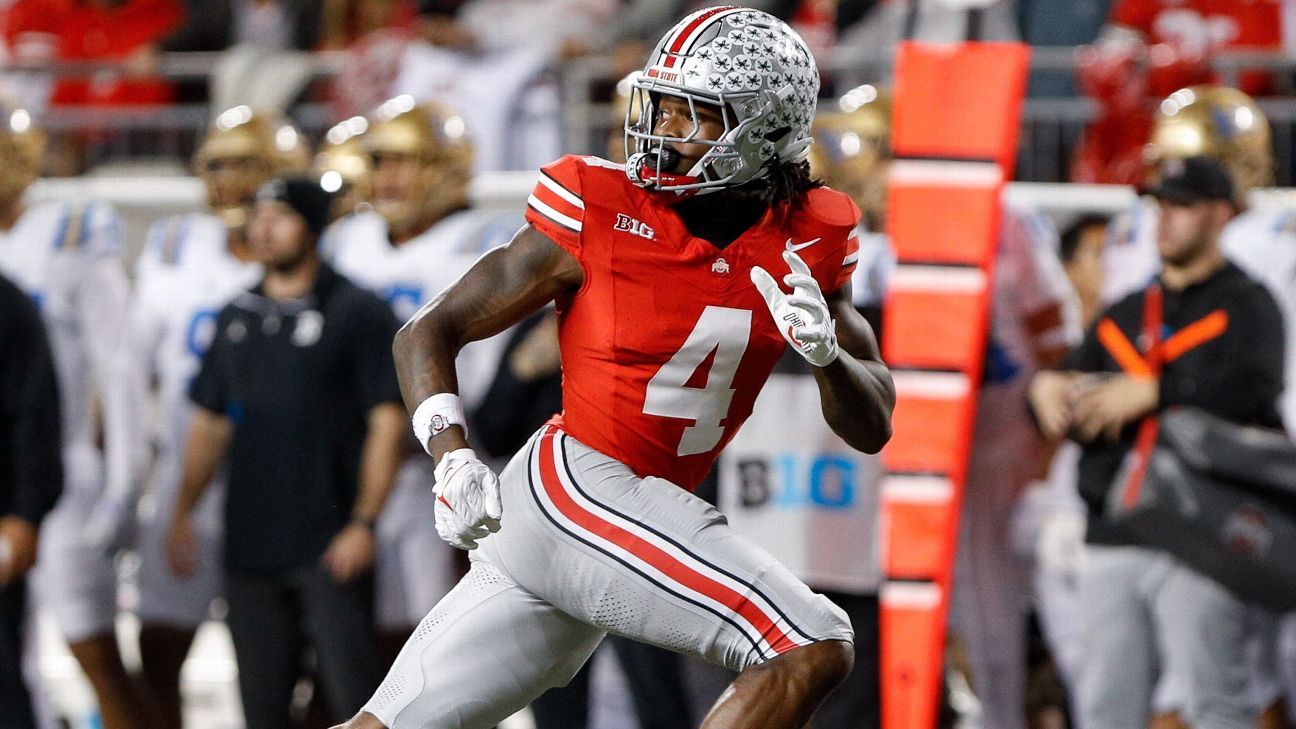
2025 stats: 80 catches, 1,086 receiving yards, 12 total touchdowns
Smith’s highlight reel of acrobatic, one-handed catches continues to grow, and he arguably has been the best player in college football this season. He was the fastest Buckeyes player to reach career marks of 2,000 receiving yards (24 games), 100 catches (20) and 25 touchdown receptions (25).
2025 stats: 78.4% completion pct, 3,323 passing yards, 31 touchdowns, 6 interceptions
Sayin might have captured the Heisman Trophy this season if Ohio State’s offense hadn’t flopped in its 13-10 loss to Indiana in the Big Ten championship game. In his first season as a starter, Sayin is on pace to break the NCAA single-season pass completion record of 77.4%, set by Oregon’s Bo Nix in 2023.

2025 stats: 70.7% completion pct, 2,691 passing yards, 442 rushing yards, 31 total touchdowns
In his first full season as Georgia’s starting quarterback, Stockton helped guide the Bulldogs to a 12-1 record and SEC title. His legs and right arm were a big reason the Bulldogs averaged 31.9 points, despite enduring myriad injuries on the offensive line. Stockton was at his best when the game was on the line — he completed 86% of his passes with 11 touchdowns and one interception in the fourth quarter against ranked opponents.

2025 stats: 84 receptions, 970 receiving yards, 7 receiving touchdowns
Toney’s teammates call him “Baby Jesus,” and the true freshman delivered in a big way in his first season with the No. 10 Hurricanes. He ranks sixth in the FBS with 84 catches and had 1,328 all-purpose yards. Toney even threw for two scores. Not bad for an 18-year-old who would be a senior in high school if he hadn’t reclassified to the class of 2025.

2025 stats: 61.4% completion pct, 2,942 passing yards, 32 total touchdowns
Even after all the hand-wringing about Manning being overrated at the start of the season, the former five-star recruit ended up putting together a good campaign, throwing for 2,942 yards with 24 touchdowns. The No. 13 Longhorns need to find some offensive linemen (he was sacked 23 times) and receivers to help him in 2026.

2025 stats: 65.5% completion pct, 3,016 passing yards, 24 total touchdowns
Ole Miss officials have submitted a waiver to the NCAA on Chambliss’ behalf for another season of eligibility. He played his first three seasons at Division II Ferris State before transferring to Ole Miss this year. He was named SEC Newcomer of the Year after taking over the starting job in the third game of the season.

2025 stats: 1,560 rushing yards, 16 touchdowns
A transfer from Louisiana-Monroe, Hardy led the FBS with 130 rushing yards per game and was No. 2 with 1,560 total rushing yards. He had eight 100-yard games for the Tigers, including a whopping 300-yard effort with three touchdowns in a 49-27 victory against Mississippi State on Nov. 15.

2025 stats: 61.8% completion pct, 2,932 passing yards, 466 rushing yards, 31 total touchdowns
Reed announced this week that he plans to stay at Texas A&M next season, which is great news for the No. 7 Aggies. He was a threat with the ball in his hands, throwing for 2,932 yards with 25 touchdowns and running for 466 yards with six scores. His decision-making needs to continue to improve, so he can cut down on his 10 interceptions.

2025 stats: 63.6% completion pct, 3,117 passing yards, 20 total touchdowns
There’s a reason new Bears coach Tosh Lupoi took a late-night flight to Hawai’i to make sure Sagapolutele was staying at Cal. He was only the second true freshman in FBS history to pass for 200 yards or more in each of his first 11 starts. In the Bears’ late-season upsets of then-No. 21 SMU and No. 15 Louisville, Sagapolutele passed for a combined 653 yards with six touchdowns and no picks.
2025 stats: 1,279 rushing yards, 20 touchdowns
After transferring from Missouri, Lacy helped the No. 6 Rebels win 11 games in the regular season for the first time. He ranks No. 2 in the FBS with 20 rushing touchdowns and piled up 1,279 yards on the ground. Will he follow former coach Lane Kiffin to LSU or remain with the Rebels in 2026?

2025 stats: 66.2% completion pct, 3,431 passing yards, 29 total touchdowns
If Maiava returns to the No. 16 Trojans for another season, he’ll probably flourish in Lincoln Riley’s offense. This year, he threw for 3,431 yards with 23 touchdowns and 8 interceptions. He ranks No. 1 with a 91.2 total QBR. According to Pro Football Focus, he was second in the FBS with 26 big-time throws. (A big-time throw is defined as a high-difficulty, high-value pass.)
2025 stats: 1,035 rushing yards, 6 total touchdowns
Jackson became the fifth true freshman in OSU history to produce a 1,000-yard season, joining Robert Smith (1990), Maurice Clarett (2002), JK Dobbins (2017) and TreVeyon Henderson (2021). That’s good company. And, of course, he’d be the second Bo Jackson to collect a stiff-armed trophy.

2025 stats: 70.2% completion pct, 4,129 passing yards, 36 total touchdowns
Mestemaker is one of the best stories in college football. He didn’t start a single game in high school, then joined North Texas as a walk-on. This season, he led the FBS with 4,129 passing yards, helping him capture the Burlsworth Trophy as the top walk-on in the country. Will he join former Mean Green coach Eric Morris at Oklahoma State in 2026?

CJ Carr, QB, Notre Dame
2025 starts: 66.6% completion pct, 2,741 passing yards, 24 touchdowns
Fighting Irish coach Marcus Freeman entrusted Carr to lead his offense after a heated battle in preseason camp. The decision paid off, as Carr put together one of the best performances by a first-time starter in Notre Dame history. He threw for at least one touchdown in each of his first 12 starts, becoming the first Irish player to do that since Everett Golson in 2012-14. Carr’s 24 passing touchdowns are tied for the most in the first 12 starts by a Notre Dame player since 1966.

2025 stats: 70% completion pct, 2,850 passing yards, 595 rushing yards, 27 total touchdowns
Williams is one of the best dual-threat quarterbacks in the FBS, and his ability to run and throw was on display in the Huskies’ 38-19 victory against Rutgers on Oct. 10. He became the first player in school history to pass for at least 400 yards (400) and run for at least 100 (136) in the same game. Williams was second on the team with 595 rushing yards.
Others to watch: Sam Leavitt, QB, TBA; Cam Coleman, WR, Auburn; Brendan Sorsby, QB, Cincinnati; Josh Hoover, QB, TCU; Darian Mensah, QB, Duke; Nate Frazier, RB, Georgia; LJ Martin, RB, BYU; Bear Bachmeier, QB, BYU; LaNorris Sellers, QB, South Carolina; Bryce Underwood, QB, Michigan

-
Adam Rittenberg
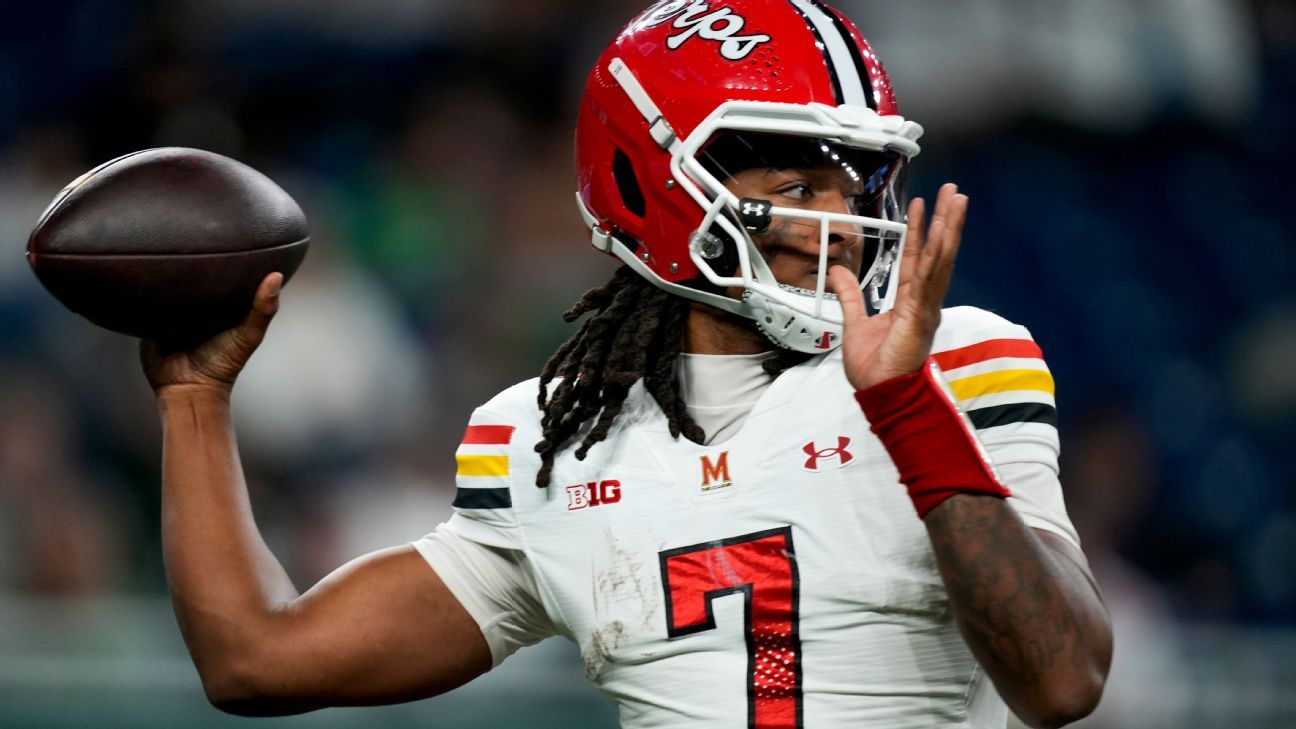
Maryland quarterback Malik Washington, who set the team’s freshman passing record this fall, will return to the Terrapins for the 2026 season.
Washington set Maryland freshman records for passing yards (2,963) and completions (273) this season, while connecting on 17 touchdown passes. He reached 200 passing yards in all but one game and finished as just the second Big Ten freshman since 1996 to record at least 2,500 passing yards and at least 300 rushing yards.
“Representing this team, this area, means so much to me and my family,” Washington said in a statement Saturday. “This is home and we’re going to continue keeping the best athletes from this area here with the Terps. I believe in everyone in our facility and I know we’re building something that our fans will be excited about for years to come.”
Washington, the nation’s No. 134 recruit in the 2025 class, grew up in Severn, Maryland, about 30 miles from Maryland’s campus. Despite a 4-8 record that included only one Big Ten win, Maryland announced that coach Mike Locksley, who recruited Washington, would return in 2026. Locksley will enter his eighth season as Maryland’s coach.
“Malik is a Terp through and through and I’m thrilled he’s coming back to lead this football team,” Locksley said in a statement. “He means so much to this area and this area means so much to him. What we saw from Malik this past season is only the tip of the iceberg. He has such a bright future and he’s already started putting the work in towards the 2026 season.”

-
 Sports2 years ago
Story injured on diving stop, exits Red Sox game
-
 Sports3 years ago
‘Storybook stuff’: Inside the night Bryce Harper sent the Phillies to the World Series
-
 Sports2 years ago
Game 1 of WS least-watched in recorded history
-
 Sports3 years ago
Button battles heat exhaustion in NASCAR debut
-
 Sports3 years ago
MLB Rank 2023: Ranking baseball’s top 100 players
-
Sports4 years ago
Team Europe easily wins 4th straight Laver Cup
-
 Environment3 years ago
Japan and South Korea have a lot at stake in a free and open South China Sea
-
 Environment1 year ago
Here are the best electric bikes you can buy at every price level in October 2024