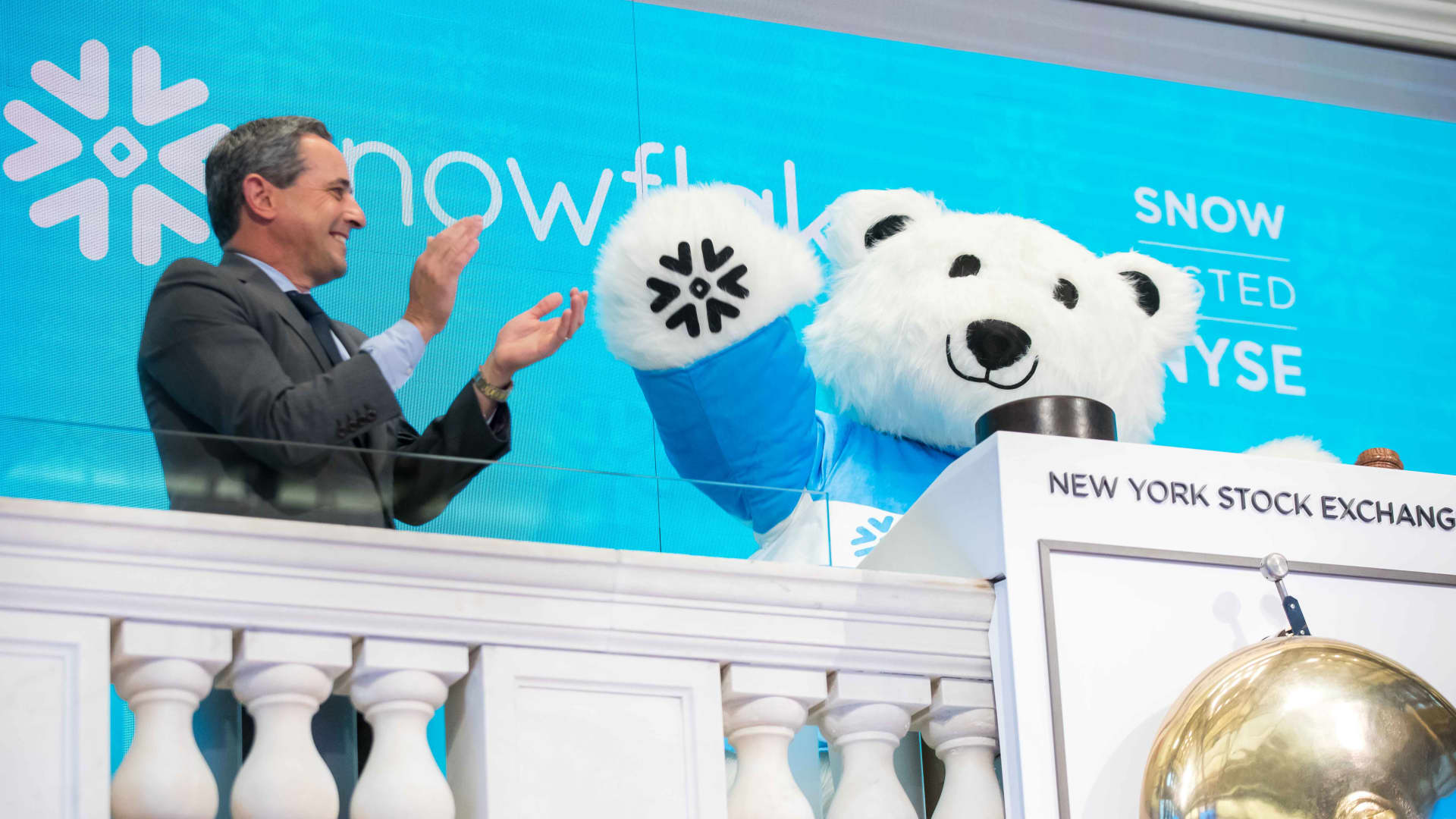
The New York Stock Exchange welcomes Snowflake (NYSE:SNOW), on Tues. Dec 21st, 2021, to usher in the first day of winter.
NYSE
Shares of cloud data platform provider Snowflake slid more than 12% in extended trading on Wednesday after the company issued weak guidance in its earnings report and said it will acquire search startup Neeva for an undisclosed amount.
Here’s how the company did:
Earnings per share: 15 cents, adjusted, vs. 5 cents expected by analysts, according to Refinitiv
Revenue: $624 million vs. $608 million expected by analysts, according to Refinitiv
related investing news
The company’s revenue grew 48% year over year in the first quarter of fiscal 2024, but that growth was lower than the 85% increase in the prior-year fiscal quarter. The bulk of Snowflake sales come from product revenue, which expanded 50% year over year. Product revenue accounts for use of Snowflake’s software for storing and running queries on data stored in its system.
Snowflake said it anticipates product revenue will be between $620 million and $625 million in the fiscal second quarter. That would represent year-over-year growth between 33% and 34%.That projection came in well below the StreetAccount estimate of $649 million.
For the 2024 fiscal year, Snowflake called for product revenue of $2.6 billion. The StreetAccount consensus was $2.7 billion.
Snowflake posted a net loss of $225.6 million, or 70 cents per share, compared with a loss of $165.8 million, or 53 cents per share, during the year-earlier period.
Snowflake also announced it plans to acquire Neeva, the privacy-focused search company co-founded by former Google executive Sridhar Ramaswamy.
Benoit Dageville, Snowflake’s co-founder and president of products, wrote in a blog post that the company intends to “infuse and leverage” Neeva’s AI-equipped search products across its cloud services. Terms of the deal were not disclosed.
“Neeva allows us to tap into some of the most cutting-edge search technologies available to bring search and conversation in Snowflake to a new level,” Dageville wrote.
The acquisition comes days after Neeva, which was founded in 2019, said it would shut down its consumer search engine to focus on developing use cases for AI and large language models.
The company will hold its quarterly call with investors Wednesday at 5 p.m. ET.
Clarification: The year-over-year sales increase of 85% occurred in the first quarter of fiscal 2023. An earlier version misstated the time frame.
— CNBC’s Ashley Capoot contributed reporting to this article.
Lovable cofounders Anton Osika and Fabian Hedin. Credit: Lovable
Vibe coding startup Lovable’s latest funding round values the firm at $6.6 billion and includes U.S. VC firm Accel, sources with knowledge of the deal told CNBC.
That figure is more than triple the $1.8 billion valuation the Swedish AI company achieved after closing its most recent funding round in July. It’s Lovable’s third in 2025 and follows a breakneck year of growth that’s seen it become one of Europe’s most valuable startups.
Both sources asked to remain anonymous while discussing private information. Forbes previously reported in November that the round would value the company at “around” $6 billion.
Accel was participating in the round, both sources said, which has not been previously reported.Accel participated in Lovable’s previous round and has emerged as a key backer in the wave of new AI startups. It’s participated in billion-dollar rounds for vibe coding startup Cursor and former OpenAI executive Mira Murati’s AI company Thinking Machines.
U.S. investor Khosla Ventures is also participating in the latest round, one of the sources told CNBC.
Lovable, Accel and Khosla Ventures have been approached for comment by CNBC, but had not responded as this article went live.
Founded in 2023, Lovable reported $200 million in annual recurring revenue (ARR) in November, just under a year after achieving $1 million in ARR for the first time.
The startup’s July fundraise picked up $200 million. As well as Accel, investors then included Creandum, Klarna founder Sebastian Siemiatkowski, ElevenLabs founder Mati Staniszewski and Synthesia founder Victor Riparbelli.
Lovable is Europe’s leading player in the vibe coding space, which has seen huge investor interest in recent times.
In the U.S., Anysphere, which created coding tool Cursor, raised $2.3 billion at a $29.3 billion valuation in November. In September, Replit hit a $3 billion price tag after picking up $250 million and Vercel closed a $300 million round at a $9.3 billion valuation.
Based in Stockholm, the company is opening offices in Boston and San Francisco.
Lovable’s platform uses AI models from providers like OpenAI and Anthropic to help users build apps and websites using text prompts, without the need to understand coding.
The startup said that 100,000 projects were being built using its platform every day when it announced its latest ARR figures in November.
Databricks CEO, Ali Ghodsi speaks on CNBC’s Fast Money on Dec. 17, 2024.
CNBC
Databricks is raising $4 billion in a funding round that would value the data analytics software company at $134 billion, the company announced Tuesday.
The valuation is a 34% jump from the funding round announced in August, which valued the company at $100 billion. At the time, Databricks became one of a handful of private companies to surpass a $100 billion valuation, after SpaceX, ByteDance and OpenAI.
Databricks said it plans to use the capital to support customer app building as artificial intelligence accelerates development.
The company said it topped a $4.8 billion revenue run-rate during the third quarter and is growing 55% year-over-year. That figure is also up from the $4 billion revenue run-rate announced earlier this year.
Databricks is among a growing list of companies that have opted to stay private for longer as private markets offer more funding opportunities.
Insight Partners, Fidelity Management & Research Company and JPMorgan Asset Management led the round, with participation from Andreessen Horowitz.
Databricks was founded in 2013 in San Francisco and ranked third on CNBC’s 2025 Disruptor 50 list.
Robotaxis felt like science fiction just a decade ago, but this year, autonomous vehicles became a commonplace option for paying passengers across big cities in the U.S. and parts of Asia.
Alphabet-owned Waymo kept expanding and dominates the robotaxi market in the U.S., though rivals Tesla and Amazon-owned Zoox also launched the first versions of their services in 2025. Meanwhile, Baidu-owned Apollo Go dominated in China.
Some parents are now sending teens to schools and activities in Waymos, and women often praise the privacy of these AVs versus rides with strangers who drive for ride-hailing and traditional taxi services.
Waymo, in particular, has been so successful in its commercial expansion that Tesla CEO Elon Musk acknowledged his rival’s achievements after previously criticizing the Google sister company. At Tesla’s annual meeting on Nov. 6, Musk thanked Waymo for “paving the path here” when it comes to working out the regulatory approvals that allow robotaxi services to do business across much of the U.S.
But driverless transportation has a long way to go before it becomes more mainstream.
A survey by the American Automobile Association in early 2025 showed that 66% of drivers in the U.S. felt fearful and 25% felt uncertain about autonomous vehicles, reflecting the same consumer skepticism that AAA tracked with the survey in 2024.
There have been rampant complaints about noise, congestion and the sometimes erratic driving behavior of robotaxis, along with economic concerns about the impact of AVs on travel and transportation workers. However, known harmful collisions caused by AVs have been relatively few so far, according to the National Highway Traffic Safety Administration, or NHTSA.
Robotaxi fares are currently higher than alternatives today, according to Obi, which tracks ride-hail pricing data and compared Waymo to human-driven Uber and Lyft rides.
Both safety records and costs per ride could change as AV fleets grow from hundreds to thousands of vehicles.
With 2026 just around the corner, here’s how the robotaxi market stands today.
Waymo driverless taxi parks in lower Manhattan in New York City, U.S., Nov. 26, 2025.
Brendan McDermid | Reuters
Alphabet’s Waymo keeps expanding
Furthest along in the robotaxi race is Waymo, which now serves rides to the public in five markets, up from three at the end of 2024. Looking ahead, the company is focused on “scaling up pretty aggressively,” Alphabet CEO Sundar Pichai said.
“Because this involves the physical world, the scale up will take a bit of time, but I think in the ’27-’28 time frame, I think that Waymo will be meaningful in our financials,” Pichai told employees at an all-hands meeting in November, according to audio obtained by CNBC. “I’m pretty excited about what’s ahead there.”
Waymo’s robotaxi service currently operates in the Austin, San Francisco Bay Area, Phoenix, Atlanta and Los Angeles markets. Earlier this month, CNBC reported that Waymo crossed an estimated 450,000 weekly paid rides, and the company in December said it had served 14 million trips in 2025, putting it on pace to end the year at more than 20 million trips total since launching in 2020.
Besides market expansion, Waymo in 2025 also hit key milestones.
In July, the company announced it would be expanding its age range for eligible riders, offering accounts to teens ages 14 to 17, starting in Phoenix. And in November, Waymo began taking customers on freeway routes in the San Francisco, Phoenix and Los Angeles markets, with plans to gradually extend freeway trips to more riders and locations over time.
In recent weeks, the company made a flurry of announcements to further expand its territory in 2026. Waymo is now either operating its robotaxis, planning to launch service or starting to test its vehicles in 26 markets, in the U.S. and abroad.
In 2026, Waymo plans to open service in Dallas, Denver, Detroit, Houston, Las Vegas, Miami, Nashville, Orlando, San Antonio, San Diego and Washington, D.C. The company also announced plans to launch its service in London in 2026, which will mark Waymo’s first overseas service region.
Additionally, the company has begun testing vehicles in New York and Tokyo, two of the most dense cities in which Waymo has started driving. The company hasn’t yet specified service launch timelines for those markets.
Waymo is also eyeing expansion northward. The company has been testing its technology to ensure it can “navigate harsher weather conditions,” Waymo spokesperson Ethan Teicher said. Markets like Denver and Detroit will let Alphabet see how its robotaxis fare against elements like freezing temperatures, blinding snow and icy roads.
And in November, the company hired a new finance chief as it looks toward its next phase, which could include seeking additional outside investment.
Alphabet doesn’t break out Waymo’s financials, but the company’s “Other Bets” segment that includes the robotaxi division reported revenue of $344 million for the third quarter, down from $388 million the year prior. Losses grew from $1.12 billion last year in the third quarter to $1.43 billion in the same period this year.
But as it looks ahead, Waymo faces challenges.
Its rivals are making progress, and the company is beginning to contend with pushback from communities as some say the robotaxis are beginning to drive more aggressively.
In San Francisco, a Waymo hit and killed a locally-known bodega cat in October, and another vehicle hit a small, unleashed dog in November. In Los Angeles, a Waymo drove through an active police standoff earlier this month.
Waymo also issued a software recall for its vehicles after Texas officials said the robotaxis illegally passed school buses at least 19 times since the start of the school year, according to a Reuters report this month.
The company issued the recall as part of its efforts to hold itself to the highest safety standards, Waymo’s safety chief Mauricio Peña said in a statement.
“We will continue analyzing our vehicles’ performance and making necessary fixes as part of our commitment to continuous improvement,” he said.
Additionally, Waymo said that safety guides every development decision it makes, and its vehicles are designed to be safely assertive.
A Zoox robotaxi is seen driving on Nov. 19, 2025 in San Francisco, California.
Justin Sullivan | Getty Images
Amazon’s Zoox gets rolling
Zoox revved up its robotaxi ambitions this year by opening up rides to the public in two markets.
Founded in 2014 and acquired by Amazon for $1.3 billion in 2020, Zoox has set itself apart with its bespoke, toaster-shaped vehicles that have no steering wheel, mirrors or pedals and are equipped with “carriage-style,” inward-facing seats.
The company notched a milestone in September when it began offering public rides around the Las Vegas Strip before launching rides to select users in certain San Francisco neighborhoods in November. Currently, Zoox is dropping riders off at specific destinations in Las Vegas, but in San Francisco, it operates on a “point-to-point” basis more akin to Uber and Lyft.
For now, rides in Zoox’s electric shuttles are free.
That’s because the company still needs federal regulators to give it the green light to operate a paid service. The NHTSA granted Zoox an exemption in August that enables the company to demonstrate its purpose-built robotaxis on public roads, but it must obtain a separate exemption for commercial deployment.
Zoox is planning to begin charging for rides in San Francisco and Las Vegas in 2026, pending regulatory approvals, co-founder Jesse Levinson told Fortune earlier this month.
More markets are also expected in 2026. Zoox plans to gradually expand its service area in San Francisco, and the company operates a fleet of retrofitted Toyota Highlander SUVs in Atlanta, Austin, Los Angeles, Miami, Seattle and Washington, D.C. It’s also preparing to begin testing its boxy robotaxis in Austin and Miami, Zoox spokesperson Marisa Wiggam said.
But Zoox’s rollout hasn’t been without hiccups.
The company issued a software recall in March for some of its test fleet to resolve a phantom braking issue that prompted a NHTSA investigation. Zoox also issued two voluntary software recalls in May after its robotaxi collided with an e-scooter rider in San Francisco and one of its vehicles was involved in a crash with a passenger car in Las Vegas.
The Amazon subsidiary has deployed a fleet of 50 robotaxis between San Francisco and Las Vegas, but Zoox is preparing to scale up. In June, the company opened a 220,000-square-foot factory in the San Francisco Bay Area, where it aims to produce 10,000 vehicles a year once it’s fully operational.
A vehicle Tesla is using for robotaxi testing purposes on Oltorf Street in Austin, Texas, US, on Sunday, June 22, 2025. The launch of Tesla Inc.’s driverless taxi service Sunday is set to begin modestly, with a handful of vehicles in limited areas of the city. Photographer: Tim Goessman/Bloomberg via Getty Images
Tim Goessman | Bloomberg | Getty Images
Tesla debuts ‘Robotaxis’ (with human safety drivers)
For more than a decade, Musk has promised that Tesla will “solve autonomy,” and that the company’s electric vehicles will soon be upgradeable into driverless robotaxis.
That still hasn’t happened, but Tesla kept the dream alive in 2025 by demonstrating a driverless delivery, where one of its electric vehicles navigated autonomously from the company’s Austin factory to a nearby customer’s doorstep in June.
At that time, the company also launched a Tesla Robotaxi pilot service in Austin and, soon after, a service in the San Francisco Bay Area called its “full self-driving” or FSD (Supervised) Rideshare.
All of Tesla’s vehicles for hire are hailed through its Robotaxi app. By September, Tesla made that app widely available. It also locked in a permit for AV testing in Nevada, and obtained a permit to operate a ride-hail service in Arizona, after previously securing permission to test self-driving cars there with a human safety driver on board.
The company has stirred controversy, and regulatory scrutiny, by recruiting test drivers in cities where it does not have permits to conduct any driverless operations — most notably New York, CNBC first reported in August.
In Tesla’s third-quarter earnings call in late October, Musk said the company expected to be operating a robotaxi service in Nevada, Florida and Arizona by the end of the year. That had not happened as of mid-December.
Tesla’s Robotaxi vehicles included human safety monitors on board as of mid-December. Those supervisors are supposed to be ready to take over steering or braking at any time.
But one California riderposted a video on Reddit in November showing a Tesla rideshare monitor asleep at the wheel. The NHTSA and California Public Utilities Commission told CNBC they were aware of the incident. CPUC said it was in touch with Tesla about it.
It’s unclear when Tesla will be able to run its ride-hail services without human supervisors. But on Sunday, Ashok Elluswamy, Tesla’s vice president of AI software, shared a post on X that said one of the company’s Model Y robotaxis was spotted driving on public roads in Austin without any people on board.
“Testing is underway with no occupants in the car,” Musk posted on Sunday.
Tesla did not respond to a request for comment.
In California, the company has yet to obtain the permits needed to run a commercial robotaxi service, according to the CPUC and the state’s Department of Motor Vehicles.
While all AV companies face uphill battles to prove the safety of their systems, Tesla’s driverless tech is drawing closer scrutiny. That’s in part because of the dozens of fatal collisions tied to its advanced driver assistance systems, currently marketed as Autopilot and FSD (Supervised) in the U.S., according to TeslaDeaths.com which tracks those incidents.
After launching its pilot service in Austin in late June, Tesla reported seven collisions involving its 2026 Model Y vehicles through Oct. 15 to NHTSA. Those vehicles were equipped with Tesla’s newer ADS, or “automated driving systems,” which are not yet widely available, and those collisions weren’t severe, according to the NHTSA data.
Musk in October said Tesla would be “paranoid about deployment because obviously even one incident will be front-page headline news.”
In November, Musk posted on X that Tesla would double its fleet of vehicles in the Austin area this month. That would put the fleet at 60 vehicles by year’s end, which is significantly less than an earlier stated goal of 500 robotaxis.
Still, Tesla bulls are betting that the automaker will evolve its cars and ride-hailing operations into fully driverless robotaxis in the year ahead, citing the company’s vast troves of data gathered from customers’ cars and updates to the FSD (Supervised) system in the past year.
And consumer interest in Tesla’s service is growing.
Launched in September, the Tesla Robotaxi-branded app has been installed 529,000 times as of Dec. 12, with an average of 2,790 downloads per day over the last 30 days, according to Apptopia. By comparison, Waymo’s app averaged 24,831 downloads per day over the same time frame, Apptopia said.
A Baidu Inc. Apollo Go autonomous driving electric vehicle displayed at the International Automotive and Supply Chain Expo in Hong Kong, China, on Thursday, June 12, 2025.
Chan Long Hei | Bloomberg | Getty Images
Formidable competition from China
Chinese rivals in 2025 posed a greater challenge to Waymo than its domestic competitors, as they continued to win market share in China and tiptoed into other countries.
Search giant Baidu ramped up its Apollo Go robotaxi this year, saying in October that it had surpassed 250,000 weekly driverless rides, which is on par with where Waymo was in April.
Apollo Go operates robotaxis in several major Chinese cities, including the suburbs of the capital city Beijing and the entire city of Wuhan.
It’s also working to expand to Abu Dhabi and Dubai in the United Arab Emirates, Guangzhou in China, Hong Kong and Switzerland. In August, the company announced a partnership with Lyft to bring its robotaxis to the U.K. and Germany in 2026.
In November, Apollo Go disclosed in a third-quarter updatethat it had received 17 million robotaxi ride orders and that its cars had driven 240 million kilometers (149 million miles), including 140 million fully driverless miles through September.
Meanwhile, Pony.ai and WeRide, both based in Guangzhou and listed in the U.S., have also rolled out service.
In 2025, Pony.ai got a permit to operate throughout Shenzhen, known as China’s Silicon Valley, and also operated a driverless robotaxi service in the suburbs of Beijing.
WeRide has focused more on ramping up overseas. The company began offering a robotaxi service in Abu Dhabi in November in partnership with Uber.
In October, WeRide and Uber also began offering robotaxi rides with human supervisors on board in Riyadh, Saudi Arabia, and the companies in May said that they planned to bring robotaxi service to several more cities, including in Europe, over the next five years.
On its own, WeRide offers robotaxi service in the Beijing and Guangzhou markets, the company told CNBC in a statement.
WeRide said its AVs are also deployed in Leuven, Belgium, and that it has obtained driverless permits for markets in France, Singapore, Switzerland and the U.S. The company said it currently has a fleet of 1,600 autonomous vehicles, which also include self-driving buses and autonomous street sweepers.