

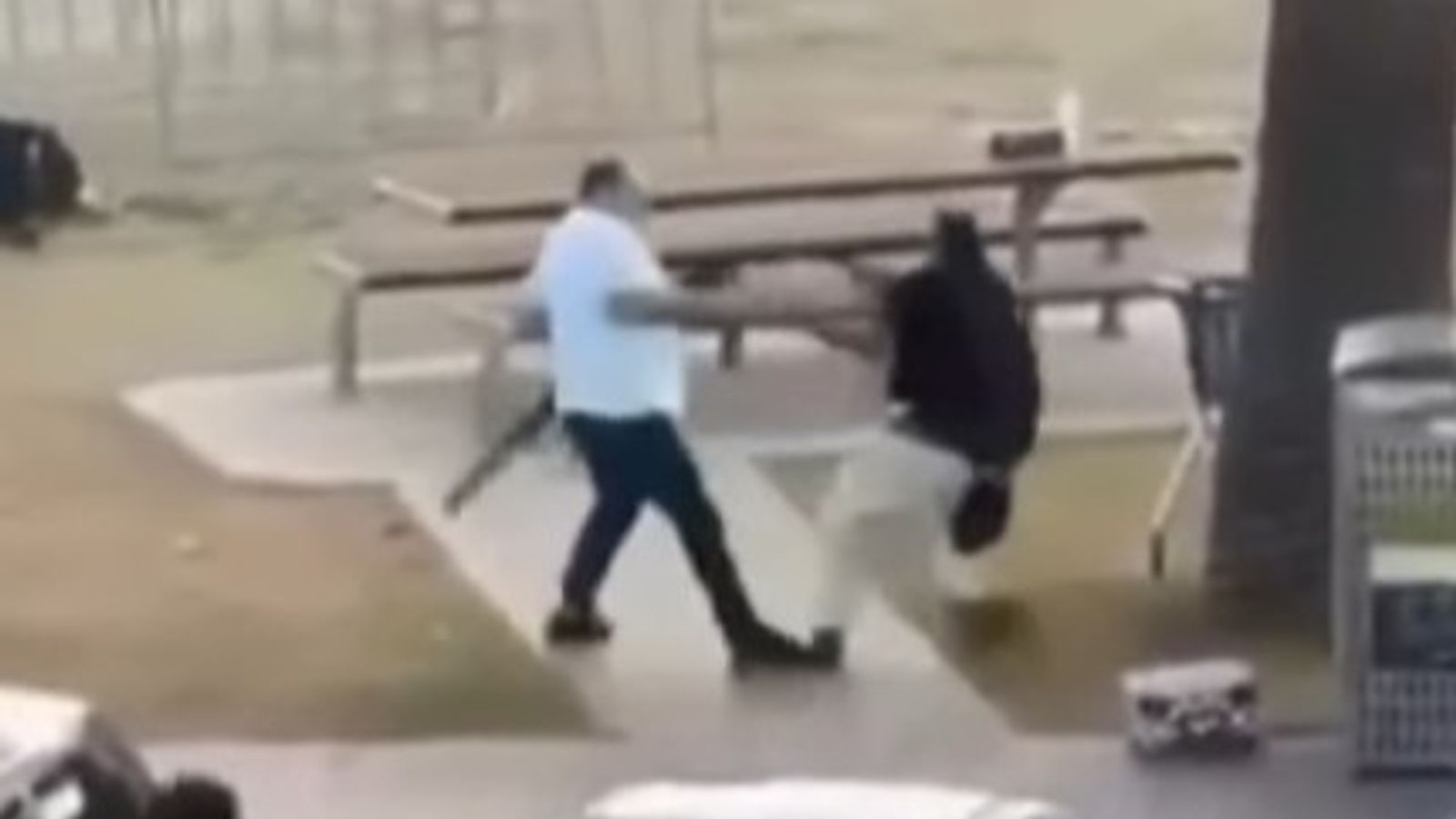
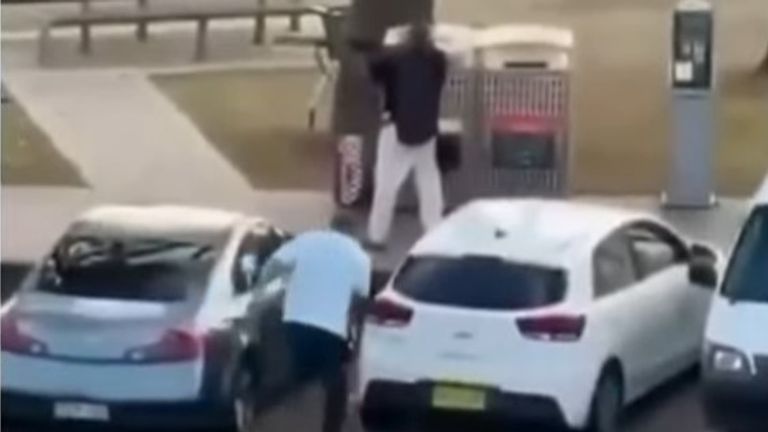
A bystander hailed a hero after he tackled and disarmed one of the gunmen in the Bondi Beach shooting is a shop owner.
The man, named by a relative as 43-year-old Ahmed al Ahmed, was seen in a video running up to the attacker from behind and then grabbing the shotgun from his hands before pointing the weapon back at him.
The footage then showed the terrorist heading towards a bridge where another gunman was located, while the bystander placed the gun beside a tree.
Ahmed al Ahmed (in a white T-shirt) is seen in a video running up to a gunman from behind
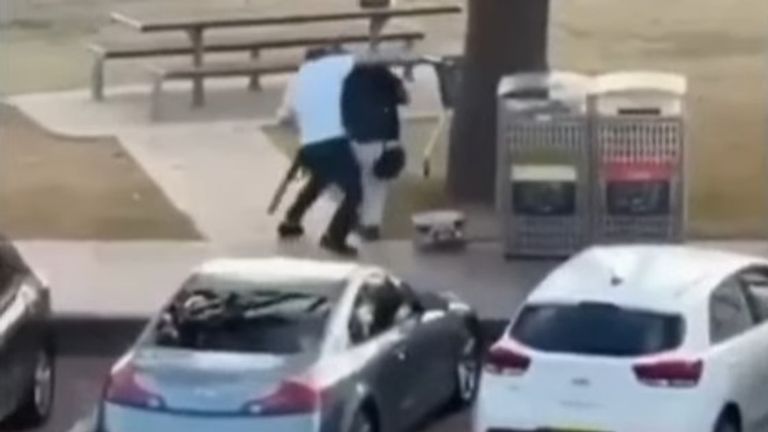
Mr Ahmed then wrestles with the attacker
Live updates on Sydney shooting
Mr Ahmed, who was wearing a white T-shirt, was shot twice in the incident and was due to have surgery, his cousin, Mustafa, has revealed.
In a video on 7News, Mr Ahmed appeared to have a bloodied arm and hand, and was helped by other people near the scene in the Australian city.
At least 11 people were killed and 29 others injured in the attack when two gunmen opened fire from a bridge on crowds at a Jewish event around 6pm local time on Sunday evening.
More than 1,000 people had been at the gathering which was celebrating the festival of Hanukkah.
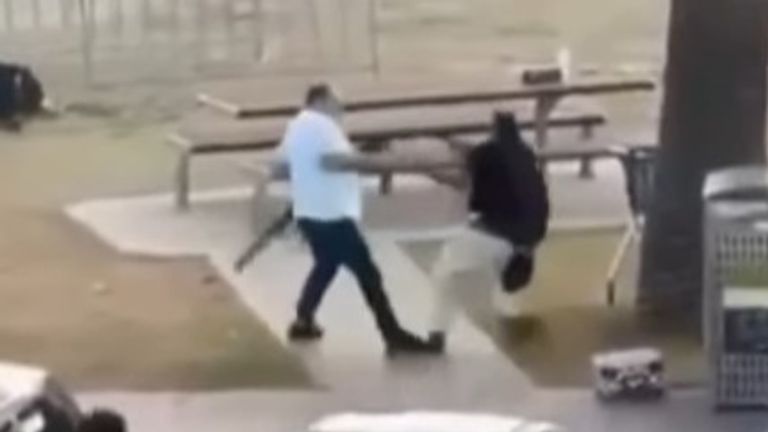
Mr Ahmed manages to get the gun off the terrorist
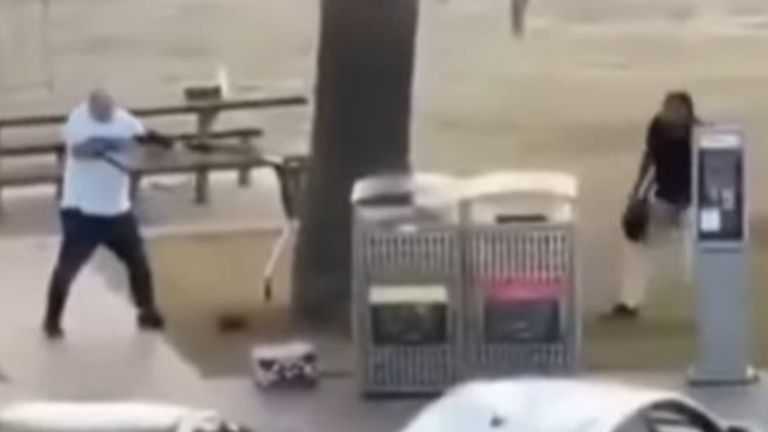
The bystander then points the weapon at the attacker who moves away towards a bridge
A gunman was killed and another was in a critical condition following the shooting.
One of the suspects was 24-year-old Naveed Akram.
His driver’s licence says he lives in Bonnyrigg, a suburb of Sydney. The identity of the other suspected attacker is not known.
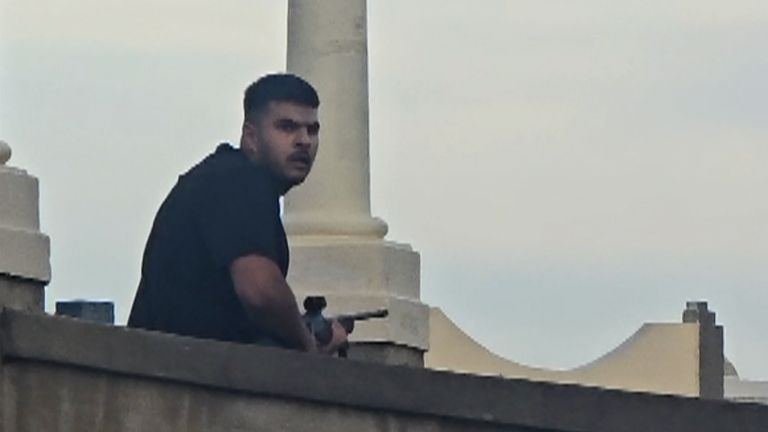
Naveed Akram, 24, was one of the suspects
Mustafa said father-of-two Mr Ahmed, who owns a fruit shop in the Sydney suburb of Sutherland, did not have any experience with guns but was just walking past when he decided to step in.
He told 7News: “He’s in hospital and we don’t know exactly what’s going on inside.
“We do hope he will be fine. He’s a hero, 100%.”
Read more:
What we know about mass shooting
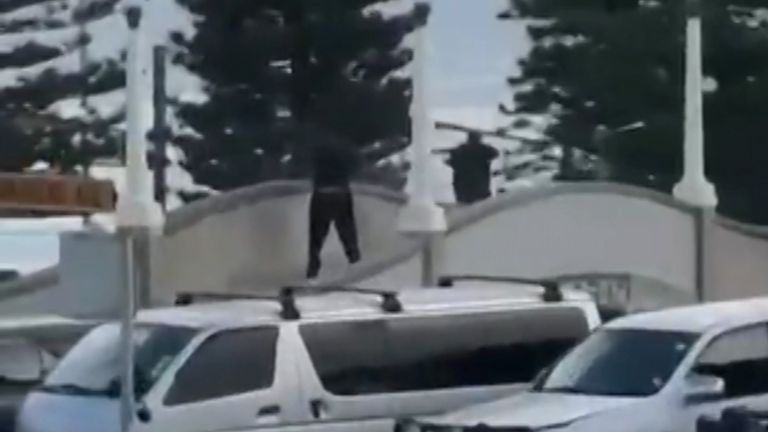
One of the suspected gunmen has been named as 24-year-old Naveed Akram.
The footage of the bystander’s actions spread quickly on social media as people praised the man for his bravery, saying his actions had potentially saved many lives.
“Australian hero (random civilian) wrestles gun off attacker and disarms him. Some people are brave and then some people are… whatever this is,” one person said on X, sharing the video.
“This Australian man saved countless lives by stripping the gun off one of the terrorists at Bondi beach. HERO,” another said.
Chris Minns, the premier of New South Wales state, where Sydney is located, said it was the “most unbelievable scene I’ve ever seen”.
“A man walking up to a gunman who had fired on the community and single-handedly disarming him, putting his own life at risk to save the lives of countless other people.”
“That man is a genuine hero, and I’ve got no doubt that there are many, many people alive tonight as a result of his bravery,” he added.
The country’s prime minister Anthony Albanese praised the actions of Australians who had “run towards danger in order to help others”.
“These Australians are heroes and their bravery has saved lives,” he told a news conference.
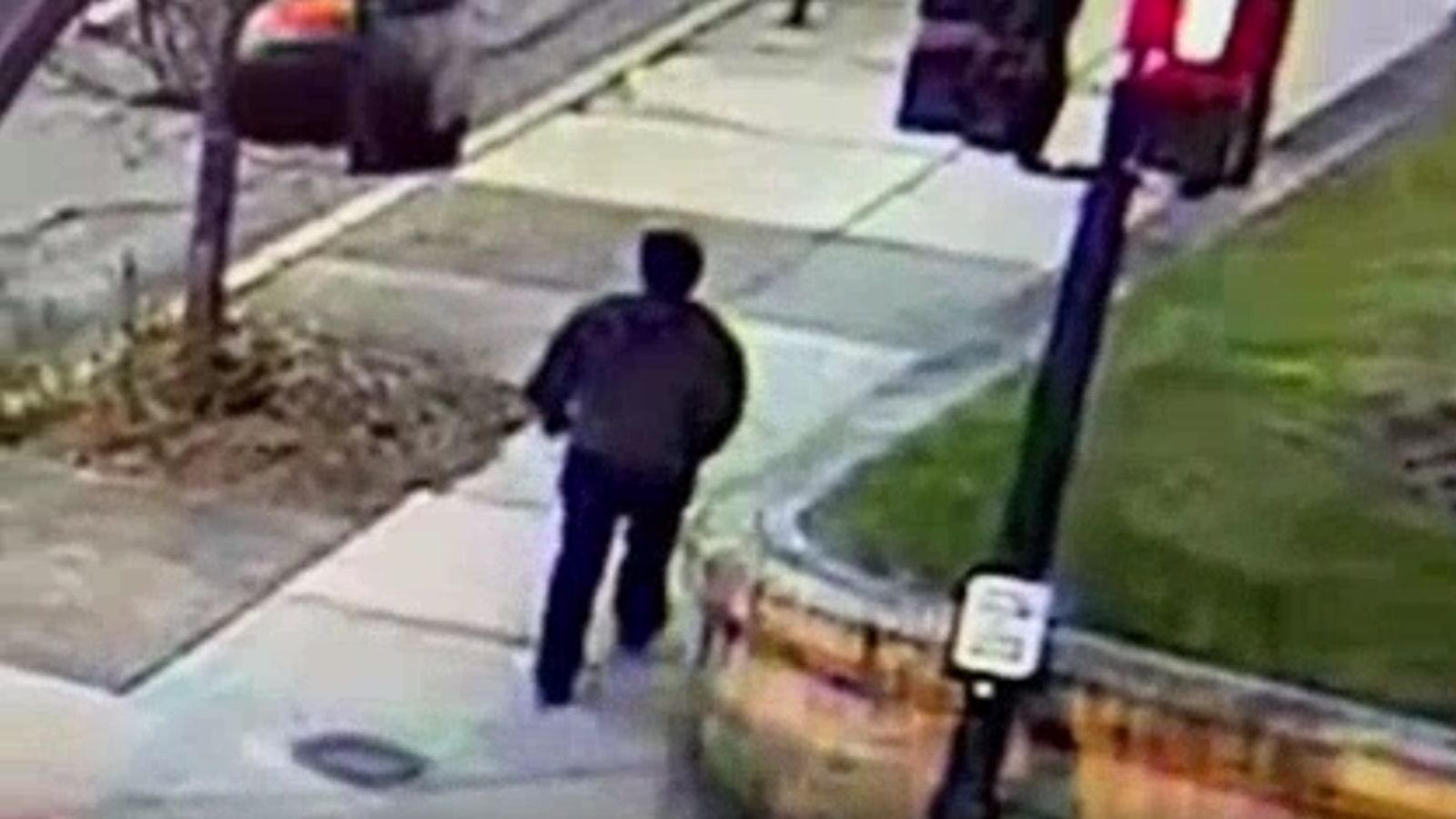
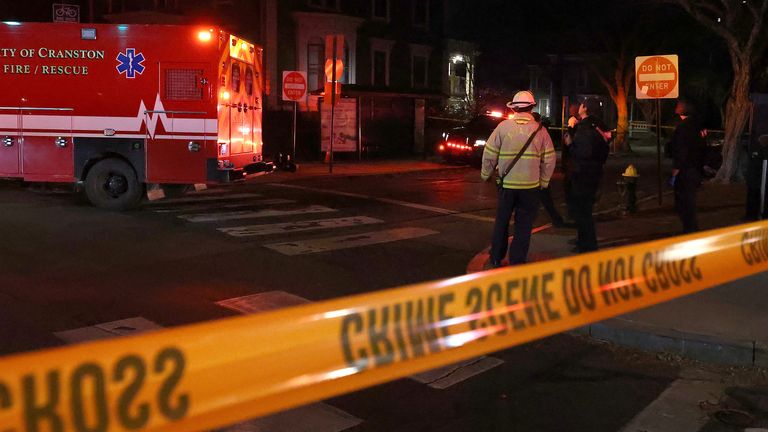
A “person of interest” has been detained after a gunman opened fire on the campus of Brown University in Providence, Rhode Island, killing two students.
Nine people, all or nearly all of whom are also believed to be students, were injured in the attack at around 4pm (9pm UK time) on Saturday.
Eight people have been described as stable, although one remains critically ill. Another person has left hospital.
A video released by officials shows a suspect walking down a street away from the campus and turning a corner, dressed in dark, loose-fitting clothing.
An FBI agent confirmed the arrest took place at a Hampton Inn hotel in Coventry, about 20 miles (32km) from Providence early on Sunday.
Authorities said the suspect was in their 20s, younger than was initially reported, but no further details have been released about them.
Pic: AP
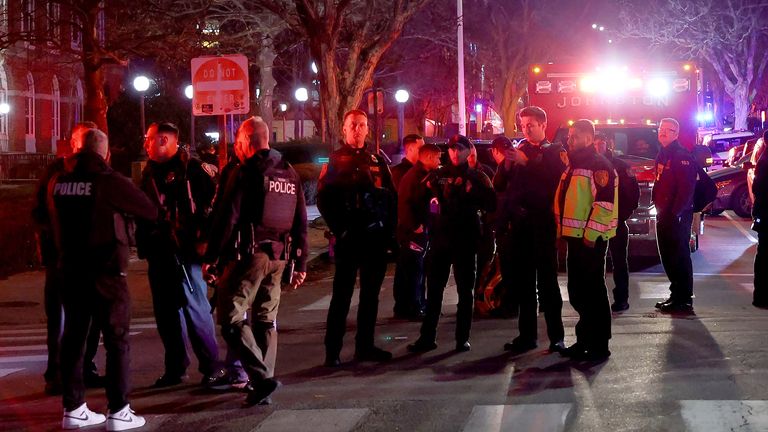
Pic: AP
Providence Police Deputy Chief Tim O’Hara said the shooting happened inside a classroom on the first floor of the Barus & Holley engineering building, a seven-storey structure home to much of the university’s engineering and physics study and research.
Brown University provost Frank Doyle confirmed that final exams were taking place in the engineering building Saturday afternoon when the gunman opened fire.
A police official told the AP news agency that the gunman fired more than 40 9mm rounds. A gun has not been recovered but officers did seize two loaded 30-round magazines.
On Sunday, Providence mayor Brett Smiley told reporters the order to shelter-in-place for nearby neighbourhoods had been lifted, but some streets remained shut as investigators work at the scene.
“The people of Providence should breathe a little easier this morning,” Mr Smiley added.
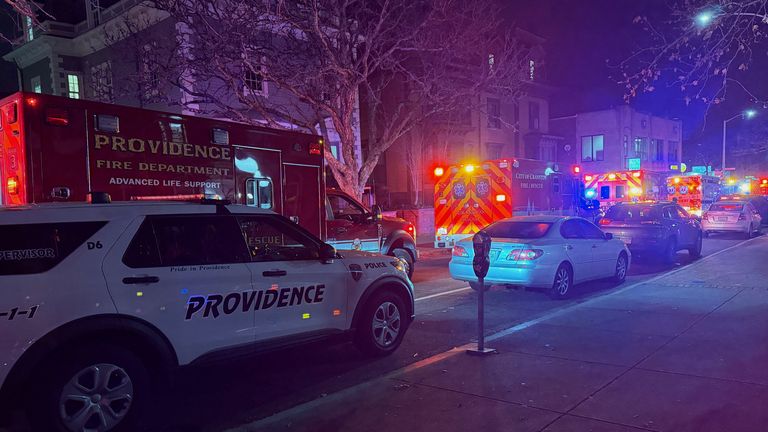
‘Stay inside’ mayor warns after shooting
Access to parts of the campus remained restricted on Sunday as police maintained a security perimeter around Minden Hall and nearby apartment buildings.
The site has hundreds of buildings, including lecture halls, laboratories and dorms.
Brown is a private university with roughly 7,300 undergraduate students and more than 3,000 graduate students.
Students hid under desks
Student Chiang-Heng Chien said he was working in one of the labs with three other students when they received a notification about a shooting nearby.
“We decided to turn the light off and close all the doors and hide under our desks, and wait for the next notification after the shooting,” he told reporters.
The students hid under the desks for about two hours.
‘We hid under our desks for two hours’
“I was hoping that no one’s getting hurt and no one’s dead,” he said.
The students left the building when they received another notification, and security personnel moved in to search the facility.
Read more from Sky News:
Terror attack at Bondi Beach shooting
Belarus pardons 123 prisoners
Thailand destroys bridge in Cambodia
Emma Ferraro, a chemical engineering student, was in the Barus & Holley lobby working on a final project when she heard loud popping sounds coming from the eastern side of the building.
For a moment, everyone paused and looked around, she recalled.
Once Ferraro realised the sounds were gunshots, she rushed to the door and ran to a nearby building, where she had been sheltering for the past few hours.
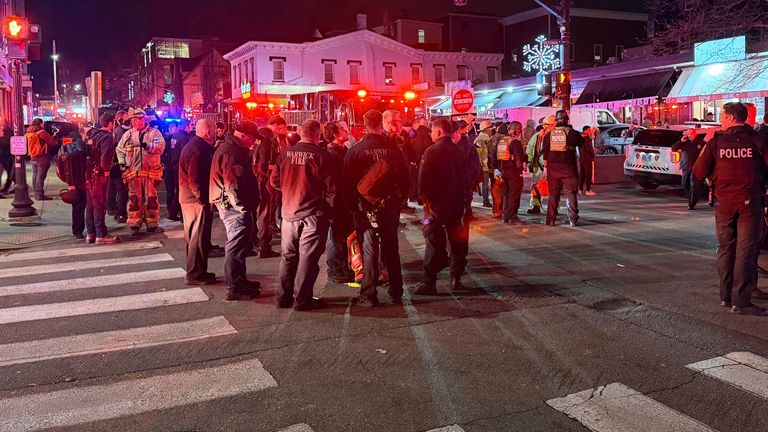
Pic: AP
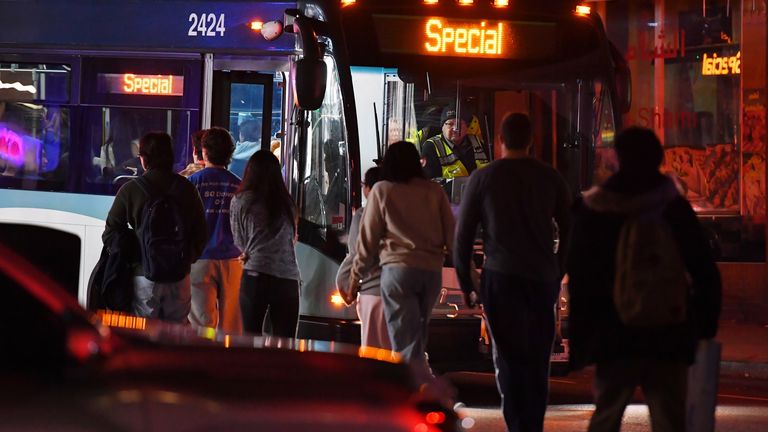
Pic: AP
One person who was initially thought to be involved in the shooting was detained but was later determined to have no involvement.
President Donald Trump told reporters at the White House that he had been briefed on the situation, which he called “terrible”.
“All we can do right now is pray for the victims and for those that were very badly hurt,” he added.
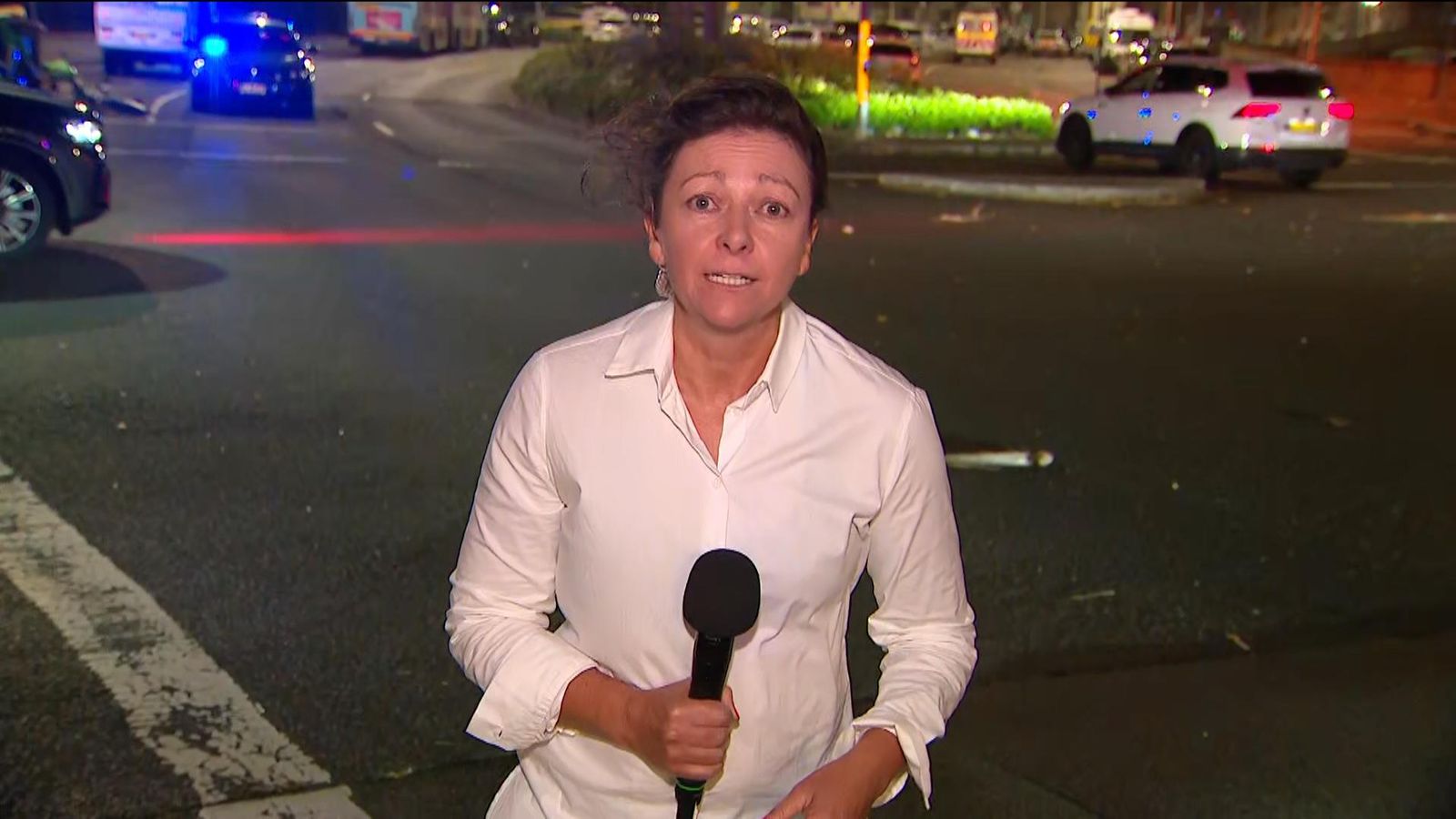
Messages were sweeping across Sydney within minutes of the attack at Bondi Beach.
Parents messaged their children and teenagers, who had been enjoying a late afternoon swim at Bondi.
Witnesses said police were on the scene quickly, and the streets of Sydney’s eastern suburbs were full of police cars and ambulances on their way to Bondi.
Follow live: 11 people killed at event celebrating Hanukkah
When we arrived, there were still dozens of people processing what had happened, and everywhere – shock.
Witnesses told us that when the gunfire started some people took cover in the North Bondi Surf Life Saving Club. Once the threat was over, lifeguards helped the injured and used surfboards to carry them out.
Witnesses tell Sky’s Nicole Johnston of Bondi ‘warzone’
Some people were clearly traumatised and provided graphic detail of witnessing the shooting and seeing people killed in front of them.
A photographer, Danny, was covering the Jewish holiday event.
Read more: What we know so far
He said he “locked eyes” with one of the gunmen, who then fired towards him. Danny said he was grazed by a bullet. He kept filming during the shooting, while taking cover.
Sam, from France, was working at Bondi. He went to the scene of the attack and saw almost a dozen people lying on the ground covered in blood. Sam described it as like a “war zone”.
Rabbi Lei Wolff, from Central Synagogue in Sydney, went to Bondi as soon as he heard about the mass shooting. A dear friend of his, Rabbi Eli Schlanger, was killed in the attack.
Rabbi Wolff has called on people around the world to stand with Australia’s Jewish community against terrorism.
-
 Sports2 years ago
Story injured on diving stop, exits Red Sox game
-
 Sports3 years ago
‘Storybook stuff’: Inside the night Bryce Harper sent the Phillies to the World Series
-
 Sports2 years ago
Game 1 of WS least-watched in recorded history
-
 Sports3 years ago
Button battles heat exhaustion in NASCAR debut
-
 Sports3 years ago
MLB Rank 2023: Ranking baseball’s top 100 players
-
Sports4 years ago
Team Europe easily wins 4th straight Laver Cup
-
 Environment3 years ago
Japan and South Korea have a lot at stake in a free and open South China Sea
-
 Environment1 year ago
Here are the best electric bikes you can buy at every price level in October 2024