

Connect with us

Published

on

the human factor — Is cybersecurity an unsolvable problem? Ars chats with law philosopher Scott Shapiro about his new book, Fancy Bear Goes Phishing.

Jennifer Ouellette – May 27, 2023 1:12 pm UTC EnlargeFarrar, Straus and Giroux reader comments 156 with

In November 1988, a graduate student at Cornell University named Robert Morris, Jr. inadvertently sparked a national crisis by unleashing a self-replicating computer worm on a VAX 11/750 computer in the Massachusetts Institute of Technology’s Artificial Intelligence Lab. Morris had no malicious intent; it was merely a scientific experiment to see how many computers he could infect. But he made a grievous error, setting his reinfection rate much too high. The worm spread so rapidly that it brought down the entire computer network at Cornell University, crippled those at several other universities, and even infiltrated the computers at Los Alamos and Livermore National Laboratories.

Making matters worse, his father was a computer scientist and cryptographer who was the chief scientist at the National Security Agency’s National Computer Security Center. Even though it was unintentional and witnesses testified that Morris didn’t have “a fraudulent or dishonest bone in his body,” he was convicted of felonious computer fraud. The judge was merciful during sentencing. Rather than 1520 years in prison, Morris got three years of probation with community service and had to pay a $10,000 fine. He went on to found Y Combinator with his longtime friendPaul Graham, among other accomplishments.

The “Morris Worm” is just one of five hacking cases that Scott Shapiro highlights in his new book, Fancy Bear Goes Phishing: The Dark History of the Information Age in Five Extraordinary Hacks. Shapiro is a legal philosopher at Yale University, but as a child, his mathematician fatherwho worked at Bell Labssparked an interest in computing by bringing home various components, like microchips, resistors, diodes, LEDs, and breadboards. Their father/son outings included annual attendance at the Institute of Electrical and Electronics Engineers convention in New York City. Then, a classmate in Shapiro’s high school biology class introduced him to programming on the school’s TRS-80, and Shapiro was hooked. He moved on to working on an Apple II and majored in computer science in college but lost interest afterward and went to law school instead.

With his Yale colleague Oona Hathaway, Shapiro co-authored a book called The Internationalists: How a Radical Plan to Outlaw War Remade the World, a sweeping historical analysis of the laws of war that spans from Hugo Grotius, the early 17th century father of international law, all the way to 2014. That experience raised numerous questions about the future of warfarenamely, cyberwar and whether the same “rules” would apply. The topic seemed like a natural choice for his next book, particularly given Shapiro’s background in computer science and coding. Advertisement

Despite that background, “I honestly had no idea what to say about it,” Shapiro told Ars. “I just found it all extremely confusing.” He was then asked to co-teach a special course, “The Law and Technology of Cyber Conflict,” with Hathaway and Yale’s computer science department. But the equal mix of law students and computer science students trying to learn about two very different highly technical fields proved to be a challenging combination. “It was the worst class I’ve ever taught in my career,” said Shapiro. “At any given time, half the class was bored and the other half was confused. I learned nothing from it, and nor did any of the students.”

That experience goaded Shapiro to spend the next few years trying to crack that particular nut. He brushed up on C, x86 assembly code, and Linux and immersed himself in the history of hacking, achieving his first hack at the age of 52. But he also approached the issue from his field of expertise. “I’m a philosopher, so I like to go to first principles,” he said. “But computer science is only a century old, and hacking, or cybersecurity, is maybe a few decades old. It’s a very young field, and part of the problem is that people haven’t thought it through from first principles.” The result was Fancy Bear Goes Phishing.

The book is a lively, engaging read filled with fascinating stories and colorful characters: the infamous Bulgarian hacker known as Dark Avenger, whose identity is still unknown; Cameron LaCroix, a 16-year-old from south Boston notorious for hacking into Paris Hilton’s Sidekick II in 2005; Paras Jha, a Rutgers student who designed the “Mirai botnet”apparently to get out of a calculus examand nearly destroyed the Internet in 2016 when he hacked Minecraft; and of course, the titular Fancy Bear hack by Russian military intelligence that was so central to the 2016 presidential election. (Fun fact: Shapiro notes that John von Neumann “built a self-reproducing automaton in 1949, decades before any other hacker… [and] he wrote it without a computer.”)

But Shapiro also brings some penetrating insight into why the Internet remains so insecure decades after its invention, as well as how and why hackers do what they do. And his conclusion about what can be done about it might prove a bit controversial: there is no permanent solution to the cybersecurity problem. “Cybersecurity is not a primarily technological problem that requires a primarily engineering solution,” Shapiro writes. “It is a human problem that requires an understanding of human behavior.” That’s his mantra throughout the book: “Hacking is about humans.” And it portends, for Shapiro, “the death of ‘solutionism.'”

Ars spoke with Shapiro to learn more. Page: 1 2 3 4 Next → reader comments 156 with Jennifer Ouellette Jennifer is a senior reporter at Ars Technica with a particular focus on where science meets culture, covering everything from physics and related interdisciplinary topics to her favorite films and TV series. Jennifer lives in Baltimore with her spouse, physicist Sean M. Carroll, and their two cats, Ariel and Caliban. Advertisement Channel Ars Technica ← Previous story Next story → Related Stories Today on Ars

Continue Reading

Entertainment

Oscars set to leave ABC and will be streamed live on YouTube from 2029

Published

on

By

Oscars set to leave ABC and will be streamed live on YouTube from 2029

The Oscars will be streamed live on YouTube from 2029 after being broadcast on the ABC network for decades.

It means the annual film awards will be available to the video-sharing platform’s two billion users for free around the world in four years.

The Academy of Motion Picture Arts and Sciences announced the deal with Google-owned YouTube on Wednesday, saying the streaming giant will have the exclusive global rights to the Hollywood awards from 2029 to 2033.

YouTube will effectively be the home to all things Oscars, including red-carpet coverage, the Governors Awards and the Oscar nominations announcement.

The Academy Awards ceremony has been broadcast by ABC for most of its history, but 2028 will be its last year showing the Oscars as they celebrate their 100th anniversary.

“The Oscars, including red carpet coverage, behind-the-scenes content, Governors Ball access, and more, will be available live and for free to over two billion viewers around the world on YouTube, and to YouTube TV subscribers in the United States,” an announcement on the Academy Awards’ website read.

“We are thrilled to enter into a multifaceted global partnership with YouTube to be the future home of the Oscars and our year-round academy programming,” said academy chief executive Bill Kramer and academy president Lynette Howell Taylor.

More on Oscars

They said the new partnership with the platform “will allow us to expand access to the work of the academy to the largest worldwide audience possible”.

File pic: Reuters
Image:
File pic: Reuters

‘Inspiring new generation of creativity and film lovers’

“The Oscars are one of our essential cultural institutions, honouring excellence in storytelling and artistry,” said YouTube chief executive Neal Mohan.

“Partnering with the academy to bring this celebration of art and entertainment to viewers all over the world will inspire a new generation of creativity and film lovers while staying true to the Oscars’ storied legacy.”

Read more from Sky News:
Paramount backer pulls out of Warner Bros takeover bid
Sydney Sweeney on challenges women face to ‘have it all’

The awards will be available with audio tracks in many languages, in addition to closed captioning.

Last year’s Academy Awards were watched by 19.7 million viewers on the Disney-owned ABC, a five-year high but far below the show’s biggest audience of 57 million in 1998.

The network has been the broadcast home to the Oscars for almost its entire history. NBC first televised the Oscars in 1953, but ABC picked up the rights in 1961.

Aside from a period between 1971 and 1975, when NBC again aired the show, the Oscars have been on ABC.
Continue Reading

UK

King meets Huntingdon train attack heroes, including guard who protected passengers

Published

on

By

King meets Huntingdon train attack heroes, including guard who protected passengers

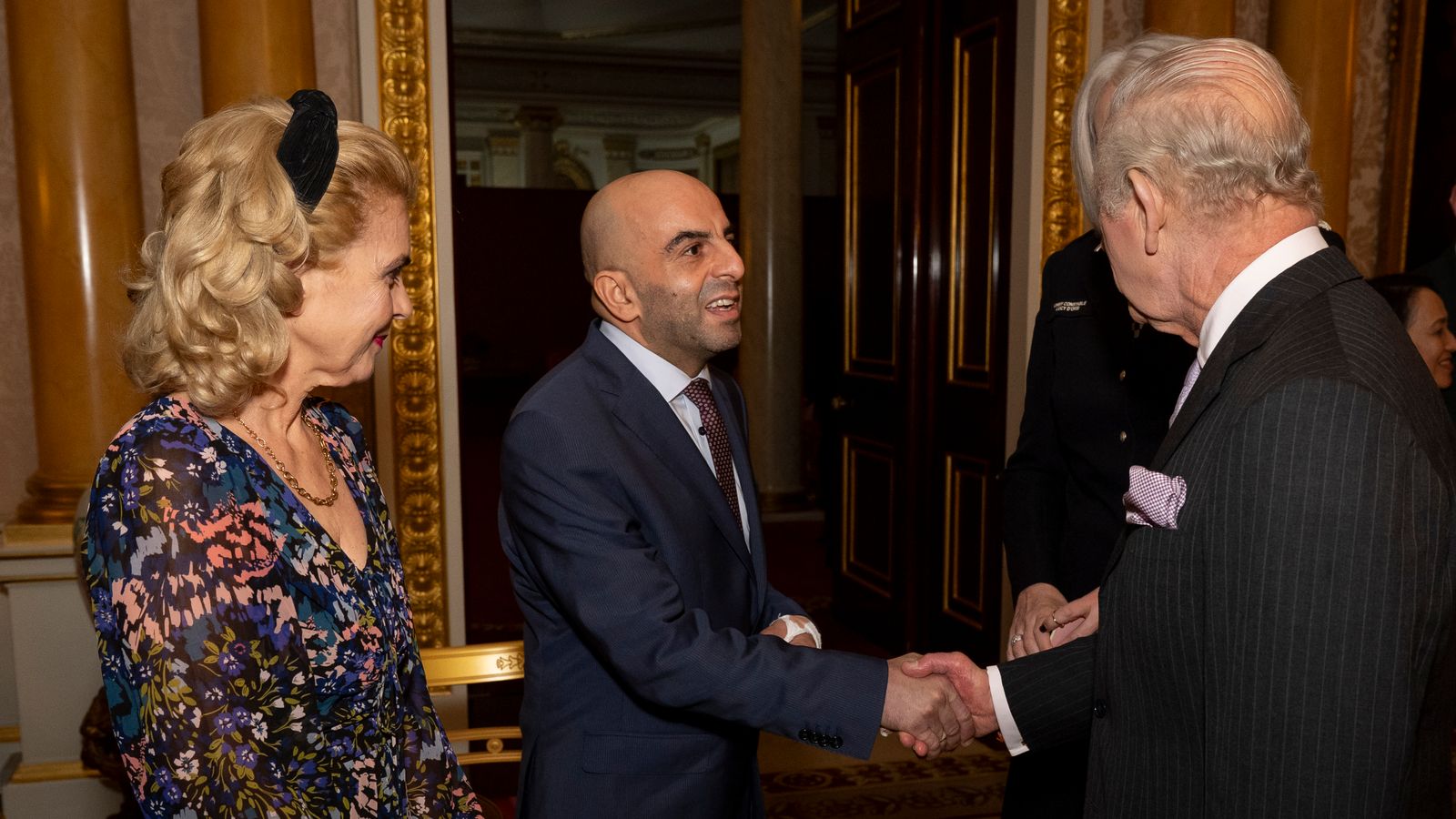
The King has met survivors of last month’s Huntingdon train mass stabbing, during a special reception at Buckingham Palace.

He shook hands with train guard Samir Zitouni, who was seriously injured as he stepped in to protect passengers.

More than 10 people were hurt in the stabbing on the 6.25pm LNER service from Doncaster to London King’s Cross on 1 November, which diverted to Huntingdon.

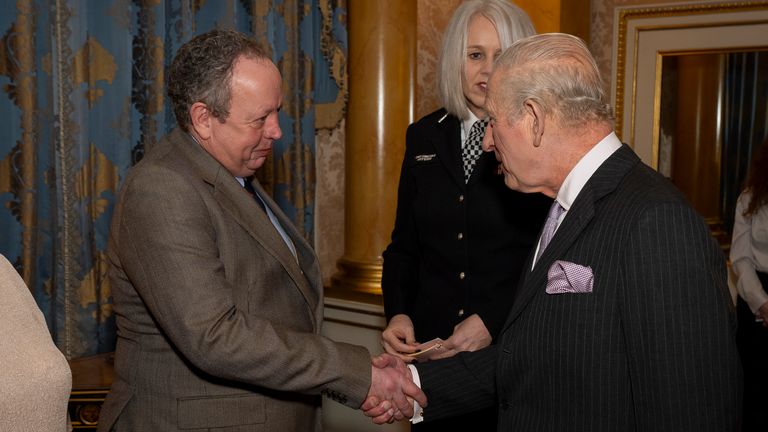
The King greets the train's driver, Andrew Johnson. Pic: PA
Image:
The King greets the train’s driver, Andrew Johnson. Pic: PA

The monarch also met Andrew Johnson, who previously served in the Royal Navy, and was driving the service at the time of the attack.

He was praised by Prime Minister Sir Keir Starmer for his quick thinking when he moved the train on to a slow line.

That decision allowed it to stop at Huntingdon station, leading to a quicker response time by emergency services and potentially saving lives.


Sky’s Rachael Venables breaks down how the stabbing unfolded.

Mr Zitouni was credited with saving multiple lives, but was left in a critical condition due to injuries he suffered in the attack.

More on Huntingdon Train Stabbing

Stephen Crean, a football fan who had been returning home after watching Nottingham Forest’s 2-2 draw with Manchester United, was also injured while fighting back to protect others during the incident.

Mr Crean said he would need plastic surgery following his injuries.
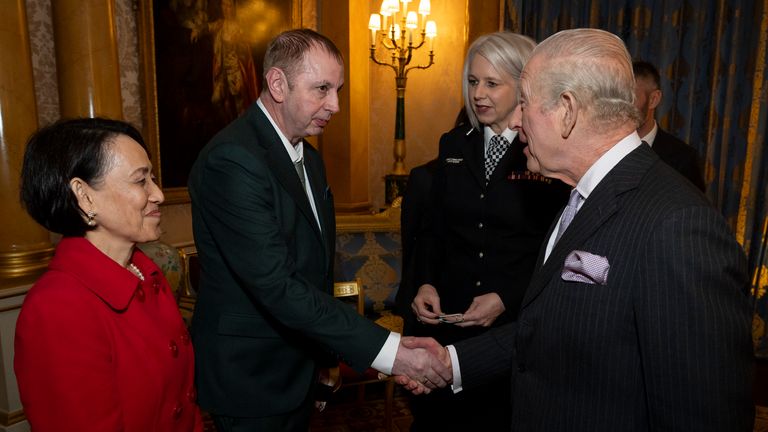
The monarch greets Stephen Crean and his wife Monludee Crean during the reception. Pic: PA
Image:
The monarch greets Stephen Crean and his wife Monludee Crean during the reception. Pic: PA

Amira Ostalski, a student who suddenly found herself in danger, said she ran into the buffet car where she picked up a metal tray to protect herself and her friend.

“I was honestly so petrified. I thought in that moment it was the last time I was ever going to be alive. I thought I was going to die,” she said.

Anthony Williams was charged with 10 counts of attempted murder, one count of actual bodily harm and one count of possession of a bladed article following the train attack.

He remains in custody pending further court hearings scheduled for next year.

Continue Reading

Technology

Instacart shares drop on report that FTC is probing company over AI pricing tool

Published

on

By

Instacart shares drop on report that FTC is probing company over AI pricing tool

Cheng Xin | Getty Images

Shares of grocery delivery service Instacart dropped about 7% in extended trading on Wednesday, following a report that said the U.S. Federal Trade Commission has begun an investigation into the company’s pricing practices.

The FTC sent a civil investigative demand to Instacart, Reuters reported, citing unnamed people.

A study released last week showed that prices for the same products in the same supermarkets that work with Instacart can vary by around 7%, which can result in over $1,000 in extra annual costs for customers. Instacart responded by saying that retailers determine prices listed in the app.

In 2022, Instacart spent $59 million to acquire Eversight, a company specializing in artificial intelligence-driven pricing and promotions for retailers and consumer packaged goods. Instacart sought to “create compelling savings opportunities for customers in real-time” with Eversight, according to a regulatory filing.

The FTC and Instacart did not immediately respond to requests for comment.

Read Reuters’ full report here.

Continue Reading

Trending





