
Microsoft inks deal for A.I. computing power with Nvidia-backed CoreWeave that could be worth billions

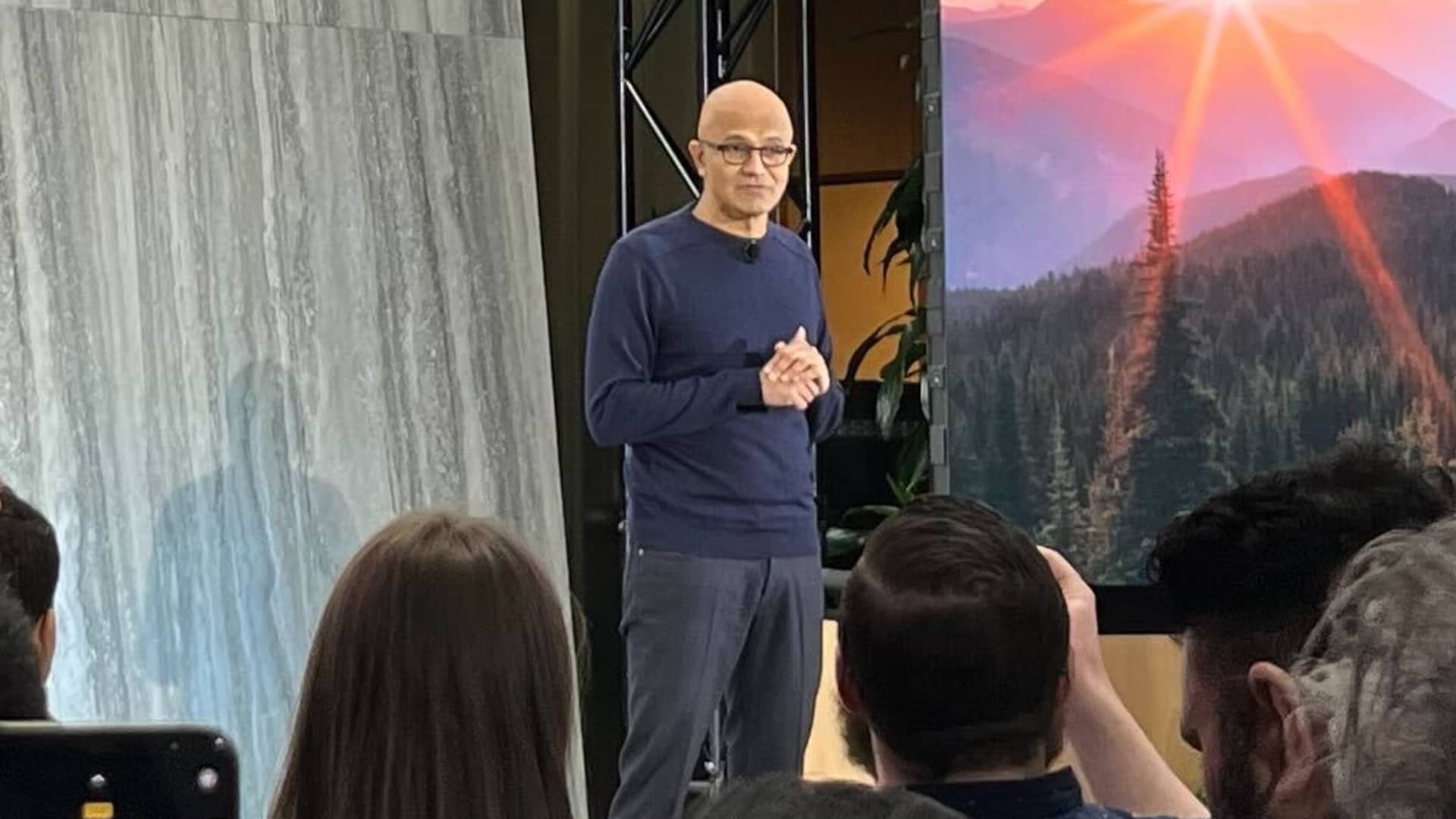
Microsoft CEO Satya Nadella
Jordan Novet | CNBC
Microsoft‘s massive investment in OpenAI has put the company at the center of the artificial intelligence boom. But it’s not the only place where the software giant is opening its wallet to meet the surging demand for AI-powered services.
CNBC has learned from people with knowledge of the matter that Microsoft has agreed to spend potentially billions of dollars over multiple years on cloud-computing infrastructure from startup CoreWeave, which announced on Wednesday that it raised $200 million. That financing comes just over a month after the company attained a valuation of $2 billion.
related investing news
CoreWeave sells simplified access to Nvidia’s graphics processing units, or GPUs, which are considered the best available on the market for running AI models. Microsoft signed the CoreWeave deal earlier this year in order to ensure that OpenAI, which operates the viral ChatGPT chatbot, will have adequate computing power going forward, said one of the people, who asked not to be named due to confidentiality. OpenAI relies on Microsoft’s Azure cloud infrastructure for its hefty compute needs.
Microsoft and CoreWeave both declined to comment.
The generative AI rush began late last year after OpenAI introduced ChatGPT to the public, demonstrating that AI can take human input and produce sophisticated responses. Many companies, including Google, have since rushed to add generative AI into their products. And Microsoft has been busy releasing chatbots for its own services, such as Bing and Windows.
With so much demand for its infrastructure, Microsoft needs additional ways to tap Nvidia’s GPUs. CoreWeave CEO Michael Intrator declined to comment about the Microsoft deal in an interview last month, but he said revenue has “gone up by many multiples from 2022 to 2023.”
Nvidia-backed startup Coreweave is based in Roseland, New Jersey, with 160 employees.
CoreWeave
CoreWeave’s announced funding on Wednesday from hedge fund Magnetar Capital was an extension of a $221 million round in April. Nvidia invested $100 million in the prior financing, Intrator said. CoreWeave was founded in 2017 and has 160 employees.
Nvidia’s stock price is up 170% this year. The company’s market cap briefly topped $1 trillion for the first time this week after it issued a forecast for the July quarter that was over 50% higher than Wall Street estimates.
The chipmaker’s growth will “largely be driven by data center, reflecting a steep increase in demand related to generative AI and large language models,” Colette Kress, Nvidia’s finance chief, said on last week’s earnings call. OpenAI’s GPT-4 large language model, trained with Nvidia GPUs on extensive online data, is at the core of ChatGPT.
Kress referred to CoreWeave by name on the call, and in March, Nvidia CEO Jensen Huang mentioned CoreWeave in his presentation at Nvidia’s GTC conference.
CoreWeave’s website claims the company can deliver computing power that’s “80% less expensive than legacy cloud providers.” Among other cards, CoreWeave offers Nvidia’s A100 GPUs, which developers can also find through the Amazon, Google and Microsoft clouds.
In addition, CoreWeave has available less expensive Nvidia A40 GPUs that are marketed for visual computing, while the A100 targets AI, data analytics and high-performance computing. Some CoreWeave clients have struggled to obtain enough GPU power on big clouds, Intrator said. At times prospects have asked for A100 or newer H100 GPUs from Nvidia, and the company has instead recommended A40 GPUs.
These “will do an excellent job at a very cost-effective price,” Intrator said.
Microsoft has had discussions with Oracle about the two companies renting servers from each other if they need added capacity, The Information reported earlier this month, citing an unnamed person.
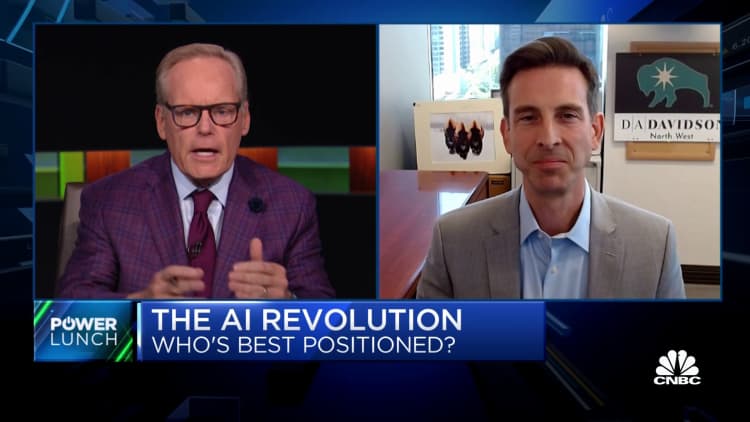
WATCH: Microsoft is ‘just getting started’ in A.I. space, says D.A. Davidson’s Gil Luria


The U.S. has halted a technology trade deal with the U.K., after officials in Washington became frustrated with the pace of progress, the Financial Times reported on Tuesday.
Announced in September during President Donald Trump’s state visit to the U.K., the “technology prosperity deal” is a sweeping agreement aimed at encouraging collaboration between the countries on tech like artificial intelligence, nuclear fusion, and quantum computing.
At the time, Trump said that the deal would “ensure our countries lead the next great technological revolution side by side.” U.K. Prime Minister Keir Starmer said that the agreement was a “generational step change in our relationship with the U.S.” that would deliver “growth, security and opportunity up and down the country.”
Talks were suspended by the U.S. last week, the FT reported, quoting unnamed British officials.
When asked to comment on the report, a U.K. government spokesperson told CNBC: “Our special relationship with the US remains strong and the UK is firmly committed to ensuring the Tech Prosperity Deal delivers opportunity for hardworking people in both countries.”
The agreement would establish AI-enabled research programs in areas including the development of models and datasets in mutual priorities such as AI for biotechnology, precision medicine for cancer and rare and chronic diseases, and fusion energy, the two countries said in September.
It came as the U.K. signed deals totalling £31 billion ($41 billion) with U.S. tech firms like Microsoft, Nvidia, Google, OpenAI, and CoreWeave to build out the country’s AI infrastructure. The U.S. is the U.K.’s largest trading partner.
The U.S. Department of Commerce has been approached for comment.


The logo of an Apple Store is seen reflected on the glass exterior of a Samsung flagship store in Shanghai, China Monday, Oct. 20, 2025.
Wang Gang | Feature China | Future Publishing | Getty Images
A shortage of memory chips fueled by artificial intelligence players is likely to cause a price rise in smartphones in 2026 and a drop in shipments, Counterpoint Research said in a note on Tuesday.
Smartphone shipments could fall 2.1% in 2026, according to Counterpoint, versus a previous outlook of flat-to-positive growth.
Shipments do not equate to sales but are a measure of demand as they track the number of devices being sent to sales channels like stores.
Meanwhile, the average selling price of smartphones could jump 6.9% year-on-year in 2026, Counterpoint said, in comparison to a previous forecast of a 3.6% rise.
This is being driven by specific chip shortages and bottlenecks in the semiconductor supply chain, which are pushing up component prices.
The continued build-out of data centres globally has hiked demand for systems developed by Nvidia, which in turn uses components designed by SK Hynix and Samsung — the two biggest suppliers of so-called memory chips.
However, a specific component called dynamic random-access memory or DRAM, which is used in AI data centers, is also critical for smartphones. DRAM prices have surged this year as demand outstrips supply.
For low-end smartphones priced below $200, the bill of materials cost has increased 20% to 30% since the beginning of the year, Counterpoint said. The bill of materials is the cost of producing a single smartphone.
The mid and high-end smartphone segment has seen material costs rise 10% to 15%.
“Memory prices could rise another 40% through Q2 2026, resulting in BoM costs increasing anywhere between 8% and over 15% above current elevated levels,” Counterpoint said.
The rising price of components could be passed on to consumers and that will in turn, drive the rise in the average selling price.
“Apple and Samsung are best positioned to weather the next few quarters,” MS Hwang, research director at Counterpoint, said in the note. “But it will be tough for others that don’t have as much wiggle room to manage market share versus profit margins.”
Hwang said this will “play out especially” with Chinese smartphone makers who are in the mid-to-lower end of the market.
Counterpoint said some companies may downgrade components like camera modules, displays and even audio, as well as reusing old components. Smartphone players are likely to try to incentivize consumers to buy their higher-priced devices too.
-
 Sports2 years ago
Story injured on diving stop, exits Red Sox game
-
 Sports3 years ago
‘Storybook stuff’: Inside the night Bryce Harper sent the Phillies to the World Series
-
 Sports2 years ago
Game 1 of WS least-watched in recorded history
-
 Sports3 years ago
Button battles heat exhaustion in NASCAR debut
-
 Sports3 years ago
MLB Rank 2023: Ranking baseball’s top 100 players
-
Sports4 years ago
Team Europe easily wins 4th straight Laver Cup
-
 Environment3 years ago
Japan and South Korea have a lot at stake in a free and open South China Sea
-
 Environment1 year ago
Here are the best electric bikes you can buy at every price level in October 2024