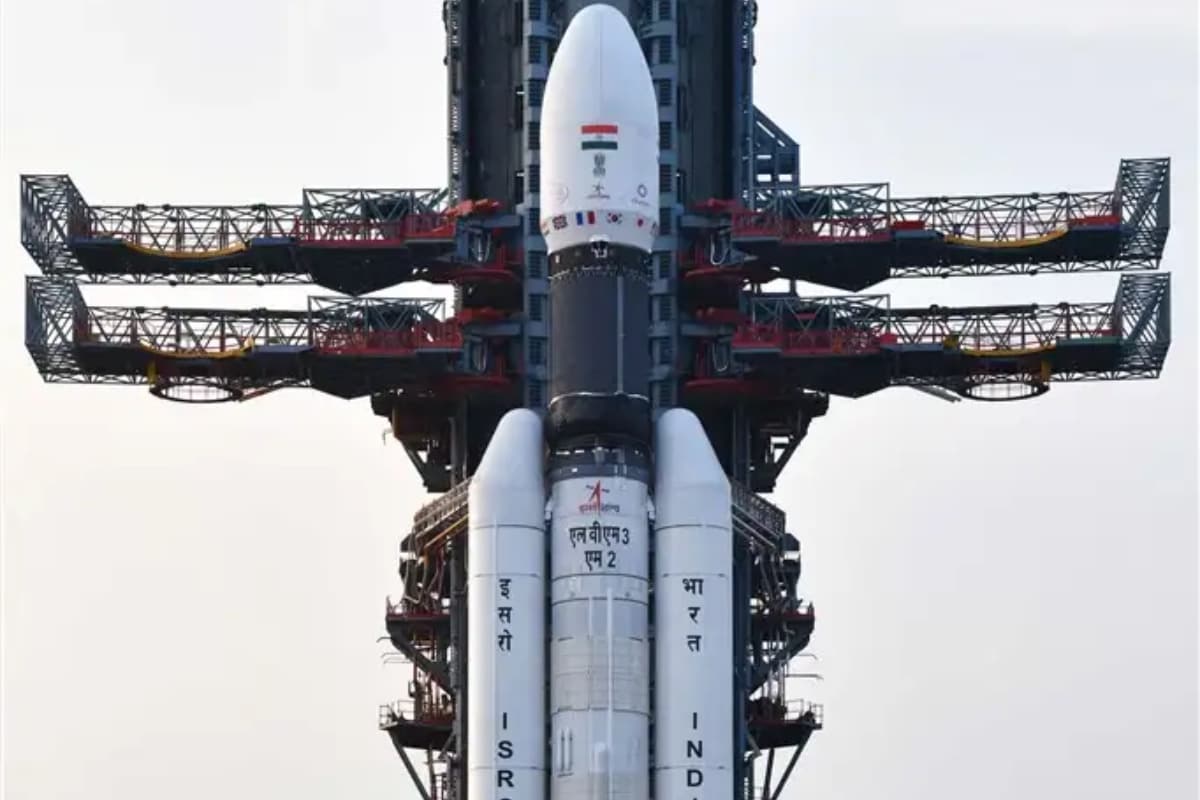
Chandrayaan-3, scheduled to be launched from Sriharikota this week, will make “India the fourth country to land its spacecraft on the surface of the Moon“, said Union Minister of State (Independent Charge) for Science and Technology, Jitendra Singh, on Sunday.
He said Prime Minister Narendra Modi’s recent US visit was marked by significant space-related agreements indicating that the countries which had started their space journey long before India are today looking up to the country as an equal collaborator.
After such a quantum rise in our space expertise under Prime Minister Narendra Modi’s regime, “India can no longer wait to be left behind in its march to the Moon,” the minister said.
Singh said Chandrayaan-3 is a follow-on mission of Chandrayaan-2 and is aimed at demonstrating India’s capability in soft landing and roving on the surface of the Moon or the lunar surface. The complex mission profile, he said, required for the spacecraft to enter the Moon’s orbit has been executed very precisely.
“After the successful landing of Chandrayaan-3 on the surface of the Moon, the rover, which has six wheels, will come out and is expected to work for 14 days on the Moon. With the support of multiple cameras on the rover, we will be able to receive images,” he said, as per a release by the Ministry.
Giving full credit to Prime Minister Narendra Modi for providing an enabling environment for space workers and taking path-breaking decisions like unlocking the space sector for Public Private Partnership (PPP), Singh said, based on the current trajectory of growth, India’s space sector could be a $1 trillion economy in the coming years.
Singh said, “The primary objectives of Chandrayaan-3 mission are threefold, to demonstrate safe and soft landing on lunar surface, to demonstrate rover roving on the moon and to conduct in-situ scientific experiments.”
The minister recalled that the first in the series of Chandrayaan missions — namely Chandrayaan-1 — is credited with having discovered the presence of water on the surface of the Moon, which was a new revelation for the world and even the most premier space agencies like the US’s NASA (National Aeronautics and Space Administration) were fascinated by this discovery and used the inputs for their further experiments.
Chandrayyan-3, he said, will be operating at the next level. The spacecraft will use Launch Vehicle Mark-3 developed by ISRO for its launch, he added.
Singh added, “There is tremendous excitement across the country about the launch of Chandrayaan-3, particularly because Chandrayaan-2 mission could not yield the desired results because of a lapse just about 13 minutes after Spacecraft began its descent on September 6, 2019. Prime Minister Narendra Modi was personally present at Sriharikota to witness the event.”
The minister added, “A successor to Chandrayaan-2, Chandrayaan-3 has undergone a few changes to increase the robustness of the lander. He said, all these modifications have been subject to exhaustive ground tests and simulations through test beds.”
“The lander and rover module of Chandrayaan-3 is also configured with payloads that would provide data to the scientific community on various properties of lunar soil and rocks including its chemical and elemental composition,” Singh was quoted as saying in the release.
From the Nothing Phone 2 to the Motorola Razr 40 Ultra, several new smartphones are expected to make their debut in July. We discuss all of the most exciting smartphones coming this month and more on the latest episode of Orbital, the Gadgets 360 podcast. Orbital is available on Spotify, Gaana, JioSaavn, Google Podcasts, Apple Podcasts, Amazon Music and wherever you get your podcasts.
Affiliate links may be automatically generated – see our ethics statement for details.