
Connect with us

Published

on

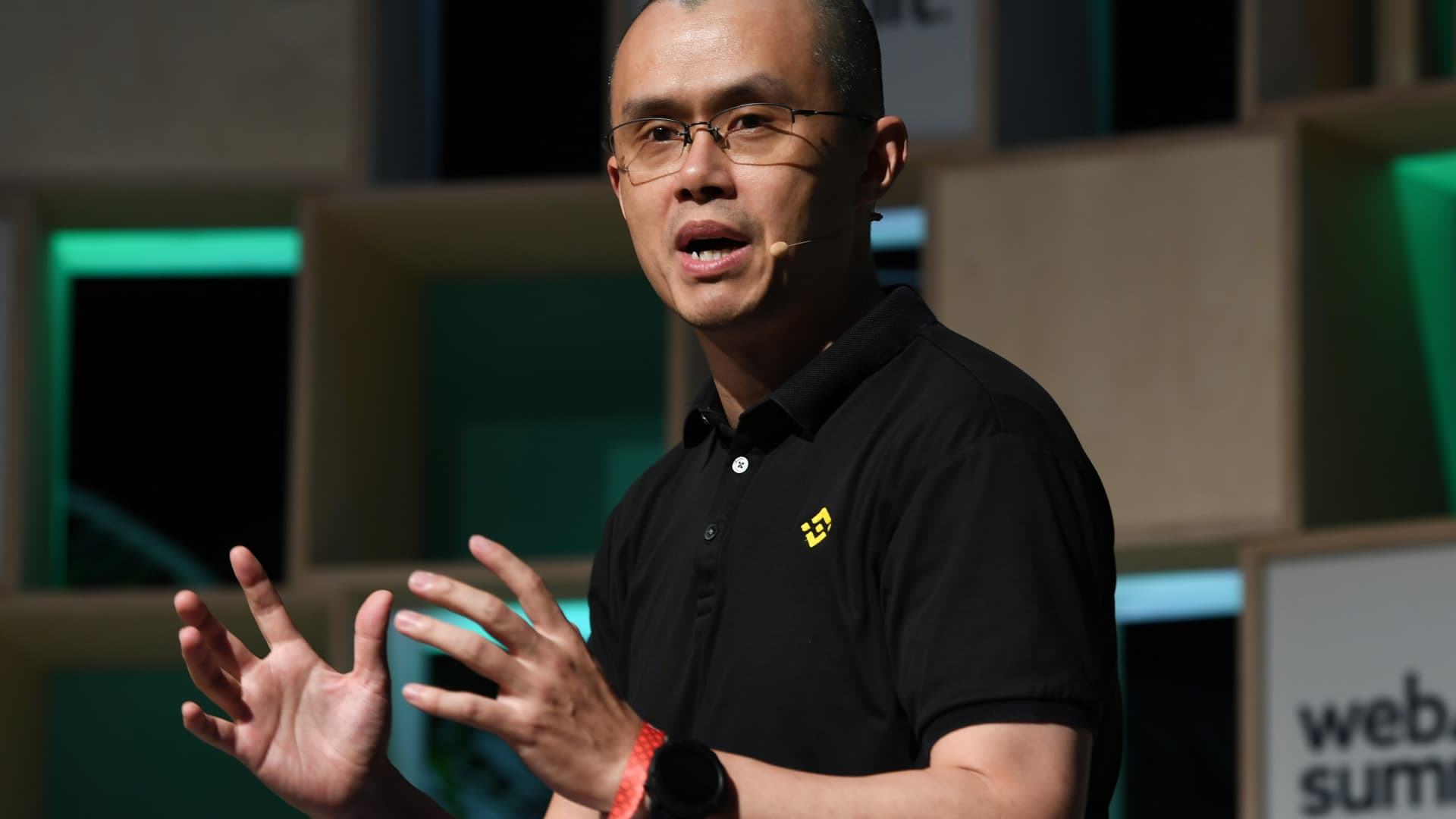
Changpeng Zhao, billionaire and chief executive officer of Binance Holdings Ltd., speaks during a session at the Web Summit in Lisbon, Portugal, on Wednesday, Nov. 2, 2022.

Zed Jameson | Bloomberg | Getty Images

Crypto exchange Binance is laying off employees in response to an ongoing Justice Department probe that is likely to end with a consent decree or settlement, according to a current employee who is familiar with the company’s plans.

The cuts will eliminate 1,500 to 3,000 of Binance’s global workforce, this person told CNBC, and will take place through the end of the year. The Wall Street Journal previously reported on Friday that 1,000 employees have already been laid off, and those layoffs are part of the total planned, the source told CNBC. This person asked to remain anonymous because they are not authorized to talk to the press about internal matters.

The Justice Department probe will likely reshape the company fundamentally, the employee told CNBC. If Binance opts to settle the DOJ allegations, it could result in a multi-billion dollar payment. Reuters has reported that federal prosecutors have been weighing anti-money laundering violations and sanctions evasion charges, allegations that would make it difficult for Binance or founder Changpeng Zhao to continue to get licenses to operate.

A Binance spokesperson disputed that the cuts would impact 3,000 employees, saying that the high-end number was “just not right.”

The spokesperson said, “As we prepare for the next major bull cycle, it has become clear that we need to focus on talent density across the organization to ensure we remain nimble and dynamic. This is not a case of rightsizing, but rather, re-evaluating whether we have the right talent and expertise in critical roles.”

Binance has faced significant regulatory challenges over the last few months, culminating in lawsuits from the Securities and Exchange Commission and the Commodity Futures Trading Commission over alleged mishandling of customer assets and the operation of an illegal, unregistered exchange in the U.S.

Binance founder Changpeng Zhao has repeatedly dismissed concerns about the future of the exchange, even after being personally named in the SEC’s lawsuit. Binance itself has suffered significantly since the lawsuits from U.S. regulators, with exchange outflows running into the hundreds of millions. The company has also seen a number of key executive departures.

Continue Reading

Technology

Startup backed by Altman, JPMorgan announces capital lending partnership with Amazon

Published

on

By

Startup backed by Altman, JPMorgan announces capital lending partnership with Amazon

Slope, a lending startup that uses artificial intelligence to vet businesses, is partnering with Amazon starting Tuesday to provide a reusable line of credit to Amazon sellers, backed by a JPMorgan Chase credit facility, the company told CNBC exclusively.

The new relationship means eligible U.S. Amazon vendors can apply for and access capital directly through their Amazon Seller accounts with real-time approvals.

Slope was co-founded by CEO Lawrence Lin Murata, who said said he saw the ups and downs of running a small business while he was growing up in São Paulo.

Lin Murata helped his parents at their family’s toy shop, which they’ve been running for more than three decades. As he gained more insight into the finances of the business, he said he realized that cash flow was a large pain point for his parents and other small businesses.

That led him to start Slope, an AI-powered lending platform backed by OpenAI CEO Sam Altman and JPMorgan Chase, with co-founder Alice Deng.

“Leveraging AI, we’re able to underwrite these businesses, and we’re able to handle all the complexity of assessing the risk for a business,” Lin Murata said. “At the same time, [we’re] providing a very easy, real-time experience to them.”

The lines of credit will start at an 8.99% APR, according to Slope, and require vendors to be in business for at least one year with more than $100,000 in annual revenue. Once approved, Amazon sellers can draw from the line as needed and choose a term ranging from three months to a year to align repayment with their inventory cycle. Scope did not disclose the financial aspects of its deal with Amazon.

“Most people don’t realize that sellers, independent sellers, are kind of the backbone of Amazon and e-commerce in general,” Deng told CNBC. “More than 60% of Amazon’s sales are driven by independent sellers.”

Deng said Slope is filling a gap with the new partnership. Currently, Amazon sellers can use some third parties to access capital, though Deng said those initiatives are more focused on smaller sellers, while Slope is focused on mature sellers, some of whom reach hundreds of millions of dollars in revenue and require bank-grade financing.

Deng said when Amazon did its own lending around four years ago, the total addressable market was between $1 billion and $2 billion. With Slope taking over the program, the company expects that number to grow.

“We’re excited about our work with Slope, which expands the financing tools available to Amazon selling partners,” an Amazon spokesperson told CNBC. “Whether they are just starting out or looking to grow, access to sufficient capital is a critical need for small business owners, and we’re always evaluating new ways to empower sellers to thrive in the Amazon store.”

With Slope’s new deal, sellers can take a few minutes directly on Amazon Seller Central to apply for capital and get approved almost instantly, using proprietary Amazon performance data and Slope’s in-house large language model, Lin Murata said.

“That is one of the reasons why we’re able to give a more compelling offer than if you were outside of the Amazon dashboard,” Lin Murata said. “And then we give real-time decisions, so we analyze Amazon performance, data, and cash flow in real time.”

It’s a process that the Slope co-founders said is easier, faster and more integrated than having to apply for loans at banks as a small business. With the granular data that Amazon provides, like a breakdown of sales by product, they said the AI model is able to make a more informed decision on financing than a bank would based on overall financial documents.

With the new deal, Amazon joins a growing slate of Slope’s customers, which already include Samsung, Alibaba, Ikea and more.

Deng and Lin Murata said the company has trialed the new Amazon integration, and though the trial has been live for just a few weeks, the pair said it’s seen significant demand and applications growing 300% week over week.

“Going back to the initial inspiration of my parents, I think we want to be the credit intelligence layer for these businesses,” Lin Murata said. “Ultimately, what we’re really doing is helping these businesses grow by giving them fair, affordable, fast and very easy access to different forms of financing.”

Continue Reading

Technology

U.S. halts UK tech trade deal negotiations, FT reports

Published

on

By

U.S. halts UK tech trade deal negotiations, FT reports

The U.S. has halted a technology trade deal with the U.K., after officials in Washington became frustrated with the pace of progress, the Financial Times reported on Tuesday.

Announced in September during President Donald Trump’s state visit to the U.K., the “technology prosperity deal” is a sweeping agreement aimed at encouraging collaboration between the countries on tech like artificial intelligence, nuclear fusion, and quantum computing.

At the time, Trump said that the deal would “ensure our countries lead the next great technological revolution side by side.” U.K. Prime Minister Keir Starmer said that the agreement was a “generational step change in our relationship with the U.S.” that would deliver “growth, security and opportunity up and down the country.”

Talks were suspended by the U.S. last week, the FT reported, quoting unnamed British officials.

When asked to comment on the report, a U.K. government spokesperson told CNBC: “Our special relationship with the US remains strong and the UK is firmly committed to ensuring the Tech Prosperity Deal delivers opportunity for hardworking people in both countries.”

Trump in the UK: What’s at stake

The agreement would establish AI-enabled research programs in areas including the development of models and datasets in mutual priorities such as AI for biotechnology, precision medicine for cancer and rare and chronic diseases, and fusion energy, the two countries said in September.

It came as the U.K. signed deals totalling £31 billion ($41 billion) with U.S. tech firms like Microsoft, Nvidia, Google, OpenAI, and CoreWeave to build out the country’s AI infrastructure. The U.S. is the U.K.’s largest trading partner.

The U.S. Department of Commerce has been approached for comment.

Continue Reading

Technology

The AI chip shortage could raise smartphone prices — new research spells out by how much

Published

on

By

The AI chip shortage could raise smartphone prices — new research spells out by how much

The logo of an Apple Store is seen reflected on the glass exterior of a Samsung flagship store in Shanghai, China Monday, Oct. 20, 2025.

Wang Gang | Feature China | Future Publishing | Getty Images

A shortage of memory chips fueled by artificial intelligence players is likely to cause a price rise in smartphones in 2026 and a drop in shipments, Counterpoint Research said in a note on Tuesday.

Smartphone shipments could fall 2.1% in 2026, according to Counterpoint, versus a previous outlook of flat-to-positive growth.

Shipments do not equate to sales but are a measure of demand as they track the number of devices being sent to sales channels like stores.

Meanwhile, the average selling price of smartphones could jump 6.9% year-on-year in 2026, Counterpoint said, in comparison to a previous forecast of a 3.6% rise.

This is being driven by specific chip shortages and bottlenecks in the semiconductor supply chain, which are pushing up component prices.

The continued build-out of data centres globally has hiked demand for systems developed by Nvidia, which in turn uses components designed by SK Hynix and Samsung — the two biggest suppliers of so-called memory chips.

The winners and losers from the surge in memory chip prices

However, a specific component called dynamic random-access memory or DRAM, which is used in AI data centers, is also critical for smartphones. DRAM prices have surged this year as demand outstrips supply.

For low-end smartphones priced below $200, the bill of materials cost has increased 20% to 30% since the beginning of the year, Counterpoint said. The bill of materials is the cost of producing a single smartphone.

The mid and high-end smartphone segment has seen material costs rise 10% to 15%.

“Memory prices could rise another 40% through Q2 2026, resulting in BoM costs increasing anywhere between 8% and over 15% above current elevated levels,” Counterpoint said.

The rising price of components could be passed on to consumers and that will in turn, drive the rise in the average selling price.

Apple and Samsung are best positioned to weather the next few quarters,” MS Hwang, research director at Counterpoint, said in the note. “But it will be tough for others that don’t have as much wiggle room to manage market share versus profit margins.”

Hwang said this will “play out especially” with Chinese smartphone makers who are in the mid-to-lower end of the market.

Counterpoint said some companies may downgrade components like camera modules, displays and even audio, as well as reusing old components. Smartphone players are likely to try to incentivize consumers to buy their higher-priced devices too.

Continue Reading

Trending





