
Elon Musk says Twitter cash flow is negative due to ad revenue declines, ‘heavy debt’

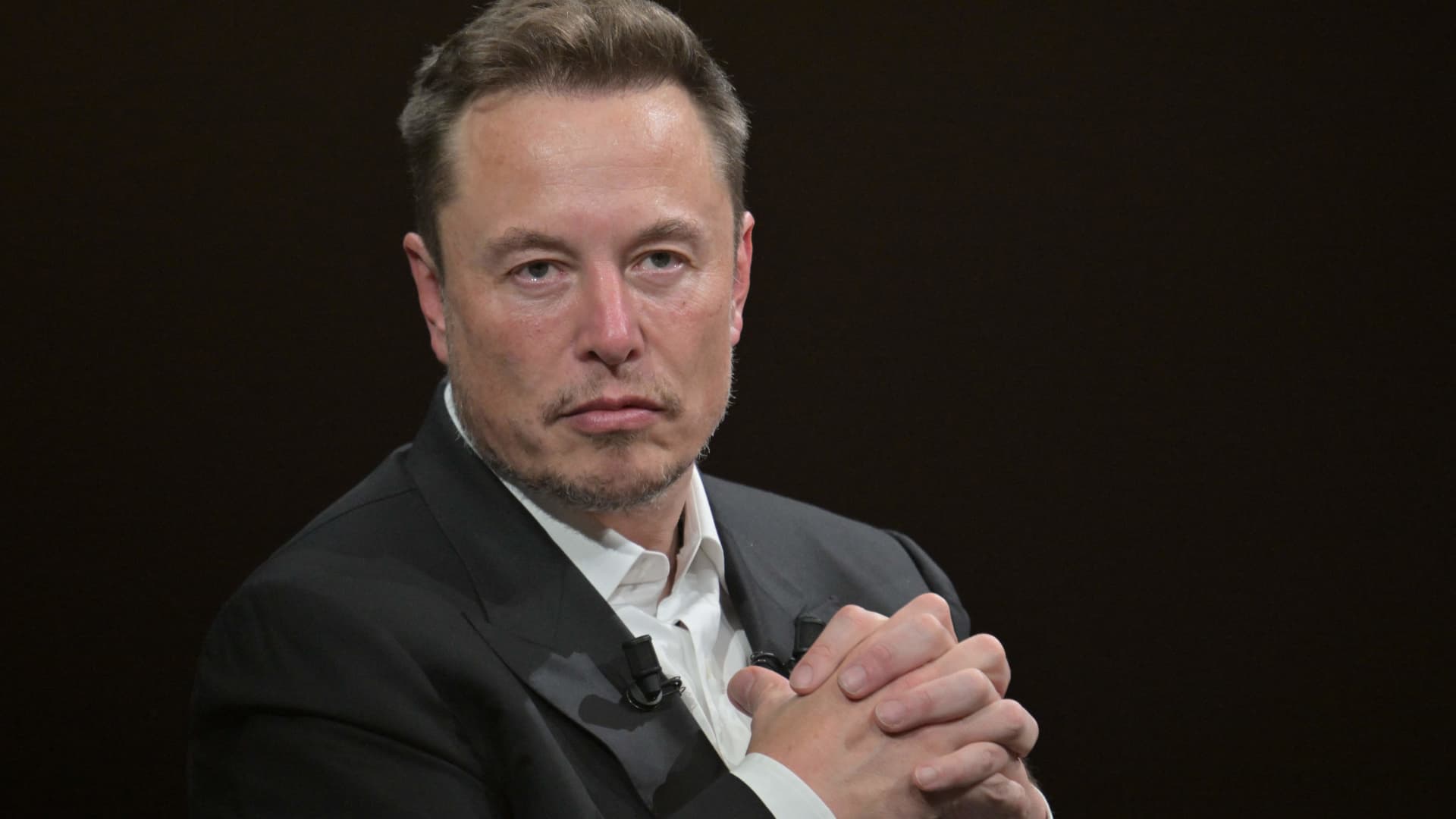
SpaceX, Twitter and electric car maker Tesla CEO Elon Musk looks on as he speaks during his visit at the Vivatech technology startups and innovation fair at the Porte de Versailles exhibition center in Paris, on June 16, 2023. (Photo by Alain JOCARD / AFP) (Photo by ALAIN JOCARD/AFP via Getty Images)
Alain Jocard | Afp | Getty Images
Tesla and SpaceX CEO Elon Musk, who is also CTO and executive chairman of Twitter, said early Saturday morning that cash flow remains negative at the social media company because of a nearly 50% drop in advertising revenue coupled with “heavy debt.”
“Need to reach positive cash flow before we have the luxury of anything else,” Musk wrote in response to a tweet.
Musk took over Twitter in October of last year in a deal valued at around $44 billion, including about $13 billion in debt. He sold billions of dollars worth of his Tesla shares in part to finance that deal.
By January, hundreds of advertisers had reduced or halted their ad spending on Twitter in response to Musk making steep staff cuts at the company, and implementing changes to the platform, especially restoring previously banned accounts and changing its approach to content moderation.
In April, Musk told a BBC reporter that “almost all” advertisers had resumed buying ads on Twitter. He also claimed at that time that the company was “roughly breakeven,” and expected to become cash flow positive within the next quarter.
His statement about Twitter’s cash flow problems today comes a little over one month since Linda Yaccarino, who previously ran global advertising for Comcast’s NBCUniversal, took on the role of Twitter CEO. NBCUniversal is the parent company of CNBC.
Yaccarino’s appointment inspired hope among media industry insiders that Twitter would address immediate challenges to its ad business.
In recent days, Twitter began doling out a share of its ad revenue to select content creators on its platform. Musk’s remarks were made in response to followers who wanted to know why that revenue-sharing program was so limited in scope.
A number of widely followed accounts on Twitter posted that they were dismayed they did not qualify to earn income from the program yet. As The Verge previously reported, the revenue-sharing program was available only to users who paid for a Twitter Blue verified subscription, and amounts paid were “driven by ads placed in the replies to tweets.”
Influencer Andrew Tate — who espouses misogynistic views online, and faces a trial on charges of rape, human trafficking and forming a criminal gang to sexually exploit women in Romania — posted that Twitter paid him more than $20,000. Tate has sued the accusers who made those charges.
Several right-wing influencers also posted about receiving Twitter payments, along with fans and promoters of Tesla stock and products, including Omar Qazi (who uses the handle “@WholeMarsBlog” on Twitter) and Sawyer Merritt, who each posted about netting more than $5,000.
Mainstream influencers who shared details about their Twitter income included Brian and Ed Krassenstein, Mr. Beast and the account @interneth0f (which stands for Internet Hall of Fame). The Internet Hall of Fame posts screenshots of other people’s popular posts from social media and re-circulates them.
It’s not clear how much Twitter paid creators in total in this first round of payments. Twitter sent an automated reply with a crude symbol in response to CNBC’s request for comment on Saturday. The parent company of Twitter, X Corp., is facing myriad lawsuits from former employees and vendors over non-payment of bills and severance.


Waymo partners with Uber to bring robotaxi service to Atlanta and Austin.
Uber Technologies Inc.
Waymo on Wednesday said humans will begin test driving the Alphabet-owned company’s robotaxi vehicles in Baltimore, Pittsburgh and St. Louis.
The three cities represent the latest additions to Waymo’s quickly growing list of cities where the Google sister company is either operating its robotaxis, planning to launch service or starting to test its vehicles. That list now stands at 26 markets.
Waymo will begin manual drives in the trio of new cities this week with hopes to eventually begin serving fully-autonomous rides there, spokesperson Ethan Teicher told CNBC.
Over the past month, Waymo has been aggressively making announcements for new markets and developments at the Google sister company. This comes as tech rivals Amazon and Tesla made advancements in the robotaxi market in 2025. Amazon’s Zoox began offering free rides in Las Vegas and San Francisco, and Tesla this year launched ride-hailing service with human supervisors in the Austin and San Francisco markets.
In November, Waymo announced that it will soon begin manually driving in Minneapolis, Tampa and New Orleans. The company also added Houston, San Antonio and Orlando to its list of cities where it’ll launch service in 2026. Waymo also began offering rides on freeways in the San Francisco, Los Angeles and Phoenix markets, and it named a new finance chief.
With more than 250,000 weekly paid trips, Waymo’s robotaxi service currently operates in Austin, the San Francisco Bay Area, Phoenix, Atlanta and Los Angeles markets. The company in May said it had provided more than 10 million paid rides since launching in 2020.
The new cities further signal that Waymo is increasingly confident its service can work well in locations with colder weather conditions.
Technology
Security startup Verkada hits $5.8 billion valuation in latest funding round led by CapitalG


Filip Kaliszan, CEO of Verkada.
Courtesy: Verkada
Security technology startup Verkada has reached a $5.8 billion valuation after a new funding round led by CapitalG, Alphabet’s venture capital arm, announced Wednesday.
“I think Google saw the opportunity with us in the application of AI and everything we’re driving to apply AI to the physical security industry,” CEO Filip Kaliszan told CNBC’s Deirdre Bosa.
The company said in a release that the investment will be used to bolster its artificial intelligence capabilities and provide liquidity.
The financing totaled $100 million, a person familiar with the terms of the round told CNBC, raising the company’s valuation by $1.3 billion from its Series E funding in February. The person asked not to be named in order to discuss details of the funding.
CapitalG also recently contributed to a $435 million fundraise for cybersecurity startup Armis in November.
The new funding comes as Verkada surpasses $1 billion in annualized bookings across 30,000 customers globally.
The company develops physical security products, including cameras, alarms and sensors, that are connected under a single cloud-based software platform.
Kaliszan said his company serves a broad span of businesses, such as retailers, government properties, schools, and transportation.
For example, TeraWatt Infrastructure, which supplies charging sites to electric vehicles like Google’s Waymo, uses Verkada technology to protect EV facilities.
In September, the company rolled out over 60 new AI features and platform updates, including tools like “AI-Powered Unified Timeline.”
The tool can automatically synthesize videos and images from several cameras into a single visual timeline, rather than requiring security teams to dig through multiple videos during an investigation.
“The genius of Filip and the team of Verkada is that they’re leveraging AI as a Rosetta Stone to really help unlock insights from cameras to help companies become safer and more efficient,” CapitalG general partner Derek Zanutto told Bosa.
By capturing over 20 million images per hour, Verkada can provide notable data like foot traffic, occupancy rates, security violations and other trends, Zanutto said.
He added that the physical security is a sleeping $60 billion market that is led by legacy hardware like “cameras that just record, not cameras that think” — a gap that Verkada is hoping to fill.
However, AI-powered technology will not necessarily replace human security guards any time soon.
“I think humans will be providing security to other humans for as long as I can think,” Kaliszan said. “But AI can empower these first responders to be more aware, to have situational knowledge, to know what to do, and in some cases, actually prevent the problems from happening.”
He pointed to the Louvre heist in October, where multiple crown jewels were robbed from the museum, as an opportunity where AI-assisted devices that could actively monitor, then immediately alert security forces, would be more effective than only physical personnel.
“If you could intervene right then, if you could know in real time that that’s happening, the potential for savings and preventing damage is tremendous,” he said.
Technology
Macy’s earnings, OpenAI under pressure, Boeing’s delivery outlook and more in Morning Squawk


Exterior view of Macy’s herald square store in New York City, on November 28, 2025.
Kena Betancur | Afp | Getty Images
This is CNBC’s Morning Squawk newsletter. Subscribe here to receive future editions in your inbox.
Here are five key things investors need to know to start the trading day:
1. Shopping around
Macy’s beat Wall Street’s top- and bottom-line expectations for the third quarter this morning, posting its strongest growth in more than three years. The department store operator’s results are only one of several recent data points investors have received on the state of the U.S. consumer.
Here’s what to know:
- Despite the strong results, shares of Macy’s dropped more than 6% before the bell. The retailer displayed caution about the current quarter, citing consumer spending concerns and pressure from tariffs.
- Meanwhile, American Eagle Outfitters shares surged 12% after the apparel company posted better-than-expected earnings and provided upbeat guidance for fourth-quarter comparable sales.
- American Eagle said its ad campaigns with actress Sydney Sweeney and NFL star Travis Kelce are “attracting more customers,” though they’ve not yet been a major revenue driver.
- Sweeney is just one of several celebrities who has starred in a denim ad for a clothing brand. As CNBC’s Gabrielle Fonrouge and Natalie Rice report, companies are pulling out all the stops in hopes of winning the so-called “denim war.”
- Plus, the numbers are in: More than 202 million Americans shopped in the five-day period from Thanksgiving through Cyber Monday, the highest number on record since the National Retail Federation began tracking in 2017.
- Follow live markets updates here.
2. Hiring or firing?
A ‘Now Hiring’ sign sits in the window of a Denny’s restaurant on Nov. 19, 2025 in Miami, Florida.
Joe Raedle | Getty Images
President Donald Trump has said his tariffs will bring production jobs back to the U.S. But as CNBC’s Jeff Cox reports, corporate executives and economic forecasters are concerned the opposite could happen.
Respondents to an Institute for Supply Management survey said the duties are pushing them to start reducing headcount and offering severance packages. “Conditions are more trying than during the coronavirus pandemic in terms of supply chain uncertainty,” one respondent said. A Federal Reserve report from last week also showed employment “declined slightly” over the past several weeks.
We’ll be keeping a close eye on the ADP private payrolls report due out this morning. Economists polled by Dow Jones are expecting growth of 40,000 jobs in November.
3. Under pressure
OpenAI CEO Sam Altman speaks to media following a Q&A at the OpenAI data center in Abilene, Texas, U.S., Sept. 23, 2025.
Shelby Tauber | Reuters
OpenAI is feeling the heat as rivals Alphabet and Anthropic gain ground in the artificial intelligence race. Earlier this week, CEO Sam Altman reportedly sent a staff memo laying out a “code red” effort to improve its ChatGPT bot.
It comes amid growing fanfare for Alphabet’s Gemini 3 model, which beat industry benchmarks. Anthropic, meanwhile, is reportedly readying for one of the largest IPOs ever.
As CNBC’s Pia Singh reports, Wall Street now sees Alphabet’s Google as the AI leader. Shares of Alphabet and its chip partner Broadcom have surged in recent weeks, while Nvidia and Microsoft — both business partners of OpenAI — pulled back.
4. Wires crossed
The Sinclair Broadcast Group, Inc. headquarters are seen July 17, 2024 in Cockeysville, Maryland.
Kevin Dietsch | Getty Images
Broadcast station owners are running toward industry consolidation, but they’re hitting roadblocks.
Nexstar is attempting to buy Tegna, while Sinclair made a hostile bid last week to acquire E.W. Scripps. These companies, like their larger media counterparts, have been trying to find ways to bolster their businesses as profitability tied to the traditional cable bundle shrinks.
But as CNBC’s Lillian Rizzo and Alex Sherman report, Sinclair’s attempt to scale up has been marred by family ownership challenges. Meanwhile, the Nexstar-Tegna deal requires changes to decades-old regulatory rules.
5. Taking off
Boeing Co. 737 Max fuselages at the company’s manufacturing facility in Renton, Washington, on April 15, 2025.
Bloomberg | Bloomberg | Getty Images
Boeing investors needed their seatbelts for yesterday’s ride.
Shares soared more than 10% — their best day since April — after CFO Jay Malave said the plane maker expects higher deliveries of its 737 and 787 jets in 2026. He also said the delayed certification for the 737-10 model could come later next year.
Malave notably said the higher deliveries will be “a big driver” for cash flow. As CNBC’s Laya Neelakandan notes, the Virginia-based company hasn’t posted an annual profit since 2018.
The Daily Dividend
Correction: Nexstar is attempting to buy Tegna. An earlier version of this story misspelled the latter company’s name.
— CNBC’s Gabrielle Fonrouge, Natalie Rice, Jeff Cox, Ashley Capoot, Dylan Butts, Pia Singh, Alex Sherman, Lillian Rizzo, Laya Neelakandan and Hayley Cuccinello contributed to this report. Josephine Rozzelle edited this edition.
-
 Sports2 years ago
Story injured on diving stop, exits Red Sox game
-
 Sports3 years ago
‘Storybook stuff’: Inside the night Bryce Harper sent the Phillies to the World Series
-
 Sports2 years ago
Game 1 of WS least-watched in recorded history
-
 Sports3 years ago
Button battles heat exhaustion in NASCAR debut
-
 Sports3 years ago
MLB Rank 2023: Ranking baseball’s top 100 players
-
Sports4 years ago
Team Europe easily wins 4th straight Laver Cup
-
 Environment3 years ago
Japan and South Korea have a lot at stake in a free and open South China Sea
-
 Environment1 year ago
Here are the best electric bikes you can buy at every price level in October 2024