
Politics
Watchdog criticises ‘unprecedented’ government offer to delay local elections – as five councils confirm requests for postponement

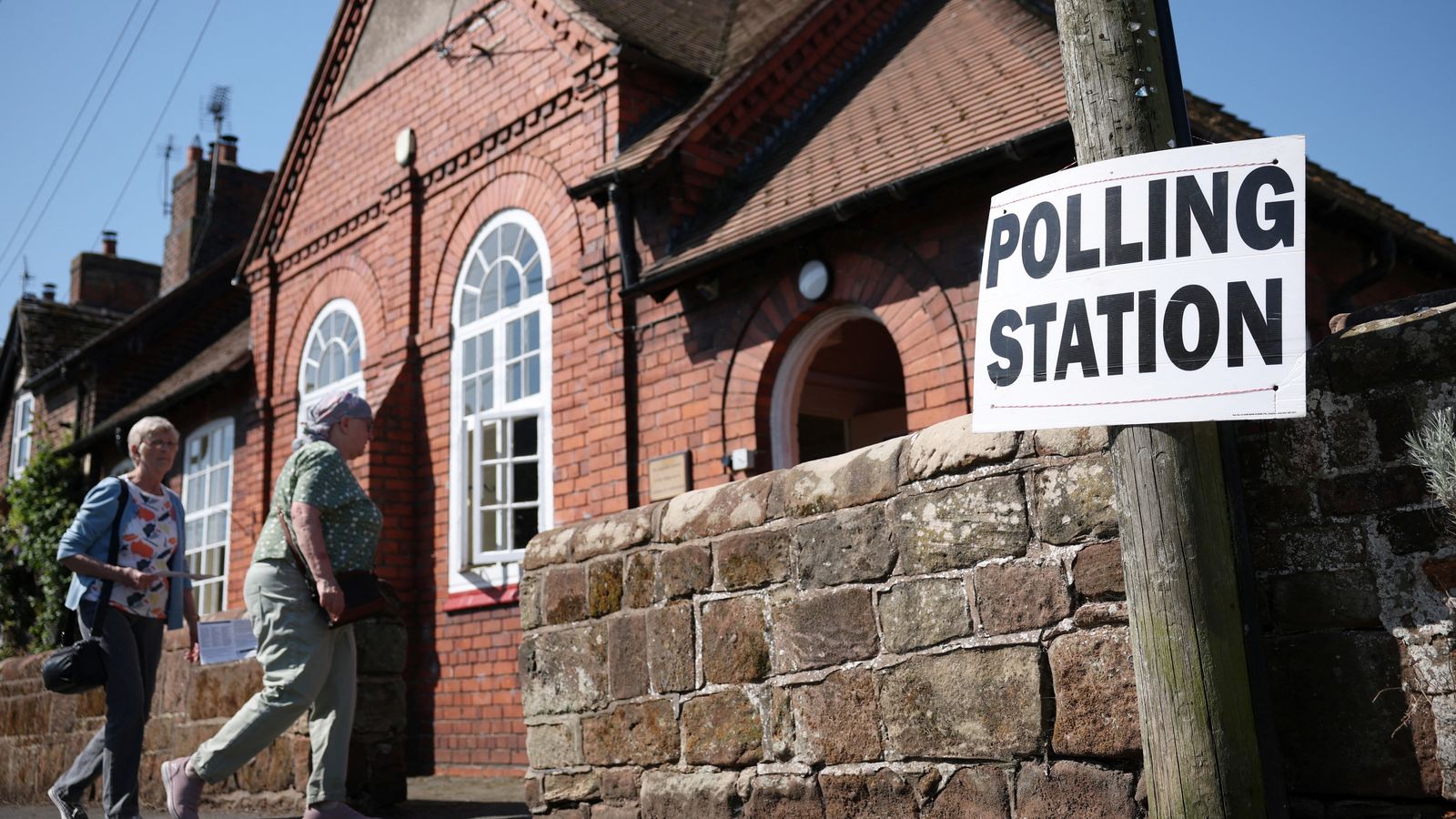

The elections watchdog has criticised the government for offering to consider delaying 63 local council elections next year – as five authorities confirmed to Sky News that they would ask for a postponement.
On Thursday, hours before parliament began its Christmas recess, the government revealed that councils were being sent a letter asking if they thought elections should be delayed in their areas due to challenges around delivering local government reorganisation plans.
The chief executive of the Electoral Commission, Vijay Rangarajan, hit out at the announcement on Friday, saying he was “concerned” that some elections could be postponed, with some having already been deferred from 2025.
“We are disappointed by both the timing and substance of the statement. Scheduled elections should, as a rule, go ahead as planned, and only be postponed in exceptional circumstances,” he said in a statement.
“Decisions on any postponements will not be taken until mid-January, less than three months before the scheduled May 2026 elections are due to begin.
“This uncertainty is unprecedented and will not help campaigners and administrators who need time to prepare for their important roles.”
Mr Rangarajan added: “We very much recognise the pressures on local government, but these late changes do not help administrators. Parties and candidates have already been preparing for some time, and will be understandably concerned.”
He said “capacity constraints” were not a “legitimate reason for delaying long planned elections”, which risked “affecting the legitimacy of local decision-making and damaging public confidence”.
The watchdog chief also said there was “a clear conflict of interest in asking existing councils to decide how long it will be before they are answerable to voters”.
Sky News contacted the 63 councils that have been sent the letter about potentially delaying their elections.
At the time of publication, 17 authorities had replied with their decisions, while 33 said they would make up their minds before the government’s deadline of 15 January.
Many councils told Sky News they were surprised at yesterday’s announcement, saying that they had been fully intending to hold their polls as scheduled.
They said they were now working to understand the appropriate democratic mechanism for deciding whether to request a postponement of elections. Some local authorities believe it should be a decision made by their full council, while others will leave it up to council leaders or cabinet members to decide.
Multiple councils also emphasised in statements to Sky News that the ultimate decision to delay elections lay with the government.
Reform UK has threatened legal action against ministers, accusing Labour and the Tories of “colluding” to postpone elections in order to lock other parties out of power – a sentiment echoed by Liberal Democrat leader Sir Ed Davey.
But shadow local government secretary Sir James Cleverly told Sky News this morning that the Conservative Party “wants these elections to go ahead”. Sky News understands that the national party is making that position clear to local leaders.
A spokesperson for the Ministry of Housing, Communities, and Local Government, said it was taking a “locally-led approach”, and emphasised that “councils are in the best position to judge the impact of postponements on their area”.
They added: “These are exceptional circumstances where councils have told us they’re struggling to prepare for resource-intensive elections to councils that will shortly be abolished, while also reorganising into more efficient authorities that can better serve local residents.
“There is a clear precedent for postponing local elections where local government reorganisation is in progress, as happened in 2019 and 2022.”
The five councils that confirmed they would be seeking postponements were:
- Blackburn with Darwen Council (Labour);
- Chorley Borough Council (Labour);
- East Sussex County Council (Conservative minority);
- Hastings Borough Council (Green minority);
- West Sussex County Council (Conservative).
The councils in Chorley, and East and West Sussex, had decided prior to Thursday’s government announcement that they would request a delay.
An East Sussex County Council spokesperson told Sky News: “It is welcome that the government is listening to local leaders and has heard the case for focussing our resources on delivery in East Sussex, particularly with devolution and reorganisation of local government, as well as delivering services to residents, such high priorities.”
They also pointed to the cost of electing councillors for a term of just one year, and argued that it would be “more prudent for just one set of elections to be held in 2027”.
Read more from Sky News:
David Walliams dropped by publisher
Woman jailed for plotting to murder husband
Christmas number one revealed
West Sussex County Council echoed those reasons and said it would cost taxpayers across the county £9m to hold elections in 2026, 2027, and 2028, as currently planned.
Chorley and Blackburn councils also cited the cost of delivering elections, and said they would prefer that money be spent on delivering the local government reorganisation and delivering services to local residents.
Meanwhile, 12 councils confirmed to Sky News that they would not be requesting delays:
- Basingstoke and Deane Borough Council (Liberal Democrat-Independents);
- Broxbourne Borough Council (Conservative);
- Colchester City Council (Labour-Liberal Democrat);
- Eastleigh Borough Council (Liberal Democrat);
- Essex County Council (Conservative);
- Hart District Council (Liberal Democrat-Community Campaign);
- Hastings Borough Council (Green minority);
- Isle of Wight Council (no overall control);
- Newcastle-under-Lyme Borough Council (Conservative);
- Portsmouth City Council (Liberal Democrat minority);
- Rushmoor Borough Council (Labour minority);
- Southampton City Council (Labour).


Toyota’s latest move in its work to harm the environment involves an internal platform where it uses video games to spread propaganda among its North American employees, enticing them with prizes to join lobbying efforts to loosen environmental rules around the automotive industry.
We’ve covered Toyota’s anti-environment lobbying efforts many times before.
For an inexhaustive list of how Toyota lobbies to harm the environment, the company:
Now, an excellent report by the Guardian details how Toyota uses internal communications to encourage its employees to join its propaganda efforts, with anti-EV and anti-environment propaganda in the form of video games where employees can earn points and prizes.
Toyota calls the platform “Toyota Policy Drivers,” and it’s available to some 10,000 employees across North America. The games were created by LGND, a software firm that has also made projects for defense contractors Aurex and Bechtel.
It consists of several videos telling Toyota’s side of the story – like Toyota’s insistence that hybrids pollute less than EVs, which is incorrect – and links to participate by reaching out to public representatives.
But that’s just normal corporate propaganda stuff. What’s different about Toyota’s platform is the gamification of the process, encouraging employees to earn points and play video games while digesting this propaganda.
Video games used as anti-environment propaganda
Games include Monster Mansion, Adventure Quest, Star Quest, and Dragon Quest (no, not the long-running and popular RPG – we wonder if trademark authorities might be interested in that one).


Toyota cycles games in and out each year, but each has a similar goal of showing propaganda videos in exchange for points. The videos were publicly visible until this morning. After the Guardian published its article, Toyota password protected them.
Playing the “games” can earn you points, which can be redeemed for stickers and t-shirts, or even trips. One employee says he earned cupcakes and a trip to Washington, DC.
Adam Zuckerman of Public Citizen had harsh words for the program, which he called “dystopian” and said “treats employees like children.” Specifically referring to Stephen Ciccone, Toyota’s VP of public affairs for North America, Zuckerman said:
It’s fitting that Ciccone calls himself a wartime consigliere because he has gone to war against the standards that protect our communities and the air that we breathe. Like the mafiosos that he fashions himself after, he is pressuring his own workers into doing his bidding against the common good. Ciccone should quit cosplaying mafia, end his dystopian game of poisoning our air, and stop blocking the green vehicles of the future.
Toyota’s actions and its public image diverge
Toyota’s propaganda contradicts its long-held public image. For decades now, Toyota has been considered by the public as one of the more environmentally-friendly automakers, first starting with its small cars in the 70s and later due to the Prius, the vehicle that is known for popularizing the conventional gas hybrid powertrain. In the early 2000s, the Prius was among the most efficient vehicles available.
However, the Prius is no longer particularly efficient comparatively. Just about any electric car is significantly more efficient than a Prius – even the ridiculous Hummer EV roughly matches the Prius in energy efficiency at 53mpge vs. 57mpg. Also, conventional hybrids get 100% of their energy from fossil fuels, and are thus inherently incompatible with climate solutions.
Despite Toyota’s false claims that gas-powered hybrids are the answer to reducing emissions, its own numbers show that its emissions have steadily increased over the years. And its average US fleet mpg is consistently middling-to-poor, according to the EPA’s automotive trends report.
When Toyota owners are educated about Toyota’s opposition to environmental policy, it results in a 32% reduction in favorability for the brand. A large majority of Toyota owners want the company to support stronger environmental policy.
Similarly, a recent appearance of Toyota’s chairman, Akio Toyoda, decked out in US campaign gear supporting Donald Trump helped many in the public to recognize Toyota’s friendliness with anti-environment actors. As former CEO, Toyoda was largely responsible for the company’s current failure to adopt electric vehicles.
But Toyota has dug in its feet in defending hybrid vehicles, which it considers its own territory, whereas electric vehicles are the territory of other brands. So it twists itself into knots trying to defend more-polluting vehicles, despite the harm that they cause to everyone who lives on Earth – yes, including Toyota employees, who breathe the same air and live in the same disrupted climate as the rest of us.
Toyota laughably claims this corporate-led effort is “grassroots”
While Toyota says that employees don’t have to participate, the combination of incentives and implicit pressure from higher-ups means that employees who would not have otherwise lobbied against the public interest would then be encouraged to do so.
It calls the effort “grassroots advocacy,” even though it is being coordinated and pushed upon employees of a one of the largest corporate entities on the planet (that’s not what “grassroots” means…). It also allows employees to participate during working hours, indicating that it sees these videogames as a work activity, rather than natural grassroots advocacy.
Indeed, the company brags about what it sees as the success of the program, taking credit for various harmful policy changes, like republicans’ illegal attempt to force dirty air on 12 US states. Toyota also used the platform to oppose EPA exhaust rules that would save Americans $100 billion in fuel costs, wrongly calling it an “EV mandate,” despite that the Biden rule is actually technology neutral (which Toyota claims to support, even though it opposed a technology neutral measure in practice).
Perhaps now, with the knowledge of yet another way that Toyota spreads anti-environment propaganda, some of the environmental sheen of this company can start to tarnish in the public eye.
The 30% federal solar tax credit is ending this year. If you’ve ever considered going solar, now’s the time to act. To make sure you find a trusted, reliable solar installer near you that offers competitive pricing, check out EnergySage, a free service that makes it easy for you to go solar. It has hundreds of pre-vetted solar installers competing for your business, ensuring you get high-quality solutions and save 20-30% compared to going it alone. Plus, it’s free to use, and you won’t get sales calls until you select an installer and share your phone number with them.
Your personalized solar quotes are easy to compare online and you’ll get access to unbiased Energy Advisors to help you every step of the way. Get started here.


FTC: We use income earning auto affiliate links. More.

In the Electrek Podcast, we discuss the most popular news in the world of sustainable transport and energy. In this week’s episode, we discuss Seth and me (Fred) each buying a new EV, Tesla Robotaxi progress, Ford’s $19 billion charge on EVs, and much more.
The show is live every Friday at 4 p.m. ET on Electrek’s YouTube channel.
As a reminder, we’ll have an accompanying post, like this one, on the site with an embedded link to the live stream. Head to the YouTube channel to get your questions and comments in.
After the show ends at around 5 p.m. ET, the video will be archived on YouTube and the audio on all your favorite podcast apps:
We now have a Patreon if you want to help us avoid more ads and invest more in our content. We have some awesome gifts for our Patreons and more coming.
Here are a few of the articles that we will discuss during the podcast:
Here’s the live stream for today’s episode starting at 4:00 p.m. ET (or the video after 5 p.m. ET:
FTC: We use income earning auto affiliate links. More.
-
 Sports2 years ago
Story injured on diving stop, exits Red Sox game
-
 Sports3 years ago
‘Storybook stuff’: Inside the night Bryce Harper sent the Phillies to the World Series
-
 Sports2 years ago
Game 1 of WS least-watched in recorded history
-
 Sports3 years ago
Button battles heat exhaustion in NASCAR debut
-
 Sports3 years ago
MLB Rank 2023: Ranking baseball’s top 100 players
-
Sports4 years ago
Team Europe easily wins 4th straight Laver Cup
-
 Environment3 years ago
Japan and South Korea have a lot at stake in a free and open South China Sea
-
 Environment1 year ago
Here are the best electric bikes you can buy at every price level in October 2024