Connect with us

Published

on

The Bank of England is expected to increase its interest rate for the 14th time in a row today.

Economists believe a 0.25 percentage point rise – to 5.25% – is the most likely increase to be announced at midday.

However, the Bank’s Monetary Policy Committee (MPC) defied expectations last time when they hiked the rate by a bigger than expected 0.5 percentage points in June. There are some who think that could happen again.

Governor Andrew Bailey has said that increases will help bring down high inflation in the UK to the Bank’s target of 2% – although some critics are not convinced it is the right strategy.

Rising interest rates mean bigger borrowing costs – including larger monthly mortgage payments for many homeowners, which can have a knock-on effect of higher rents for tenants.

But, in theory, they should also result in much better rates for savers. However, concerns have been raised that many banks are not fully passing on such benefits to customers.

The Bank of England’s “shock” hike in the interest rate in June came after inflation did not fall as predicted, and instead remained at 8.7% in the year up to May.

However, inflation then dropped by more than expected to 7.9% the following month.

The last time the bank base rate stood at 5.25% was 15 years ago in March 2008.

The MPC’s announcement will be closely watched for its impact on the housing market – and the wider economy, amid fears that rising rates could help push the UK into recession.

The Nationwide Building Society said earlier this week that property values declined by 3.8% in July, the biggest drop in 14 years. It blamed dampened demand on stretched affordability for mortgages.

Read more:
Analysis: The squeeze on renters is a symptom of Britain’s housing crisis
Uber records first ever operating profit
Gatwick Airport strikes called off as workers accept pay rise

According to figures from Moneyfacts, the average two-year fixed residential mortgage rate was 6.85% on Monday and Tuesday.

Over the same period, the average five-year fixed residential mortgage rate was 6.37%, the financial information company said.

A survey of economists found they believe there is a 64% probability of the interest rate being increased by 0.25 percentage points on Thursday, and a 36% chance of a 0.50 percentage points rise.

But Joseph Calnan, from payments provider Moneycorp, said it was “anyone’s guess” what the MPC would do.

He said: “For the first time in a long time, we’re unsure what to expect at this next meeting. We could see a 50 bps [basis points] hike, a 25 bps hike, or even no change at all given [inflation] finally eased off in June after a stubborn 11 months.”

Continue Reading

Business

Strawberry fields forever? The West Sussex farm growing berries in December

Published

on

By

Strawberry fields forever? The West Sussex farm growing berries in December

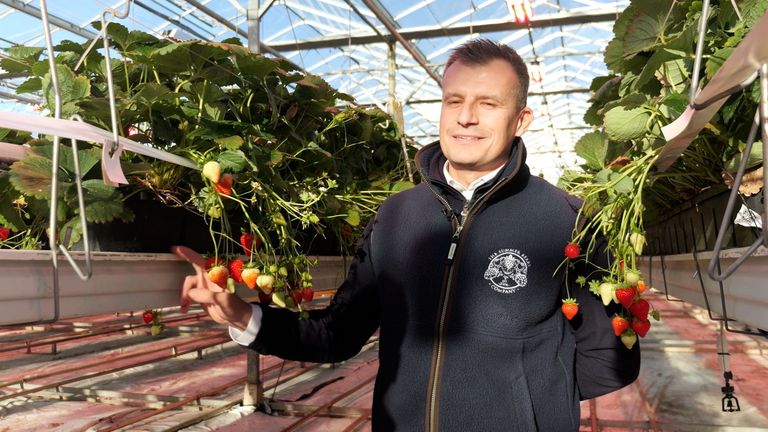
Acres of sweet, red strawberries are ripening in West Sussex this winter ready to be sold in UK supermarkets.

LED lighting in vast glasshouses is enabling berries to be grown all year on a commercial scale for the first time ever.

It means less reliance on fruit flown in from countries like Egypt.

Bartosz Pinkosz
Image:
Bartosz Pinkosz

“The LED lighting is the prime reason for successful growing,” said Bartosz Pinkosz, operations director of The Summer Berry.

“If it was not a sunny day, the LED lighting would create enough energy for leaves to absorb that energy, take it in and deliver the energy to the berries.

“We are able to have the right sweetness in the berries and the right shape, right size.”

There are 36,000 square metres of the greenhouses at the site in Chichester, partially powered by renewable energy and buzzing with bees as pollinators.

Acres of strawberries ripening in West Sussex
Image:
Acres of strawberries ripening in West Sussex

And the new strand to the business means year-round work for 50 people.

But while it might cut the food miles dramatically, there’s still an inevitable environmental impact when a colossal space is created warm enough for pickers to wear short sleeves in winter.

Dr Tara Garnett, director of food systems platform TABLE, said: “You’re going to need a lot of heat and you’re going to need a lot of light in order to reproduce those summer growing conditions so everything hinges on the energy source you’re going to be using.

“And when we look at the UK self sufficiency levels in fruit and vegetables they are appalling – 16% of the fruit we consume is UK-grown, so the vast majority is imported, and when it comes to vegetables we’re looking more at 50% or so, so there’s a lot more we can do to build up, and should be doing.”

Around 1.5 million punnets of strawberries are expected to be picked on the site over the full stretch of winter, allowing British strawberries to be eaten this Christmas.

But for some, it’s simple – strawberries should be saved for summer, even if it is a much shorter journey from plant to plate.
Continue Reading

Business

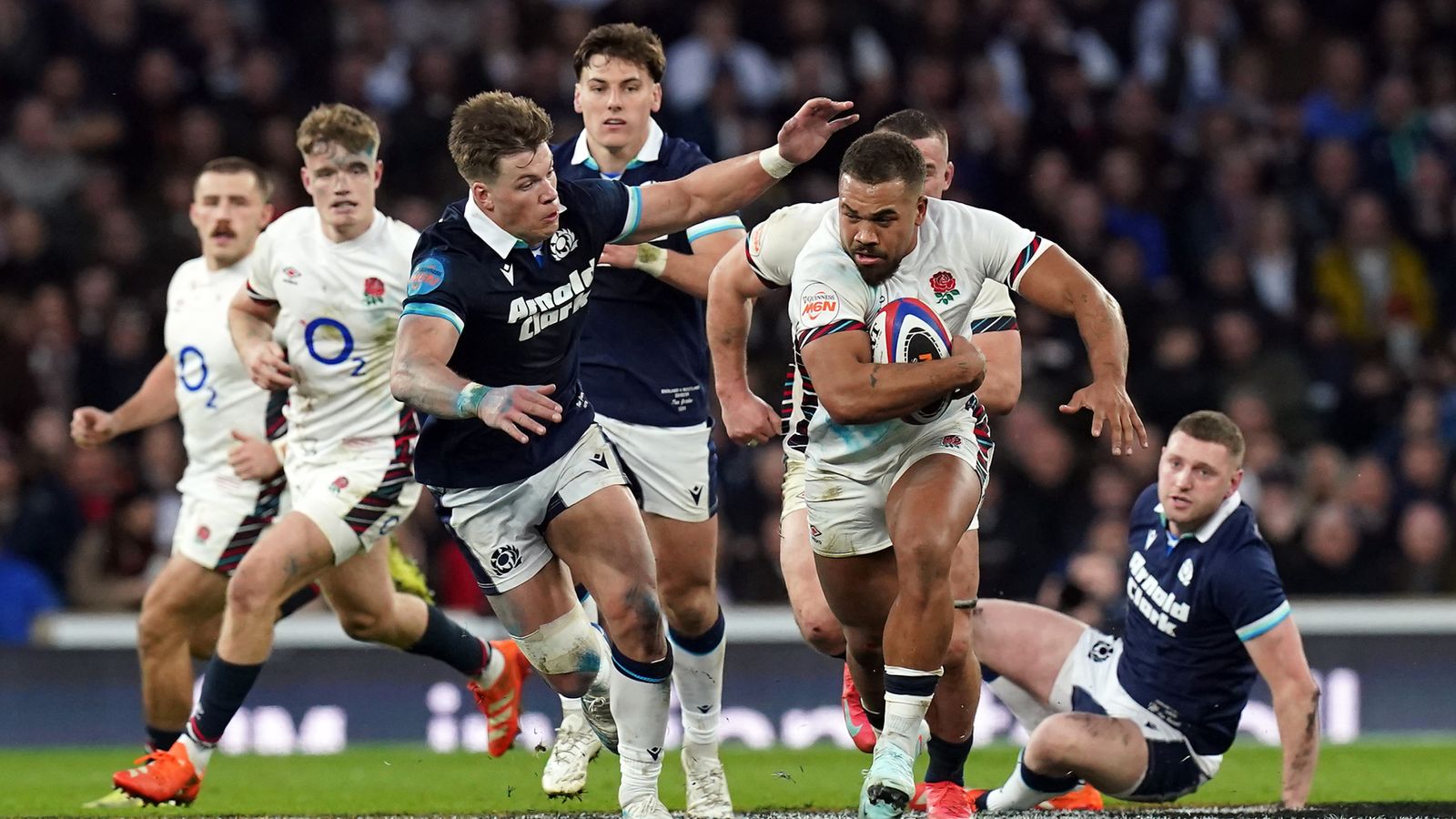
Blackrock arm in talks to back Six Nations Rugby investor

Published

on

By

Blackrock arm in talks to back Six Nations Rugby investor

A division of Blackrock, the world’s biggest asset manager, is in talks to provide hundreds of millions of pounds of funding to a company which owns stakes in Six Nations Rugby and the women’s professional tennis tour.

Sky News has learnt that HPS, the global private credit giant, is among the parties negotiating with CVC Capital Partners over the financing of its Global Sports Group (GSG) holding company.

The talks, which are not exclusive, would see HPS help provide firepower for the CVC-backed vehicle to make further acquisitions to expand its portfolio.

Chaired by Marc Allera, the former BT Group consumer boss, GSG holds stakes in Premiership Rugby, the top flights of French and Spanish football and the international volleyball tour.

In recent weeks, Mr Allera has outlined his ambitions to acquire further global sports properties.

HPS, which was acquired by Blackrock for $12bn late last year, is said to be serious about becoming involved in GSG.

Other parties with whom CVC is in discussions include Ares Management, which is interested in providing both debt and equity to GSG, according to insiders.

More from Money

Any new financing package was expected to be secured on favourable terms for the CVC-controlled group because of the underlying credit quality of the assets in the portfolio.

Sky News revealed during the summer that CVC had engaged a trio of banks to explore plans for a refinancing of what was at the time referred to internally as SportsCo and which has since been renamed Global Sport Group.

The portfolio also includes an Indian Premier League cricket franchise, several of which are currently exploring sales at valuations of well over $1bn.

Goldman Sachs, PJT Partners and Raine Group are advising on the refinancing of GSG, which has been set up to optimise CVC’s investments in the sector.

The deal is expected to allow CVC to remain invested in its sports portfolio for longer, while also paving the way for the sale of a minority stake in SportsCo or a future initial public offering.

Having made billions of dollars from its ownership of Formula One motor racing – one of the most lucrative deals in the history of sport – CVC has bought stakes in leagues and other assets spanning a spectrum of elite sporting assets over the last two decades.

Its investment in the media rights to La Liga – Spain’s equivalent of the Premier League – is expected to generate a handsome return for the firm, although a comparable deal in France has faced significant challenges amid broadcasters’ financial challenges in the country.

CVC’s backing of global sports properties is intended to position it to maximise their commercial potential through new media and sponsorship rights deals, as well as their expansion into new formats aimed at drawing wider audiences amid rapid shifts in media consumption.

In rugby union, its acquisition of a stake in Premiership Rugby’s commercial rights was hit by the pandemic and the subsequent financial pressures on clubs which saw a number of the league’s teams forced into insolvency.

CVC, which bought into Premiership Rugby in 2019, owns a 27% stake in the league.

Its sporting assets will continue to remain autonomous and independent of one another, despite the new umbrella holding entity.

One expected benefit of the SportsCo approach would be the sourcing of new investment opportunities, with CVC being linked to a bid for one of the new European NBA basketball franchises which is expected to be sold in the coming months.

Global sports properties have become one of the hottest growth areas for private capital in recent years, with firms such as Ares, Silver Lake Partners and Bridgepoint all investing substantial sums in teams, leagues and other assets across the industry.

CVC and Blackrock declined to comment.

Continue Reading

Business

Next plots swoop on family-owned shoe chain Russell & Bromley

Published

on

By

Next plots swoop on family-owned shoe chain Russell & Bromley

Next, the high street fashion giant, is plotting a swoop on Russell & Bromley, the 145 year-old shoe retailer.

Sky News has learnt that Next, which has a market capitalisation of £16.6bn, is among the parties in talks with Russell & Bromley’s advisers about a deal.

City sources said this weekend that a number of other suitors were also in the frame to make an investment in the chain, although their identities were unclear.

The talks come amid the peak Christmas trading period, with retail bosses hopeful that consumer confidence holds up over the coming weeks despite the stuttering economy.

Russell & Bromley confirmed several weeks ago that it had drafted in Interpath, the advisory firm, to explore options for raising new financing for the business.

The chain trades from 37 stores and employs more than 450 people.

It was formed in 1880 when the first Russell & Bromley store opened in Eastbourne.

More from Money

Seven years earlier, George Bromley and Elizabeth Russell, both of whom hailed from shoemaking families, were married, paving the way for the establishment of the business.

Russell & Bromley is now run by Andrew Bromley, the fifth generation of his family to hold the reins.

Billie Piper, the actress and singer, is the current face of the brand as it tries to appeal to younger consumers as part of a five-year turnaround plan.

If it materialised, an acquisition or investment by Next would mark the latest in a string of brand deals struck by Britain’s most successful London-listed fashion retailer.

In recent years, it has bought brands such as Cath Kidston, Joules and Seraphine, the maternitywear retailer for knockdown prices.

Next also owns Made.com, the online furniture retailer, and FatFace, the high street fashion brand.

Under Lord Wolfson, its veteran chief executive, Next has defied the wider high street gloom to become one of the UK’s best-run businesses.

Its Total Platform infrastructure solution has enabled it to plug in other retail brands in order to provide logistics, e-commerce and digital service capabilities.

Both Victoria’s Secret and Gap also have partnerships with Next using the Total Platform offering.

It was unclear whether any deal between Next and Russell & Bromley would involve acquiring the latter’s brand outright or making an investment into the business.

This weekend, Next declined to comment, while neither Russell & Bromley nor Interpath could be reached for comment.

In a statement in October, Mr Bromley said: “We are currently exploring opportunities to help take Russell & Bromley into the next phase of our ‘Re Boot’ vision.

“Since the announcement of the ‘Re Boot’ earlier this year we have made significant progress, positioning us well to build on our momentum and continue along our journey.

“We are looking forward to working with our advisory team to secure the necessary investment to accelerate our expansion plans.”

Continue Reading

Trending