
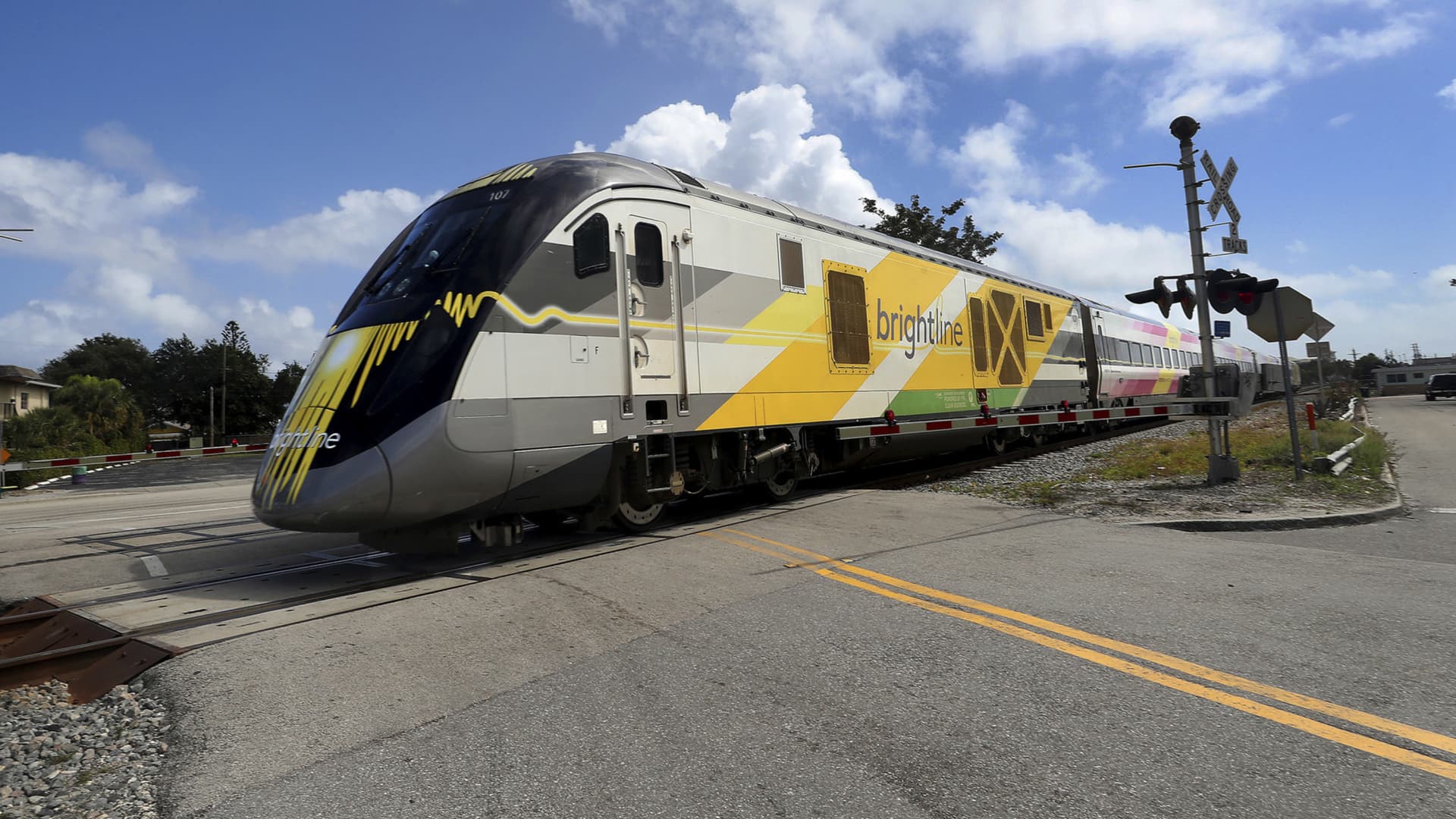
How Brightline is changing passenger rail in the U.S.


Josh Woodward, VP of Google Labs, addresses the crowd during Google’s annual I/O developers conference in Mountain View, California on May 20, 2025.
Camille Cohen | AFP | Getty Images
Josh Woodward may not be a household name in Silicon Valley. But inside Google, everybody knows about him.
The 42-year-old Oklahoma native, who started at Google by way of a product management internship in 2009, has spent the past eight months running the Gemini app, the centerpiece of the search giant’s artificial intelligence strategy.
Heading into 2026, Woodward’s work is more critical than ever as Google rushes to keep pace with its high-powered AI rivals, namely OpenAI, which kickstarted the generative AI boom with the launch of ChatGPT just over three years ago.
As industry experts forecast a shift in consumer behavior from traditional search to AI-powered apps, Google is fighting to make sure users stay within its ecosystem, whether it’s for chatbot services, images, videos or online shopping. Woodward is helping to spearhead that effort while also keeping his job as head of Google Labs, home to the company’s experimental AI projects.
Clay Bavor, former co-lead of Google Labs, said Woodward’s ability to move fast, break down barriers and execute “has landed him right at the center of the most important work at Google.”
CNBC spoke with more than a dozen people who have worked with Woodward about his evolving profile at Google, how he got there and the pressure he faces to help Google stay ahead of the competition without losing the trust of users. Several current and former colleagues, including some who asked not to be named because they weren’t authorized to speak to the press, emphasized how seriously Woodward takes the societal concerns that come with the power of AI, and about Google’s role in shaping the future.
In April, when Woodward was promoted to run the Gemini app, Google’s position in AI was tenuous. Alphabet shares plunged 18% in the first quarter, their worst performance for any period since 2022, and concerns were building that the company was losing its long-held position as the internet’s front door.
Demis Hassabis, co-founder of Google DeepMind and the person considered the top AI executive at Google, said in the memo announcing the move that Woodward would be focused on the “next evolution” of the app, according to a Semafor report.
A major turning point for Woodward’s group came in late August, with the launch of image generator Nano Banana, a Gemini feature that lets users blend multiple photos together to create personal digitized figurines.
Within days, Nano Banana had become so popular it was overloading the company’s infrastructure, forcing Google to place temporary limits on usage to ease the burden on its custom-designed chips called tensor processing units.
“Our TPUs almost melted,” said Amin Vahdat, Google’s head of AI infrastructure, at a November all-hands meeting, according to audio reviewed by CNBC.
By the end of September, the Gemini app surpassed 5 billion images and dethroned OpenAI’s ChatGPT at the top of Apple’s App Store. Nano Banana is now being rolled into other products like Google Lens and Circle to Search.
Like its top rivals, Alphabet is pouring money into AI infrastructure ahead of an expected surge of new business. The company said in its earnings report in October that capital expenditures for the full year would reach between $91 billion and $93 billion, up from a prior forecast of $85 billion.

Alphabet vs. Meta in 2025
Wall Street’s mood on the company has reversed dramatically.
Despite a brutal first quarter, Alphabet’s stock is up 62% this year, outperforming all of its megacap peers including Meta, which is up 13%.
Google said in October that the Gemini app’s monthly active users swelled to 650 million from 350 million in March. AI Overviews, which uses generative AI to summarize answers to queries, has 2 billion monthly users. OpenAI said in October that ChatGPT hit 800 million users per week.
Last month, Google introduced Gemini 3, its latest model, prompting excitement across much of the tech sector.
“I’ve never had more fun than right now,” Woodward told CNBC’s Deirdre Bosa in an interview soon after the release. “It’s partly the pace. It’s partly the abilities these models give to people who can imagine use cases and products.”
Bavor, who’s now co-founder of AI agent startup Sierra, said Woodward “was among the very earliest people in the company to see the potential in large language models for building products,” and lauded his ability to “get his mind fully around a new technology, to see around corners, to see how it might evolve and how it might be used.”
‘Change for good or bad’
Woodward now faces the challenge of not only leading two units within Google but also finding a balance between moving fast to compete with AI rivals OpenAI and Anthropic and not moving so fast that the search company’s AI products enable potential harm.
It’s a pressing issue as AI rapidly bleeds into daily life, more slop populates social media, and an onslaught of AI-generated content makes it difficult for average consumers to distinguish fact from fiction.
Woodward discussed the theme in a podcast with partners from venture firm Sequoia in March, shortly before taking over the Gemini app. AI-generated videos were rapidly getting more advanced, following the launch of OpenAI’s Sora in late 2024.
“When I’m thinking of video, for example, I’m on the side of wanting to amplify human creativity, but there are these moments that happen in our valley here where things change,” Woodward said. “And they change often for generations. And they can change for good or bad.”
The Nano Banana Pro, released in November, is so advanced that its creations blur the lines between images that are clearly AI generated and those that are real. The product has faced criticism for depicting white women surrounded by Black children in responding to a prompt about humanitarian aid in Africa.
The intensity of the job is hardly reflected in Woodward’s persona. Colleagues harp on his disarming, goofy laugh that often comes out mid-conversation and a friendliness stemming from his Midwestern upbringing.
Caesar Sengupta, who worked with Woodward on one of his earliest projects at Google, said, “I’ve never seen him get angry with anyone.” Sengupta, who’s now founder of AI finance platform Arta, added that he used to tease Woodward, suggesting he would be Google’s next CEO.
Clay Bavor, VP of Virtual Reality for Google, introduces the Daydream View VR headset during the presentation of new Google hardware in San Francisco, California, U.S. October 4, 2016.
Beck Diefenbach | Reuters
Woodward joined Google Labs in 2022. Bavor said Woodward was his first choice to help lead the effort.
One of the team’s first breakout products was known as Project Tailwind, an AI notebook that senior product manager Raiza Martin thought up in her 20% time, Google’s longstanding practice of letting employees dedicate one day a week to a project of personal interest.
Woodward helped shepherd the project through several iterations to what morphed into NotebookLM, a popular product that analyze articles, PDFs or videos a user uploads, and provides summaries or offers insights. Martin stayed on as a senior product manager until December 2024, when she left to co-found AI startup Huxe.
To help build NotebookLM, Woodward turned to an unsuspecting hire.
Steven Johnson had never had a full-time boss and had no connection to Google. Living in New York, he’d spent his career up to that point as an author, writing books about the history of science and technology.
Woodward was an admirer of his work.
“We hatched plans for him to join us as a visiting scholar,” Bavor said.
Johnson joined on a part-time basis in 2022. When he went full time in May 2023, Woodward put him to work immediately.
With Google’s annual I/O developer conference a week away, Woodward had the idea to demo an audio feature for what would become NotebookLM, viewing it as a way to test the evolving capabilities of Google’s AI models. The group worked overtime to get it done in time for Woodward’s presentation.
Leading up to the event, Martin wanted to collect user feedback on communication app Discord even though Google preferred that staffers use homegrown products for such efforts. Woodward intervened to make sure Martin could keep using Discord, employees told CNBC.
“In true Google fashion, everyone was like ‘What is Discord?'” Martin said in October 2024, on Lenny’s Podcast, hosted by tech investor and researcher Lenny Rachitsky. She recalled being asked by Google administration, “Why not use Google Meet, why not Google Groups, why not this and that, and I was like, ‘The server is the way to go.'”
Johnson, who spoke with CNBC on a video call, said Woodward’s approach was, “Let them cook.” The discord server now has more than 200,000 members, a company spokesperson told CNBC.
The screen displays the inscription ”NotebookLM” during a meeting between Alphabet and Google CEO Sundar Pichai and Polish Prime Minister Donald Tusk at Google for Startups in Warsaw, Poland, on Feb. 13, 2025.
Klaudia Radecka | Nurphoto | Getty Images
At I/O, Woodward took the stage after Google Cloud CEO Thomas Kurian’s keynote. He opened by talking about Project Tailwind, a concept that “five engineers at Google put together over the last few weeks.”
“We’ve been developing this idea with authors like Steven Johnson and testing it at universities like University of Oklahoma, where I went to school,” said Woodward, as he walked across the stage to a laptop. “You want to see how it works?”
He began his demo, uploading documents into the app. In a side panel, Tailwind instantly began showing key concepts and questions based on the materials in each document. He hovered his mouse over a button that said citations, saying “My favorite part is it shows its work.”
NotebookLM was initially released in July 2023, followed by a broader rollout in the ensuing months. It was an instant hit, and has since been updated to include podcasting, audio and video features.
Recommended reading
Woodward graduated from Oklahoma with an economics degree in 2006, and then headed to graduate school at University of Oxford in the U.K., where he studied the effects of the U.S. military and economic foreign aid on democracy.
He kicked off his career at Google in 2009 with a product management internship, and went on to hold a number of product management roles.
When Sengupta was tapped by CEO Sundar Pichai to start the Next Billion Users (NBU) project, an initiative to understand users in emerging markets like India, Woodward was “one of the first people I asked to join,” he told CNBC.
At NBU, Woodward wrote a weekly newsletter that was concise and thought-provoking, and became so popular that people would email the author asking to be added to the newsletter, Sengupta said.
Woodward still writes a newsletter — now it’s quarterly — about matters of interest to him and what he’s been reading. Woodward reads so much that he’s often the first person Google executives go to for book recommendations, colleagues said.
He also assigns reading. Martin said on the podcast last year that Woodward had given her an article to read that dissected whether users should trust AI chatbots.

One of Woodward’s best-known attributes, employees said, is his ability to circumvent Google’s massive bureaucracy. He helped set up a system called “block,” where workers can file a note if they see a perceived roadblock, and a team within Labs will handle it, they said. When NotebookLM launched, the product needed more TPUs, and Woodward was able to get them.
“It’s been very cool that we have someone who can take care of the annoying stuff, and we’re able to just get to the users,” said Usama Bin Shafqat, a Google Labs software engineer.
Woodward also came up with a process called “Papercuts” to address minor issues that create friction in a particular product. In October, Woodward posted on X, “Papercut fixed: You can now change models mid-conversations on GeminiApp without having to start over.” The post got more than 100 replies, including many from users thanking him.
Woodward is known for responding directly to users on X and Reddit, and brings feedback to employees so they can address complaints, said Jason Spielman, a former designer at NotebookLM.
“It’s that level of commitment to the end user I hadn’t seen in other leaders,” said Spielman, who left Google in January to join Martin at Huxe.
At a Google all-hands meeting last December, Woodward took the microphone as the Zombie Nation song “Kernkraft 400” blared in the background.
“I’m going to try to do six demos in eight minutes,” Woodward told the audience, according to audio obtained by CNBC.
He started with Jules, a coding assistant. He showed off NotebookLM, which had received several updates. He then moved to Project Mariner, an AI-powered multitasking Chrome extension, and demoed AI video generator Veo and experimental AI tool Whisk. He also showed project Maya, an image generation tool built in collaboration with the Google Shopping team.
Attendees erupted in applause after seeing all of the demos work in real time.
Ahead of last year’s I/O event, Woodward suggested Google host a second show tailored to staffers, according to two employees.
Pichai quickly greenlit the proposal and dispatched Woodward’s Labs teams to make it a reality. The result was Demo Slam, where employees showed off rapid demos to an audience of their peers, who could also try the products. It was such a hit that Google hosted a second Demo Slam in May, the same week as I/O.
Expectations are high for Woodward, and Google broadly, to continue delivering new AI features in 2026. But with 2025 wrapping up, Pichai sees the company riding high.
“The momentum has been incredible to see,” Pichai said at a recent all-hands meeting. “We’ve been shipping at a pretty fast pace across the company”
WATCH: Battle of the chatbots


Medianews Group/boston Herald Via Getty Images | Medianews Group | Getty Images
Los Angeles resident Ruth Horne, 76, enticed by a bargain, bought what she thought was a Roomba to vacuum her house, but the experience ended in frustration.
“It kept getting stuck somewhere and would then just go around in circles,” Horne said. She realized it was a cheaper knock-off.
Meanwhile, Marcy Lewis, 75, of Madeira, Ohio, had been wanting a robot vacuum cleaner and deliberately chose a knock-off.
“I’m pretty low tech, but it just seemed like a good idea — cleaner house, less work,” Lewis said.
She was watching Prime Day sales and got a good deal on a Eufy robot vacuum cleaner. “I really liked it and it did a good job, but didn’t last long,” Lewis said.
Product quality was one of the advantages for the Roomba in a flood of less expensive knock-offs, but that didn’t save it from the corporate bankruptcy its maker iRobot announced earlier this week. And cheap Chinese competition was not the only factor in its failure. An attempted 2022 acquisition of iRobot by Amazon, thwarted by regulators, and the changing dynamics around mergers and acquisitions, represent an ongoing concern for struggling tech companies that in the past have turned to M&A as not just an exit ramp, but savior.
The company, which Amazon agreed to pay $1.7 billion to acquire in August 2022, reported in a court filing last Sunday that it had between $100 million-$500 million in assets and liabilities, and owed roughly $100 million to its largest creditor, Shenzhen Picea Robotics Co., the contract manufacturer, located in China and Vietnam, which now owns it. In all, Reuters reported the company has $190 million in debt.
“Today’s outcome is profoundly disappointing — and it was avoidable,” Colin Angle, co-founder and CEO of iRobot, told CNBC in a statement earlier this week. “This is nothing short of a tragedy for consumers, the robotics industry and America’s innovation economy.”
In early 2024, Amazon CEO Andy Jassy told CNBC that regulators’ efforts to block the deal were a “sad story” and said it would’ve given iRobot a competitive boost against rivals.
Some M&A experts agree with the view of both the would-be acquirer and bankrupt company.
“The iRobot case demonstrates that when regulators prioritize hypothetical future harms over present-day financial realities, they don’t protect competition; they destroy the target company,” said Kristina Minnick is a professor of finance at Bentley University. “The bankruptcy of iRobot serves as a definitive cautionary tale for the current M&A environment, underscoring fears that regulators are dismantling the traditional safety net for struggling companies,” she said.
Acquisitions are an integral part of recycling assets and growing the economy, but regulators in the U.S. and in Europe have taken a stance in recent years which Minnick says “distorts this natural cycle.”
She added that by blocking Amazon’s white knight acquisition of iRobot, regulators removed the only viable exit ramp for a struggling American robotics pioneer.
“The tragic irony is that instead of remaining an independent competitor, iRobot was forced into bankruptcy and is now being sold to one of its Chinese manufacturing partners. In their zeal to prevent Big
Tech expansion, regulators effectively handed valuable IP and market share to the very foreign competitors that were crushing the company in the first place,” Minnick said.
After Amazon abandoned the deal in early 2024 citing the likelihood that European regulators would block it, newer issues emerged for the already vulnerable company.
“Roomba didn’t just run out of battery, it got shoved into Chapter 11 after European regulators kicked out Amazon’s $1.4 billion escape hatch and left it bleeding cash on the living-room floor,” said Eric Schiffer, chairman at Reputation Management Consultants. “Amazon walked, tariffs hit, cheap rivals swarmed, and suddenly the king of robo-vacs is begging its own manufacturer to save its plastic rear end,” Schiffer said. “This is a cautionary tale that if your business model is to get bought by Big Tech, one hostile regulator in Europe can turn your dream exit into a Caligula-level catastrophic implosion.”
Jay Jung, managing partner at Embarc Advisors, a San Francisco-based corporate finance advisory firm, says that iRobot’s bankruptcy is ominous for future similar deals if regulators don’t learn the lessons of the past few years. “European regulators are within their rights to block these deals,” he said. But he added that “their stance is too tilted towards anti-big tech. When a Chinese company like this takes over, they will preserve the brand but everything moves to China — lost jobs, and any other economic benefit other than the brand is gone.”
At least publicly, the Trump administration’s Federal Trade Commission seems to be taking a more hands-off approach to M&A than its Biden era predecessors led by FTC Chair Lina Khan, who had a hawkish antitrust stance. It has vowed to take a dual approach on mergers: vigorously pursue ones deemed anti-competitive and stand out of the way one of ones that don’t meet that criteria. “If we’ve got a merger or conduct that violates the antitrust laws, and I think I can prove it in court, I’m going to take you to court. And if we don’t, I’m going to get the hell out of the way,” FTC Chair Andrew Ferguson told CNBC’s Squawk Box earlier this year.
But in Europe, the view towards tech M&A remains tilted to scrutiny. EU antitrust chief Teresa Ribera telegraphed that there could be more to come in comments earlier this month when announcing an anti-trust probe against Meta’s plans to block AI rivals from Whatsapp, which it owns. The action she said was to prevent dominant tech players from “abusing their power to crowd out innovative competitors”
That is cold comfort for a struggling tech company, and Minnick said big tech is already finding workarounds to avoid antitrust scrutiny. As a direct result of these blocked exit ramps, the tech giants are now attempting to circumvent regulators through asset purchases rather than full company acquisitions.
“In deals like Microsoft’s arrangement with Inflection AI or Amazon’s deal with Adept, the acquirer hires the target’s founders and key engineering talent while licensing their intellectual property, leaving the corporate shell behind,” Minnick said, adding that this “reverse acqui-hire” structure is designed specifically as a loophole to bypass antitrust review.
The FTC did in fact issue a report on these types of deals in the final days of Lina Khan’s tenure, after it had targeted the Amazon-Adept deal for scrutiny.
Minnick says even if the deal tweaks are successful, they remain imperfect solutions for a broader M&A problem. “While this allows the technology to survive, it is a sub-optimal outcome that often leaves regular shareholders and non-essential employees stranded in a hollowed-out zombie company, proving that regulatory friction is forcing the market into increasingly complex and inefficient contortions to survive,” she said.
The iRobot headquarters in Bedford, Massachusetts, US, on Friday, June 16, 2023.
Bloomberg | Bloomberg | Getty Images
Minnick believes that if things don’t change, we are likely to see more of these zombie scenarios, where struggling tech and media companies find their exit ramps blocked by regulators overseas or at home. “The refusal to allow organic consolidation means that instead of orderly acquisitions that preserve jobs and innovation, we may see more disorderly bankruptcies,” Minnick said. “If potential acquirers are genuinely concerned about overpaying or regulatory hurdles, they will choose not to engage. But when regulators preemptively block these lifelines to make a philosophical point, they are not saving the market; instead, they are breaking the machinery that allows the economy to heal and grow,” she added.
Roomba did face more than just M&A headwinds, including financial problems accelerated by the Trump administration’s trade policy.
Ragini Bhalla, head of brand at Creditsafe, has been watching iRobot’s deteriorating finances for a while. The company began paying vendors three to four weeks late beginning in May, Bhalla said, and that volatility in paying vendors and suppliers is usually an early warning sign of emerging liquidity pressure. She also said that iRobot’s credit score steadily dropped over a period of five months until it was rated “Very High Risk” in June 2025, where it stayed until the bankruptcy filing.
Bhalla also noted that revenue declined amid intensifying competition from lower-priced Chinese rivals and that tariffs emerged as a direct and material accelerant. Trade policy was the final blow. “Most Roombas are manufactured in Vietnam, exposing iRobot to new U.S. import levies that added millions in costs and disrupted forward planning,” Bhalla said.
Ultimately, the combination of elevated debt, eroding demand, and tariff-driven cost pressure pushed iRobot into a manufacturer-led buyout through bankruptcy. “This illustrates how trade policy shocks can quickly turn underlying operational stress into a solvency event for hardware-dependent businesses,” Bhalla said.
There is no going back from an antitrust regime that has gone global, according to Schiffer, and Roomba may merely be the most high-profile casualty of 2025.
“Your suitor can live in Seattle, your stock on Nasdaq, and some wacky commission in Brussels holds the shotgun to your wedding,” Schiffer said, adding that for founders, “Roomba is the billboard warning that if you rely on one mega-deal to save you, you’re not running a strategy, you’re rehearsing for disaster.”
Meanwhile, Lewis in Ohio just wants a working Roomba.
“I am surprised about the bankruptcy, but I don’t feel that it affects me. I’m also disappointed that a Chinese company is buying Roomba — sadly that seems to be the way things go now. It’s nice to buy American, but it gets harder and harder.”


Lucid Motors gets rave reviews from critics. But it’s sorely lacking customers.
That’s a problem the company can’t afford.
The Arizona-based EV maker has top-shelf tech, deep-pocketed backers, and highly praised cars. However, it has struggled to meet production targets, and has been unable to steal the spotlight away from established luxury brands with century-old pedigrees.
Lucid is ramping up production of its high-end, three-row, Gravity SUV, though it has sold only a few hundred units so far in 2025. The Gravity’s production ramp has faced a slew of challenges, primarily supply chain shortages.
Yet the company already has plans for another vehicle aimed more at the middle of the market, where it would compete with the top-selling Tesla Model Y SUV. And it’s investing in self-driving cars for consumers while working on a robotaxi fleet with Uber and self-driving tech maker Nuro.
A Lucid Gravity coming off the line at the company’s factory in Casa Grande, Arizona
In the process, Lucid is burning through a lot of money. The company’s third-quarter results were worse than Wall Street expected, with a net loss of close to $1 billion.
“Their gross profit has been getting kind of worse,” said Tom Narayan, an analyst at RBC Capital Markets. “A lot of people are doing the math. How long can the company keep losing cash?”
Adding to its challenges is a tougher environment for all EV manufacturers. Demand has fallen short of expectations, and many automakers are pulling back. EVs have lost key support from the federal government, including a $7,500 tax credit, funding for charging, and restrictions on state level programs that incentivize automakers to produce zero-emission vehicles.
A ‘fantastic car’
Lucid’s first vehicle, a sedan call the Air, is the most popular vehicle in its segment, according to Cox Automotive. Through the third quarter, it was the third best-selling full-size luxury sedan, and the top selling electric one, according to the company. The Air is frequently a “critic’s pick.” No other EV can touch the 512-mile range of the Air Grand Touring, one of its top trim levels.
Last year, Lucid delivered 10,241 vehicles, the majority of which were Air sedans, a 71% increase from 2023. U.S. EV leader Tesla delivered 1.8 million.
Unfortunately, sedans have consistently compared to SUVs, crossovers, and pickups–which now all but dominate the roads. Of the top 10 best-selling models in the U.S., seven are from those three segments, according to Edmunds.
“It was a fantastic car,” said Sam Abuelsamid, vice president of market research for Telemetry. “It still is a fantastic car. But it came to market at kind of the wrong time.”
Marc Winterhoff, interim chief executive officer of Lucid Group Inc., in a Lucid Air Grand Touring model in San Francisco, California, US, on Thursday, July 17, 2025.
Jason Henry | Bloomberg | Getty Images
In 2023, Tesla’s Model Y was the best-selling vehicle in the world, according to JATO Dynamics. It sold more than 265,000 units in the U.S. through the third quarter of 2024, according to Cox Automotive, about 100,000 more than the Model 3 sedan. Among EVs, the Model 3 is unusually popular for a sedan. Behind the two Tesla Models, the three vehicles that round out the top five are crossovers — Chevrolet Equinox, Ford Mustang Mach-E and Hyundai Ioniq5.
The Model S, the Air’s closest Tesla competitor in terms of size, performance, and price, sold just over 4,500 units in the same period.
The highest volume EVs, such as the Model Y, are also less expensive than the Air, which starts just above $70,000 and runs up to about a quarter of a million dollars. The Model 3 is nearly half that. The average EV transaction price in November was just above $59,000, according to Cox Automotive.
“There’s just not enough of a market for those premium electric sedans right now,” Abuelsamid said.
Lucid sold slightly more than 300 Gravity SUVs in the US through the third quarter of 2025, according to Cox Automotive. Like the Air, the Gravity has a high price tag. Nevertheless, the company has said the Gravity stands to attract six times as many customers as the Air.
“We’ll see if that’s the case,” said Narayan. “The latest numbers I’ve seen show it kind of equalizing the sales of sedans.”
Lucid interim CEO Mark Winterhoff told CNBC in an interview that the company has seen “a very good uptick in demand when it comes to the Gravity as compared to the Air.” He added that most customers are configuring the car in ways that run the price up above $100,000.
Production trouble
Demand might be strong, but Lucid also has to get the vehicle into customers’ hands. Gravity’s launch earlier in 2025 was beset by shortages of key materials like magnets, aluminum, and chips, Winterhoff said on the company’s third-quarter earnings call.
“We haven’t been able to produce as many as we wanted up until this point,” Winterhoff told CNBC. “We’re very confident right now that we solved those problems.”
Deliveries have risen for seven straight quarters, culminating in a 47% percent jump over the third quarter of 2024. Lucid has added a second shift to the final assembly section of its factory to meet demand.
The company said demand has been resilient despite worries the EV market is stalling after the federal EV incentive ended on Sept. 30.
“In October, our delivery numbers went up,” Winterhoff said. “Whereas in many other pure EV players or even EVs for incumbent players that also have [internal combustion] vehicles, the deliveries dropped down drastically.”

Still, analysts say it’s a tougher time to make EVs than it was when Tesla was ramping up the Model 3 and Model Y.
“They were the only game in town,” Narayan said. “So there wasn’t competition there. They also benefited from battery prices falling significantly. And they got a lot of government support. Today we’re in a very different world.”
If gross profit does keep getting worse, the company will eventually have to return to investors, Narayan said. Lucid is currently about 55% owned by the Saudi Public Investment fund, according to FactSet.
In the third quarter, Lucid and the PIF agreed to increase a delayed draw term loan credit facility from $750 million to roughly $2 billion. A DDTL is a loan the company can draw on over time, rather than all at once. That brings its total liquidity to $5.5 billion. The company has said it has enough to get through the first half of 2027.
CNBC tours Lucid Motors factory in Casa Grande, Arizona.
Andrew Evers
“So far, the Saudis have put many billions of dollars into Lucid, and they’ve been very patient through Lucid’s struggles as they try to ramp up production and sales,” said Abuelsamid. “It’s unclear how long they will continue to be patient.”
The company also received a $300 million investment from Uber in September to develop a platform for robotaxis with a third partner, autonomous driving tech developer Nuro. On top of that, Uber plans to buy 20,000 Gravity vehicles for the self-driving fleet.
Separately, Lucid has a partnership with Nvidia to develop what it calls the “the first true eyes-off, hands-off, and mind-off (L4) consumer owned autonomous vehicle.” L4 means Level 4, nearly the highest level of autonomy in the current system devised by the Society for Automotive Engineers.
“You need to invest first and then you reap the benefits later on,” Winterhoff said. “And therefore we have to do a lot of things in parallel.”
Smaller SUV on the way
Despite Gravity’s production challenges, the company is already at work on its next vehicle — a mid-size crossover priced closer to the industry average of about $50,000.
This could boost volumes, but deepen losses.
“If gross profit is negative at a vehicle transacting around $100,000 or more on average, what Lucid’s Air and Gravity are currently going for, what will it look like when the company is selling a vehicle that is closer to half of that?” Narayan said.
“One answer could be, well, it’s a much bigger scale, so you have better operating leverage,” Narayan said. The argument, he said, is that Lucid’s technology enables it to squeeze a lot more range out of a battery than competitors.
“Our vehicles are way more efficient by 30% to 40% than the competition, which means smaller battery use smaller battery to achieve the same range,” said Emad Dlala, senior vice president of engineering and digital at Lucid. “That means a lower [bill of materials] cost. That means better margins.”
Dlala said the Lucid Air Pure has a battery size of a Tesla Model Y, but has a range of 420 miles, about a hundred miles more than the Tesla Model Y.
Lucid says the money it’s spending goes to developing an array of technologies and manufacturing processes that are hard to copy.
“Lucid has about over 10 years of powertrain history,” Dala said. “This didn’t come overnight. There’s lots of IP patented technologies across powertrain, vehicle and software,” which lead to “gains in efficiency across the board,” he said.
Brand new Lucid electric cars sit parked in front of a Lucid Studio showroom in San Francisco on May 24, 2024.
Justin Sullivan | Getty Images
That even extends to the way the cars are made.
“We use manufacturing processes here that no one else in the industry uses in powertrain,” said Adrian Price, senior vice president of operations at Lucid.
“Lucid is very highly vertically integrated,” he said, meaning it brings much of the car-making process in house. “We have a lot more of our own subassemblies. That’s also how we get the performance that other people don’t. A lot of that engineering is outsourced by other major automakers. Not only do we do the engineering, but we also do the manufacturing, and we can control some of the Lucid secret sauce by doing it in-house.”
One area where Lucid appears to lag competitors is brand awareness.
“A lot of people don’t know what Lucid is,” Narayan said. “That’s the biggest, I think, hurdle that they have.”
The company has given more thought to marketing, and raising its profile in the luxury market, where it’s going up against names like Mercedes-Benz, Porsche, and BMW.
“The buyer of a luxury brand, typically, they like things like heritage,” Narayan said. “The brand matters. So, you know, how do you create that from scratch?”
“We are very well known and have tons of accolades in the motor press, Winterhoff said. “So everybody who’s interested in cars knows about it. But that’s not the majority of vehicle buyers.”
So, it has begun a new marketing and advertising strategy for the Gravity, with Hollywood actor Timothee Chalamet as its first “global brand ambassador.”
“We’re shifting from focusing on our vehicles, about the capabilities of our vehicles, to what does it mean to own a Lucid and what does it say about you?” Winterhoff said.
Winterhoff said he’s confident the company can successfully ramp the Gravity, while building and eventually delivering its mid-size vehicle.
“That is the point where I think this is a sustainable business going forward,” he said. “We have a clear plan also to profitability.”
Watch the video to get an exclusive inside look at Lucid’s Gravity production and to find out what’s next for the automaker.
-
 Sports2 years ago
Story injured on diving stop, exits Red Sox game
-
 Sports3 years ago
‘Storybook stuff’: Inside the night Bryce Harper sent the Phillies to the World Series
-
 Sports2 years ago
Game 1 of WS least-watched in recorded history
-
 Sports3 years ago
Button battles heat exhaustion in NASCAR debut
-
 Sports3 years ago
MLB Rank 2023: Ranking baseball’s top 100 players
-
Sports4 years ago
Team Europe easily wins 4th straight Laver Cup
-
 Environment3 years ago
Japan and South Korea have a lot at stake in a free and open South China Sea
-
 Environment1 year ago
Here are the best electric bikes you can buy at every price level in October 2024