

Ditching gas just got more affordable for low-income EV buyers in California


California has added a new $2,000 incentive for low- and moderate-income EV buyers, bringing the total state incentives to $9,500.
On top of the federal $7,500 EV tax credit and potential local or regional credits, this means some new EV buyers can get $17,000 or more back on the purchase of a new EV.
The new incentive comes in the form of an “EV Charge Card.” The charge card will be loaded with $2,000 worth of funds which can only be used at public charging stations.
One issue for lower-income EV buyers, especially in California, is that housing is quite expensive, which means some may not have access to their own parking spots. While California does have “right to charge” laws, which make it easier for renters to install charging and require new developments to have EV charging, there can still be difficulties for short-term renters and those who live in places that park on the street (e.g., many beach communities).
This means these groups are more likely to rely on public charging, so to meet that need, California’s new program gives $2,000 in free charging to this income group.
The charge card will be mailed out to rebate applicants that qualify for the Clean Vehicle Rebate Project’s (CVRP) “increased rebate” for lower-income households. Buyers of battery electric vehicles and plug-in hybrids will get the charge card, but fuel cell vehicles won’t.
The “increased rebate” is $7,500 for BEVs and $6,500 for PHEVs, and it applies to any household with income less than or equal to 400% of the federal poverty line. In 2023, this means an income of under $58,320 for an individual or $120k for a family of four. But this is household income, not individual income, so dual-income families will need to account for both.
Higher-income EV buyers will still have access to California’s typical $2,000 EV rebate but won’t get the charge card and don’t qualify for the increased rebate.
Between the new charge card, the increased rebate, and the federal EV tax credit, this means that some buyers in a narrow income range could potentially qualify for $17,000 in incentives on the purchase of a new EV.
Better yet, some cities, utilities, and regions have additional incentives available. For example, the San Joaquin Valley Air District offers a $3,000 incentive, Central Coast Community Energy offers $2,000-$4,000, and so on.
CVRP has created a “savings calculator” where you can input information about your household, and it will help you find various incentives available to you.
For buyers who happen to live in the right location and have the right income level, it could be possible to get over $20k worth of incentives on the purchase of a new EV. We recently ran a story on how one person supposedly got a new Tesla Model 3 for under $14k.
And there are even cheaper EVs than that. Electrek’s vehicle of the year, the Chevy Bolt EV – which is already a screaming deal at a base MSRP of $26,500 – could be an even more phenomenal deal for anyone who manages to qualify for California’s increased rebate and the federal tax credit.
And while the Chevy Bolt will go out of production at the end of this year, some other budget EVs will remain, like the Nissan Leaf, which is still under $30k.
However, the federal tax credit isn’t refundable, meaning you need to have enough total federal tax liability to take advantage of it (for a single filer, a tax burden of $7,500 correlates with ~$54k in taxable income). This means lower-income buyers may only be able to take advantage of part of the federal tax credit rather than all of it.
This could change next year when the federal tax credit becomes available upfront at the point of sale. Also, low-income EV buyers can take advantage of the full federal tax credit now by leasing an EV because the credit is then taken by the lessor, which can be passed on via lower lease payments.
In the case of a lease, the CVRP rebate is still available as long as the lease is at least 30 months. You still have to pay the down payment, but you’ll get a check from California a few weeks later. (In the past, we’ve seen lease down payments set such that you would see “zero down payment” after the rebate check comes in.)
For other questions about eligibility, see CVRP’s FAQ here. And have a look at the savings calculator mentioned above to find other potential rebates. And if you’re looking for the best deal in EVs right now, you can use our link to search your local dealers for a Chevy Bolt (or a Nissan Leaf).
FTC: We use income earning auto affiliate links. More.


This week on Electrek’s Wheel-E podcast, we discuss the most popular news stories from the world of electric bikes and other nontraditional electric vehicles. This time, that includes Tern’s NYC e-bike delivery fleet surpasses 1 million miles, the CPSC has a stark warning about Rad’s e-bike batteries, what parents should know if their kid wants a Sur Ron e-moto, JackRabbit MG Doble review, Strutt’s EV1 electric mobility chair, and more.
The Wheel-E podcast returns every two weeks on Electrek’s YouTube channel, Facebook, Linkedin, and Twitter.
As a reminder, we’ll have an accompanying post, like this one, on the site with an embedded link to the live stream. Head to the YouTube channel to get your questions and comments in.
After the show ends, the video will be archived on YouTube and the audio on all your favorite podcast apps:
We also have a Patreon if you want to help us to avoid more ads and invest more in our content. We have some awesome gifts for our Patreons and more coming.
Here are a few of the articles that we will discuss during the Wheel-E podcast today:
Here’s the live stream for today’s episode starting at 9:00 a.m. ET (or the video after 10:00 a.m. ET):


FTC: We use income earning auto affiliate links. More.


The Port of Houston took a big step towards electrifying its operations this week, when the stevedores at Houston Terminal deployed the first new SANY electric reach stacker at the major seaside port – and it won’t be the last.
Multinational equipment brand SANY launched its latest 50-ton electric reach stacker earlier this summer. The new machine drew headlines by cleverly pairing gravity and a KERS-style regenerative braking system attacked to its boom to generate electricity as it lowers loads. The tech significantly improved the machine’s operating efficiency and reduced the sort of costs typically associated with charging and downtime.
With the purchase of the new SANY electric reach stacker from local equipment dealer, Equipment Depot, Houston Terminal has begun to do its part to help keep the air and water around America’s busy seaports pollution-free.
“In this market, there’s a shift towards sustainable equipment,” explains Greg Schertz, Sr. National Account Executive at Equipment Depot — a national equipment supplier that sells and services to roughly 85% of US sea ports. “Electric equipment is a growing trend, and it has become more than a conversation point. Actual machines are going into service and are proving their capability.”
Equipment Depot is quick to point out that the national move towards electrification isn’t about regulations. “The bigger picture is that the world has become more of a global market,” says Chad Larson, VP of Heavy Trucks and Port Equipment at Equipment Depot. “(And) in the port industry, there are many relationships and parent companies with ties into Europe and other parts of the world where zero carbon initiatives are more progressive than the US.”
Robert Marshall, General Manager of Houston Terminal, echoes Schertz’ sentiment, “Electric equipment has a much easier, much simpler maintenance program, because basically you’re just maintaining tires.”
SANY electric reach stacker

At its launch in August, SANY said its new 50t reach stacker would be available with a 512 kWh swappable battery pack. That pack isn’t just huge, it’s compatible with the brand’s other electric equipment assets, and can support both DC fast charging when swapping isn’t practical and the grid itself by “plugging in” to the company’s BESS modules when not needed.
Houston Terminal bought the SANY unit with help from a Texas Emissions Reduction Plan (TERP) Grant, part of TERP’s Seaport and Rail Yard Areas Emissions Reduction (SPRY) Program to replace older drayage trucks and equipment at seaports and rail yards. Houston Terminal intends to apply for another TERP grant to buy a second reach stacker in 2026.
SOURCE | IMAGES: Equipment Depot; via AJOT.

If you’re considering going solar, it’s always a good idea to get quotes from a few installers. To make sure you find a trusted, reliable solar installer near you that offers competitive pricing, check out EnergySage, a free service that makes it easy for you to go solar. It has hundreds of pre-vetted solar installers competing for your business, ensuring you get high-quality solutions and save 20-30% compared to going it alone. Plus, it’s free to use, and you won’t get sales calls until you select an installer and share your phone number with them.
Your personalized solar quotes are easy to compare online and you’ll get access to unbiased Energy Advisors to help you every step of the way. Get started here.
FTC: We use income earning auto affiliate links. More.

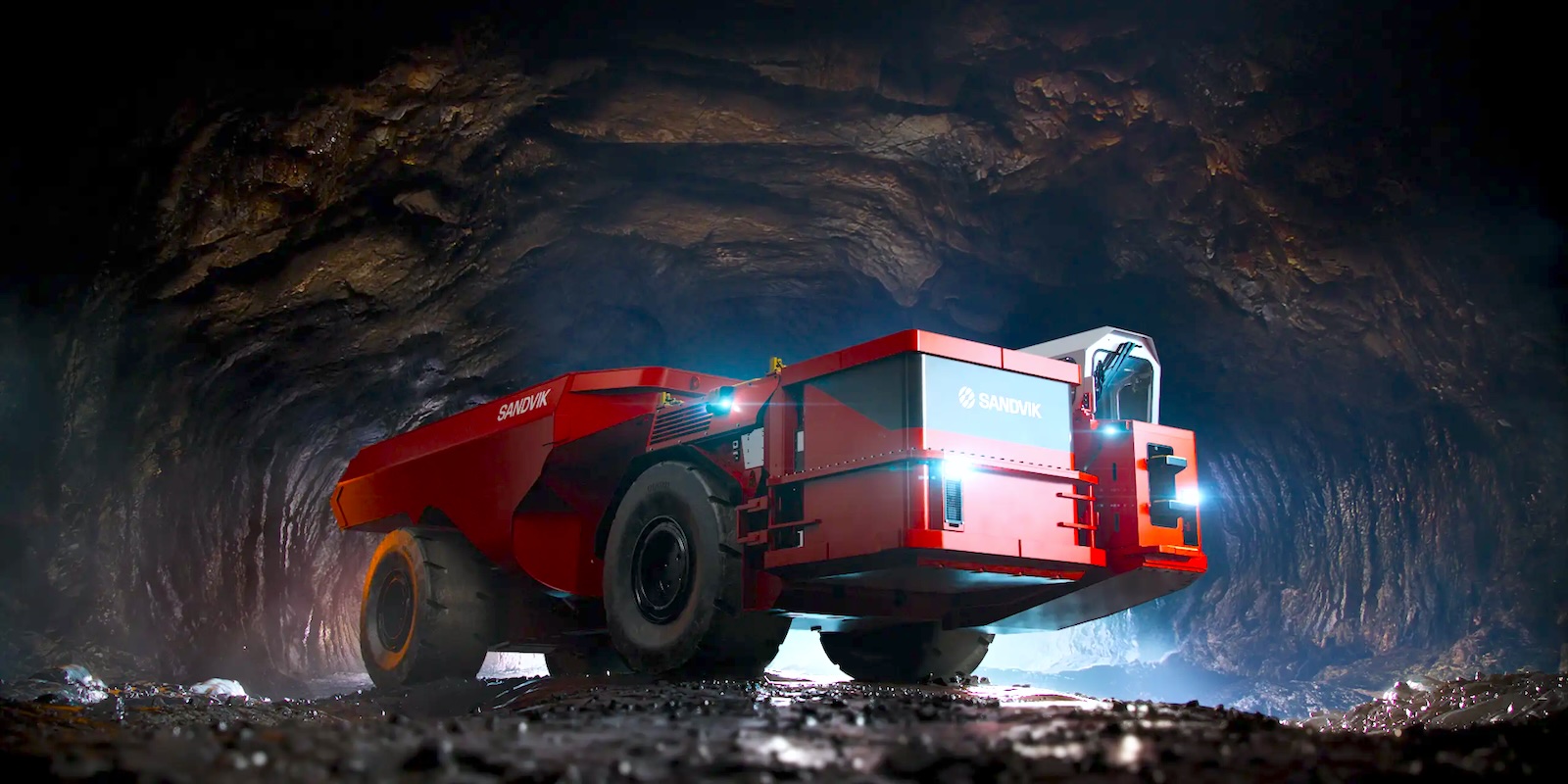
The mining equipment experts at Sandvik have been developing next-generation electric equipment options for years – largely on their own. Now, with a €500 million capital injection from the EIB, the company is ready to get serious about its next-generation machinery.
The European Investment Bank (EIB) is the lending arm of the European Union (EU), and its core mission is to strengthen the global competitiveness, technological innovations, and sustainability initiatives of European companies like Sandvik by providing affordable financing for R&D projects conducted on the continent.
“We have a strong strategic focus on developing solutions that strengthen our technology leadership, and that enhances productivity, safety and sustainability for our customers,” explains Stefan Widing, President and CEO of Sandvik. “The EIB financing supports our R&D initiatives and provides flexibility to our overall funding strategy.”
The €500 million loan has a seven-year term, and will support Sandvik’s efforts to develop new advanced, productive, safe, and (above all) sustainable heavy equipment solutions across the company’s business lines.
Electrek’s Take
We’ve covered Sandvik’s electric equipment several times over the years, from their surface drill rigs to their underground loaders to their quarry- and concrete-focused electric cone plants, and the brand’s commitment to sustainability and operator safety has been commendable. Even the company’s push towards automation and AI, often seen as a corporate tactic to slash labor costs and boost stock prices before the executives bail out with a fat stack of cash fulfill their exit strategies, seems to be genuinely motivated by worker safety in one of the world’s most dangerous environments.
Of course, I said that about Volvo and they’re actively suing California to be able to sell more diesels as aI type this, so what do I know?
SOURCE | IMAGES: Sandvik.
If you’re considering going solar, it’s always a good idea to get quotes from a few installers. To make sure you find a trusted, reliable solar installer near you that offers competitive pricing, check out EnergySage, a free service that makes it easy for you to go solar. It has hundreds of pre-vetted solar installers competing for your business, ensuring you get high-quality solutions and save 20-30% compared to going it alone. Plus, it’s free to use, and you won’t get sales calls until you select an installer and share your phone number with them.
Your personalized solar quotes are easy to compare online and you’ll get access to unbiased Energy Advisors to help you every step of the way. Get started here.
FTC: We use income earning auto affiliate links. More.
-
 Sports2 years ago
Story injured on diving stop, exits Red Sox game
-
 Sports3 years ago
‘Storybook stuff’: Inside the night Bryce Harper sent the Phillies to the World Series
-
 Sports2 years ago
Game 1 of WS least-watched in recorded history
-
 Sports3 years ago
Button battles heat exhaustion in NASCAR debut
-
 Sports3 years ago
MLB Rank 2023: Ranking baseball’s top 100 players
-
Sports4 years ago
Team Europe easily wins 4th straight Laver Cup
-
 Environment3 years ago
Japan and South Korea have a lot at stake in a free and open South China Sea
-
 Environment1 year ago
Here are the best electric bikes you can buy at every price level in October 2024