
Amazon adds a new fee for sellers who ship their own packages

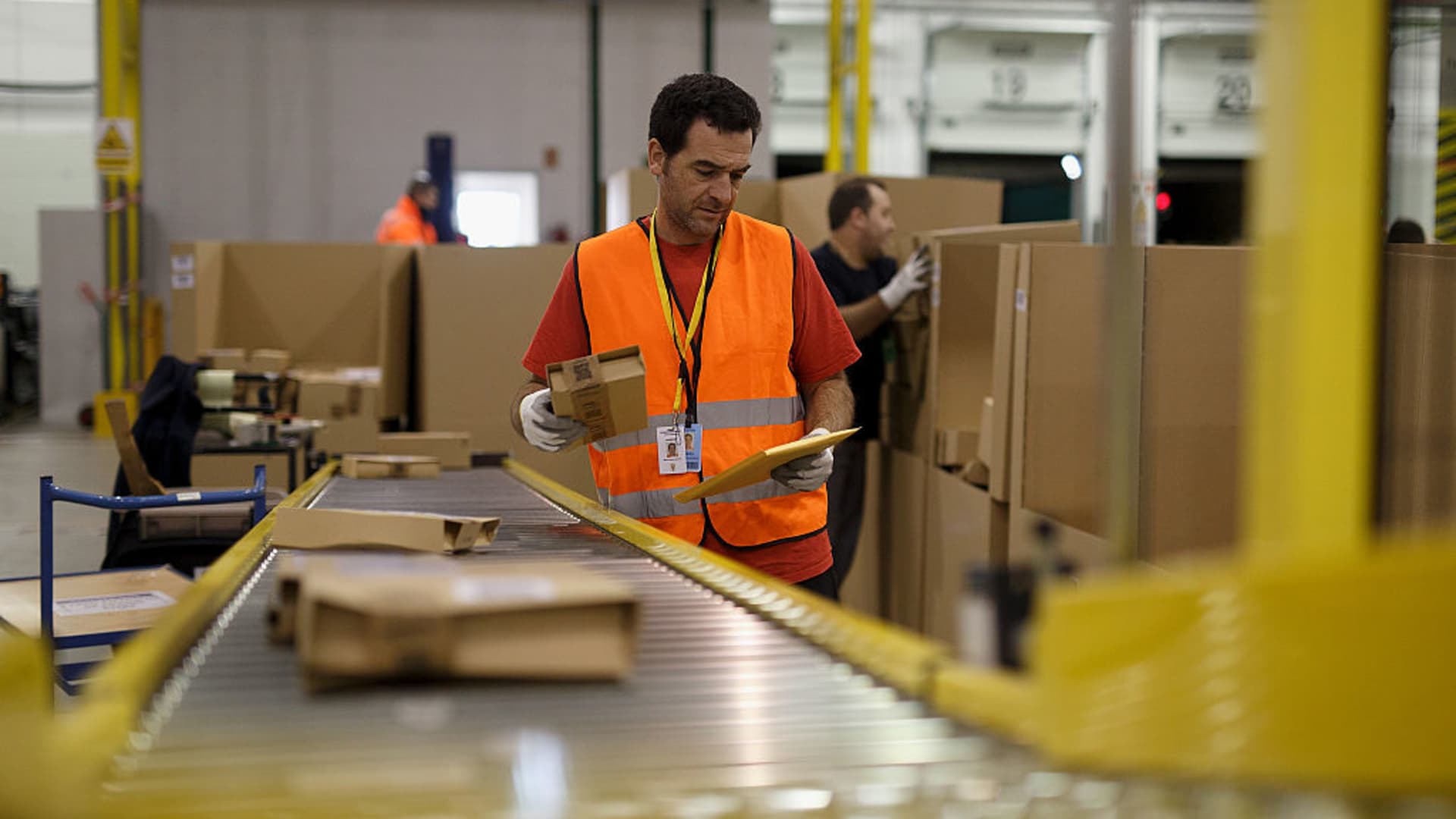
An Amazon warehouse
Getty Images
Amazon is adding a new charge for third-party sellers who ship their own products instead of paying for the company’s fulfillment services.
Beginning Oct. 1, members of Amazon’s Seller Fulfilled Prime program will pay the company a 2% fee on each product sold, according to a notice sent to merchants last week, which was viewed by CNBC. Previously, there was no such fee for sellers.
“We’re updating our requirements for Seller Fulfilled Prime to ensure that it provides customers a great and consistent Prime experience,” the notice states.
Representatives from Amazon did not immediately respond to a request for comment. The news was first reported by Bloomberg.
The SFP program, launched in 2015, allows third-party merchants to sell their products with the Prime badge without paying for Amazon’s fulfillment services, known as Fulfillment By Amazon. The SFP program hasn’t attracted as many users as FBA has, given that sellers are expected to meet the company’s Prime delivery standards, such as speedy shipping and weekend service. In June, Amazon reopened sign-ups for the invite-only program, after it suspended enrollment in SFP in 2019.
The e-commerce giant also charges sellers a referral fee between 8% and 15% on each sale. Sellers may also pay for things like warehouse storage, packing and shipping, as well as advertising fees.
Amazon’s marketplace has been an increasing focus of antitrust investigators in the U.S. and abroad, many of whom believe the company uses its power to squeeze the merchants that sell on its platform. Regulators have examined whether Amazon pressures sellers into using its services in exchange for preferential treatment on the marketplace.
The fee increase comes as the Federal Trade Commission is reportedly gearing up to file a long-awaited lawsuit against Amazon as soon as this month. The agency has been probing the company on a number of fronts, including its treatment of sellers on the marketplace, which now accounts for roughly 60% of its overall retail sales.
Amazon has pushed back on regulators’ accusations. In a blog post on Monday, the company argued sellers continue to flock to its sprawling marketplace “because it’s a great value.”
“These optional, paid services aren’t required for succeeding in the Amazon store — some independent sellers run thriving businesses without them — but many sellers choose to use them because they offer impactful opportunities to drive their business growth at lower cost,” Dharmesh Mehta, Amazon’s vice president of worldwide selling partner services, wrote in the blog post.


Davide Bonaldo | Lightrocket | Getty Images
The New York Times on Friday filed a lawsuit against Perplexity, alleging the artificial intelligence startup has illegally copied and distributed its copyrighted content.
The suit, filed in the Southern District of New York, accuses Perplexity of unlawfully scraping The Times’ stories, videos, podcasts and other content to formulate responses to user queries. The startup also generates outputs that are “identical or substantially similar to” The Times’ content, according to the complaint.
“While we believe in the ethical and responsible use and development of AI, we firmly object to Perplexity’s unlicensed use of our content to develop and promote their products,” Graham James, a spokesperson for The Times, said in a statement. “We will continue to work to hold companies accountable that refuse to recognize the value of our work.”
Perplexity did not immediately respond to CNBC’s request for comment.
Founded in 2022, Perplexity is best known for its AI-powered search engine that gives users simple answers to questions. The startup has raised more than $1.5 billion in funding from investors including IVP, New Enterprise Associates and Nvidia, according to PitchBook.
The lawsuit from The Times on Friday serves as the latest example of how media companies and publishers are working to protect their intellectual property during the AI boom.
The Times is already involved in another ongoing copyright suit against Microsoft and OpenAI, which alleges the companies improperly used The Times’ content to train their AI models. That suit was filed in the Southern District of New York in 2023.
In September, AI startup Anthropic agreed to pay $1.5 billion to settle a class action lawsuit with a group of authors who claimed that the company had illegally downloaded their books and others from pirated databases.
That settlement makes up the largest publicly reported copyright recovery.
WATCH: Amazon sends Perplexity cease-and-desist over AI browser agents making purchases


Antonio Neri, President and CEO of Hewlett Packard Enterprise.
Anjali Sundaram | CNBC
Hewlett Packard Enterprise shares fell 5% Friday after the company reported fourth-quarter revenue that missed analyst expectations.
The company reported earnings after the bell on Thursday, posting revenue of $9.68 billion, which was up 14% over the year prior but fell short of the $9.94 billion in revenue expected by analysts polled by LSEG.
Revenue for HPE’s server segment came in at $4.46 billion, down 5% from the $4.68 billion a year ago. The fourth-quarter number missed StreetAccount analyst expectations of $4.58 billion.
CFO Marie Myers addressed the shortfall on the analyst call Thursday, attributing it to the timing of artificial intelligence service shipments and lower-than-expected government spending.
“Despite these headwinds, we were encouraged by robust server order growth across both traditional server and AI offerings, with demand significantly outpacing revenue in this period,” she said.
Server revenue declined 10% from the third quarter.
HPE beat earnings expectations with adjusted earnings of 62 cents per share, coming in above the 58 cents per share expected by LSEG.
The company expects fiscal 2026 first-quarter revenue in the range of $9 billion to $9.4 billion, which was short of the $9.87 billion expected by FactSet analysts.
HPE one-day stock chart.
Technology
Netflix to buy Warner Bros. Discovery, Ulta earnings, Meta’s rebound and more in Morning Squawk

-
 Sports2 years ago
Story injured on diving stop, exits Red Sox game
-
 Sports3 years ago
‘Storybook stuff’: Inside the night Bryce Harper sent the Phillies to the World Series
-
 Sports2 years ago
Game 1 of WS least-watched in recorded history
-
 Sports3 years ago
Button battles heat exhaustion in NASCAR debut
-
 Sports3 years ago
MLB Rank 2023: Ranking baseball’s top 100 players
-
Sports4 years ago
Team Europe easily wins 4th straight Laver Cup
-
 Environment3 years ago
Japan and South Korea have a lot at stake in a free and open South China Sea
-
 Environment1 year ago
Here are the best electric bikes you can buy at every price level in October 2024