

Makeshift Tesla Powerwall-based power station helps Maui amid fires

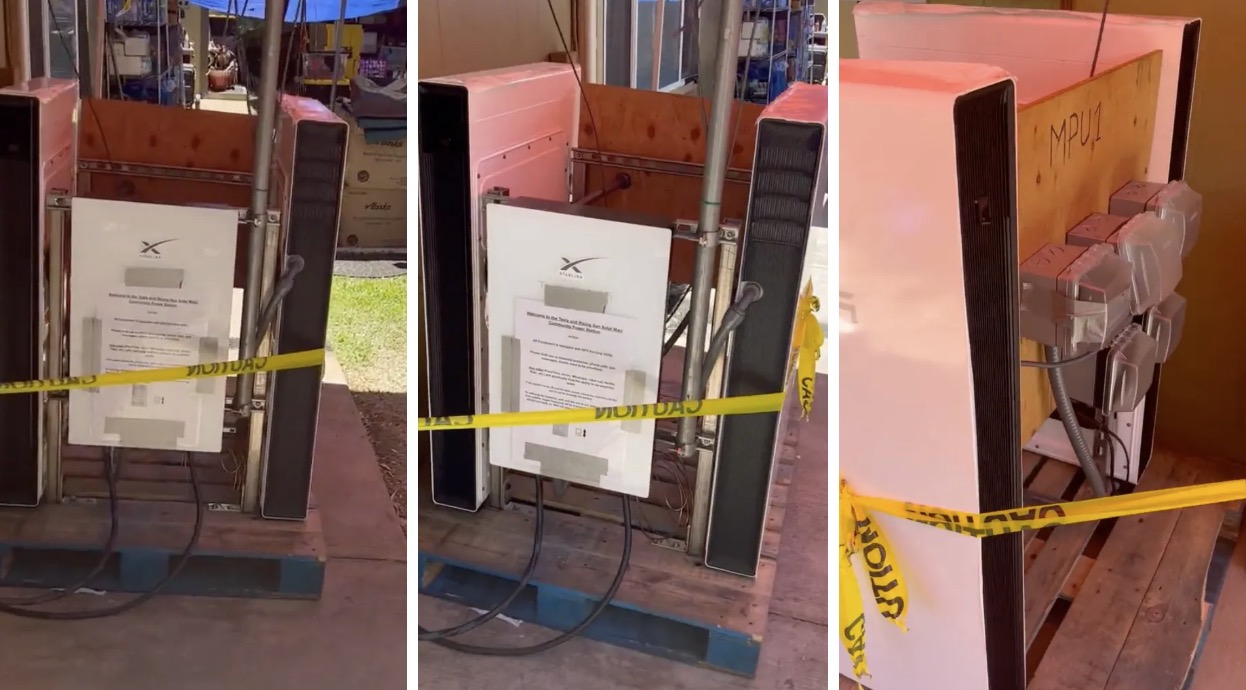
Tesla and its solar partners in Hawaii are helping the local popular in Maui amid the devasting fires with interesting looking makeshift Tesla Powerwall-based power stations.
In recent days, Maui was hit by devasting wildfires that have ravaged communities, taken the lives of over a hundred people, and still many are missing.
Yesterday, Elon Musk, CEO of Tesla and SpaceX, said that both companies were doing their “best to be helpful in Hawaii”:
SpaceX had confirmed that it sent hundreds of Starlink antennas and routers to keep locals connected amid the infrastructure being destroyed.
As for Tesla, it wasn’t clear what it was doing to help, but we are starting to get a better idea.
Local Will Cain shared a video of a “Tesla Power station” helping provide power to the affected area:
The piece of paper on the station reads “Tesla and Rising Sun Solar Maui Community Power Station,” which would indicate Tesla has partnered with Rising Sun Solar, a Tesla certified solar and Powerwall installer, to provide the station.
The station seems to consist of two Tesla Powerwalls and a solar inverter fitted on a skid with some plywood:

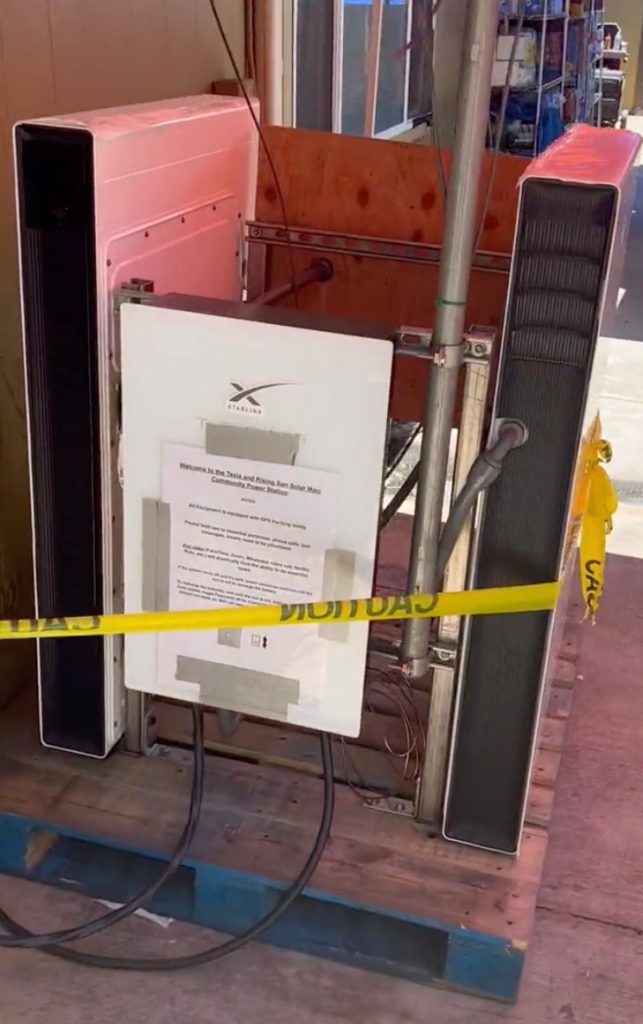
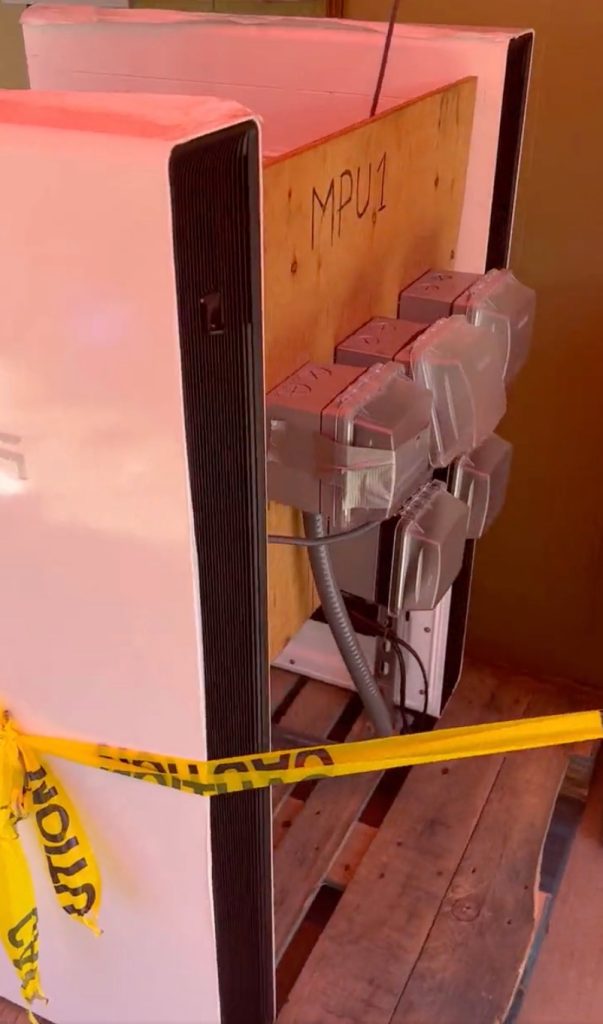
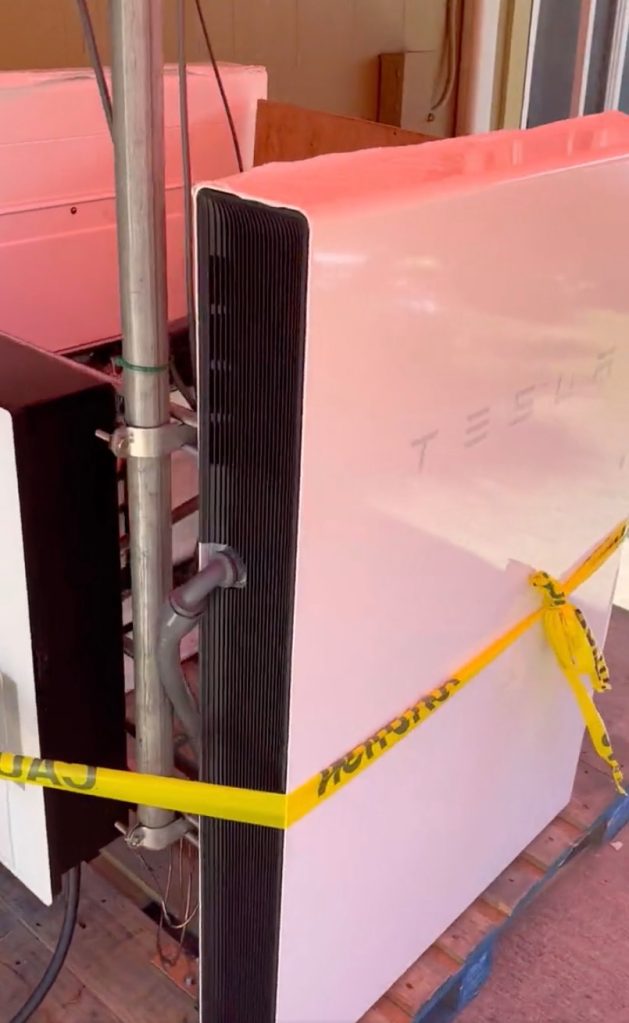
It should provide 27 kWh of energy capacity and if connected with some solar panels, it can be charged back by the sun.
While it might not look good, it seems like a pretty efficient way to quickly deploy significant power and energy capacity in minutes.
Tesla sent similar systems in Ukraine last year, and it even produced a video showing how to use Powerwall as a makeshift mobile power station.
FTC: We use income earning auto affiliate links. More.


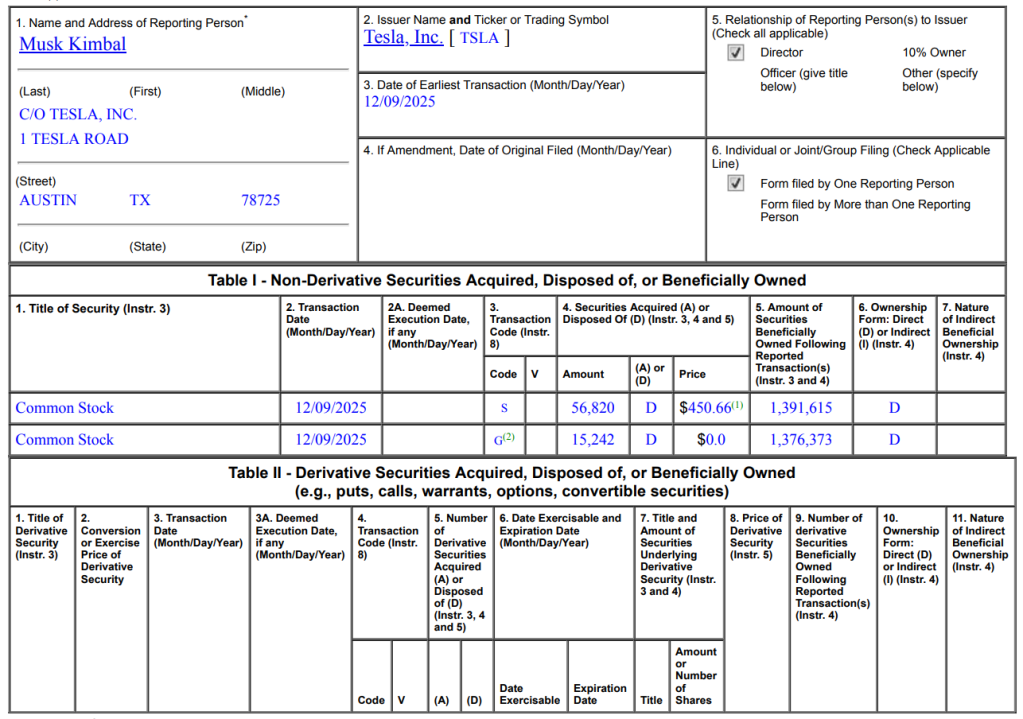
Tesla board member and Elon Musk’s brother, Kimbal Musk, is back to selling Tesla (TSLA) stocks. According to a new SEC filing, Kimbal has cashed out over $25 million worth of shares and donated a few more as the stock rides high in late 2025.
We often report on insider selling at Tesla, and Kimbal is one of the more active sellers on the board. He frequently exercises options and sells shares.
According to a Form 4 filing with the SEC released yesterday, Kimbal sold 56,820 shares of Tesla common stock on December 9.
The shares were sold at a weighted average price of $450.66, with individual transactions ranging from $450.44 to $450.90.
That adds up to a total cash-out of approximately $25.6 million.
But that wasn’t the only movement. The filing also reveals that Kimbal gifted 15,242 shares to a “donor-advised fund”. At the execution price of the sold shares, that donation is worth roughly $6.8 million.
Following these transactions, Kimbal still holds a significant stake in the company. The filing indicates he retains 1,376,373 shares of Tesla directly.
Electrek’s Take
For those who are not aware, Kimball is notorious for calling the top on Tesla’s stock.
Tesla’s stock is currently trading at a price-to-earnings ratio of over 300. That’s unsustainable.
In short, owning Tesla’s stock right now is a bet that Tesla can ~6-10x earnings in the next year or two, while the current earnings trend is a rapid decline.
If you don’t think Tesla can do that, then it might make sense to own it. I doubt Kimball believes that this is the case.
The donation to the donor-advised fund is also standard practice for him. It allows him to take the tax deduction for the charitable contribution immediately while distributing the funds to specific charities over time.
Many billionaires have been known to do that, often transferring the shares to “charities” under their control.


FTC: We use income earning auto affiliate links. More.


The electric Ford Bronco is rolling off the production line, but not in the US, as you would expect. This one is made in China.
Ford Bronco EV production kicks off in China
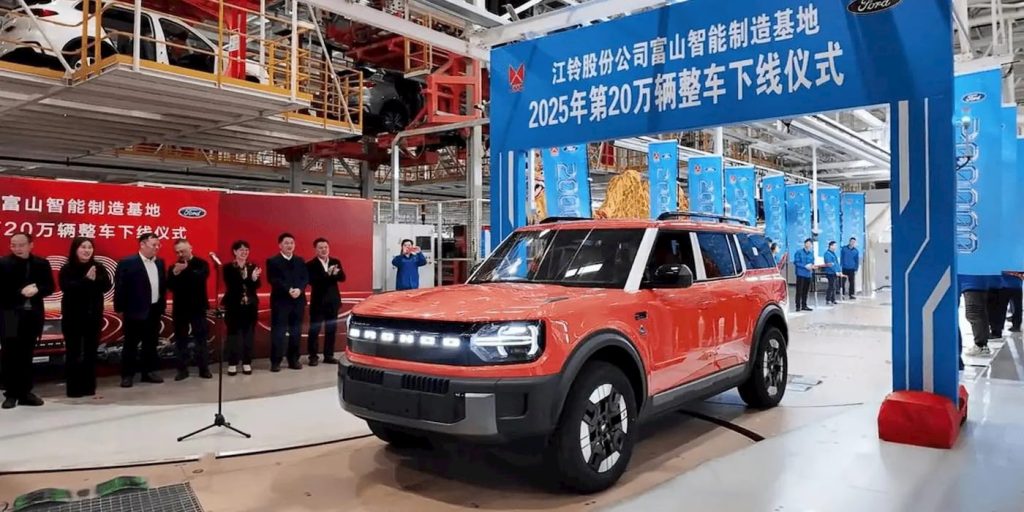
China gets another cool new electric vehicle that the US will miss out on. The electric Bronco is now rolling off the production line at Ford’s Nanchang, China, manufacturing plant.
On December 12, Ford announced the Bronco EV, or what it calls the “All-Terrain Camping SUV,” has entered mass production. The SUV rolled off the assembly line as the 200,00th vehicle built at the facility.
The plant is part of Ford’s joint venture with Jiangling Motors Group (JMC) and currently produces other Ford, Lincoln, and JMC vehicles.
Earlier this year, the JV invested RMB 300 million ($42.5 million) in upgrades to produce new energy vehicles (NEVs), starting with the electric Bronco.
The electric SUV looks nearly identical to the one sold in the US, but it draws power from a 105.4 kWh battery supplied by BYD’s FinDreams, delivering a CLTC driving range of 650 km (404 miles).
It’s equipped with a dual-motor (AWD) powertrain, packing a combined 445 horsepower (332 kW). The EREV version uses a 43.7 kWh battery and a 1.5T engine, good for 220 km (137 miles) all-electric range. Combined, it delivers a driving range of 1,220 km (758 miles).
The interior is custom-tailored for Chinese buyers with modern tech and features. It even includes a built-in 7.5L refrigerator.
A 15.6″ infotainment sits at the center with a smaller driver cluster. Ford also offers an optional 70″ AR head-up display (HUD).
The Bronco EV is 5,025 mm long, 1,960 mm wide, and 1,825 mm tall, with a wheelbase of 2,950 mm, which is about the same size as the standard version sold in the US.


Ford opened orders for the Bronco EV last month with pre-sale prices starting at RMB 229,800 ($32,300). Although it is available with a fully electric (EV) powertrain, it’s also offered as an extended-range electric vehicle (EREV).
The electric Bronco is available in China in three variants, priced from RMB 229,800 ($32,300) to RMB 282,800 ($40,000).
While Ford is planning to build a plug-in hybrid (PHEV) Bronco at its Valencia assembly plant in Spain for Europe, the American automaker still has no plans to launch a fully electric version in the US. We’ll keep wishing.
FTC: We use income earning auto affiliate links. More.


Everything is bigger in Texas. That’s also true for data center demand in the Lone Star State, where project developers are rushing to cash in on the artificial intelligence boom.
Cheap land and cheap energy are combining to attract a flood of data center developers to the state. The potential demand is so vast that it will be impossible to meet by the end of the decade, energy experts say.
Speculative projects are clogging up the pipeline to connect to the electric grid, making it difficult to see how much demand will actually materialize, they say. But investors will be left on the hook if inflated demand forecasts lead to more infrastructure being built than is actually needed.
“It definitely looks, smells, feels — is acting like a bubble,” said Joshua Rhodes, a research scientist at the University of Texas at Austin and a founder of energy consulting firm IdeaSmiths.
“The top line numbers are almost laughable,” Rhodes said.
More than 220 gigawatts of big projects have asked to connect to the Texas electric grid by 2030, according to December data from the Electric Reliability Council of Texas. More than 70% of those projects are data centers, according to ERCOT, which manages the Texas power grid.
That’s more than twice the Lone Star State’s record peak summer demand this year of around 85 gigawatts, and its total available power generation for the season of around 103 gigawatts. Those figures are “crazy big,” said Beth Garza, a former ERCOT watchdog.
“There’s not enough stuff to serve that much load on the equipment side or the consumption side,” said Garza, director of ERCOT’s independent market monitor from 2014 to 2019.
Rhodes agreed. “There’s just no way we can physically put this much steel in the ground to match those numbers. I don’t even know if China could do it that fast,” he said.
‘Not all real’
Data center requests have exploded in Texas since state legislation in 2023 required projects that have not signed electric connection agreements to be considered in power demand forecasts.
The number of big projects requesting an electric connection has nearly quadrupled this year. But more than half of them, representing about 128 gigawatts of increased potential demand, have not submitted studies for ERCOT to review yet. About another 90 gigawatts are either under review or have had planning studies approved.
“We know it’s not all real. The question is how much is real,” said Michael Hogan, a senior advisor at the Regulatory Assistance Project, which advises governments and regulators on energy policy.
The huge numbers in Texas reflect a broader data center bubble in the U.S., said Hogan, who has worked in the electric industry for more than four decades, starting at General Electric in 1980.
“As with everything else in Texas, it’s an outsized example of it,” he said.
The number of projects that have actually connected to the grid or have been approved by ERCOT is much smaller, at only around 7.5 gigawatts. It is still a large number, equivalent to nearly eight large nuclear plants. But Texas can meet that level of demand, Rhodes said.
“We could comfortably grow 8 gigawatts of data centers,” Rhodes said. Texas might be able to meet 20 gigawatts or 30 gigawatts of data center demand by 2030, he said.
Texas has acted to separate serious data center projects from those that are merely speculative. A law passed in May requires developers to pay $100,000 for the initial study of their project and show that a site is secured through an ownership interest or lease. And they have to disclose whether they have outlined the same project anywhere else in Texas.
The Texas Public Utility Commission has proposed a rule that would require data centers to pay $50,000 security per megawatt of peak power. The cost to a developer would total at least $50 million for a gigawatt-scale data center.
“The serious developers with long-term contracts signed with anchor tenants, they’re going to be willing to put that money down,” Rhodes said. More speculative developers will likely drop out of the line for an electric connection, which will help authorities get a more accurate forecast, he said.
Risk to investors
The risk is that electric infrastructure such as power plants, transmission lines and transformers will be built for speculative data centers that either do not materialize or use less electricity than anticipated, Rhodes said. And overbuilding would come at time when the cost of that infrastructure has soared as data centers and other industries all compete for the same scarce equipment, he said.
“When the bubble bursts, who pays is going to depend on how much steel has been moved,” Rhodes said. The cost of a natural gas plant, for example, has more than doubled over the past five years, he said.
“It’s kind of like buying your house at the top of the market,” the analyst said. “If the house price goes down in five years, you’re out of luck.”

The cost of building new power plants to serve the Texas electric market is generally borne by investors, Rhodes and Hogan said, providing some protection to households from higher electricity prices if too much capacity is built.
By contrast, electric prices have spiked in some Midwestern and mid-Atlantic states from data center demand because the grid operator, PJM Interconnection, buys power generation years in advance — with the burden falling on consumers.
In Illinois, where the northern part of the state is served by PJM, residential electricity prices rose about 20% in September compared to the same month last year. But prices in Texas increased just 5% year over year, below the average national increase of more than 7%, according to data from the Energy Information Administration.
Texas has less risk of building too much generation compared to PJM states because of the way the market is structured, Hogan said. But “whatever [new] build we do end up seeing in Texas, the people who ended up investing in the excess capacity are the ones that are going to suffer,” he said.
-
 Sports2 years ago
Story injured on diving stop, exits Red Sox game
-
 Sports3 years ago
‘Storybook stuff’: Inside the night Bryce Harper sent the Phillies to the World Series
-
 Sports2 years ago
Game 1 of WS least-watched in recorded history
-
 Sports3 years ago
Button battles heat exhaustion in NASCAR debut
-
 Sports3 years ago
MLB Rank 2023: Ranking baseball’s top 100 players
-
Sports4 years ago
Team Europe easily wins 4th straight Laver Cup
-
 Environment3 years ago
Japan and South Korea have a lot at stake in a free and open South China Sea
-
 Environment1 year ago
Here are the best electric bikes you can buy at every price level in October 2024