
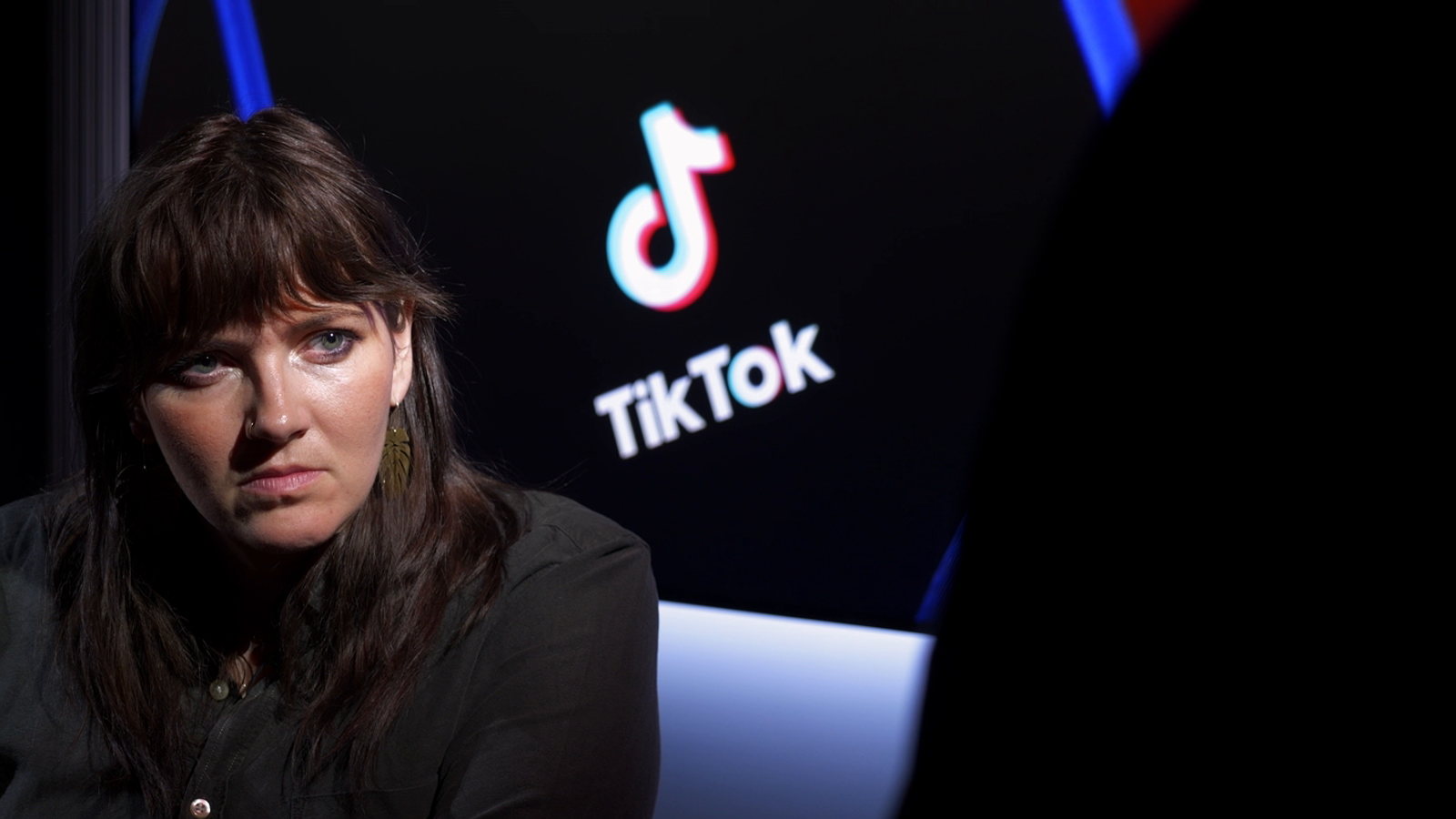
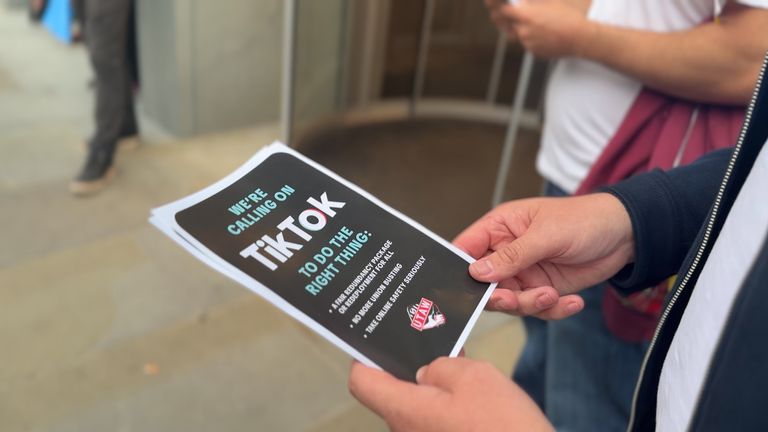
Hundreds of UK online safety workers at TikTok have already signed agreements to leave the company, whistleblowers have told Sky News, despite the firm stressing to MPs that the cuts were “still proposals only”.
More than 400 online safety workers have agreed to leave the social media company, with only five left in consultation, Sky News understands.
“[The workers have] signed a mutual termination agreement, a legally binding contract,” said John Chadfield, national officer for the Communication Workers’ Union.
“They’ve handed laptops in, they’ve handed passes in, they’ve been told not to come to the office. That’s no longer a proposal, that’s a foregone conclusion. That’s a plan that’s been executed.”
Moderators gathered to protest the redundancies
In August, TikTok announced a round of mass layoffs to its Trust and Safety teams.
“Everyone in Trust and Safety” was emailed, said Lucy, a moderator speaking on condition of anonymity for legal reasons.
After a mandatory 45-day consultation period, the teams were then sent “mutual termination agreements” to sign by 31 October.
Sky News has seen correspondence from TikTok to the employees telling them to sign by that date.
“We had to sign it before the 31st if we wanted the better deal,” said Lucy, who had worked for TikTok for years.
“If we signed it afterwards, that diminished the benefits that we get.”
Three former moderators at TikTok have spoken to Sky News on camera
Despite hundreds of moderators signing the termination contracts by 31 October, Ali Law, TikTok’s director of public policy and government affairs for northern Europe, said to MPs in a letter on 7 November: “It is important to stress the cuts remain proposals only.”
“We continue to engage directly with potentially affected team members,” he said in a letter to Dame Chi Onwurah, chair of the science, innovation and technology committee.
After signing the termination contracts, the employees say they were asked to hand in their laptops and had access to their work systems revoked. They were put on gardening leave until 30 December.
“We really felt like we were doing something good,” said Saskia, a moderator also speaking under anonymity.
“You felt like you had a purpose, and now, you’re the first one to get let go.”
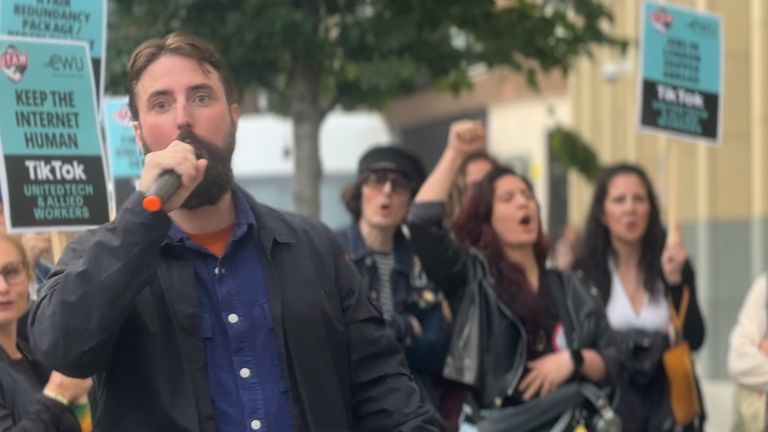
TikTok moderators and union workers protested outside the company’s London headquarters in September
A TikTok worker not affected by the job cuts confirmed to Sky News that all of the affected Trust and Safety employees “are now logged out of the system”.
“Workers and the wider public are rightly concerned about these job cuts that impact safety online,” said the TUC’s general secretary, Paul Nowak.
“But TikTok seem to be obscuring the reality of job cuts to MPs. TikTok need to come clean and clarify how many vital content moderators’ roles have gone.
“The select committee must do everything to get to the bottom of the social media giant’s claims, the wider issues of AI moderation, and ensure that other workers in the UK don’t lose their jobs to untested, unsafe and unregulated AI systems.”
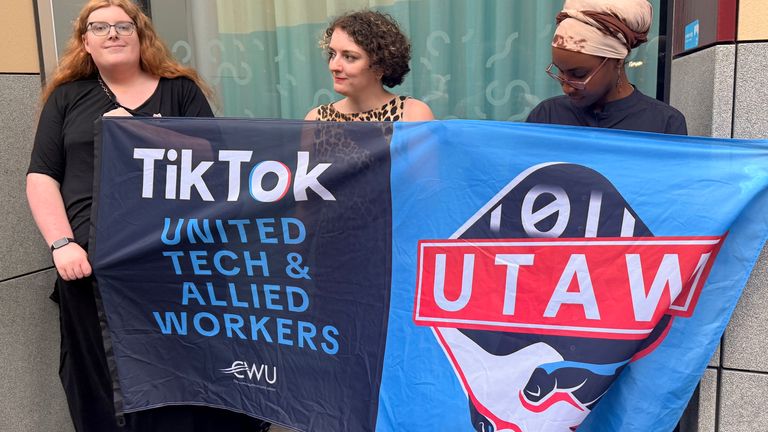
Moderators and union representatives outside TikTok’s offices
What TikTok has said about the job cuts
In an interview with Sky News on 18 November, Mr Law again called the cuts “proposals”.
When asked if the cuts were in fact a plan that had already been executed, Mr Law said there was “limited amounts” he could directly comment on.
TikTok told us: “It is entirely right that we follow UK employment law, including when consultations remained ongoing for some employees and roles were still under proposal for removal.
“We have been open and transparent about the changes that were proposed, including in detailed public letters to the committee, and it is disingenuous to suggest otherwise.”
The three whistleblowers Sky News spoke to said they were concerned TikTok users would be put at risk by the cuts.
The company said it will increase the role of AI in its moderation, while maintaining some human safety workers, but one whistleblower said she didn’t think the AI was “ready”.
“People are getting new ideas and new trends are coming. AI cannot get this,” said Anna, a former moderator.
“Even now, with the things that it’s supposed to be ready to do, I don’t think it’s ready.”
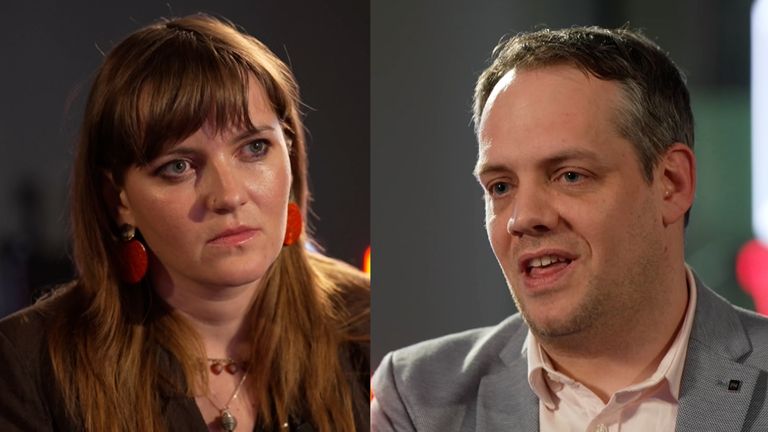
Is TikTok improving safety with AI?
Lucy also said she thought the cuts would put users at risk.
“There are a lot of nuances in the language. AI cannot understand all the nuances,” she said.
“AI cannot differentiate some ironic comment or versus a real threat or bullying or of a lot of things that have to do with user safety, mainly of children and teenagers.”
TikTok has been asked by MPs for evidence that its safety rates – which are currently some of the best in the industry – will not worsen after these cuts.
The select committee says it has not produced that evidence, although TikTok insists safety will improve.
“[In its letter to MPs] TikTok refers to evidence showing that their proposed staffing cuts and changes will improve content moderation and fact-checking – but at no point do they present any credible data on this to us,” said Dame Chi earlier this month.
“It’s alarming that they aren’t offering us transparency over this information. Without it, how can we have any confidence whether these changes will safeguard users?”
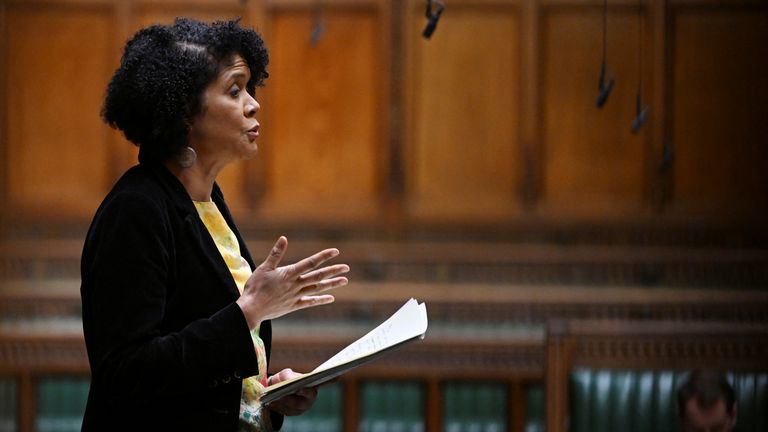
Dame Chi Onwurah speaks at the House of Commons. File pic: Reuters
TikTok’s use of AI in moderation
In an exclusive interview with Sky News earlier this month, Mr Law said the new moderation model would mean TikTok can “approach moderation with a higher level of speed and consistency”.
He said: “Because, when you’re doing this from a human moderation perspective, there are trade-offs.
“If you want something to be as accurate as possible, you need to give the human moderator as much time as possible to make the right decision, and so you’re trading off speed and accuracy in a way that might prove harmful to people in terms of being able to see that content.
“You don’t have that with the deployment of AI.”
As well as increasing the role of AI in moderation, TikTok is reportedly offshoring jobs to agencies in other countries.
Sky News has spoken to multiple workers who confirmed they’d seen their jobs being advertised in other countries through third-party agencies, and has independently seen moderator job adverts in places like Lisbon.
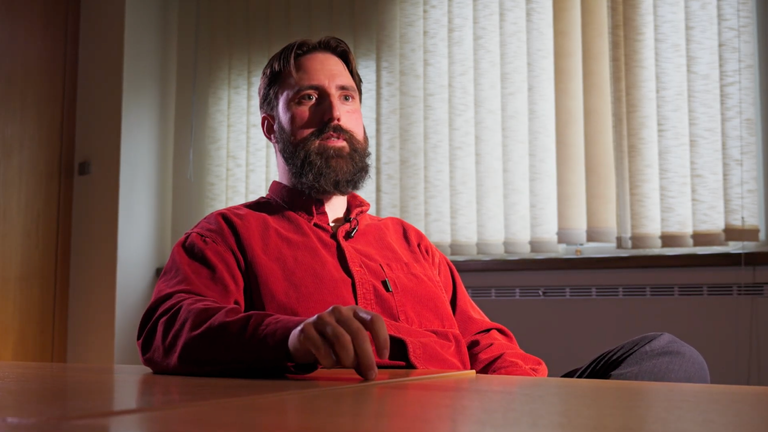
John Chadfield, national officer for technology at the Communication Workers Union
“AI is a fantastic fig leaf. It’s a fig leaf for greed,” said Mr Chadfield. “In TikTok’s case, there’s a fundamental wish to not be an employer of a significant amount of staff.
“As the platform has grown, as it has grown to hundreds of millions of users, they have realised that the overhead to maintain a professional trust and safety division means hundreds of thousands of staff employed by TikTok.
“But they don’t want that. They see themselves as, you know, ‘We want specialists in the roles employed directly by TikTok and we’ll offshore and outsource the rest’.”
Mr Law told Sky News that TikTok is always focused “on outcomes”.
He said: “Our focus is on making sure the platform is as safe as possible.
“And we will make deployments of the most advanced technology in order to achieve that, working with the many thousands of trust and safety professionals that we will have at TikTok around the world on an ongoing basis.”
Asked specifically about the safety concerns raised by the whistleblowers, TikTok said: “As we have laid out in detail, this reorganisation of our global operating model for Trust and Safety will ensure we maximize effectiveness and speed in our moderation processes.
“We will continue to use a combination of technology and human teams to keep our users safe, and today over 85% of the content removed for violating our rules is identified and taken down by automated technologies.”
*All moderator names have been changed for legal reasons.
World
‘If someone took Trump’s land, how would he feel?’ – Ukrainians view peace talks with suspicion

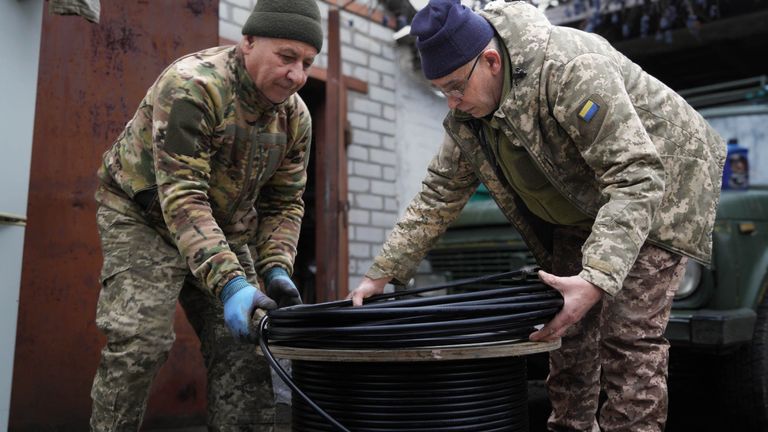
A Ukrainian farmer-turned-soldier in the Donbas has a message for Donald Trump as the US president attempts to broker a peace deal between Kyiv and Moscow.
Anatolii, 59, said: “If someone took a piece of his territory, what would he say to that? The same goes for us.”
Like many Ukrainians, the serviceman volunteered to join a territorial defence unit when Russia launched its full-scale war almost four years ago.
He has been fighting ever since, but will have the option to quit next year once he turns 60.
Anatolii and a colleague
Unable to wear body armour anymore because of its weight, Anatolii now operates further back from the frontline in a small workshop on the outskirts of the city of Kramatorsk where he helps to fix and improve the performance of drones – a crucial weapon on the battlefield.
“I want this war to finally end,” he said. “I want to go home, to my family, to my land.”
But not at any price.
He and other soldiers in 107 Brigade of Ukraine’s Territorial Defence Force view Mr Trump’s efforts to negotiate a peace agreement with suspicion.
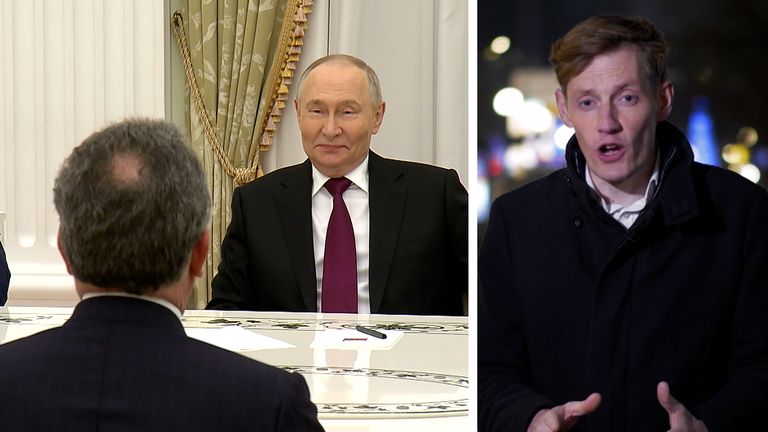
Peace deal: Russia ‘in no mood to compromise’.
An initial proposal envisaged the Ukrainian government giving up Donetsk and Luhansk, the two regions that make up the Donbas, to Russia.
This includes large swathes of land that are still under Ukraine’s control, and that thousands of Ukrainian soldiers have lost their lives fighting to defend.
“I feel negative about it,” Anatolii said, referring to the proposal.
“So many people already fell for this land … How can we give away our land? It would be like someone comes to my house and says: ‘Give me a piece of your home.'”
However, he added: “I understand, we have nothing to take it back with. Maybe through some political means…
“I do not want more people to fall, more people to die. I want politicians to somehow come to terms.”
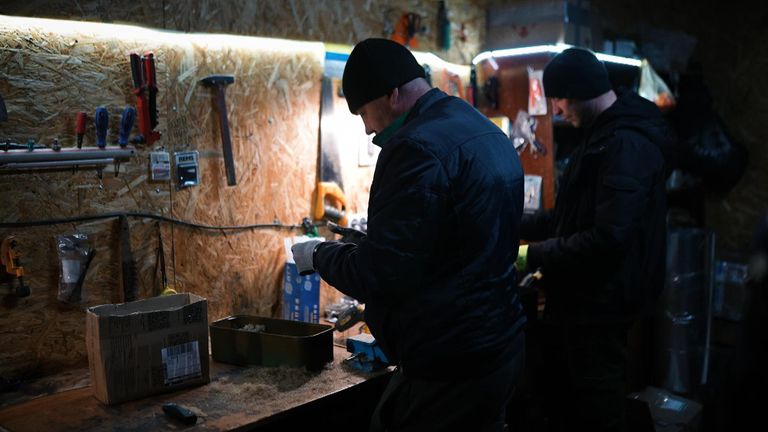
A short drive away from the workshop is a hidden bomb factory where other soldiers from the same unit are focused on a different kind of war effort.
Surrounded by 3D printed gadgets, metal ball bearings and plastic explosives, they make improvised bombs, including anti-personnel mines and devices that can be fitted onto one-way attack drones and exploded onto targets.
Vadym, 41, is in charge of the production line.
He has been fighting since Russian President Vladimir Putin first attacked eastern Ukraine in 2014.
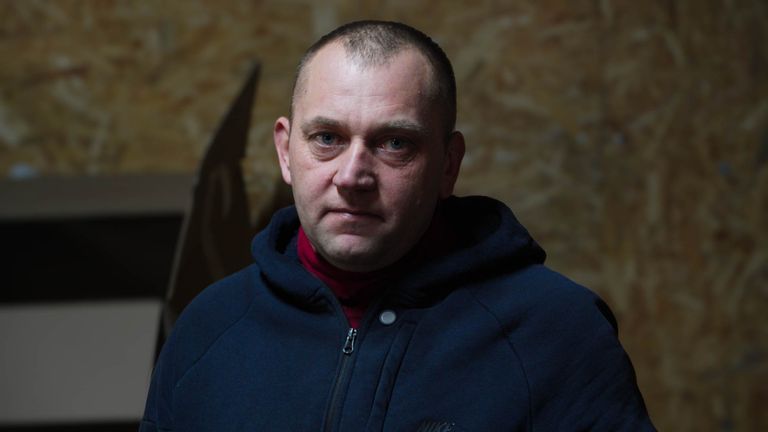
Vadym
Asked whether he felt tired, he said: “We are always tired, we have no motivation as such, but there is the understanding that the enemy will keep coming as long as we do not stop him. If we stop fighting, our children and grandchildren will fight. That keeps us going.”
Vadym is also against simply handing over Ukrainian land to Russia.
“If we now give away borders, give away Donbas, then what?” he said.
“Any country can come to any other country and say: This is our land. Let’s coordinate, do business, and keep living as before. That is not normal in my view.”

The Ukrainian president says ‘everyone must be on this side of peace’
The city of Kramatorsk stands testament to Ukraine’s will to fight, remaining firmly in Ukrainian hands, though Russia’s war is inching closer.
Nets stretched like a tunnel line a main road leading into the city to protect vehicles from the threat of small, killer drones.
Coils of barbed wire are also strung across fields around the outskirts of Kramatorsk along with other fortifications such as mounds of dirt and triangular lumps of concrete.
Many civilians have remained here as well as the nearby city of Slovyansk, even as other landmark sites such as Mariupol, Bakhmut and Avdiivka have fallen.
Yet the toll of living in a warzone is clear.
Stallholders swept away rubble and broken glass on Sunday after a Russian missile smashed into a central market in Kramatorsk on Saturday night.
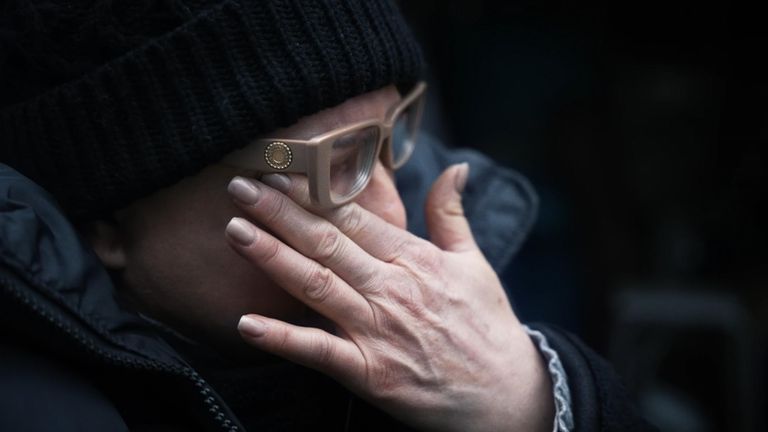
Some, like Ella, 60, even chose to reopen despite the carnage.
“It’s frightening. We need to earn a living. I have my mother, I need to look after her, help my children. So we do what we have to do,” she said.
Her adult children live in Kyiv and want her to leave, but Kramatorsk is her home.
“We’ve been living like this for four years now. We’re so used to it. A drone flies overhead and we keep working,” she said.
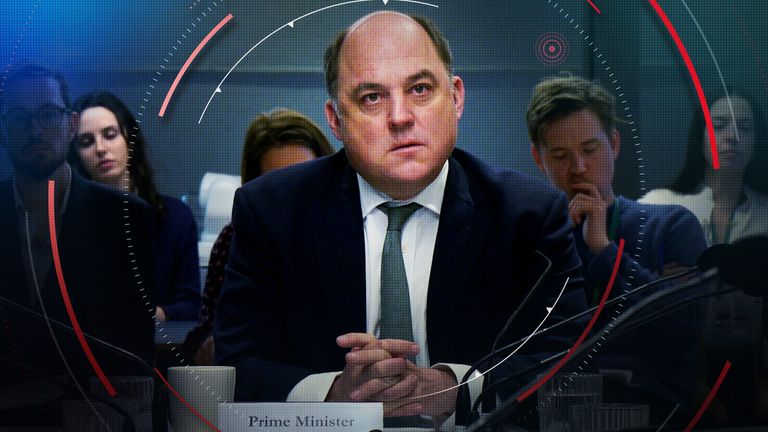
Is the UK prepared to fight a war?
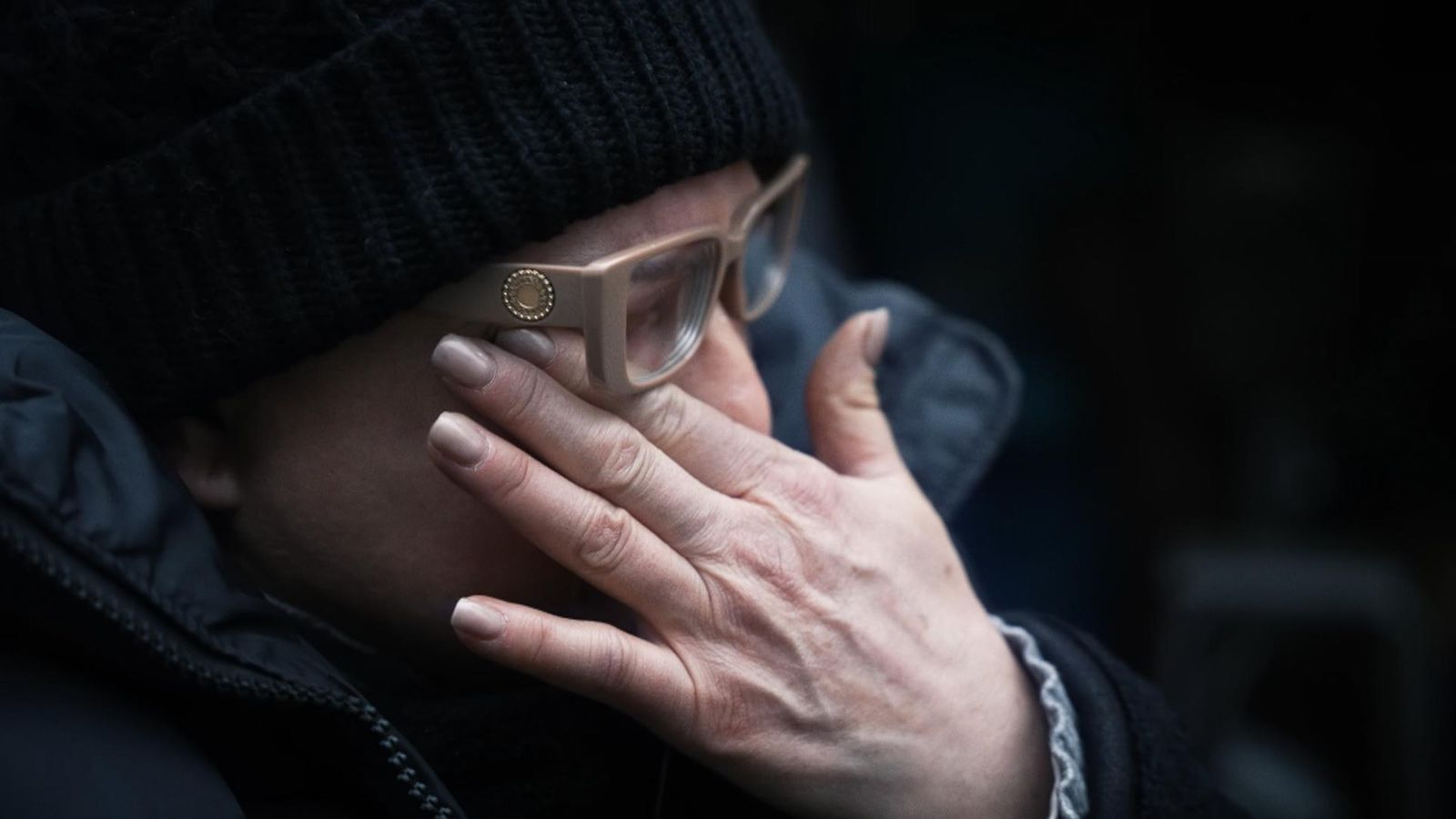
Asked how she felt about what the war had done to her city, Ella’s voice wobbled and she wiped tears from her eyes.
“We keep it all inside, but it still hurts. It’s frightening and painful. I just want things as they used to be. We don’t want anything here to change,” she said.
As for what she would do if a future peace deal forced Ukraine to surrender the area, Ella said: “That’s a hard question … I wouldn’t stay. I’d leave.”
Production by security and defence producer Katy Scholes, Ukraine producer Azad Safarov, camera operator Mostyn Pryce
-
 Sports2 years ago
Story injured on diving stop, exits Red Sox game
-
 Sports3 years ago
‘Storybook stuff’: Inside the night Bryce Harper sent the Phillies to the World Series
-
 Sports2 years ago
Game 1 of WS least-watched in recorded history
-
 Sports3 years ago
Button battles heat exhaustion in NASCAR debut
-
 Sports3 years ago
MLB Rank 2023: Ranking baseball’s top 100 players
-
Sports4 years ago
Team Europe easily wins 4th straight Laver Cup
-
 Environment3 years ago
Japan and South Korea have a lot at stake in a free and open South China Sea
-
 Environment1 year ago
Here are the best electric bikes you can buy at every price level in October 2024