
Meta’s Threads begins rolling out on the web, as Zuckerberg takes more direct aim at Elon Musk’s X

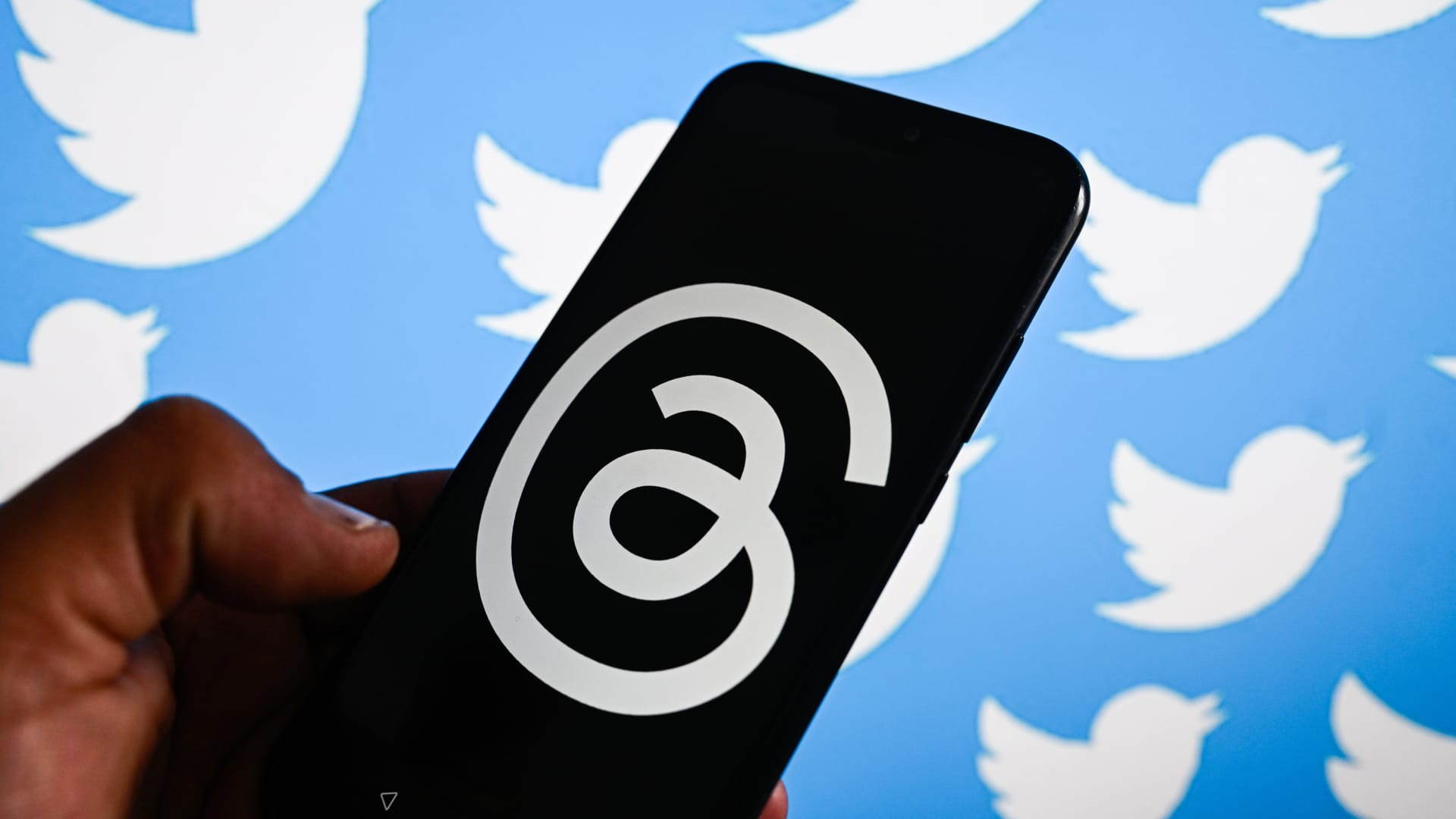
In this photo illustration, the Threads logo by META is displayed on a smartphone with Twitter logo in the background. Threads is the new social network from Meta Platforms which was launched on the 5th of July 2023.
Omar Marques | Lightrocket | Getty Images
Meta’s Twitter clone called Threads, which launched last month and quickly shot up the app rankings, is starting to roll out on the web, giving users access from their PCs. The site, Threads.net, is not live for everyone yet and may still just show a link to download the mobile app.
A Meta spokesperson said the company will be “rolling out” the web version of Threads for the general public “over the next few days.”
Meta said that, in the coming weeks it will be improved to look more like the mobile app.
While Threads was quick to sign on users after it was introduced in July, the app saw a drop-off in growth and engagement the following week as its limitations became apparent. Meta CEO Mark Zuckerberg said in early August that the company was working on a web version of Threads as well as a search function, underscoring efforts to make the app more compelling.
Advertisers and influencers previously told CNBC that Threads needs more features like a search tool and a way to access the app from desktop computers to be a serious challenger to X, formerly known as Twitter. Influencers and power users on X often use the desktop version of the app to post comments and share content throughout the day.
Meanwhile, X has been attempting to win back advertisers with new brand safety tools, intended to make companies more comfortable with running ads on the service. Several nonprofit organizations and researchers have documented a rise in hate speech and racist content since Tesla CEO Elon Musk took control of X in October, claims the company disputes.
Although Zuckerberg recently told analysts on an earnings call that he’s “quite optimistic” about Threads, Meta is not planning to monetize the app until it’s more established.
WATCH: Threads is the perfect situation at the perfect time for Meta


Artificial intelligence has created a device that turns moon dust into energy.
The moon vacuum, which was unveiled on Wednesday by Blue Origin at Amazon‘s re:Invent 2025 conference in Las Vegas, was built using critical technology from startup Istari Digital.
“So what it does is sucks up moon dust and it extracts the heat from it so it can be used as an energy source, like turning moon dust into a battery,” Istari CEO Will Roper told CNBC’s Morgan Brennan.
Spacecraft carrying out missions on the lunar surface are typically constrained by lunar night, the two-week period every 28 days during which the moon is cast in darkness and temperatures experience extreme drops, crippling hardware and rendering it useless unless a strong, long-lasting power source is present.
“Kind of like vacuuming at home, but creating your own electricity while you do it,” he added.
The battery was completely designed by AI, said Roper, who was assistant secretary of the Air Force under President Donald Trump‘s first term and is known for transforming the acquisition process at both the Air Force and, at the time, the newly created Space Force.
A major part of the breakthrough in Istari’s technology is the way in which it handles and limits AI hallucinations.
Roper said the platform takes all the requirements a part needs and creates guardrails or a “fence around the playground” that the AI can’t leave while coming up with designs.
“Within that playground, AI can generate to its heart’s content,” he said.
“In the case of Blue Origin’s moon battery, [it] doesn’t tell you the design was a good one, but it tells us that all of the requirements were met, the standards were met, things like that that you got to check before you go operational,” he added.
Istari is backed by former Google CEO Eric Schmidt and already works with the U.S. government, including as a prime contractor with Lockheed Martin on the experimental x-56A unmanned aircraft.
Watch the full interview above and go deeper into the business of the stars with the Manifest Space podcast.

Technology
Nvidia CEO Jensen Huang talks chip restrictions with Trump, blasts state-by-state AI regulations


Nvidia CEO Jensen Huang said he met with President Donald Trump on Wednesday and that the two men discussed chip export restrictions, as lawmakers consider a proposal to limit exports of advanced artificial intelligence chips to nations like China.
“I’ve said it repeatedly that we support export controls, and that we should ensure that American companies have the best and the most and first,” Huang told reporters on Capitol Hill.
Lawmakers were considering including the Guaranteeing Access and Innovation for National Artificial Intelligence Act in a major defense package, known as the National Defense Authorization Act. The GAIN AI Act would require chipmakers like Nvidia and Advanced Micro Devices to give U.S. companies first pick on their AI chips before selling them in countries like China.
The proposal isn’t expected to be part of the NDAA, Bloomberg reported, citing a person familiar with the matter.
Huang said it was “wise” that the proposal is being left out of the annual defense policy bill.
“The GAIN AI Act is even more detrimental to the United States than the AI Diffusion Act,” Huang said.
Nvidia’s CEO also criticized the idea of establishing a patchwork of state laws regulating AI. The notion of state-by-state regulation has generated pushback from tech companies and spurred the creation of a super PAC called “Leading the Future,” which is backed by the AI industry.
“State-by-state AI regulation would drag this industry into a halt and it would create a national security concern, as we need to make sure that the United States advances AI technology as quickly as possible,” Huang said. “A federal AI regulation is the wisest.”
Trump last month urged legislators to include a provision in the NDAA that would preempt state AI laws in favor of “one federal standard.”
But House Majority Leader Steve Scalise (R-LA) told CNBC’s Emily Wilkins on Tuesday the provision won’t make it into the bill, citing a lack of sufficient support. He and other lawmakers will continue to look for ways to establish a national standard on AI, Scalise added.
WATCH: Nvidia currying favor to be able to sell chips in China


File: Then Apple Creative Director Alan Dye celebrates the launch of the July Issue at the new WIRED office on June 24, 2015 in San Francisco, California.
Kimberly White | Getty Images
Apple‘s head of user interface design, Alan Dye, will join Meta, in a notable shift of executive talent in Silicon Valley.
The iPhone maker confirmed Dye’s departure on Wednesday and Apple CEO Tim Cook said in a statement that the company prioritizes design and has a strong team. The statement said that veteran designer Stephen Lemay will succeed Dye.
“Steve Lemay has played a key role in the design of every major Apple interface since 1999,” Cook said in a statement.
Meta CEO Mark Zuckerberg in a Wednesday social media post said that Dye would lead up a new creative studio that brings together design, fashion and technology.
“We plan to elevate design within Meta,” wrote Zuckerberg, who did not say what specific products Dye will work on.
Compared to other Silicon Valley companies, Apple has always emphasized design to customers and investors as one of its strengths. Apple prominently features its design executives to discuss interface changes at the company’s launch events.
In June, Dye revealed a redesign of Apple’s software interface for iPhones, Macs and the Apple Watch called Liquid Glass. The company described it as an “elegant” new design with translucent buttons, updated app icons and fluid animations.
Dye said it was the “next chapter” of the company’s software and said it “sets the stage” for the next era of Apple products.
“Our new design blurs the lines between hardware and software to create an experience that’s more delightful than ever while still familiar and easy to use,” Dye said at the launch.
Reviews were mixed on the Liquid Glass update, which shipped with new iPhones in September.
Apple announces liquid glass during the Apple Worldwide Developers Conference (WWDC) on June 9, 2025 in Cupertino, California.
Justin Sullivan | Getty Images
For years, Apple design was embodied by executive Jony Ive, who left Apple in 2019 and is now working with OpenAI on artificial intelligence hardware alongside Sam Altman.
Dye took over user interface design and became one of the design studio’s leads in 2015 when Ive stepped back from a day-to-day role. Dye started at Apple in 2006 and worked on software for the iPhone, iPad, Mac, Apple Watch, Apple TV and Vision Pro, according to his LinkedIn profile.
He was also partly responsible for the first iPhone in 2017 that did away with the home screen button at the bottom of the device and replaced it with a software-based swipe-up motion.
Meta has said in recent years that it wants to be a major developer of hardware and Zuckerberg has said Apple is one of his company’s biggest competitors.
The social media company currently makes several virtual reality headsets under its Quest brand, and recently scored its first hardware hit with Ray-Ban Meta smart glasses, which are stylish sunglasses equipped with cameras and the ability to run an AI model that can answer questions. Sales of the device tripled over the past year, Ray-Ban parent company EssilorLuxottica said in July.
“We’re entering a new era where AI glasses and other devices will change how we connect with technology and each other,” Zuckerberg wrote.
Bloomberg first reported the move.
-
 Sports2 years ago
Story injured on diving stop, exits Red Sox game
-
 Sports3 years ago
‘Storybook stuff’: Inside the night Bryce Harper sent the Phillies to the World Series
-
 Sports2 years ago
Game 1 of WS least-watched in recorded history
-
 Sports3 years ago
Button battles heat exhaustion in NASCAR debut
-
 Sports3 years ago
MLB Rank 2023: Ranking baseball’s top 100 players
-
Sports4 years ago
Team Europe easily wins 4th straight Laver Cup
-
 Environment3 years ago
Japan and South Korea have a lot at stake in a free and open South China Sea
-
 Environment1 year ago
Here are the best electric bikes you can buy at every price level in October 2024