


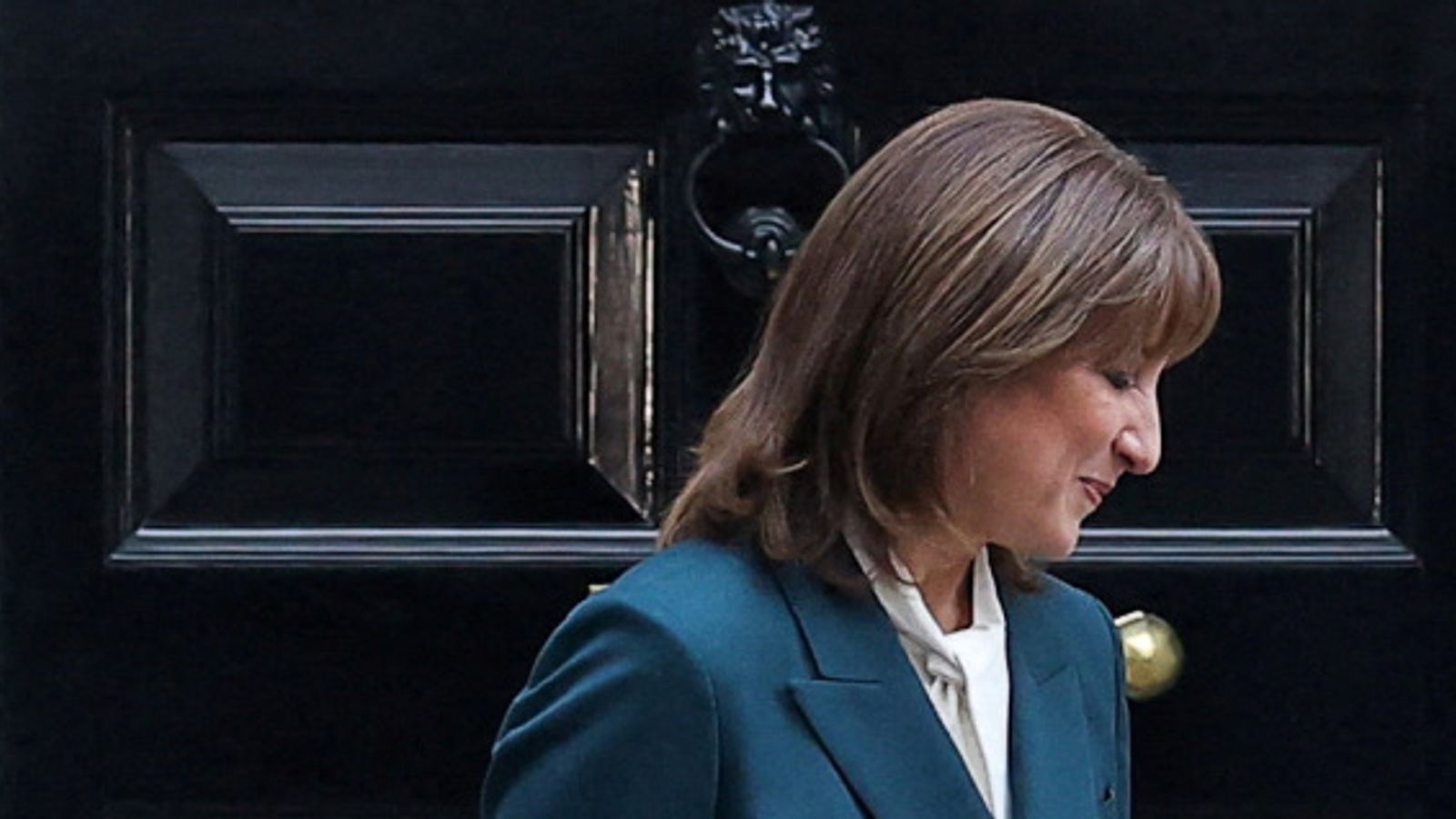
Chancellor Rachel Reeves has suffered another budget blow with a rebellion by rural Labour MPs over inheritance tax on farmers.
Speaking during the final day of the Commons debate on the budget, Labour backbenchers demanded a U-turn on the controversial proposals.
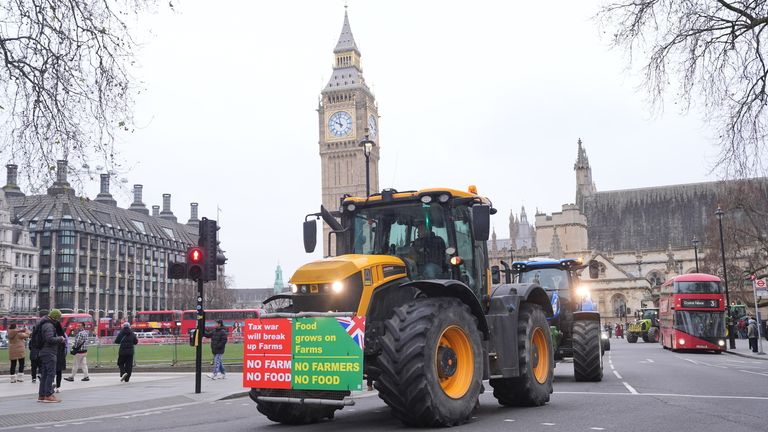
Plans to introduce a 20% tax on farm estates worth more than £1m from April have drawn protesters to London in their tens of thousands, with many fearing huge tax bills that would force small farms to sell up for good.
Farmers have staged numerous protests against the tax in Westminster. Pic: PA
MPs voted on the so-called “family farms tax” just after 8pm on Tuesday, with dozens of Labour MPs appearing to have abstained, and one backbencher – borders MP Markus Campbell-Savours – voting against, alongside Conservative members.
In the vote, the fifth out of seven at the end of the budget debate, Labour’s vote slumped from 371 in the first vote on tax changes, down by 44 votes to 327.
‘Time to stand up for farmers’
The mini-mutiny followed a plea to Labour MPs from the National Farmers Union to abstain.
“To Labour MPs: We ask you to abstain on Budget Resolution 50,” the NFU urged.
“With your help, we can show the government there is still time to get it right on the family farm tax. A policy with such cruel human costs demands change. Now is the time to stand up for the farmers you represent.”
After the vote, NFU president Tom Bradshaw said: “The MPs who have shown their support are the rural representatives of the Labour Party. They represent the working people of the countryside and have spoken up on behalf of their constituents.
“It is vital that the chancellor and prime minister listen to the clear message they have delivered this evening. The next step in the fight against the family farm tax is removing the impact of this unjust and unfair policy on the most vulnerable members of our community.”

Farmers defy police ban in budget day protest in Westminster.
The government comfortably won the vote by 327-182, a majority of 145. But the mini-mutiny served notice to the chancellor and Sir Keir Starmer that newly elected Labour MPs from the shires are prepared to rebel.
Speaking in the debate earlier, Mr Campbell-Savours said: “There remain deep concerns about the proposed changes to agricultural property relief (APR).
“Changes which leave many, not least elderly farmers, yet to make arrangements to transfer assets, devastated at the impact on their family farms.”
Samantha Niblett, Labour MP for South Derbyshire abstained after telling MPs: “I do plead with the government to look again at APR inheritance tax.
“Most farmers are not wealthy land barons, they live hand to mouth on tiny, sometimes non-existent profit margins. Many were explicitly advised not to hand over their farm to children, (but) now face enormous, unexpected tax bills.
“We must acknowledge a difficult truth: we have lost the trust of our farmers, and they deserve our utmost respect, our honesty and our unwavering support.”

UK ‘criminally’ unprepared to feed itself in crisis, says farmers’ union.
Labour MPs from rural constituencies who did not vote included Tonia Antoniazzi (Gower), Julia Buckley (Shrewsbury), Torquil Crichton (Western Isles), Jonathan Davies (Mid Derbyshire), Maya Ellis (Ribble Valley), and Anna Gelderd (South East Cornwall), Ben Goldsborough (South Norfolk), Alison Hume (Scarborough and Whitby), Terry Jermy (South West Norfolk), Jayne Kirkham (Truro and Falmouth), Noah Law (St Austell and Newquay), Perran Moon, (Camborne and Redruth), Samantha Niblett (South Derbyshire), Jenny Riddell-Carpenter (Suffolk Coastal), Henry Tufnell (Mid and South Pembrokeshire), John Whitby (Derbyshire Dales) and Steve Witherden (Montgomeryshire and Glyndwr).

The UK has passed a bill into law that treats digital assets, such as cryptocurrencies and stablecoins, as property, which advocates say will better protect crypto users.
Lord Speaker John McFall announced in the House of Lords on Tuesday that the Property (Digital Assets etc) Bill was given royal assent, meaning King Charles agreed to make the bill into an Act of Parliament and passed it into law.
Freddie New, policy chief at advocacy group Bitcoin Policy UK, said on X that the bill “becoming law is a massive step forward for Bitcoin in the United Kingdom and for everyone who holds and uses it here.”

Common law in the UK, based on judges’ decisions, has established that digital assets are property, but the bill sought to codify a recommendation made by the Law Commission of England and Wales in 2024 that crypto be categorized as a new form of personal property for clarity.
“UK courts have already treated digital assets as property, but that was all through case-by-case judgments,” said the advocacy group CryptoUK. “Parliament has now written this principle into law.”
“This gives digital assets a much clearer legal footing — especially for things like proving ownership, recovering stolen assets, and handling them in insolvency or estate cases,” it added.
Digital “things” now considered personal property
CryptoUK said that the bill confirms “that digital or electronic ‘things’ can be objects of personal property rights.”
UK law categorizes personal property in two ways: a “thing in possession,” which is tangible property such as a car, and and a “thing in action,” intangible property, like the right to enforce a contract.
The bill clarifies that “a thing that is digital or electronic in nature” isn’t outside the realm of personal property rights just because it is neither a “thing in possession” nor a “thing in action.”
The Law Commission argued in its report in 2024 that digital assets can possess both qualities, and said that their unclear fit into property rights laws could hamstring dispute resolutions in court.
Related: Group of EU banks pushes for a euro-pegged stablecoin by 2027
Change gives “greater clarity” to crypto users
CryptoUK said on X that the law gives “greater clarity and protection for consumers and investors” and gives crypto holders “the same confidence and certainty they expect with other forms of property.”
“Digital assets can be clearly owned, recovered in cases of theft or fraud, and included within insolvency and estate processes,” it added.
The group added that the UK now has a “clear legal basis for ownership and transfer” of crypto and the country would now be “better positioned to support the growth of new financial products, tokenised real-world assets, and more secure digital markets.”
The country’s finance authority reported late last year that roughly 12% of UK adults own cryptocurrency, up from 10% in its previous findings.
The UK also revealed plans for a crypto regulatory regime in April that would bring crypto businesses under similar rules to other finance companies, aiming to make the country a global hub for crypto while promoting consumer protections.
Magazine: 2026 is the year of pragmatic privacy in crypto — Canton, Zcash and more

-
 Sports2 years ago
Story injured on diving stop, exits Red Sox game
-
 Sports3 years ago
‘Storybook stuff’: Inside the night Bryce Harper sent the Phillies to the World Series
-
 Sports2 years ago
Game 1 of WS least-watched in recorded history
-
 Sports3 years ago
Button battles heat exhaustion in NASCAR debut
-
 Sports3 years ago
MLB Rank 2023: Ranking baseball’s top 100 players
-
Sports4 years ago
Team Europe easily wins 4th straight Laver Cup
-
 Environment3 years ago
Japan and South Korea have a lot at stake in a free and open South China Sea
-
 Environment1 year ago
Here are the best electric bikes you can buy at every price level in October 2024