
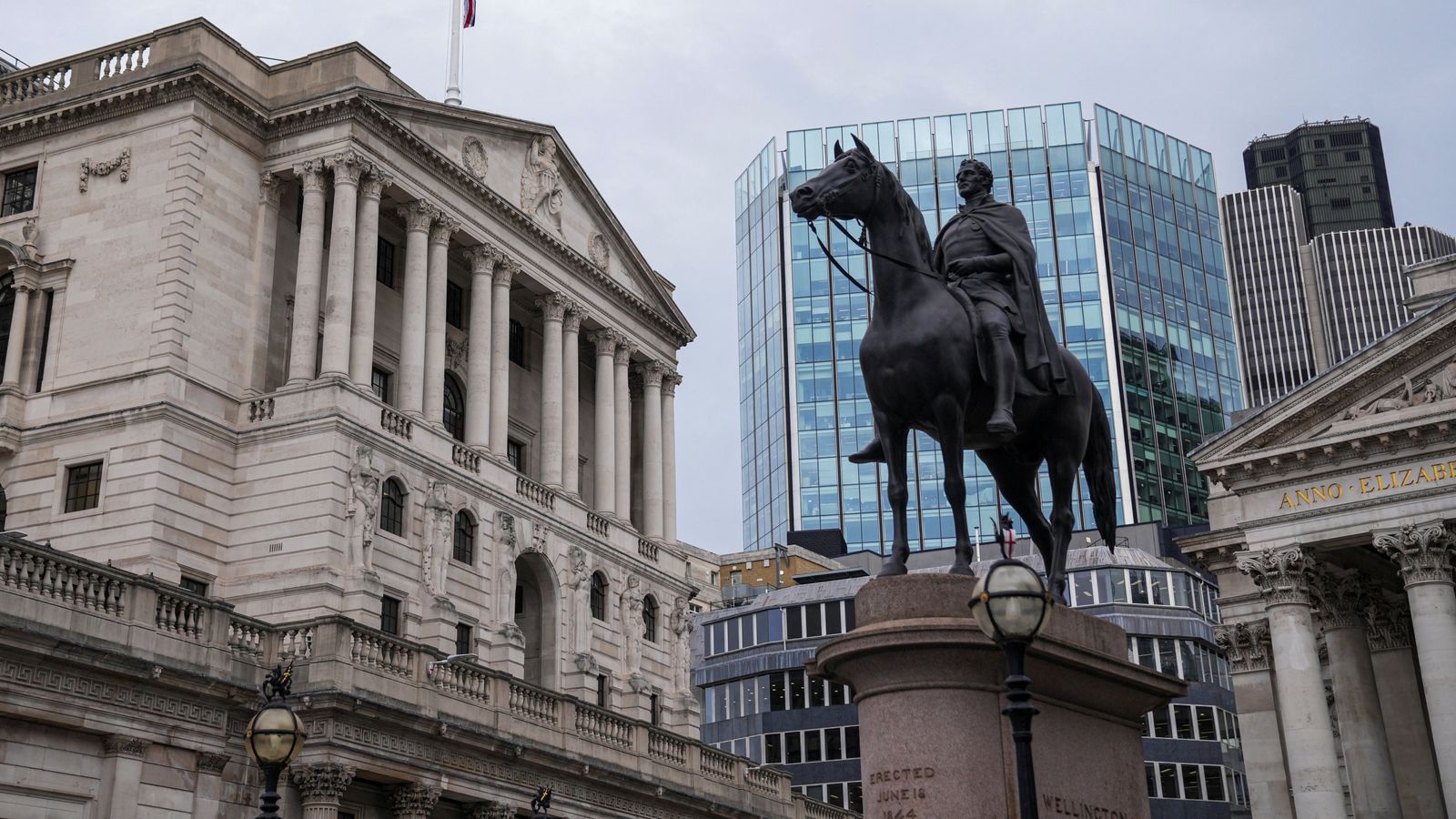
The Bank of England has warned of heightened risks to the UK’s financial system but cut the amount of money that banks need to hold in reserve in case of shock.
The twice-yearly financial stability report highlights a series of pressures, from higher government borrowing costs to risks around lending to major tech firms and record stock market valuations – particularly in areas exposed to artificial intelligence (AI).
“Risks to financial stability have increased during 2025,” the Bank‘s financial policy committee (FPC) said.
“Global risks remain elevated and material uncertainty in the global macroeconomic outlook persists. Key sources of risk include geopolitical tensions, fragmentation of trade and financial markets, and pressures on sovereign debt markets.
Money latest: My supermarket delivery row
“Elevated geopolitical tensions increase the likelihood of cyberattacks and other operational disruptions.
“In the FPC’s judgement, many risky asset valuations remain materially stretched, particularly for technology companies focused on AI.
“Equity valuations in the US are close to the most stretched they have been since the dot-com bubble, and in the UK since the global financial crisis (GFC). This heightens the risk of a sharp correction.”
Its concern extended to the growing trend of tech firms using debt finance to fund investment.
Could the AI bubble burst?
The Bank, which joined the International Monetary Fund in warning over an AI-led bubble in October, delivered its verdict at a time when UK regulators are under pressure from the government to place a greater focus on supporting economic growth.
It is understood, for example, the UK’s ringfencing regime – that sees retail banking separated from more risky investment banking operations within major lenders – is the subject of a review between the Bank and government.
Efforts by the chancellor to grow the economy will be potentially helped by the Bank’s decision today to lower capital requirements – the reserves banks must hold to help them withstand shocks in the financial system such as the global crisis of 2008/9.
The sector’s main capital requirement was cut by the Bank from 14% to 13%.

The Bank said that almost four million households face higher mortgage costs as fixed-term deals end. Pic: iStock
Such a move was urged, not only by the government, but by businesses to bolster UK lending and competitiveness.
The relaxation of the buffer does not take effect until 2027.
It was announced alongside confirmation that the country’s biggest lenders – Barclays, HSBC, Lloyds, NatWest, Santander UK, Standard Chartered and Nationwide building society – had passed the Bank’s latest stress tests.
The shocks each was exposed to included a 5% contraction in UK economic output, a 28% drop in house prices and Bank rate at 8%.
Despite the growing risks identified by the FPC, the Bank said that each was strong enough to support households and businesses even in the event of such scenarios, given the healthy state of their reserves.
It is widely expected that the gradual reduction in Bank rate will continue next year, assuming the outlook for inflation remains on a downwards trajectory, helping wider borrowing costs – a source of record bank profitability – decline.
The Bank said that three million households were expected to see their mortgage payments decrease in the next three years but that 3.9 million were forecast to refinance onto higher rates.
As such, it projected a £64 (8%) rise in costs for a typical owner-occupier mortgage customer rolling off a fixed rate deal in the next two years.
Banking stocks, which have enjoyed strong gains this year, were up when the FTSE 100 opened for business despite wider market caution globally which is aligned with the risks spoken of in the financial stability report.
Matt Britzman, senior equity analyst at Hargreaves Lansdown, said: “UK banks are offering a dose of optimism this morning in what’s turning out to be a good couple of weeks for the major lenders.
“The UK’s seven biggest banks sailed through the latest stress test, reaffirming their resilience and earning a regulatory nod to ease capital buffers.
“Most banks already hold capital well above the minimum by choice, so any shift in strategy may take time – but in theory, it frees up extra capital for lending or capital returns.
“However they use the new freedom, this is another clear signal that the UK banking sector is in robust health. This was largely expected, but the confirmation should still be taken well, especially after dodging tax hikes in last week’s budget.”
World
More than 800,000 young children seeing social media content ‘designed to hook adults’, figures show




Sudan’s paramilitary Rapid Support Forces says it has captured Babanusa, a transport junction in the south of the country, just a month after the fall of Al Fashir to the same group.
The RSF said in a statement the seizure of the city in West Kordofan state came as it repelled “a surprise attack” by the Sudanese army in what it called “a clear violation of the humanitarian truce”.
The paramilitary group added it had “liberated” the city in the state, which has become the latest frontline in the war in Sudan.
Sky’s Yousra Elbagir explains the unfolding humanitarian crisis
It comes just over a month after the Sudanese Armed Forces (SAF) withdrew from military positions in the heart of Al Fashir, the capital of North Darfur, and the symbolic site was captured by the RSF with no resistance.
The RSF claimed at the time it had taken over the city and completed its military control of the Darfur region, where the administration of former US president Joe Biden has accused the group of committing genocide.

Sky’s Africa correspondent Yousra Elbagir on why evidence suggests there is a genocide in Sudan.
The war between the Sudanese army and the RSF – who were once allies – started in Khartoum in April 2023 but has spread across the country.
About 12 million people are believed to have been displaced and at least 40,000 killed in the civil war, according to the World Health Organization (WHO) – but aid groups say the true death toll could be far greater.
Tom Fletcher, the UN’s under-secretary-general for humanitarian affairs, recently told Sky’s The World With Yalda Hakim the situation was “horrifying”.
“It’s utterly grim right now – it’s the epicentre of suffering in the world,” he said of Sudan.
Read more:
Tens of thousands killed in two days in Sudan city
Sudan’s war: Is it a genocide?
The United States, the United Arab Emirates, Egypt and Saudi Arabia – known as the Quad – earlier in November proposed a plan for a three-month truce followed by peace talks.
The RSF responded by saying it had accepted the plan, but soon after attacked army territory with a barrage of drone strikes.
-
 Sports2 years ago
Story injured on diving stop, exits Red Sox game
-
 Sports3 years ago
‘Storybook stuff’: Inside the night Bryce Harper sent the Phillies to the World Series
-
 Sports2 years ago
Game 1 of WS least-watched in recorded history
-
 Sports3 years ago
Button battles heat exhaustion in NASCAR debut
-
 Sports3 years ago
MLB Rank 2023: Ranking baseball’s top 100 players
-
Sports4 years ago
Team Europe easily wins 4th straight Laver Cup
-
 Environment3 years ago
Japan and South Korea have a lot at stake in a free and open South China Sea
-
 Environment1 year ago
Here are the best electric bikes you can buy at every price level in October 2024