
Suspected people-smuggling gang leader goes on trial

A man who sought asylum in Britain from Iran will go on trial today in Belgium, accused of leading an organised crime gang that helped smuggle thousands of people across the English Channel.
Hewa Rahimpur, 30, is alleged to have led a gang that criss-crossed Europe, sourcing boats, engines and life-jackets for migrant crossings.
The gang is claimed to have brought the items into Germany, using suppliers in Turkey and China, before later driving them to northern France.
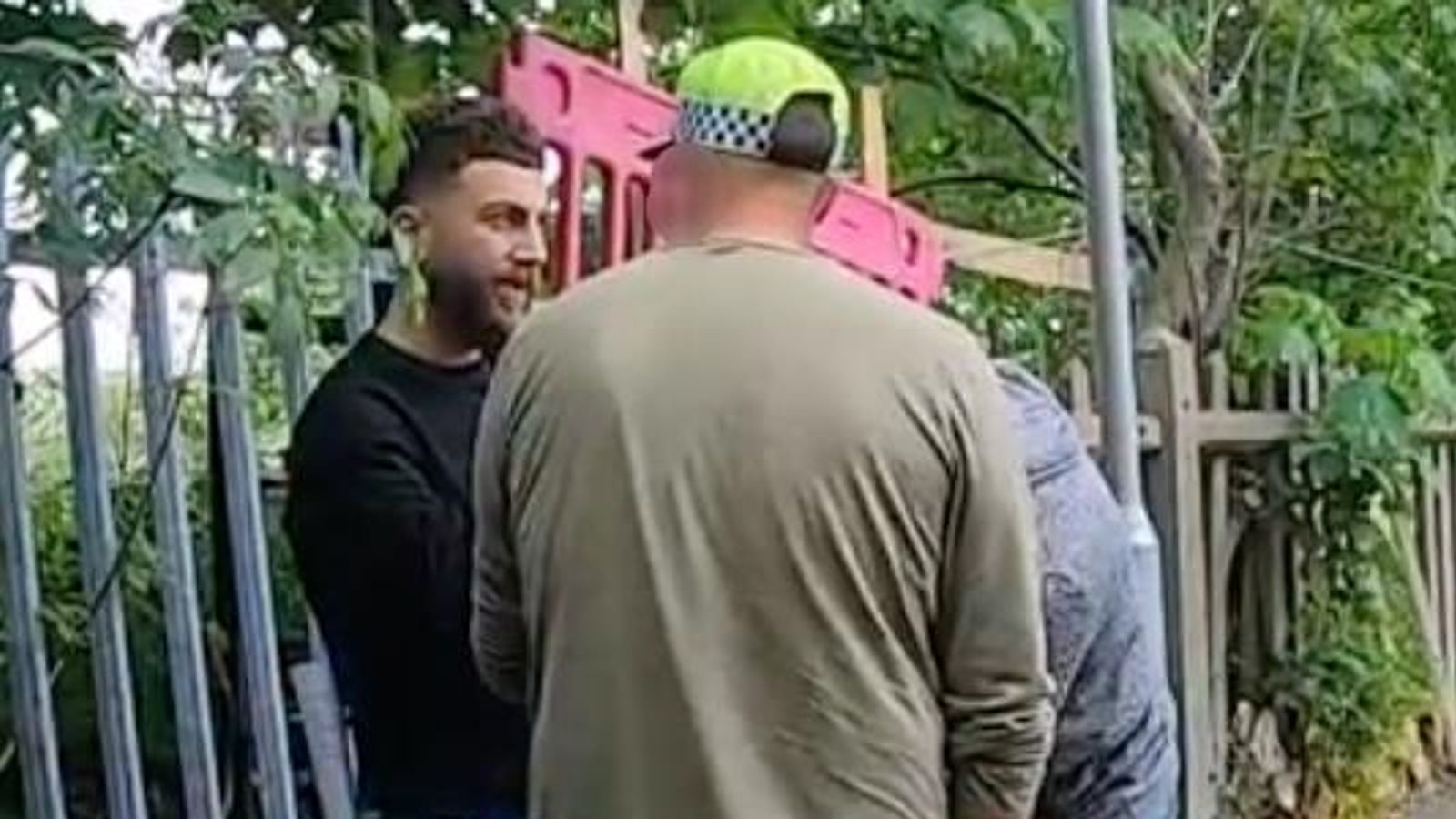
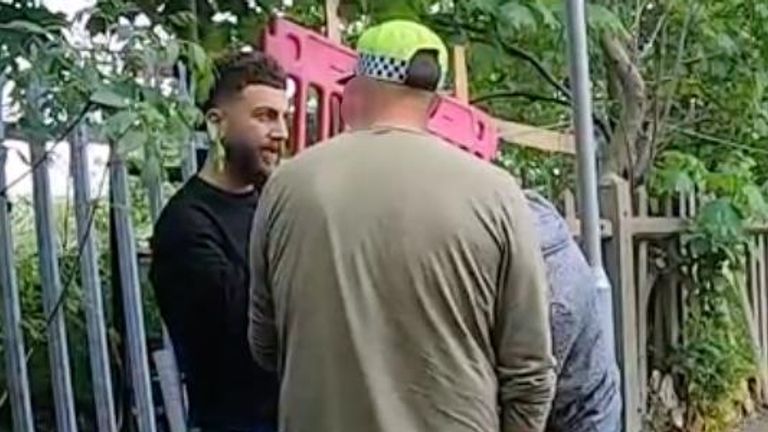
Hewa Rahimpur being arrested by NCA officers
There the boats were handed over to groups of migrants waiting near the sea, who were given rudimentary instructions about how to use the boats to try to get to Britain.
Rahimpur is one of 21 people who are facing trial in Bruges. The other 20 were all registered as living in Germany, but Rahimpur had made his home in Ilford, east London.
He was arrested in May 2022 by police from the National Crime Agency.
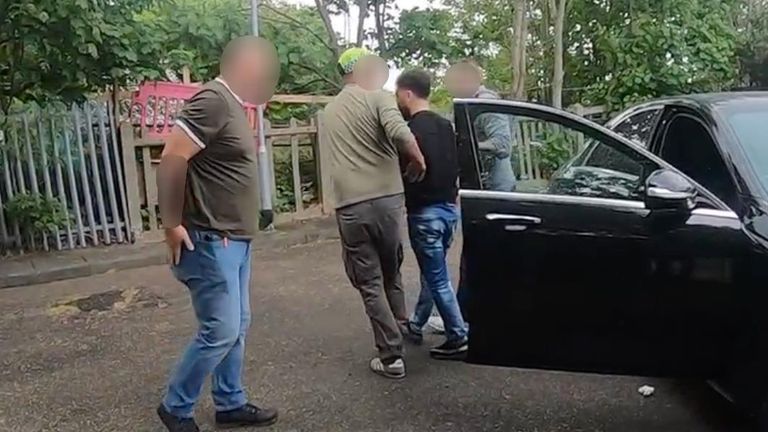
Rahimpur was driving to work when he was detained in May 2022
Rahimpur has been charged with being “a leading person” in a criminal organisation committed to smuggling people across the European Union.
The court will be told that, operating from Britain, he arranged the logistics of the people-smuggling network, co-ordinating the purchase of boats and other materials and then arranged for them to be delivered to France at just the right time to meet pre-arranged groups of paying customers.
Rahimpur’s arrest was part of a co-ordinated investigation carried out by police in Britain, France, Germany, Belgium and the Netherlands.
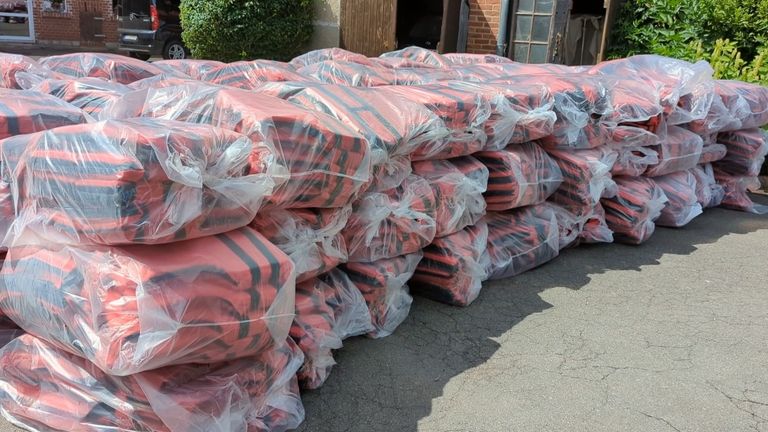
Life jackets were seized at a farm near Osnabruck, Germany, in 2022
According to the NCA, a total of 135 boats, 45 outboard engines and more than 1,200 life jackets were seized. Around half the boats were being stored at a single location – a farm in Osnabruck, Germany.
The NCA’s regional head of investigations, Jacque Beer, said the crime group was “one of the most significant criminal networks involved in supplying boats to people smugglers”.
The indictment against Rahimpur, in common with the all defendants, claims they smuggled children and adults, took advantage of “the vulnerable condition” of people, endangered lives and brought “unidentified victims” into the realm of crime.
The allegation says the crimes were so common that they became “a habit”.
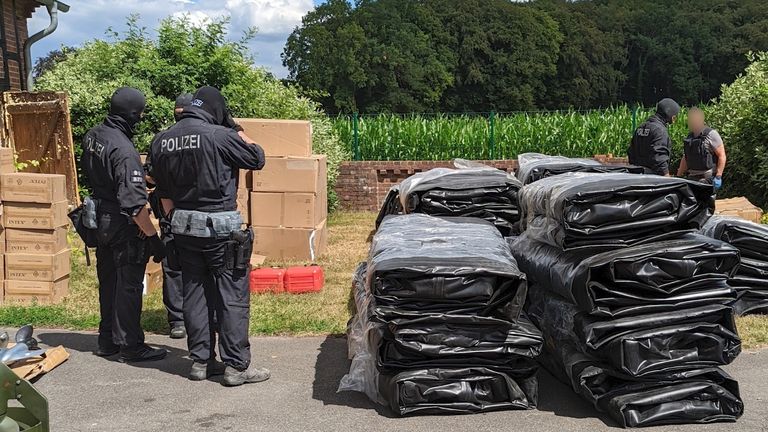
A total of 135 boats, 45 outboard engines and more than 1,200 life jackets were seized in the operation, according to the NCA
As well as facing a lengthy jail term, and deportation, prosecutors have demanded that Rahimpur repay £157,000 – a sum described as “the capital gains derived directly from the crime”.
Rahimpur arrived in Britain in 2016 and claimed asylum, saying he was an Iranian Kurd who would face persecution if he was returned home. Four years later, he was given leave to remain, and he set up a barber’s shop with a friend.
The business struggled and Rahimpur turned his attention to starting an east London food kiosk, called Manor Park Retails, in 2021. The following year, he was arrested while driving to work.
The trial of the men will be held at the main court in Bruges in front of legal teams who are familiar with allegations of people smuggling.
The case has officially been scheduled for a single day, but the court has been reserved until the end of the week.
World
Ukraine war: Putin rejects peace deal after meeting Trump’s team – and telling Europe he’s ready for war
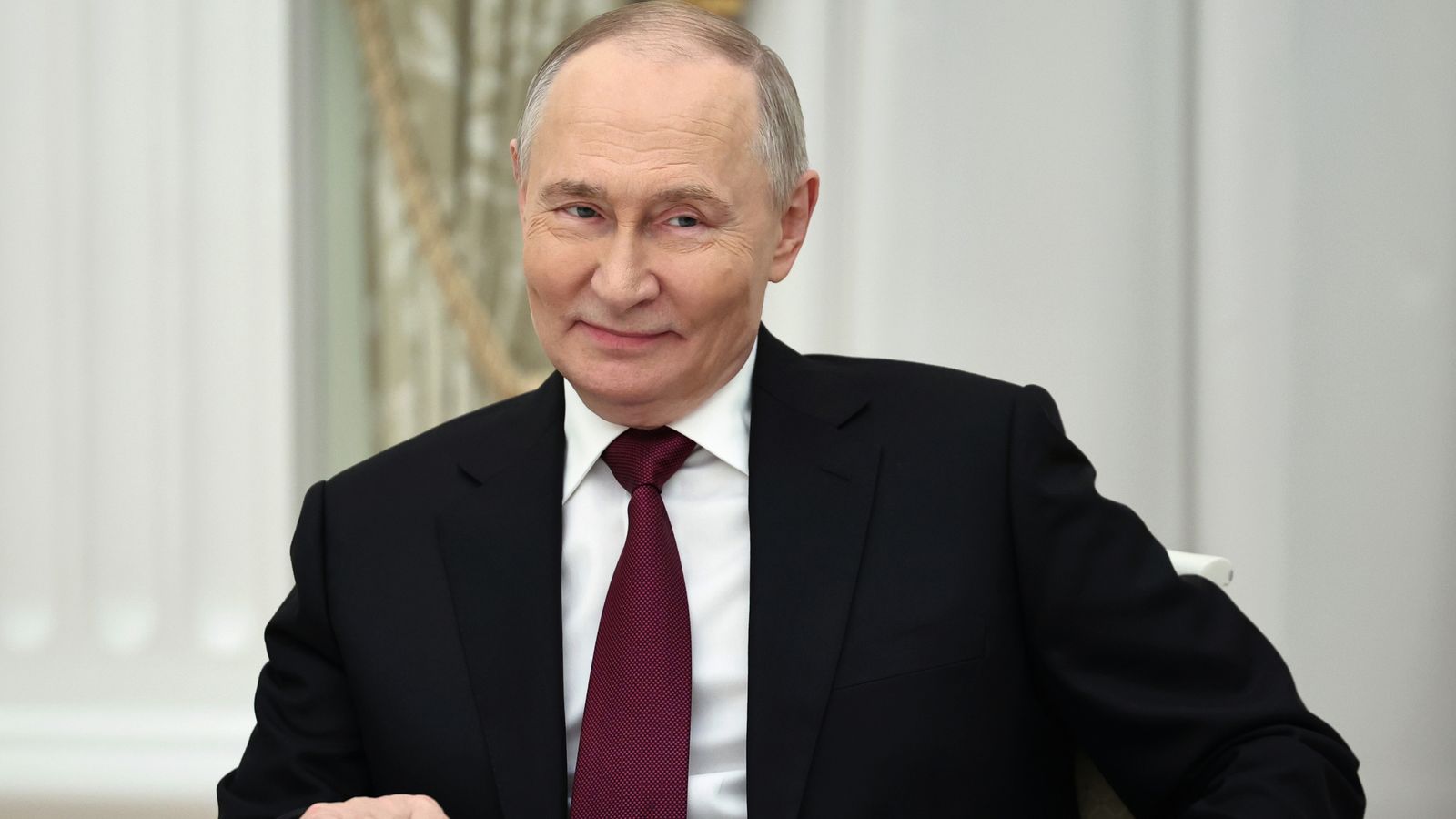
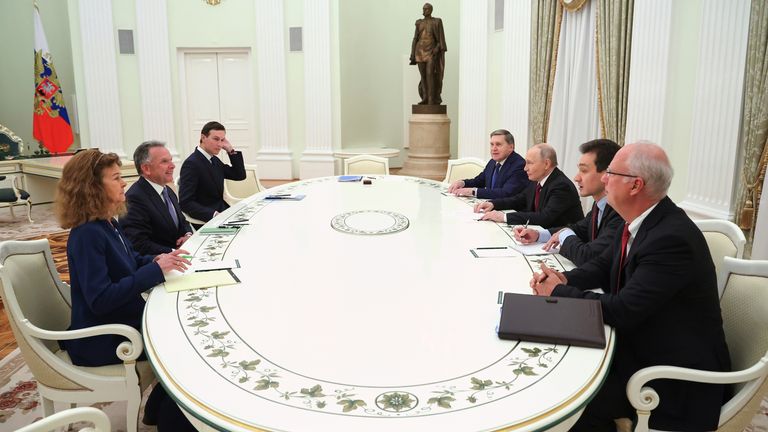
Talks between US negotiators and Vladimir Putin about Ukraine were “productive” but there was no breakthrough, according to Russian officials.
Donald Trump sent special envoy Steve Witkoff and his own son-in-law, Jared Kushner, to Tuesday’s summit in Moscow.
They were pictured in Red Square prior to the summit and Mr Witkoff later told a smiling Mr Putin that Moscow was a “magnificent city”.
Shortly before the summit, the Russian president warned his country was ready to fight if Europe wanted a war.
Analysis: Why Putin won’t agree to latest peace plan
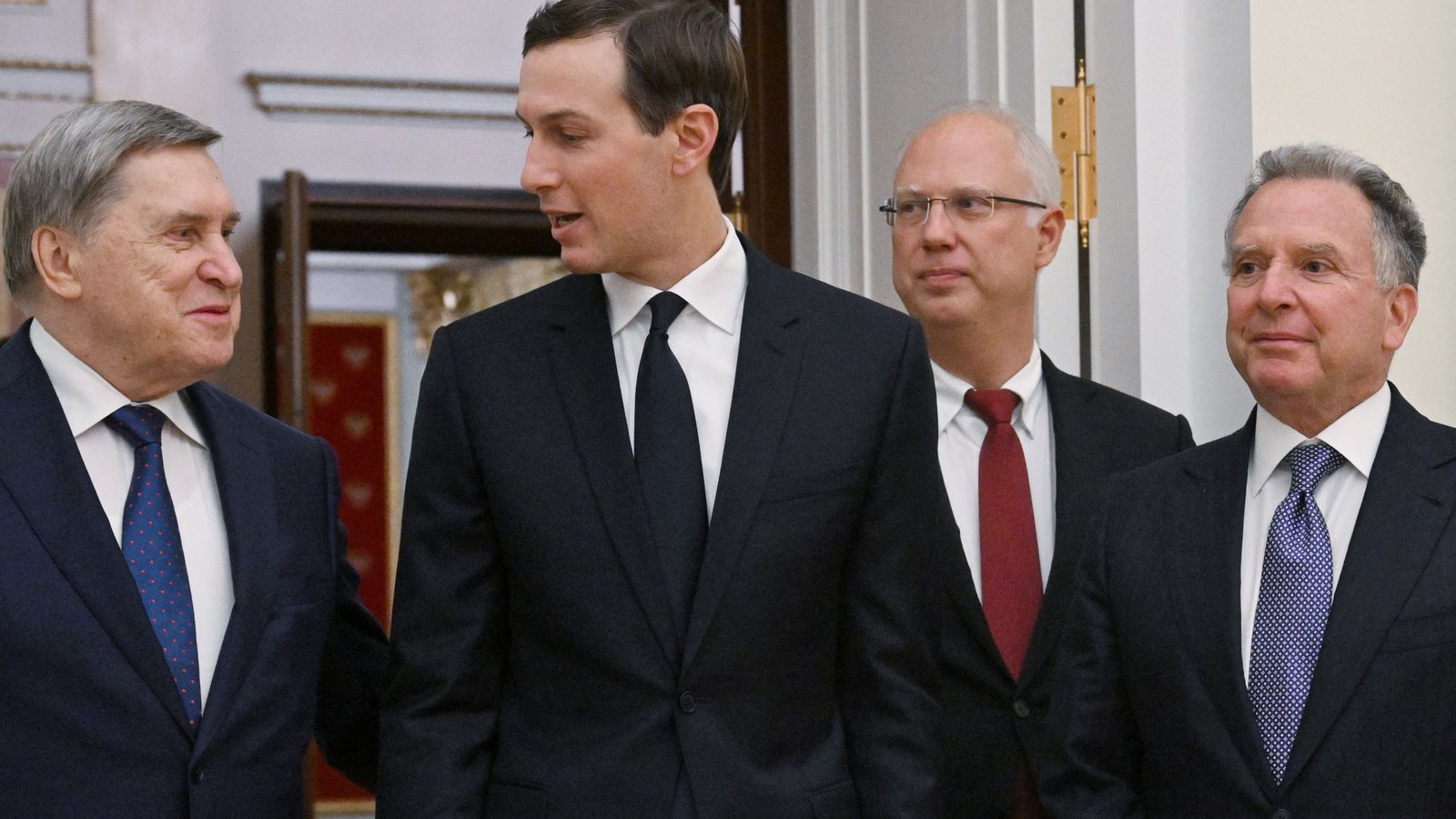
Russian foreign policy aide Yuri Ushakov and investment envoy Kirill Dmitriev were involved in the talks, which lasted over five fours and ended after midnight.
Both sides agreed not to disclose precise details, but in a one-word social media post, Mr Dmitriev described the meeting as “productive”.
Mr Ushakov called it “rather useful, constructive” and asked whether peace was closer or further, he commented: “Not further, that’s for sure”.
However, he said a compromise hadn’t been reached on the issue of territories and that the Kremlin sees “no resolution to the crisis” without one.
Russia wants the whole of the Donbas region – even the parts it does not hold – but Ukraine has balked at the prospect.
Mr Ushakov said there was “still a lot of work to be done, both in Washington and in Moscow” and that “contacts will continue”.
The two sides were joined by translators. Pic: Sputnik/AP
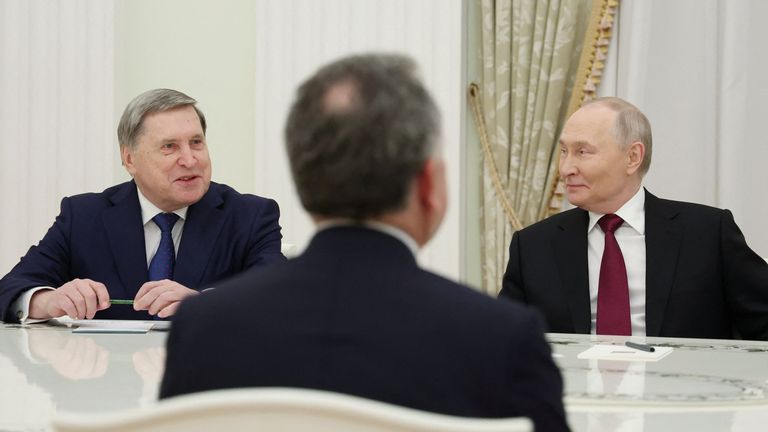
Pic: Reuters
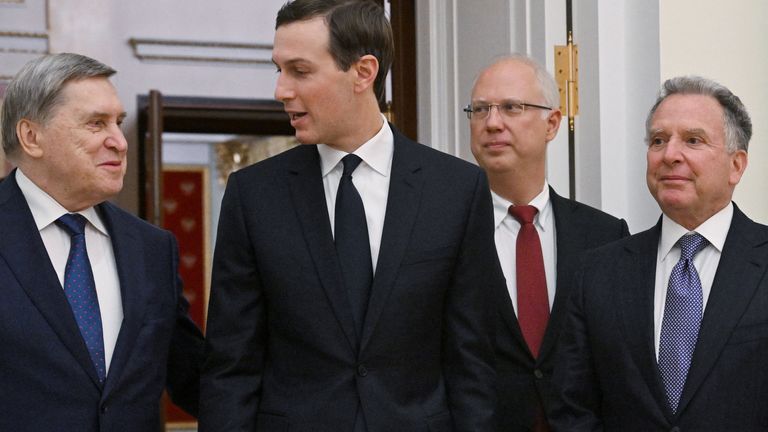
Jared Kushner and Steve Witkoff were joined by Kirill Dmitriev (2nd right) and Yuri Ushakov (left). Pic: Reuters
The meeting took place after an initial 28-point US peace plan was leaked and alarmed European officials, who said it heavily favoured Russia.
An “updated and refined peace framework” was formulated after talks between Europe, the US, and Ukraine in Geneva last month, but Mr Putin has indicated he will not accept it.
Putin: Europe on the side of war
Earlier on Tuesday, Mr Putin said Russia was ready to fight if Europe wanted a war.
The Russian president accused European powers of changing peace proposals for Ukraine with “demands” that Russia considered “absolutely unacceptable”.
Mr Putin said the Europeans were “on the side of war”.
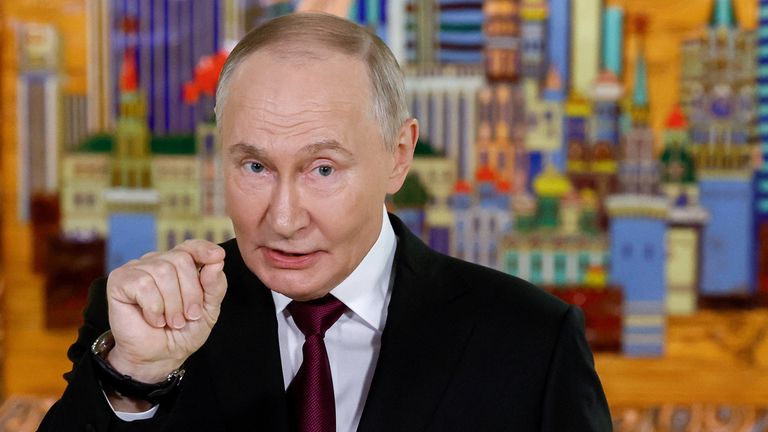
Putin ‘lashes out’ at Europe
“We’re not planning to go to war with Europe, I’ve said that a hundred times,” he said following an investment forum.
“But if Europe suddenly wants to fight us and starts, we’re ready right now. There can be no doubt about that.”
“If Europe suddenly wants to start a war with us and does, then a situation could very quickly arise in which we have no one to negotiate with,” he added.
Putin trying to frighten US away from Europe with war remarks
Zelenskyy in Dublin
Ukraine’s President Volodymyr Zelenskyy was in Dublin on Tuesday to meet Ireland’s prime minister and president.
During the trip, Mr Zelenskyy said he was ready to meet Mr Trump again, but it would depend on how successful the Moscow talks were.
He said the chances of ending the war were “better now than ever” but warned there would be “no easy decisions” and there must be “no games behind Ukraine’s back”.
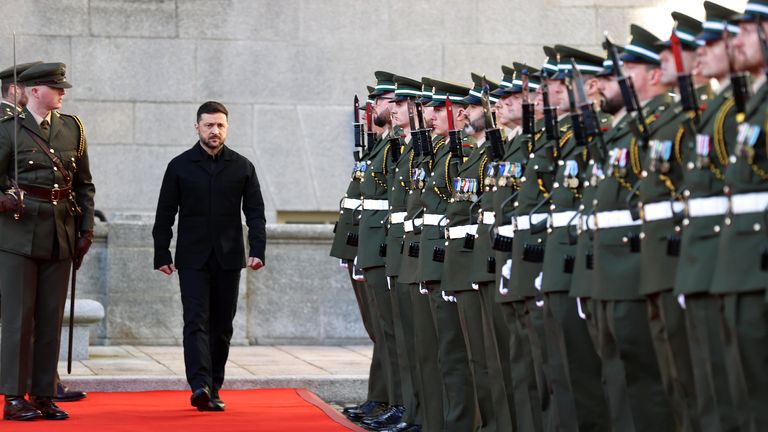
President Zelenskyy had a guard of honour in Dublin. Pic: Reuters
Calling it “one of the most challenging but optimistic moments” since Russia invaded in 2022, he said the US was “taking serious steps to end this war one way or another”.
He admitted “some things still need to be worked out” and said a “decent, dignified peace” was needed.
Read more:
How history could view Trump as ‘biggest useful idiot’
Hotspots: Reality of life on frontline of journalism
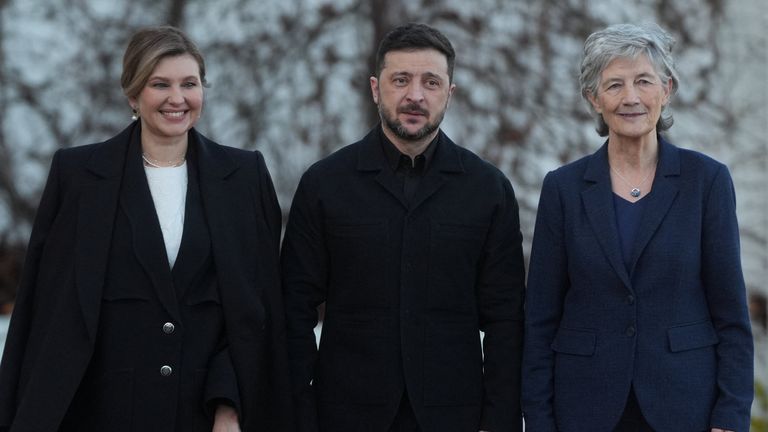
President Zelenskyy, his wife Olena, and Irish President Catherine Connolly. Pic: Reuters
The Irish government announced €100m (£88m) in non-lethal aid for Ukraine, “generosity” for which Mr Zelenskyy said Ukraine was grateful.
It brings the total in non-lethal military aid provided to Ukraine this year to €200m (£176m).
The funding is part of a new Ireland-Ukraine partnership, which builds on an agreement signed last year.
It includes €25m (£22m) for the restoration and protection of energy infrastructure and a scheme to support training and other efforts as part of Ukraine’s path to EU accession, which Mr Zelenskyy said he hoped to achieve within five years.
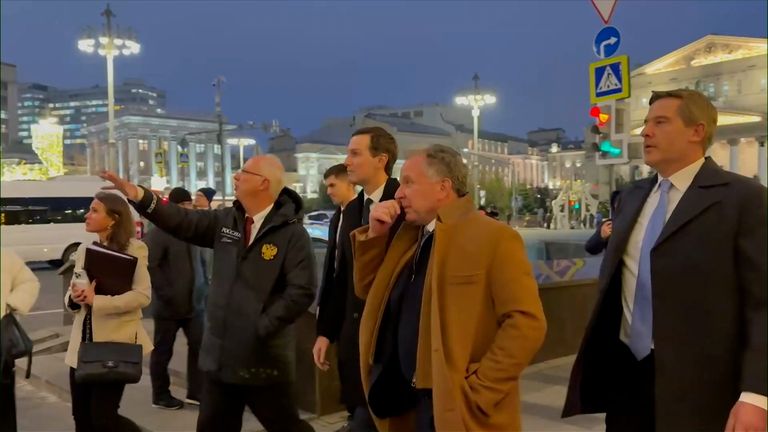
The Americans were given the full VIP treatment on their visit to Moscow.
There was a motorcade from the airport, lunch at a Michelin-starred restaurant, and even a stroll around Red Square.
It felt like Steve Witkoff and Jared Kushner were on more of a tourist trail than the path to peace.
Trump’s envoys walk around Moscow
They finally got down to business in the Kremlin more than six hours after arriving in Russia. And by that point, it was already clear that the one thing they had come to Moscow for wasn’t on offer: Russia’s agreement to their latest peace plan.
According to Vladimir Putin, it’s all Europe’s fault. While his guests were having lunch, he was busy accusing Ukraine’s allies of blocking the peace process by imposing demands that are unacceptable to Russia.
The Europeans, of course, would say it’s the other way round.
But where there was hostility to Europe, only hospitality to the Americans – part of Russia’s strategy to distance the US from its NATO allies, and bring them back to Moscow’s side.
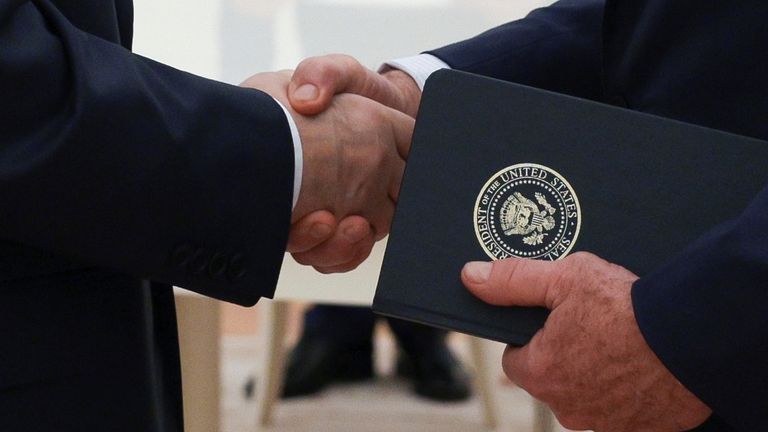
Vladimir Putin and Steve Witkoff shaking hands in August. AP file pic
Putin thinks he’s winning…
Russia wants to return to the 28-point plan that caved in to its demands. And it believes it has the right to because of what’s happening on the battlefield.
It’s no coincidence that on the eve of the US delegation’s visit to Moscow, Russia announced the apparent capture of Pokrovsk, a key strategic target in the Donetsk region.
It was a message designed to assert Russian dominance, and by extension, reinforce its demands rather than dilute them.
Read more:
Michael Clarke answers your Ukraine war questions
‘Thousands’ of Westerners applying to live in Russia

‘Everyone must be on this side of peace’
…and believes US-Russian interests are aligned
The other reason I think Vladimir Putin doesn’t feel the need to compromise is because he believes Moscow and Washington want the same thing: closer US-Russia relations, which can only come after the war is over.
It’s easy to see why. Time and again in this process, the US has defaulted to a position that favours Moscow. The way these negotiations are being conducted is merely the latest example.
With Kyiv, the Americans force the Ukrainians to come to them – first in Geneva, then Florida.
As for Moscow, it’s the other way around. Witkoff is happy to make the long overnight journey, and then endure the long wait ahead of any audience with Putin.
It all gives the impression that when it comes to Russia, the US prefers to placate rather than pressure.
According to the Kremlin, both Russia and the US have agreed not to disclose the details of yesterday’s talks in Moscow.
I doubt Volodymyr Zelenskyy is filled with hope.
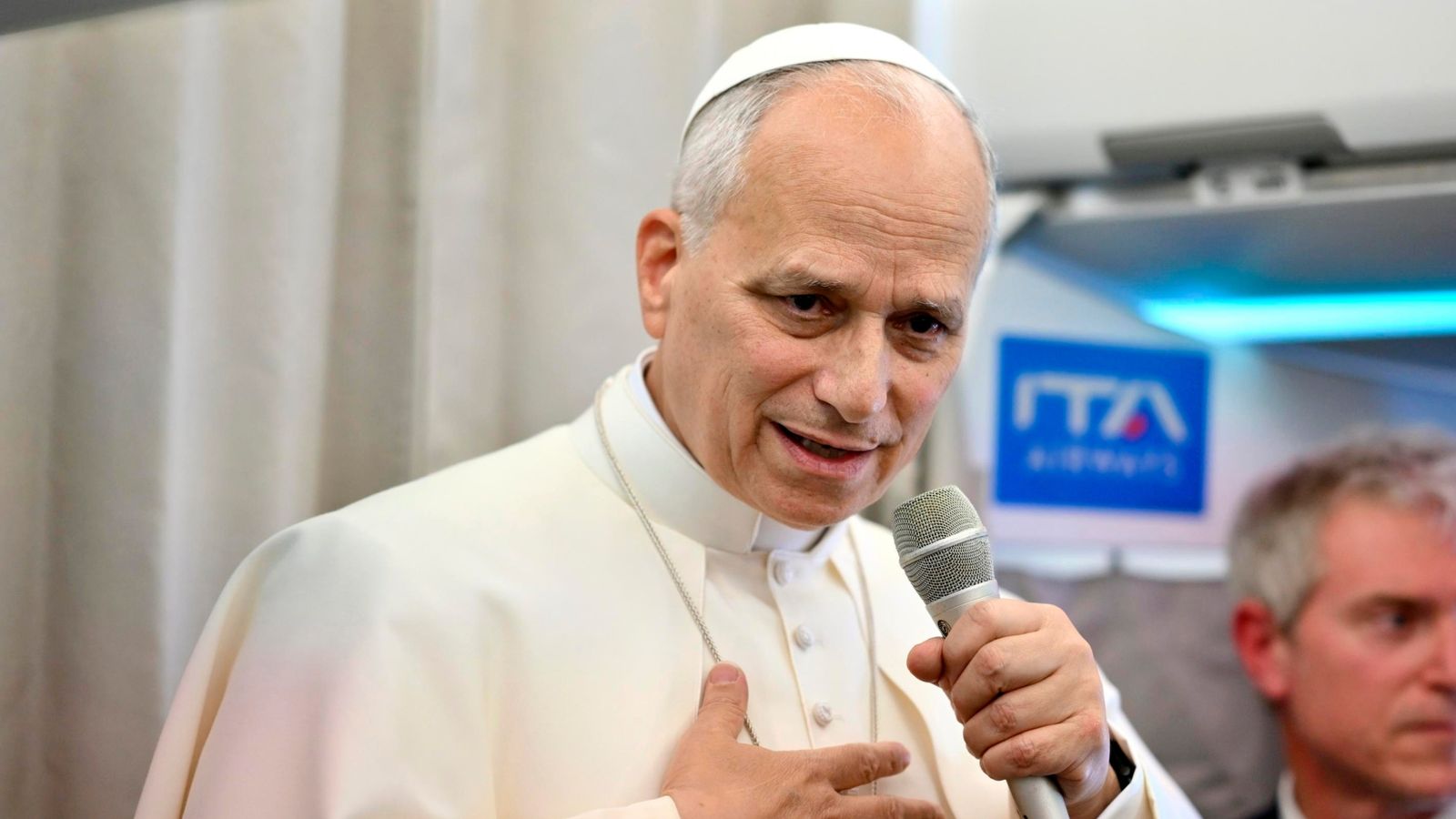
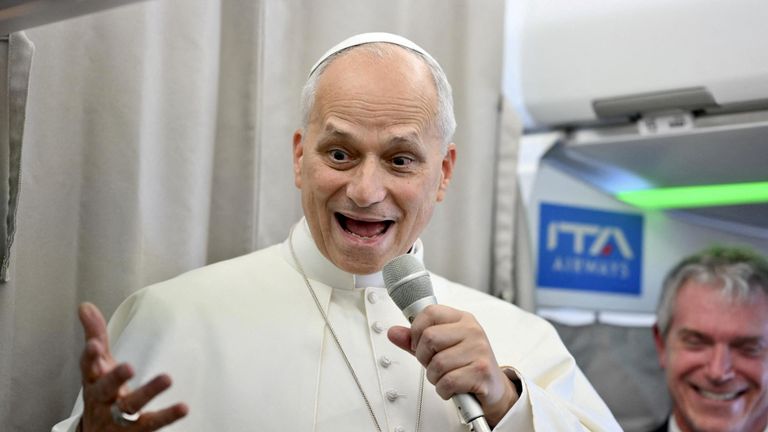
The Pope has urged Donald Trump not to try to oust Venezuelan President Nicolas Maduro using military force.
Leo, the first American pontiff, said it would be better to attempt dialogue or impose economic pressure on Venezuela if Washington wants to pursue change there.
The Trump administration has been weighing options to combat what it has portrayed as Mr Maduro’s role in supplying illegal drugs that have killed Americans.
The socialist Venezuelan president has denied having any links to the illegal drug trade.
Pope Leo XIV aboard a flight to Rome. Pic: Reuters
Asked during a news conference about President Trump’s threats to remove Mr Maduro by force, the Pope said: “It is better to search for ways of dialogue, or perhaps pressure, including economic pressure.”
He added that Washington should search for other ways to achieve change “if that is what they want to do in the United States”.
The Pope was speaking as he flew home from a visit to Turkey and Lebanon – his first overseas trip in the role.
Mr Maduro has said Venezuelans are ready to defend their country as the US considers a land attack.
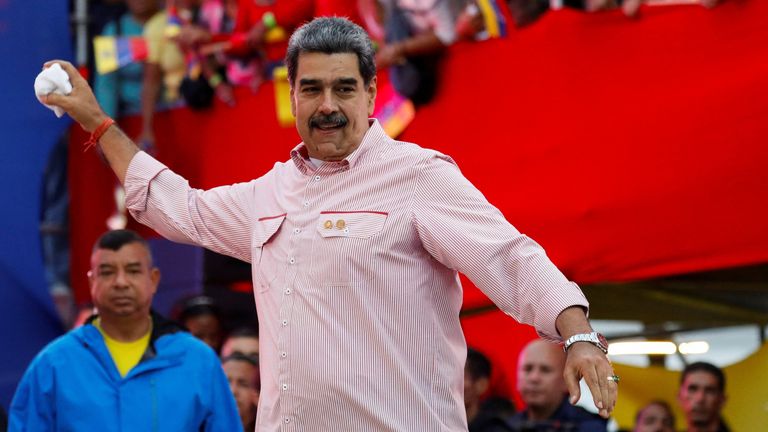
Venezuela’s President Nicolas Maduro in Caracas. Pic: Reuters
The president held a rally in Caracas amid heightened tensions with Mr Trump’s administration, which has been targeting what it says are boats carrying drug smugglers.
Mr Trump met his national security team on Monday evening, having warned last week that land strikes would start “very soon”.
It’s not been confirmed what was discussed at the meeting, but White House press secretary Karoline Leavitt told reporters: “There’s many options at the president’s disposal that are on the table – and I’ll let him speak on those.”
US forces have carried out at least 21 strikes on boats it claims were carrying narcotics to its shores over the last few months.
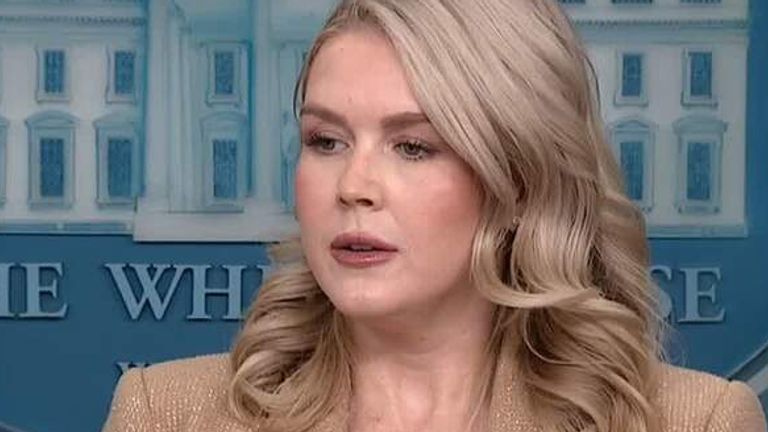
‘The president has a right to take them out’
Mr Maduro – widely considered a dictator by the West – said on Monday that Venezuelans are ready “to defend [the country] and lead it to the path of peace”.
“We have lived through 22 weeks of aggression that can only be described as psychological terrorism,” he said.
Venezuela has said the boat attacks, which have killed more than 80 people, amount to murder – and that Mr Trump’s true motivation is to oust Mr Maduro and access its oil.
This breaking news story is being updated and more details will be published shortly.
Please refresh the page for the latest version.
You can receive breaking news alerts on a smartphone or tablet via the Sky News app. You can also follow us on WhatsApp and subscribe to our YouTube channel to keep up with the latest news.
-
 Sports2 years ago
Story injured on diving stop, exits Red Sox game
-
 Sports3 years ago
‘Storybook stuff’: Inside the night Bryce Harper sent the Phillies to the World Series
-
 Sports2 years ago
Game 1 of WS least-watched in recorded history
-
 Sports3 years ago
Button battles heat exhaustion in NASCAR debut
-
 Sports3 years ago
MLB Rank 2023: Ranking baseball’s top 100 players
-
Sports4 years ago
Team Europe easily wins 4th straight Laver Cup
-
 Environment3 years ago
Japan and South Korea have a lot at stake in a free and open South China Sea
-
 Environment1 year ago
Here are the best electric bikes you can buy at every price level in October 2024