
College Football Week 2 Power Rankings: Texas, Colorado surge


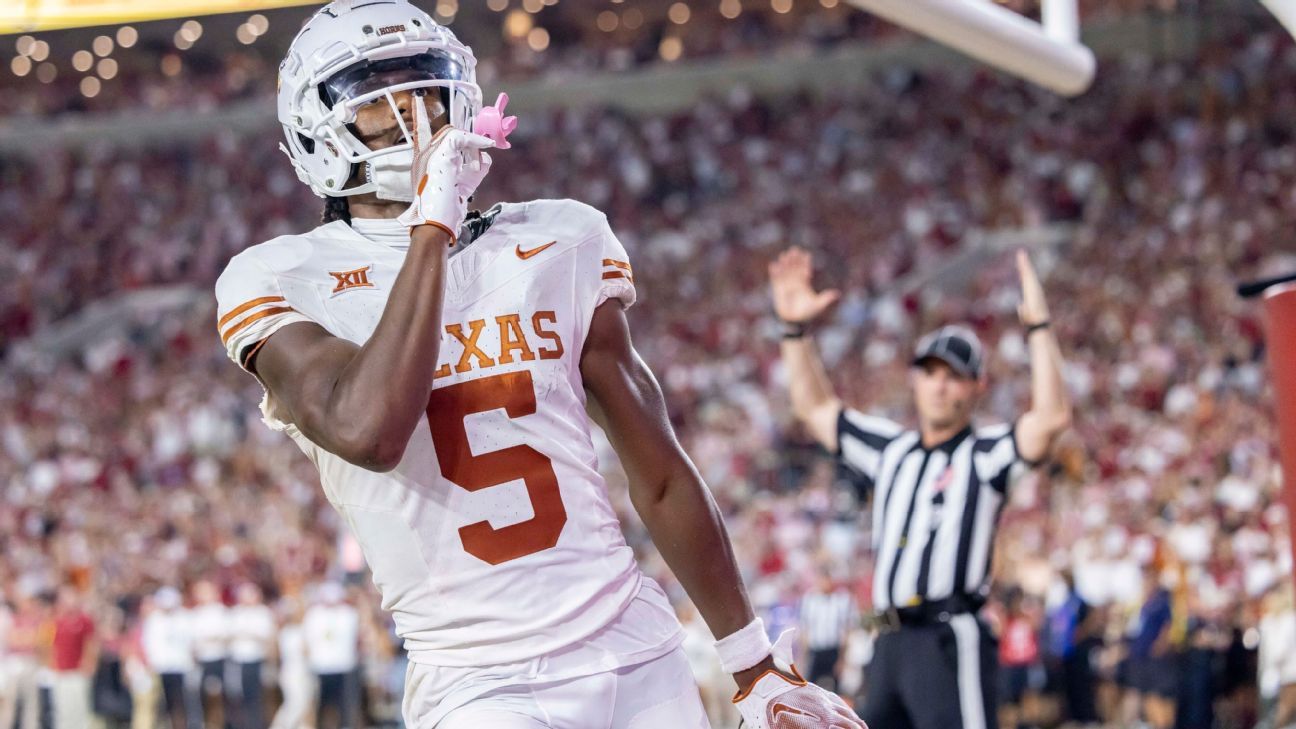
Huddled in a corner of Bryant-Denny Stadium, Texas players sang the “Eyes of Texas” to a large contingent of fans in burnt orange T-shirts and arms raised with Hook ‘Em hand signs Saturday night. It was a rare scene.
Texas’ 34-24 win over No. 3 Alabama was the Longhorns’ first against an AP Top-3 team since 2008 against Oklahoma. It was their first against Alabama since the 1982 Cotton Bowl, and the first by double digits against Alabama since the 1948 Sugar Bowl.
It was Alabama’s first loss by double digits when entering the fourth quarter since 2008 against Florida in the SEC title game, and it snapped a 21-game home win streak (longest active home winning streak in FBS).
The win launched Texas up to No. 4 in this week’s Power Rankings.
Here’s a look at Texas and the rest of the Power Rankings after Week 2 of the college football season.
Quarterback Carson Beck delivered a workmanlike 283 yards, two touchdowns and one interception, and if you’re offensive coordinator Mike Bobo you have to like the way the ball was spread around with 12 different players catching passes. But the story once again was the Georgia defense, which pitched a first-half shutout for the 21st time since the start of the 2021 season — the most during that span. Ball State got a fourth quarter field goal to avoid the full shutout, but only 3 points allowed and 2.8 yards per rush allowed should have Bulldogs coach Kirby Smart feeling good about his team’s effort. — Alex Scarborough
Up next: vs. South Carolina (3:30 p.m. ET, CBS)

The Seminoles were not perfect against Southern Miss, but you would not know it from the final score. There was no letdown from Florida State after a big Week 1 win over LSU. Trey Benson ran for three touchdowns, while Keon Coleman added another receiving touchdown — and a ridiculous hurdle after another reception as the starters played a little more than a half. This is the first time Florida State has scored 45 or more points in each of its first two games since 2016. — Andrea Adelson
Up next: at Boston College (noon ET, ABC)

Wolverines quarterback J.J. McCarthy threw for 278 yards and two touchdowns, completing 22 of 25 passes against UNLV. Through two games, McCarthy owns the second- and third-highest one-game completion percentage by a Michigan quarterback (88% this week and 86.7 last week). He’s the first Big Ten quarterback in the past 25 years to post an 85% completion percentage or higher in consecutive games. Running back Blake Corum put points on the board, as well, running for three touchdowns. The Wolverines defense gave up just seven points to UNLV after holding East Carolina to three points. Despite losing some pieces along the defensive line from last season, they have been dominant through two weeks. — Tom VanHaaren
Up next: vs. Bowling Green (7:30 p.m., Big Ten Network)

Texas and Quinn Ewers made a Texas-sized statement in Tuscaloosa, beating No. 3 Alabama and snapping the Tide’s 21-game home winning streak. Ewers completed 24 of 38 passes for 349 yards with a 44-yard TD to Xavier Worthy and 7- and 39-yard TD strikes to Georgia transfer Adonai Mitchell. The defense, much maligned in recent years, intercepted Jalen Milroe twice and held the Tide to 107 yards rushing and 3.1 yards an attempt. This was the win Texas fans have been waiting for since Steve Sarkisian arrived from Alabama. The hype around this Texas team was legit, and the toughest game on the schedule this season is now behind it. — Dave Wilson
Up next: vs. Wyoming (8 p.m. ET, Longhorn Network)

Caleb Williams needed only half a game to throw for 300 yards, three touchdowns and add a rushing score to boot as the Trojans dominated Stanford in the Pac-12 finale between the two teams. An invigorated USC defense had their best performance of the season, limiting the Cardinal offense to only three points through three quarters while also forcing two turnovers. Thanks to Williams’ play, rushing touchdowns from MarShawn Lloyd and Austin Jones as well as a 75-yard punt return TD by the electric freshman Zachariah Branch, the second half was a mere formality and another chance for USC to test out its depth ahead of a bye week and tougher matchups to come— Paolo Uggetti
Up next: at Arizona State, Sept. 23

The Nittany Lions’ running game was in full effect, accounting for touchdowns on their first four possessions of a 63-7 win over Delaware. Kaytron Allen (103 rushing yards, one TD) and Nicholas Singleton (47 rushing yards, three TDs) took turns for an offense that churned out 315 rushing yards. The two sophomore running backs allowed Penn State to control the clock considerably, scoring on eight of 11 possessions. Quarterback Drew Allar completed 22 of 26 passes for 204 yards and a touchdown, hitting eight different receivers and adding a one-yard TD run. Defensively, the Nittany Lions held Delaware to 140 total yards, and linebacker Dominic DeLuca had a 26-yard pick-six. — Blake Baumgartner
Up next: at Illinois (noon ET, Fox)

After an unsettling offensive opener against Indiana that largely ignored its star wide receivers, Ohio State not surprisingly got right against FCS Youngstown State. Quarterback Kyle McCord found Biletnikoff Award favorite Marvin Harrison Jr. for a 71-yard touchdown on the game’s opening possession, and a 39-yard score later in the first quarter. Harrison and fellow standout receiver Emeka Egbuka, who had only five receptions and 34 yards against Indiana, steadied themselves with a combined 254 yards and three touchdowns on 12 receptions. McCord looked more comfortable, finishing with 258 passing yards and three touchdowns, and running back TreVeyon Henderson averaged 11.2 yards per carry with two scores. Ohio State still has room to improve, scoring only once after halftime and struggling a bit on early third-down chances. But the much-maligned defense has allowed only 10 points through two games, as high-powered Western Kentucky visits next week. — Adam Rittenberg
Up next: vs. Western Kentucky (4 p.m. ET, FOX)

Quarterback Michael Penix Jr. did nothing to hurt his Heisman Trophy candidacy in a win against Tulsa, completing 28 of 38 passes for 409 yards with three touchdowns and an interception. He completed passes to 10 different receivers. The Huskies racked up 563 total yards and had two 100-yard receivers in Jalen McMillan (eight receptions for 120 yards and a score) and Rome Odunze (seven catches for 107 yards and a TD). Two receivers — Ja’Lynn Polk and Odunze — each ran for a touchdown as well. Washington tallied at least 37 points for the fifth time in its last six games, dating back to last season. — Baumgartner
Up next: at Michigan State (5 p.m. ET, Peacock)

In 2016, Notre Dame played in hurricane conditions at NC State and lost 10-3 as part of a miserable 4-8 season. The Irish wouldn’t let another weather-impacted game in Raleigh derail them, overcoming a one-hour, 45-minute delay early in the second quarter to pull away from the Wolfpack behind a big-play offense and an aggressive defense. Al Golden’s blitzing defense harassed NC State quarterback Brennan Armstrong and picked off three passes, including interceptions on consecutive possessions, by Xavier Watts and DJ Brown to prevent any chance of a rally. Audric Estime set the tone on offense early by racing for an 80-yard touchdown. Quarterback Sam Hartman had four more touchdown passes to give him 10 through three games at Notre Dame, which won its 29th consecutive regular-season game against an ACC foe, tying Florida State (1992-95) for the league record. — Rittenberg
Up next: vs. Central Michigan (2:30 p.m., ET, Peacock)

Since coming to Tennessee, Josh Heupel’s Tennessee teams have typically beaten up on the teams the Vols were supposed to. That wasn’t the case Saturday as Tennessee sputtered to a 30-13 win in its home opener over FCS foe Austin Peay, the same Austin Peay team that lost 49-23 in its opener to Southern Illinois. The game was tied at 6-6 with 4:55 left in the second quarter, and the Vols didn’t score their first touchdown until the 15-second mark of the second quarter when quarterback Joe Milton III scored on a 6-yard run. The Vols had 10 penalties for 88 yards, lost a fumble in the red zone and gave up a 52-yard touchdown reception in the fourth quarter. Austin Peay actually had more first downs than Tennessee (19 to 17), so it was anything but a clean performance for the Vols, who have some things to clean up before they travel to Florida for their SEC opener next week. — Chris Low
Up next: at Florida (7 p.m. ET, ESPN)

With Jalen Milroe, apparently you have to take the good with the bad. The good being elite athleticism running the ball, and a strong arm to take shots deep. The bad being that you never know quite what you’re going to get with the rest of his game. Too often he stares down receivers and telegraphs his passes. Twice Texas took advantage with interceptions. And lest we put the loss all on Milroe’s shoulders, the running game didn’t do much, and the offensive line consistently allowed pressure. The defense, on the other hand, was good at points but couldn’t get home and sack the quarterback and was exposed when Quinn Ewers decided he wanted to let it rip. A non-conference 34-24 loss this early doesn’t mean Alabama’s season is over. But it doesn’t portend anything good. — Scarborough
Up next: at South Florida (3:30 p.m. ET, ABC)

The Utes went into Waco without starting quarterback Cam Rising for a second straight game, and this time, his absence really showed. While dueling QBs Bryson Barnes and Nate Johnson were able to keep the Utes afloat against Florida in the season opener, both struggled to get anything going against Baylor, combining for only 153 passing yards and zero touchdowns the entire game. The Utes somehow managed to outlast Baylor thanks to a game-tying drive in the fourth quarter and an ensuing interception from safety Cole Bishop, which set up the game-winning drive. Ja’Quinden Jackson tallied 129 of the team’s 224 yards on the ground. A 2-0 start was almost ruined by a miracle Baylor drive with less than 30 seconds left in the game. After allowing a 47-yard pass that left a single second on the clock, the Utes found some luck when a throw to the end zone as time expired was not called for defensive pass interference, which would have given the Bears another shot at tying or winning the game in regulation. — Uggetti
Up next: vs. Weber State (2 p.m. ET, PAC-12 Network)

The Ducks rode a 20-3 fourth quarter to erase a 9-point deficit and win 38-30 at Texas Tech. Quarterback Bo Nix turned in what has become an expected performance from him in an Oregon uniform: 32 of 44 completed passes, 359 yards with two TD passes, along with 46 yards on nine carries. He outshined former Oregon QB Tyler Shough, who rushed for 101 yards and passed for 282, but threw three costly interceptions including a pick-six in the game’s waning moments that ended any shot of a Tech upset. — Kyle Bonagura
Up next: vs. Hawai’i (8 p.m., PAC-12 Network)

Two games in and Oregon State is still waiting for its first competitive game. FCS UC Davis hardly resembled a speed bump as the Beavers got their starters out of the game early, opening up the freshly-renovated Reser Stadium in style. Their next opponent, San Diego State, figures to provide a more difficult test, but after a 25-point loss to UCLA, the Beavers will be strong favorites to finish nonconference play undefeated. — Bonagura
Up next: vs. San Diego State (3:30 p.m., FS1)

The best kind of early-season tuneup is one in which you get punched in the mouth and respond beautifully. Troy punched, and Kansas State responded. The Trojans scored to cut an early K-State lead to 14-10 late in the first half, and it looked destined to go to halftime with that score. Instead, quarterback Will Howard completed a 38-yard touchdown pass to Phillip Brooks with 10 seconds left in the half. In the second half, one Howard touchdown pass and two Howard keepers turned this one into a 42-13 laugher. Howard finished with 250 yards and had a hand in five touchdowns, and the defending Sun Belt champions just couldn’t keep up. — Bill Connelly
Up next: at Missouri (noon, SEC Network)

Coming into the season, it was fair to think Colorado — having gone 1-11 the year before — could start 0-2 with games at TCU and home against Nebraska. Instead, the Buffs sit at 2-0 with a pair of impressive victories and will welcome ESPN’s “College GameDay” to campus next week as a heavy favorite to triple their win total from last year before the start of conference play. Colorado started slowly against Nebraska but was in control for nearly the entirety in a 36-14 win. It was a particularly encouraging performance from the defense, which rebounded from giving up 42 points last week and limited the Huskers to few scoring chances. — Bonagura
Up next: vs. Colorado State (10 p.m. ET, ESPN)

The offense that was such a mess in the season opener against Florida State found itself Saturday, scoring 72 points against Grambling. Jayden Daniels, whose Heisman Trophy campaign started with a dud, showed signs of life again with 269 yards and five touchdowns. And a nonexistent running game showed up to the tune of 302 yards, five touchdowns and an average of 6.3 yards per carry. In other words: It was the perfect get-right game ahead of the start of the SEC schedule. — Scarborough
Up next: at Mississippi State (noon ET, ESPN)

It is probably safe to say North Carolina does not want to see Appalachian State back on its schedule anytime soon. A year after a wild 63-61 win, North Carolina needed double overtime to beat the Mountaineers 40-34. Omarion Hampton ran for 234 yards and three touchdowns as the Tar Heels relied on their ground game. In all, North Carolina had at least 300 rushing yards and five rushing touchdowns in a game for the seventh time since Mack Brown rejoined the program in 2019, the most by any Power 5 team during that span. Quarterback Drake Maye did not have a touchdown pass for just the third time in his career. — Adelson
Up next: vs. Minnesota (3:30 p.m. ET)

The Rebels won their first road game against a nationally ranked opponent under Lane Kiffin and showed some serious grit in doing so. Leading receiver Tre Harris was injured in the first quarter after catching a 31-yard touchdown pass from Jaxson Dart and didn’t return to the game. And after falling behind 17-7 in the second quarter, Ole Miss owned the second half and went home with a 37-20 victory over Tulane in the kind of road environment that most SEC teams try to avoid: playing a Group of 5 team on its campus. The Rebels caught a break in that Tulane starting quarterback Michael Pratt was injured and didn’t play, but they also made their own breaks, particularly on defense. Deantre Prince returned an interception 44 yards to set up a fourth-quarter field goal and break a 17-17 tie, and Jared Ivey had a 26-yard fumble return for a touchdown to cap the game. For the second straight game, Ole Miss running back Quinshon Judkins had a quiet game. He finished with 48 rushing yards after rushing for 60 in the opener. — Low
Up next: vs. Georgia Tech (7:30 p.m. ET, SEC Network)

Coach Brent Venables’ Sooners moved to 2-0 with a workmanlike 28-11 win over what appears to be a rock-solid SMU. OU led 14-3 for most of the second and third quarters but faced a gut check when SMU cut the lead to three early in the fourth. They responded by driving 75 yards for a touchdown, forcing a quick four-and-out, then scoring the game-clinching points on a 27-yard Dillon Gabriel-to-Marcus Major pass. Gabriel finished with just 19 completions for 176 yards, but four of those completions went for scores, and thanks in part to a huge game from linebacker Danny Stutsman (17 tackles, 2.5 for loss), the Sooner defense made a number of huge stops. — Connelly
Up next: at Tulsa (3:30 p.m. ET)

The Blue Devils got off to a slow start against Lafayette, and who could blame them after an emotional win over Clemson just five days earlier? Once Duke settled down, it cruised to a 42-7 victory. Quarterbacks Riley Leonard and Henry Belin IV combined to go 20-of-20 passing. According to ESPN Stats & Information, they are the first FBS duo since 1996 to each throw for 100 passing yards with a 100% completion percentage in the same game. Duke held Lafayette to 213 total yards. — Adelson
Up next: vs. Northwestern (3:30 p.m. ET, ACC Network)

Nobody is going to declare Miami back after a 48-33 win over Texas A&M, but it is clear the Hurricanes are a markedly improved team from a year ago. The Hurricanes completely controlled the second half, and quarterback Tyler Van Dyke played his best game since 2021, becoming the first player in Miami history to throw five passing touchdowns against an AP Top 25 opponent. Its 48 points are the most against an AP-ranked team since scoring 56 in a win over then No. 18 Virginia Tech on Dec. 7, 2002. Those two stats perfectly illustrate where Miami has been — and where it has the potential to go. — Adelson
Up next: vs. Bethune (7:30 p.m. ET, ACC Network)

Despite being a 6.5-point home underdog, the Cougars were in control for most of their 31-22 win against No. 19 Wisconsin. There were some shaky moments in the third quarter as Wisconsin came within a missed two-point conversion of tying the game, but the Cougars’ defense stood tall and shut down the Badgers on their final three possessions. With a game against FCS Northern Colorado next week, WSU looks like a safe bet to head into the unofficial Pac-2 championship game against Oregon State on Sept. 23 in what will likely be a matchup between ranked teams. — Bonagura
Up next: vs. Northern Colorado (5 p.m. ET)

After generating only seven points and 150 yards in last year’s home loss to Iowa State, Iowa exceeded both totals somewhat easily in coach Kirk Ferentz’s 200th overall victory and sixth straight in Ames. Coordinator Brian Ferentz’s offense is far from dominant, especially when it gets behind the chains, but boasts some playmakers in tight end tandem Luke Lachey and Erick All, as well as emerging redshirt freshman running back Jaizun Patterson, who had a 59-yard run and tacked on a touchdown. Iowa not surprisingly won with defense, as Sebastian Castro returned an interception for a touchdown and the line stoned Cartevious Norton on fourth-and-1 after ISU had closed to within a touchdown. Iowa has only 44 points (37 on offense) through its first two games, but Kirk Ferentz likes the unit’s potential to grow behind quarterback Cade McNamara, who struggled with the deep ball against ISU but came out of the game setback-free with his quad injury. — Rittenberg
Up next: vs. Western Michigan (3:30 p.m. Big Ten Network)

True freshman quarterback Dante Moore not only started the game and played every potential snap at the position until garbage time, but he also threw for 290 yards and three touchdowns on his way to leading the Bruins to a commanding 35-10 win over San Diego State. UCLA added 254 yards on the ground as a team as well as two rushing touchdowns. The story of the game, though, was once again Moore, who averaged nearly 11 yards a throw and showed exactly why he was such a highly touted recruit and the likely starter for the Bruins headed forward into conference play. — Uggetti
Up next: vs. North Carolina Central (5 p.m. ET)
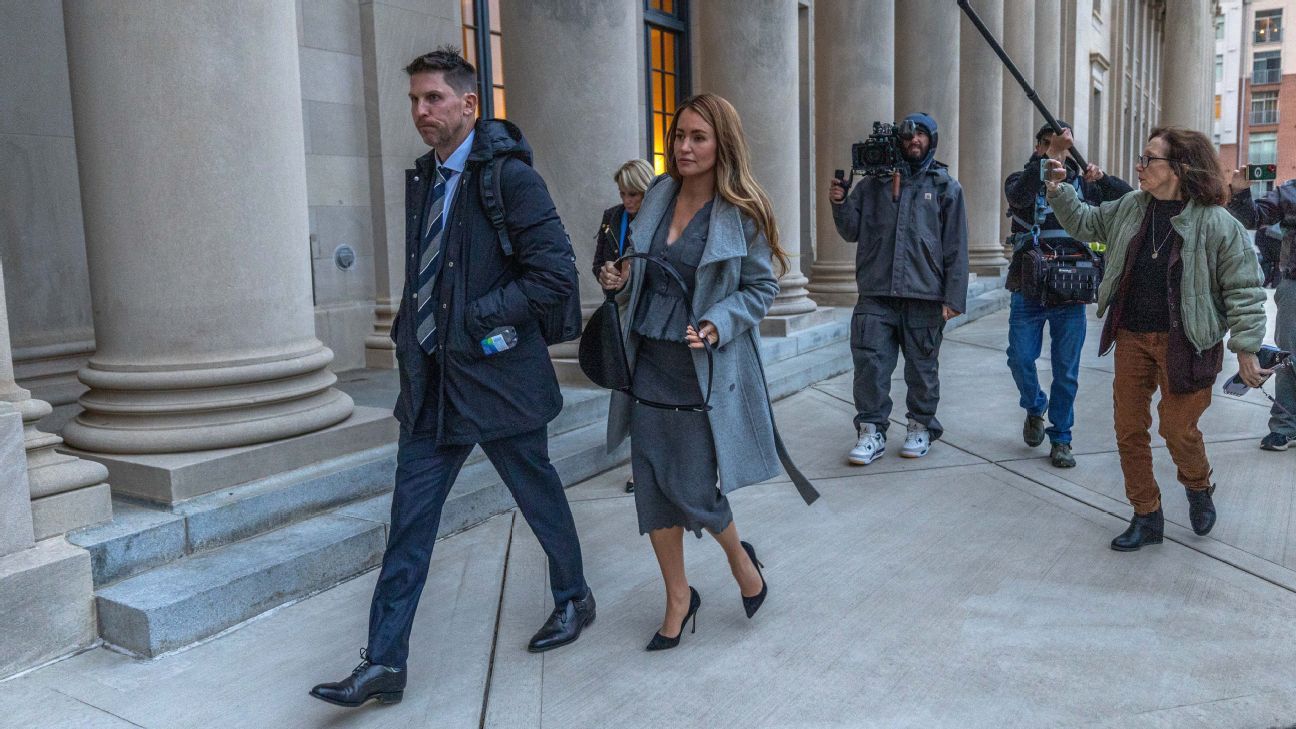
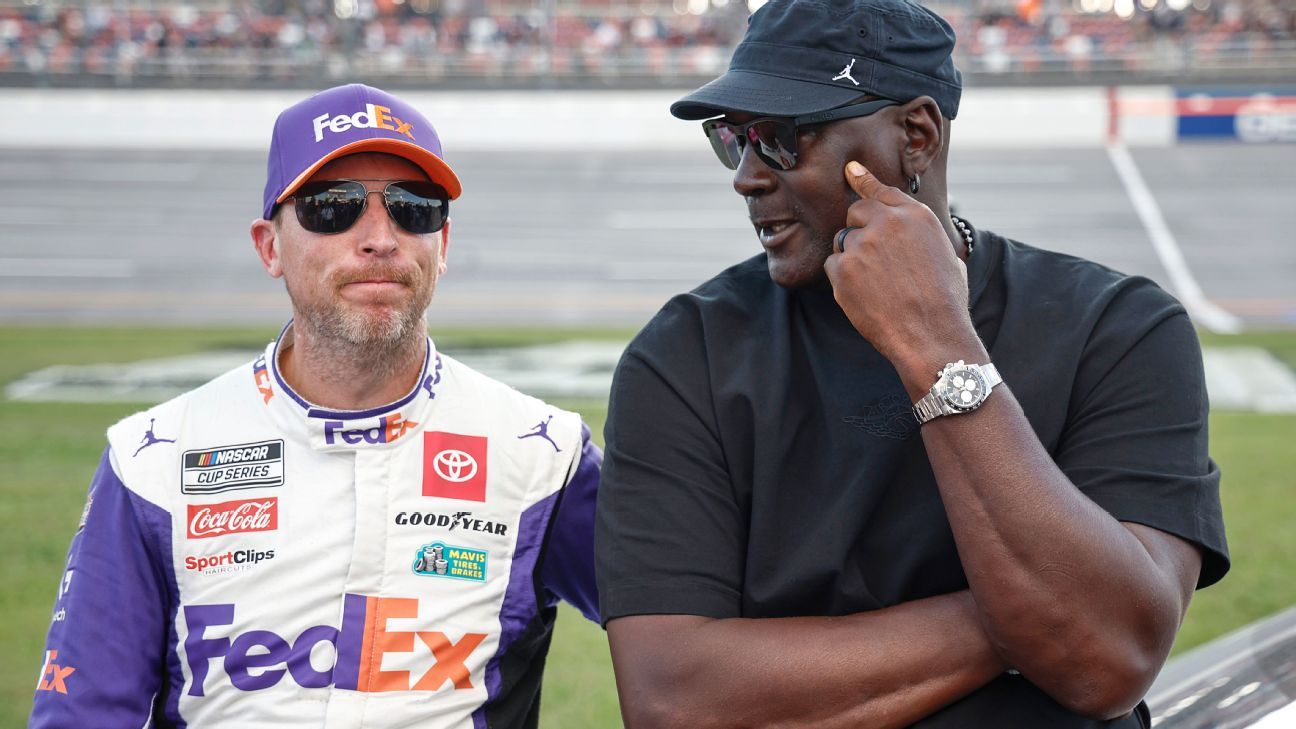

CHARLOTTE, N.C. — The landmark federal antitrust trial against NASCAR opened Monday with three-time Daytona 500 winner Denny Hamlin breaking down in tears minutes into his testimony as the first witness in a case that could upend the venerable stock car series.
Hamlin’s 23XI Racing, which he co-owns with Michael Jordan, and Front Row Motorsports claim the series is a monopolistic bully that leaves its teams no option but to comply with rules and financing they don’t agree with.
As Jordan watched from the gallery, Hamlin began to cry and had to stop and compose himself when asked how he got into racing. He disclosed to The Associated Press last month that his father is dying, and he said on the stand he was emotional because his dad “is not in great health.”
“We got to when I was about 20 and a decision had to be made, I could keep racing or go out and work for my dad’s trailer business,” Hamlin testified, adding that he later was thinking about what retirement looked like and found a team going out of business. He needed a partner and turned to Jordan, who he had developed a friendship with when the Basketball Hall of Famer owned the Charlotte Hornets and Hamlin was a season-ticket holder.
“If I can’t be successful with Michael as a partner, I knew this was never going to work,” he said.
The references to his early days in auto racing and the sacrifices his family made were intended to show how difficult it is for both team owners and drivers to make it at the top level of the sport. He said he never would have been able to start 23XI in 2021 had he not partnered with Jordan.
Because of Jordan’s presence with the team, Hamlin testified, 23XI has turned a profit in all but one of its five seasons of operation. His attorney, Jeffrey Kessler, said in his opening statement that fast-food restaurant entrepreneur Bob Jenkins has never turned a profit since starting his Front Row team in 2004, a team that won the Daytona 500 in 2021.
Kessler said a NASCAR-commissioned study found that 75% of teams lost money in 2024 and added that over a three-year period almost $400 million was paid to the France Family Trust. He said a 2023 evaluation by Goldman Sachs found NASCAR to be worth $5 billion. NASCAR is currently run by Jim France, son of founder Bill France Sr.
“What the evidence is going to show is Mr. France ran this for the benefit of his family at the expense of the teams and sport,” Kessler said.
At the heart of the lawsuit is NASCAR’s revenue sharing model, which 23XI and Front Row argue is unfair to race teams that often operate at a loss. Hamlin testified it cost $20 million to simply bring a single car to the track over a 38-race season, not including overhead expenses such as driver salary and business operations.
“So, why would these people do this if you are just going to lose money because NASCAR isn’t giving you a fair deal?” asked Kessler, “Because you love stock car racing, and there’s nowhere else to do it.”
The charter agreements signed for this year that triggered the lawsuit guarantee the teams $12.5 million in annual revenue per chartered car. NASCAR argues the guaranteed payouts are an increase from $9 million from the previous agreement, but Hamlin noted that 11 of the first 19 chartered teams are no longer in business.
All three charters 23XI purchased came from teams that ceased operations, and Hamlin said 23XI paid $4.7 million for its first charter, $13.5 million for its second and $28 million for its third, acquired late last year. He acknowledged purchasing the third charter was a risk because of the pending litigation – and the price concerned him – but it was required if 23XI intends to build itself into a top team.
The charter system guarantees a car a spot in the field each race week as well as a percentage of the purse and gives team owners an asset to sell should they want to get out of the business.
NASCAR attorneys argued that the charter system has created $1.5 billion in equity for the 36 chartered teams. Prior to the charter system, teams raced “open,” with no guarantee they’d make the field or earn a payout.
“The France family built NASCAR from nothing. They are an American success story,” Johnny Stephenson said in the opening statement for NASCAR. Stephenson is a colleague of Christopher Yates, who had previously handled most of the courtroom arguments for the defendants.
“They’ve done it through hard work over 75 years. That’s the kind of effort that doesn’t deserve a lawsuit. That’s the kind of effort that deserves admiration.”
The case has churned through hearings and arguments for more than a year despite calls from other NASCAR teams to settle. U.S. District Judge Kenneth Bell even helped mediate a failed two-day summit in October.
A NASCAR victory could put 23XI, Front Row and their six combined cars out of business. Their charters – now being held by NASCAR – would likely be sold. The last charter went for $45 million, and NASCAR has indicated there is interest from potential buyers including private equity firms.
A win for the teams could lead to monetary damages and the potential demolition of NASCAR as it is run today. The judge has the power to unravel a monopoly, and nothing is off the table, from ordering a sale of NASCAR to the dismantling of the charter system.
Jordan’s presence factors into the trial
Jordan’s presence in the courtroom gallery near Hamlin was a factor: Among those dismissed from serving on the jury was a man who said he can’t be impartial because “I like Mike” and another who said he had Michael Jordan posters on his walls growing up. A juror said they were a North Carolina fan but noted the football team at Jordan’s alma mater is not “doing too well right now” to which the star shook his head and laughed.
NASCAR executives in the courtroom included chairman Jim France and vice chair Lesa France Kennedy, two scions of the family that founded NASCAR in 1948 and still owns it.
Hamlin will resume testimony Tuesday morning. NASCAR Commissioner Steve Phelps, 23XI minority owner Curtis Polk, France Kennedy and other top executives had to leave the courtroom after opening arguments because they are all potential witnesses.

-
Greg Wyshynski
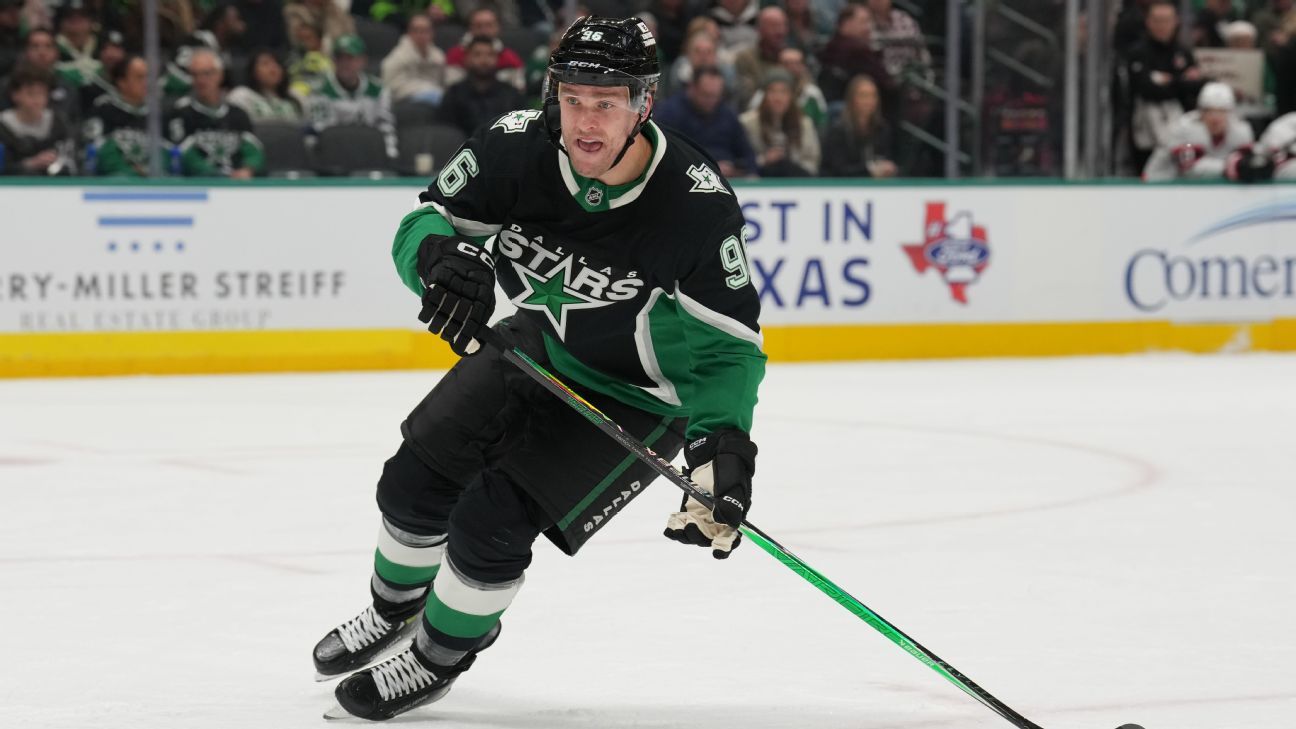
NEW YORK — After 11 seasons as one of the NHL’s leading scorers, Mikko Rantanen has become accustomed to fame.
But infamy? Not so much, although he has experienced plenty of that this season.
Rantanen recently served the first suspension of his NHL career, having earned an automatic one-game ban for two game misconducts for physical infractions.
NHL rules state that players must go 41 games between ejections to avoid suspension. Rantanen’s second ejection, for boarding Calgary Flames forward Matt Coronato, came four days after his first ejection on a play that earned Rantanen widespread derision from fans — and one very angry coach.
On Nov. 18, Rantanen skated through a check by New York Islanders defenseman Scott Mayfield and shoved defenseman Alexander Romanov in the back, sending him violently into the end boards. As a result of that play, Romanov had shoulder surgery that will put him on the shelf for five months at a minimum.
Rantanen didn’t have a hearing with the NHL Department of Player Safety for either of these misconducts, but he heard plenty from Islanders coach Patrick Roy after the Romanov hit. It was a scene that instantly went viral: Rantanen leaving the ice after his major penalty and a red-faced Roy screaming at him from the New York bench.
0:38
Mikko Rantanen ejected for nasty hit on Alex Romanov
Alex Romanov is left flat out on the ice after this shove in the back from Mikko Rantanen with under a minute left in regulation.
“Usually if something happens, if somebody gets pissed off, the media picks it up,” Rantanen told ESPN on Tuesday. “So I’m not really surprised it got so big.”
Roy, who called the hit “disrespectful,” yelled at Rantanen, appearing to say, “You’re not going to f—ing finish that game” in reference to the teams’ rematch scheduled for March 26 on Long Island.
Is Rantanen worried about what might happen in that game?
“No, no, no,” he said. “I’m just going to play there, play hard, play hockey and see what comes at me. But I’m a grown man. So I can stand up for myself.”
But the notoriety wasn’t only on the ice for Rantanen in 2025. Earlier this year, thanks to two blockbuster trades, he became one of the NHL’s most debated players.
RANTANEN WAS PLAYING for the Colorado Avalanche in a contract year. His salary demands remained high — rumored at the time to be around $14 million annually for one of the league’s most dominant scoring wingers and a player who helped Colorado win the Stanley Cup in 2022.
Avalanche GM Chris MacFarland shocked the hockey world by trading him to the Carolina Hurricanes in a blockbuster deal on Jan. 24 that saw Canes leading scorer Martin Necas sent back to the Avalanche. MacFarland called it a “business decision” involving a player who “had the unrestricted free agent card” but lamented losing “a superstar human being.”
However, Rantanen’s time with the Hurricanes was incredibly short. Carolina hoped to convince him to sign an extension — meeting his salary demands — and to put roots down in Raleigh. But after 13 games, the player the Hurricanes hoped could lead them to the Stanley Cup was traded again, this time to Dallas, in a deal involving young forward Logan Stankoven.
“My sense of it was that this just didn’t feel like home for him, as far as I can tell. And that’s OK. He’s making an eight-year commitment,” Carolina GM Eric Tulsky said at the time.
It was a dizzying, at times humbling, experience for Rantanen. He wanted to remain in Colorado. He learned quickly how much was out of his control. It was no surprise that Rantanen’s contract with Dallas spanned eight seasons (for $96 million total) and carried a full no-movement clause.
“You learn always from those tough moments, whether it’s on the ice or wherever in life,” he said. “You always learn from those moments when you’re going through tough times.”
The double-trade season and the new monster contract sparked questions around the NHL about whether Rantanen was in fact worth coveting. Was he a superstar away from the Avalanche? Was he a franchise-level player?
“There’s been a lot written about him. There’s been a lot said about him,” then-Stars coach Peter DeBoer said last postseason. “There’s been a lot of doubters out there, based on the situations he’s been in and how it’s looked at different points.”
Rantanen began answering those questions in the Stanley Cup playoffs, leading the Stars back to the conference finals for the third straight season — including a seven-game, first-round elimination of his friends from Colorado. Rantanen had 22 points in 18 playoff games, including one torrid stretch in which he had nine goals and eight assists in the span of six games.
DALLAS IS HOME NOW. Rantanen and his girlfriend, Susanna Ranta, got engaged in the offseason. No contract talk leaks. No trade chaos. To his relief, just playing the game.
“We’re settled and know where we’re going to be,” he said. “You don’t have to think about off-ice stuff as much. You can just focus on hockey. It’s been more comfortable.”
Rantanen’s comfort has been to Dallas’ benefit. Through 25 games, he has 33 points, including 10 goals. That includes 18 points on the Stars’ torrid power play, which ranked second to Pittsburgh heading into Tuesday’s game against the New York Rangers.
Winger Jason Robertson said having Rantanen for a full training camp was a key to that unit’s success. “You really didn’t have time to develop that look, that chemistry after the trade deadline last year,” he said.
At 5-on-5, Rantanen has found a fit with center Wyatt Johnston, who was tied with Robertson at 16 goals to lead the Stars. Like Nathan MacKinnon, the Avalanche star with whom Rantanen had explosive chemistry, Johnston is a right-shot center.
“Obviously last year I had a lot of success with playing with [Roope] Hintz and [Mikael] Granlund. Those are two lefties, so it’s not end of the world,” Rantanen said. “But playing a lot with Nate in the past as a righty, it’s more common for me to make plays and stuff. [Johnston] is a really good player. He can score goals. We find each other pretty well. Obviously, it takes some time. We haven’t played that long together, so we can still get better, but it’s going in a good direction.”
0:45
Mikko Rantanen capitalizes on the power play
Mikko Rantanen scores on the power play for Dallas Stars
Rantanen has played with Johnston and Dallas captain Jamie Benn recently, which is to say the Finland native is not playing with his countryman Hintz. When he was traded to the Stars last season, Rantanen joined what was colloquially known as Dallas’ “Finnish Mafia,” along with Hintz, defensemen Miro Heiskanen and Esa Lindell, and Granlund, who left for Anaheim as a free agent last summer. He played on a line with Hintz and Granlund for much of the playoffs.
There are moments when the Finns flock together. Such as at the end of a recent morning skate, when they were speaking their native tongue during a Suomi-only shooting drill. But Dallas players say Rantanen also has subverted some expectations.
“Normally, most of our Finnish guys are relatively quiet and whatever. Mikko comes in here and he’s this big, loud and happy guy. Just a different dynamic,” Robertson said. “He fit in obviously very well, and everyone welcomed him in.”
Forward Tyler Seguin knew Rantanen only as an opponent before the trade. A rather large opponent, at 6-foot-4 and around 230 pounds. Seguin said having Rantanen as a teammate offered an up-close glimpse at “how thick he is and why his nickname is what it is” referring to “Moose,” Rantanen’s moniker in Colorado.
“He’s a big boy,” Seguin said.
But Seguin also appreciates what a charismatic teammate he is, too.
“I used to know him as a skilled big forward that put up a lot of offense and points with Colorado. Getting him here as a teammate, I’ve learned what a good person he is. How much he can affect our locker room with his leadership,” Seguin explained. “Sometimes, guys come in and won’t feel comfortable talking. He does. So it’s nice.”
RANTANEN BRINGS SIZE, skill and personality to Dallas. He also brings a superstar quality to the franchise as “one of the elite power forwards in the game,” as GM Jim Nill described him last March.
Dallas coach Glen Gulutzan, hired to replace DeBoer in the offseason, coached two other elite forwards on the Edmonton Oilers‘ bench as an assistant coach: Connor McDavid and Leon Draisaitl. Gulutzan said that Rantanen is “certainly there” as far as comparable star quality.
“The most interesting thing that I’ve found coaching Mikko and then coaching Leon and Connor: The similarity is their fire. Their competitiveness. And that’s what you need, right?” Gulutzan said. “They’re very hard on themselves, just to be great every night. That’s what I really noticed. I didn’t know that as much with Mikko, but now that I’ve gotten to coach him, you just see that drive and that intensity.”
Rantanen is trying to drive the Stars into the Stanley Cup Final after three straight conference finals losses, and push Dallas to its first Cup win since 1999. He has found the right fit with a team committed to him for the long term. But he learned a lesson the hard way during last season’s chaos: Take nothing for granted.
“Last year was nothing like I’ve experienced before. Hopefully it never happens again,” he said. “But if it does, I’m ready.”
-
 Sports2 years ago
Story injured on diving stop, exits Red Sox game
-
 Sports3 years ago
‘Storybook stuff’: Inside the night Bryce Harper sent the Phillies to the World Series
-
 Sports2 years ago
Game 1 of WS least-watched in recorded history
-
 Sports3 years ago
Button battles heat exhaustion in NASCAR debut
-
 Sports3 years ago
MLB Rank 2023: Ranking baseball’s top 100 players
-
Sports4 years ago
Team Europe easily wins 4th straight Laver Cup
-
 Environment3 years ago
Japan and South Korea have a lot at stake in a free and open South China Sea
-
 Environment1 year ago
Here are the best electric bikes you can buy at every price level in October 2024