
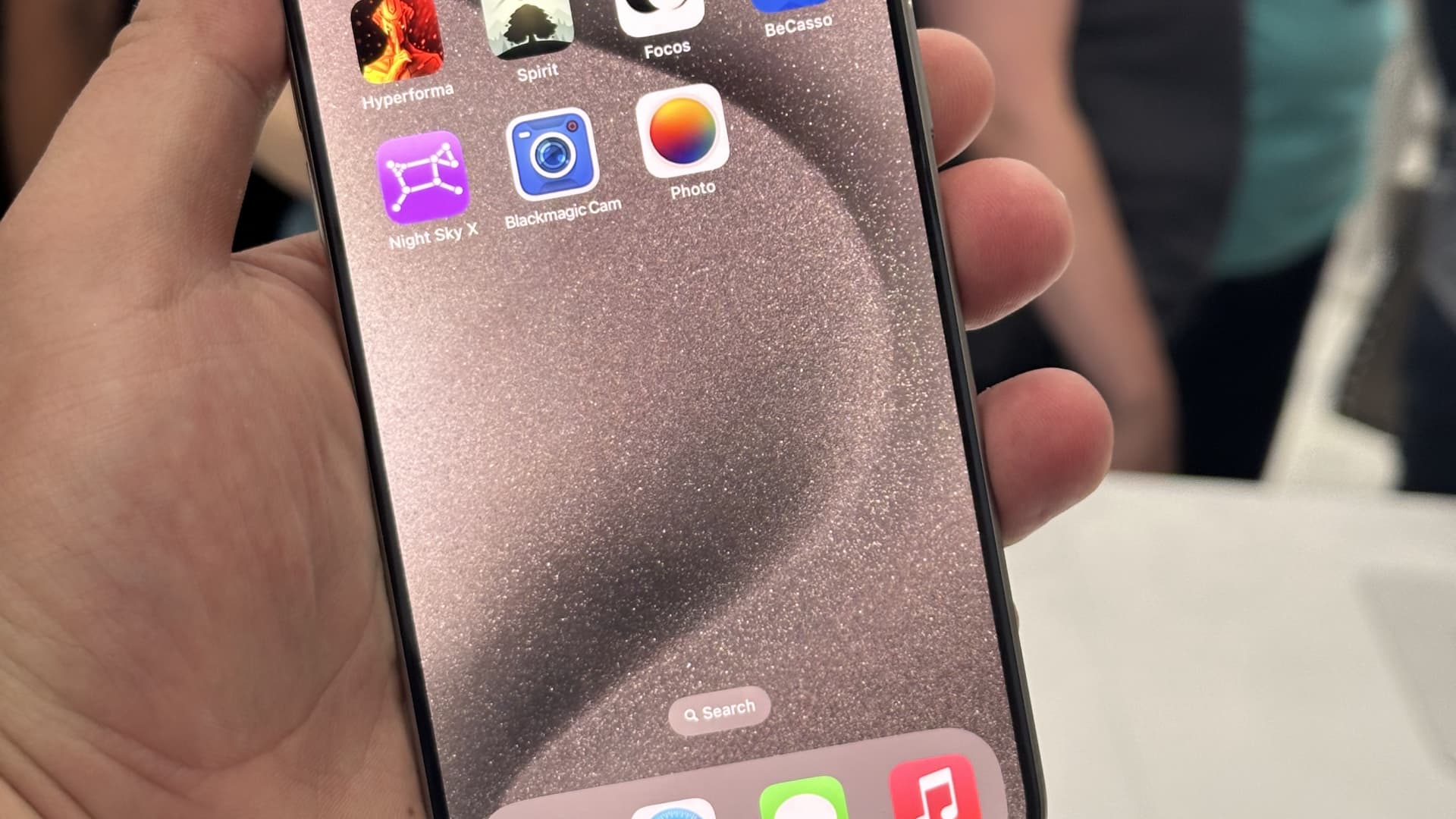
Where media and analysts could hold and try out the iPhone 15 on Tuesday after it was announced.
CNBC/Kif Leswing
Apple announced its new iPhones for 2023 on Tuesday at its headquarters in Cupertino, California.
This year’s models are called the iPhone 15. There are four new models, ranging from the entry-level iPhone 15 at $799 to the iPhone 15 Pro Max, which costs at least $1199.
I was able to hold and test out the new devices on Tuesday, and although most of this year’s improvements aren’t immediately noticeable to the untrained eye, there was one aspect of the new devices that made me go “wow.”
The new Pro devices are significantly lighter, thanks to their new bodies, which replaced steel with titanium. The moment I picked one up, I could immediately can tell that it’s way easier to hold and won’t weigh down my pockets as much.
It feels a lot lighter.
CNBC/Kif Leswing
In fact, I think the reduced weight is so significant that people with last year’s Pro phones — like me — should consider updating. After all, people hold their phones for hours a day. Even shaving off a little bit of weight makes it a much more pleasant experience.
Apple says that the 6-inch iPhone 15 Pro is 187 grams, or 9% lighter than last year’s model. The iPhone 15 Pro Max, with a bigger 6.7-inch screen, weighs 8% less.
Apple’s titanium is clearly titanium, but most people will put it in a case, and it is a fingerprint magnet.
CNBC/Kif Leswing
In the 2001 comedy “Zoolander,” one memorable gag spoofed cell phones by implying that they would get smaller and smaller until they were a tiny speck.
The iPhone and the rise of smartphones changed that, as people wanted bigger, brighter screens and longer battery life, and were willing to trade size and weight for a more useful device.
In fact, Apple’s “pro”-level iPhone with a 6-inch screen has been getting heavier every year since 2019, despite no major changes in the phone’s general shape. The light-and-small “mini” iPhones, introduced in 2020, haven’t been a success in terms of sales, and haven’t gotten an update in two years.
But the trend towards brick-like smartphones has firmly shifted this year with the iPhone 15. I don’t care for the very biggest Pro Max phones, even though they have bigger screens and more battery life, simply because they are so large and heavy. But this year’s model, with the lighter titanium body, was much more manageable from a heft perspective, and some people who had previously written off the most expensive devices may find themselves taking another look.
The weight is such a big deal that I think that some people will upgrade simply for the lighter weight. I’m considering it, even though $999 (or more, if you need more than 128GB of storage) for an iPhone 15 Pro is a lot of money, especially if you have a phone that works just fine — but at the very least, my pinky finger, which holds up my phone when I’m using it, will appreciate it.
Other notes from the iPhone 15 hands-on
The new Apple iPhone 15, with EU ordered USB-C charger, is displayed amongst other new products during a launch event at Apple Park in Cupertino, California, on September 12, 2023.
Nic Coury | AFP | Getty Images
This year’s colors don’t really pop. In particular, the titanium colors on the iPhone 15 Pros aren’t very bright and appear at a distance to look like shades of gunmetal.
Apple isn’t making leather and silicone cases anymore. They’ve been replaced by a new woven material case, which doesn’t really stand out. From a distance, it looks a lot like last year’s silicone.
The mainstream iPhone 15, which comes in two sizes, hasn’t changed that much on the outside from last year’s model. However, the bezels around the front have been smoothed, which is a nice touch.
The iPhone 15 gets the Dynamic Island, a feature that can show updating information at the top of the phone, where the front-facing camera is hidden.
CNBC/Kif Leswing
The entry-level iPhone 15 models also have the “Dynamic Island,” a software feature that hides the phone’s front-facing camera under the screen.
The iPhone 15 Pro Max did get a $100 price increase, now starting at $1,199 in the U.S., although you get more storage at the entry level.
CNBC/Kif Leswing
The button that has replaced the mute switch on the Pro phones has a very fun animation when you hold it down. I suspect most people will customize it to pull up the camera app quickly.
CNBC/Kif Leswing
USB-C is the default port on all the devices this year, and it’s glorious. Finally, someone with a Mac, iPhone, and wireless headphones will be able to charge them all with the same charger. People with Android phones will be able to borrow chargers from iPhone users and vice versa, and finding a way to juice up will just get a little bit easier for iPhone users.
Broadcom shares hit an all-time high during Monday’s trading session after the emergence of another encouraging sign that the company’s custom chips are all the rage on the AI scene. The newest development comes from the tech website, The Information, which said Microsoft could be looking to move its custom chip business from Marvell Technology to Broadcom. The report is the latest in a string of recent good news for Broadcom, which delivers quarterly earnings after Thursday’s close. Shares of Marvell were understandably falling more than 7%. Also weighing on Marvell stock was a note from Benchmark, in which the analysts call out with a “high degree of conviction” that Amazon may also be looking to move the development of future generations of its Trainium chips away from Marvell to AIchip, a Taiwanese designer. Taken together, Broadcom shareholders should feel good about the company’s standing in the custom AI market, as specialized silicon emerges as a competitor to Nvidia’s all-purpose AI chips, which have been the gold standard in running artificial intelligence workloads. At the same time, the weakening position of Marvell amplifies Broadcom as the go-to company for custom chips. The Information report, as it relates to Microsoft, comes after the success of Google’s tensor processing units, which were co-developed by Broadcom. The TPUs have been praised in recent weeks following the release of Gemini 3, the latest large language model from Alphabet ‘s Google. Gemini 3, which has leapt to the top of the app leaderboards, was trained and runs entirely on Google’s custom TPUs. A couple of weeks ago, The Information reported that Meta Platforms was thinking about using Google’s TPUs for its data centers in 2027. AVGO YTD mountain Broadcom YTD While it’s great to watch Broadcom’s share price climb, we don’t love it when a stock runs into an earnings release, as it indicates high expectations. We do understand the move, though, because all this news has made it clear that Broadcom’s custom silicon business is primed for further gains. We don’t expect to hear much about these latest two developments on the post-earnings call. We do, however, suspect that talk about custom chip demand will center around the interest Broadcom has been seeing following the launch of Gemini 3. Outside of custom chips, there will be high interest in Broadcom’s networking business, which has seen incredible growth over the past year, given the increased need for high-bandwidth networking solutions resulting from the explosion of AI adoption — especially with the introduction of reasoning models and agentic solutions. On the legacy front, we expect to see some gradual improvement, thanks in part to seasonality as the company’s wireless revenues are tightly linked with the iPhone sales cycle, given that Apple is the company’s primary wireless customer. As for software, we continue to expect strong growth and margin performance driven by VMware, and we will be interested to hear about any additional synergy and cross-selling opportunities the team has been working on. (Jim Cramer’s Charitable Trust is long AVGO, MSFT, AMZN, META. See here for a full list of the stocks.) As a subscriber to the CNBC Investing Club with Jim Cramer, you will receive a trade alert before Jim makes a trade. Jim waits 45 minutes after sending a trade alert before buying or selling a stock in his charitable trust’s portfolio. If Jim has talked about a stock on CNBC TV, he waits 72 hours after issuing the trade alert before executing the trade. THE ABOVE INVESTING CLUB INFORMATION IS SUBJECT TO OUR TERMS AND CONDITIONS AND PRIVACY POLICY , TOGETHER WITH OUR DISCLAIMER . NO FIDUCIARY OBLIGATION OR DUTY EXISTS, OR IS CREATED, BY VIRTUE OF YOUR RECEIPT OF ANY INFORMATION PROVIDED IN CONNECTION WITH THE INVESTING CLUB. NO SPECIFIC OUTCOME OR PROFIT IS GUARANTEED.
A Google logo is at the announcement of Google’s biggest-ever investment in Germany on November 11, 2025 in Berlin, Germany.
Sean Gallup | Getty Images News | Getty Images
Google on Monday said it plans to launch the first of its AI-powered glasses in 2026, as the tech company ramps up its efforts to compete against Meta in a heating consumer market for AI devices.
The Alphabet-owned company is collaborating on hardware design with Samsung, Gentle Monster and Warby Parker, with whom Google agreed to a $150 million commitment in May.
Google plans to release audio-only glasses that will allow users to speak with the Gemini artificial-intelligence assistant, the company said in a blog. Google also said there will be glasses with an in-lens display that show users information such as navigation directions and language translations. The company said the first of these glasses will arrive next year, but it did not specify which styles that will include.
In a Monday filing, Warby Parker said that the first of its glasses in partnership with Google are expected to launch in 2026.
Google’s Monday updates come after the company in May announced that it would be getting back into the smart glasses game. At the time, co-founder Sergey Brin said he learned from Google’s past mistakes of failed smart glasses, citing less advanced AI and a lack of supply chain knowledge, which led to expensive price points.
“Now, in the AI world, the things these glasses can do to help you out without constantly distracting you — that capability is much higher,” Brin said in May.
The AI wearables space has been gaining traction with Meta leading the pack. the social media company’s Ray-Ban Meta glasses were met with surprising success. The glasses, which were designed in partnership with eyewear giant EssilorLuxottica, are infused with the Meta AI digital assistant
Meta also released its own display glasses in September, which allows users to see features like messages, photo previews and live captions through a small display that’s built into one of the device’s lenses.
Other companies like Snap and Alibaba have also been churning out their own AI glasses offerings as the small but competitive market continues to grow.
Google on Monday also revealed more software updates to the Galaxy XR headset, including the ability to link it to Windows PCs and a travel mode that will allows the device to be used in planes and cars.
CEO Tim Cook now has two fewer direct reports than he did before Thanksgiving.
The executive who designed the software for the Apple Vision Pro also bounced and is heading to Meta to do the same thing for AI glasses in Menlo Park.
As if last week’s departures weren’t enough, there was another potential exit over the weekend. Senior vice president of hardware technologies Johny Srouji told Cook he wanted out soon, according to Bloomberg.
But any drama seems to have passed, with Srouji telling his staff Monday morning in a memo seen by CNBC that he isn’t planning to leave Apple any time soon.
Srouji is the chip design guru who kicked Intel while it was down and made in-house chips for Mac that performed a lot better, leading to a healthy surge in sales. Srouji is essentially the Jony Ive of chip design, a singular talent, and it is tough to imagine him leaving Apple.
An Apple spokesperson provided no comment on Srouji or any of the recently departed executives.
There are multiple ways to read into all the changes at the top of a company known for keeping a steady leadership team while producing innovative and industry-leading products.
Apple stayed the course while the tech world changed around it in just three short years, as the entire industry has made a massive pivot to AI.
Read more CNBC tech news
So it was no surprise AI chief John Giannandrea was out last week. It was on him to deliver an innovative AI experience on the iPhone. Instead, Apple had to admit it couldn’t launch the supercharged version of Siri it had been advertising for months.
Perhaps the new strategy of partnering with an established AI leader such as Google or Anthropic will make up for all of it, but the pressure is enormous for Apple to get it right after the flop this year.
Getting the AI launch right is important for other products as well.
If Apple isn’t going to charge for its AI system, then using it as a selling point for new hardware is its best bet to show it can make some cash.
There are already hints that 2026 is going to be a monumental year.
Some new, rumored AI product categories are expected, such as AI glasses similar to what Meta sells and a tablet for controlling all your smart home appliances.
Apple will also turn 50 on April 1 next year, and it’s expected to launch its first-ever foldable iPhone. Plus, there are more challenges ahead with a looming antitrust trial and whether Apple can maintain its truce with PresidentDonald Trump.
Taken together, perhaps the shake-ups were necessary, especially regarding AI.
It looks like next year will show if Apple got it right.





