
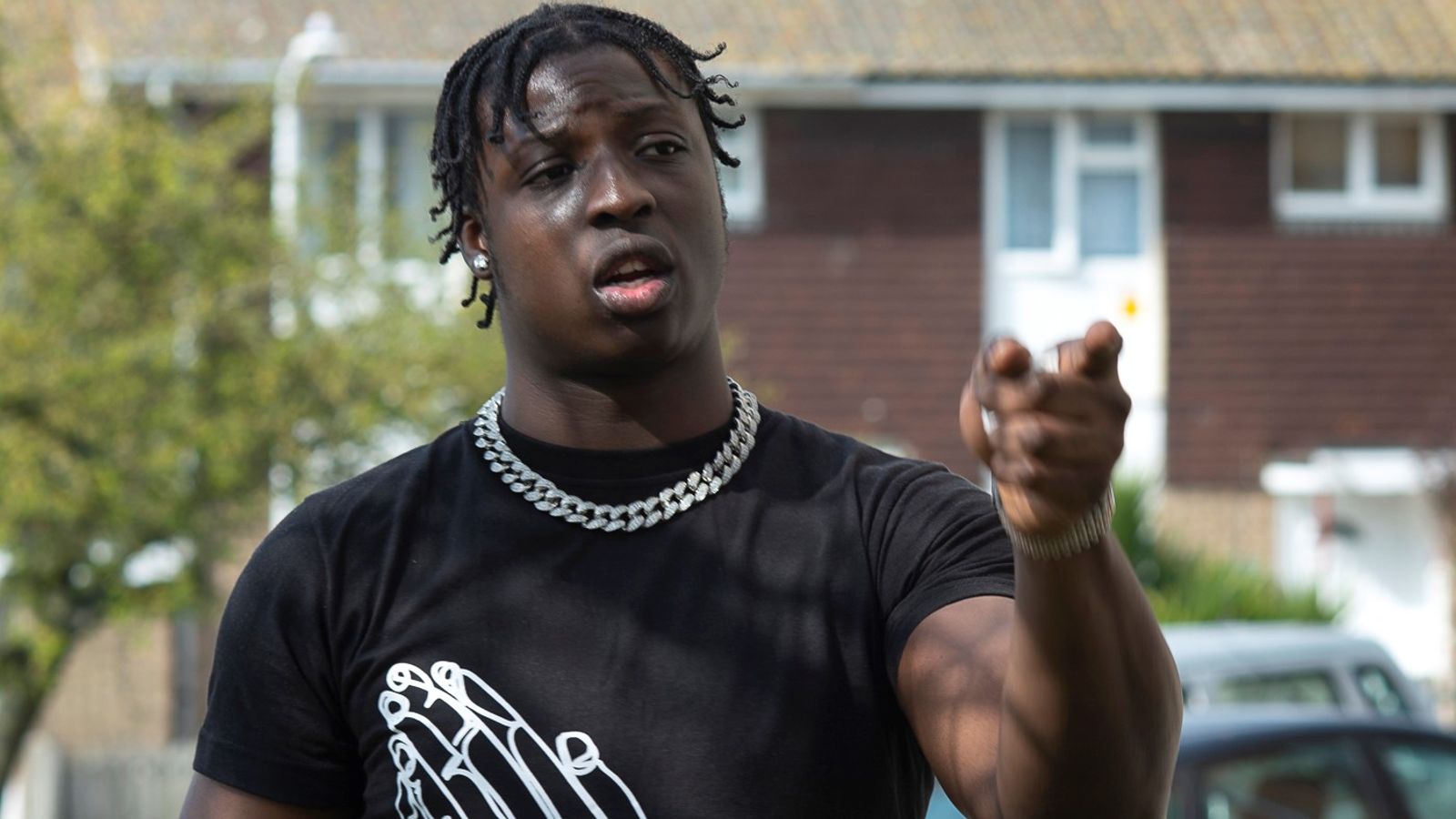
Trapping filmmakers and rapper Abra Cadabra to take ‘grim reality’ of county lines drugs to parliament

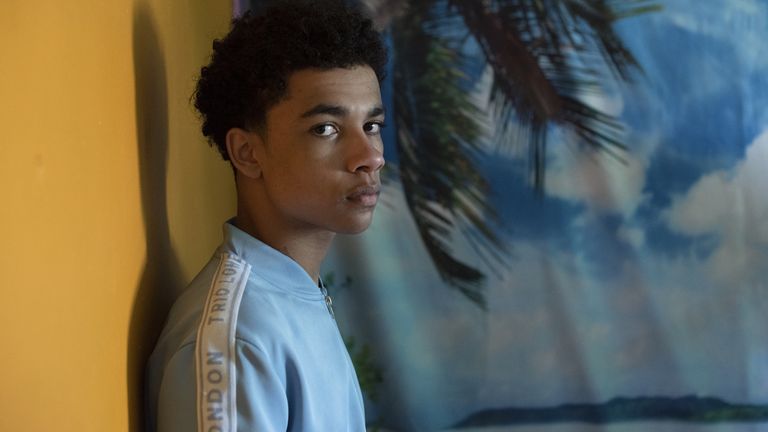
It takes just minutes for the scenes to turn grim: a dirty trap house, a drug user injecting scabbed feet, a tiny baby crawling amid the filth.
This is Trapping, a new British film starring MOBO-winning drill rapper Abra Cadabra and produced by filmmakers and grime pioneers Femi Oyeniran and Nicky “Slimting” Walker.
Later this evening, they take the story to parliament for a discussion about the bleak reality of the UK’s county lines problem, where vulnerable adults and children as young as six, according to the Children’s Society, are recruited to move and supply drugs.
While the portrayal of drug dealing often shown on screen has long drawn criticism for glamourising the lifestyle, the same cannot be said for Trapping. Rather than focusing on the “girls, the money, the cars”, as writer and director Penny Woolcock tells Sky News, it delves into the world of “going county” and those on the frontline, also showing the hopelessness of the addicts they feed.
Louis Ede plays main character Daz. Pic: Alice Dunhill
Raised on the Broadwater Farm estate in Tottenham, Abra Cadabra, real name Aaron Philips, told Sky News at the film’s premiere that he drew on his personal experiences to play county lines gang leader Magic.
“It’s reality,” he said. “It’s what some of the kids in London go through growing up. It’s good to show what’s really going on… I’ve seen a couple of my friends go through stuff like that. It hit home.”
Louis Ede, who plays main character Daz, a young boy wanting to earn some money to help his struggling mum, is now 20 but had just turned 18 when filming started.
“I learnt a lot of things I didn’t know before. I’ve been around people who have been in that environment – that’s why, in a way, it was kind of easy for me to portray the character because I could channel the things I’ve experienced from my past. However, saying that, I didn’t know how gritty that lifestyle actually is until I shot the film.”
‘This is not just a black problem – it’s a white problem, too’
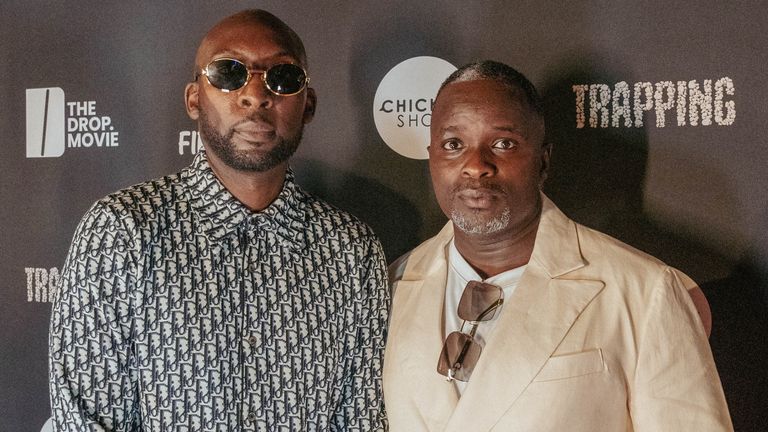
Nicky ‘Slimting’ Walker and Femi Oyeniran at the premiere of Trapping
For the film’s stars and creators, taking the debate to parliament is a big deal. Oyeniran and Abra Cadabra will be part of a panel supported by campaigner and chief executive of Enact Equality L’myah Sherae; author and activist Ben Lindsay, founder of Power The Fight; filmmaker and youth coach Amani Simpson; and Labour MP for Streatham Bell Ribeiro-Addy.
They are calling on the government to launch a creative grants scheme to help young people in need, taking stats from the Children’s Society stating that 46,000 children in England – and likely many more unknown – are thought to be involved in gangs, with 4,000 teenagers being criminally exploited in London alone.
They say the situation has been made worse by the recent rise in children reported missing from school and increasing child poverty.
Oyeniran, who started his career starring in the cult classic Kidulthood and went on to produce films including It’s A lot, The Intent and The 12, says widening the debate is as important as the film itself.
“[Trapping] gives a rounded perspective of drug dealing,” he says. “Sometimes you look at films about drugs and it’s either a critique of drug use, or it’s about drug dealers. This shows the real side, it humanises the drug users, and also it shows that it’s beyond just a working class thing, it’s also a middle class thing. And it’s not just a black problem, it’s a white problem, too.”
Too often, in the media and with politicians as well as in film and TV, the focus is on gangs, he says. “It’s titillating, the idea of a gang is scary, and all of that stuff. But let’s talk about the middle-class people that live in counties that consume drugs… who are these drugs being sold to?”

Abra Cadabra also recorded the soundtrack for the film, and performed at the premiere in London
Read more on Sky News:
Guns and swords seized in county lines crackdown
Organised crime group targeted in ‘largest single operation’ to close down county lines
Walker, his filmmaking partner, says he hopes children and young people watching the film will be put off the lifestyle often sold to them. “There’s only one thing that happens to you when you’re a drug dealer – you end up going to jail for a very long time. Or, you end up dead.
“A film like Trapping will show you the dark side. It’s not glamourising, to be the next Pablo Escobar. It’s not showing you about the flashy clothes and all these things… it’s showing that you’re in this sh*tty, horrible flat, that it smells, and you’re around dirty people.”
‘This is about protecting children’
Woolcock said she wanted to make something authentic, that young people vulnerable to the lifestyle could relate to. You have kids that queue up [to sell drugs] because they think it’s going to be great. We wanted to show that, that’s truthful.”
Woolcock is calling on MPs to tackle the problem. “Youth service has been cut to shreds, there’s virtually no youth provision. Poverty and inequality have increased and those are the underlying causes, why people want to get into this.
“A kid in a certain neighbourhood will think there are three options: you are either a drug dealer, a footballer or a rapper, and that is it.”
“Politicians have a responsibility to end this issue,” says Ms Sherae. “In order to protect the next generation, they have to do more and introduce laws to really think about prevention rather than a hard line on drug use. If you think about this as a safeguarding issue, this is about protecting children.”
The Trapping movie panel discussion takes place this evening, with the film released on Friday on The Drop, a new streaming platform which aims to serve minority and underrepresented audiences and promote independent and upcoming British talent, supported by the British Film Institute and launched by Oyeniran and Walker’s Fan Studios.
Entertainment
Scottish artist Nnena Kalu wins Turner Prize 2025 for hanging Barcelona sculptures and Liverpool exhibition
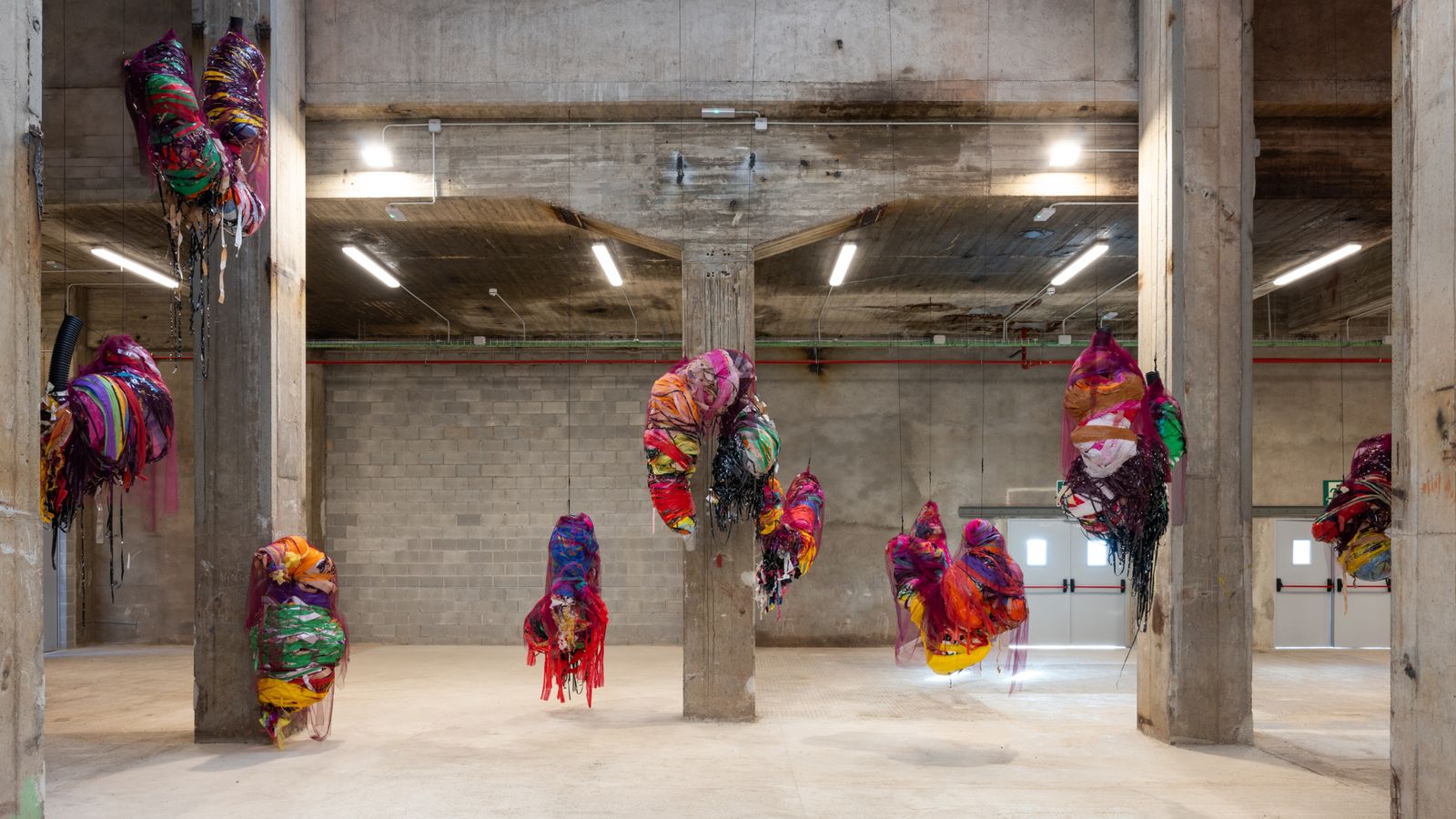
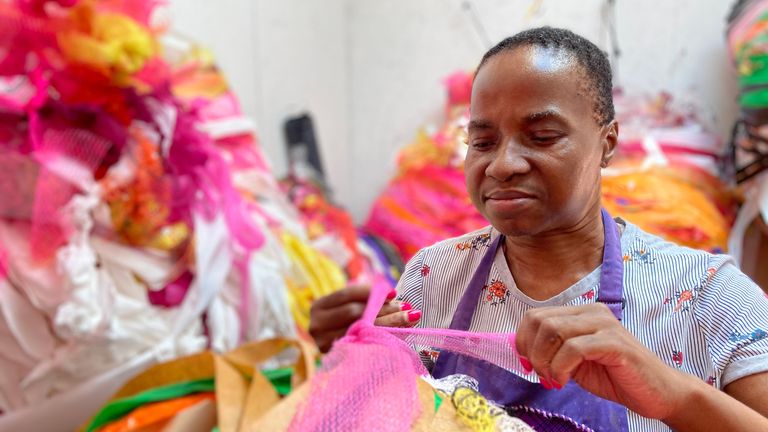
Scottish artist Nnena Kalu has won the 2025 Turner Prize with two exhibitions, including a series of brightly coloured sculptures.
The Glaswegian, 59, took home the visual arts prize along with £25,000 at an award ceremony on Tuesday in Bradford, this year’s UK City of Culture.
As reported by The Guardian, she is the first artist with a learning disability to win the award.
Nnena Kalu, from Glasgow, is the winner of this year’s Turner Prize. Pic: Nnena Kalu/ActionSpace/PA
Along with Hanging Sculpture 1-10, which European art exhibitors Manifesta commissioned her to create at a disused power station in Barcelona, Ms Kalu won for her presentation in Conversations, a group exhibition at Walker Art Gallery in Liverpool.
For the sculpture series, the artist created the vividly-coloured works from repeated lines and wrappings of different materials, making nest or cocoon-like forms.
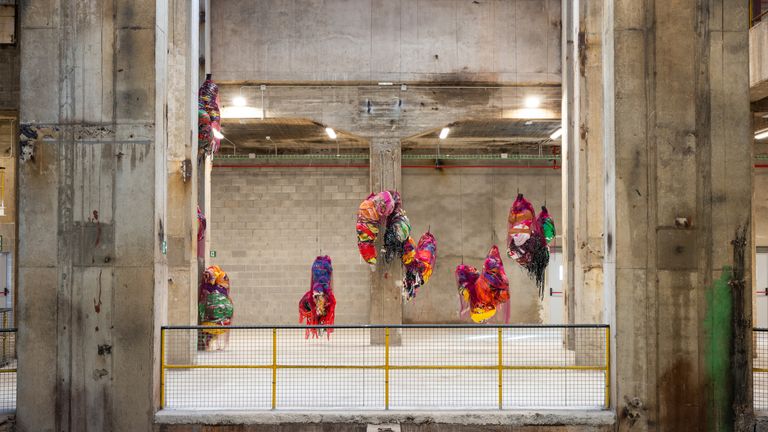
Hanging Sculpture 1 – 10 by Nnena Kalu. Pic: PA
The installation consisted of 10 large brightly-coloured sculptures that hung from grey concrete pillars of the industrial site.
Meanwhile, for Conversations, Kalu presented work in pen, graphite and chalk pen on two pieces of paper.
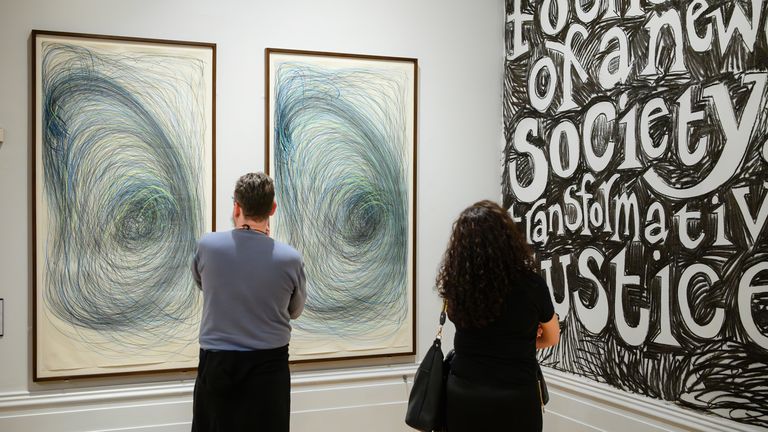
Conversations by Nnena Kalu. Pic: PA
The jury, which was chaired by Alex Farquharson, the director of Tate Britain, commended Kalu’s “bold and compelling work” and praised the “lively translation of expressive gesture” in the abstract sculpture and drawing.
The panel also acknowledged her scale, composition and colour, highlighting “the powerful presence” her works have.
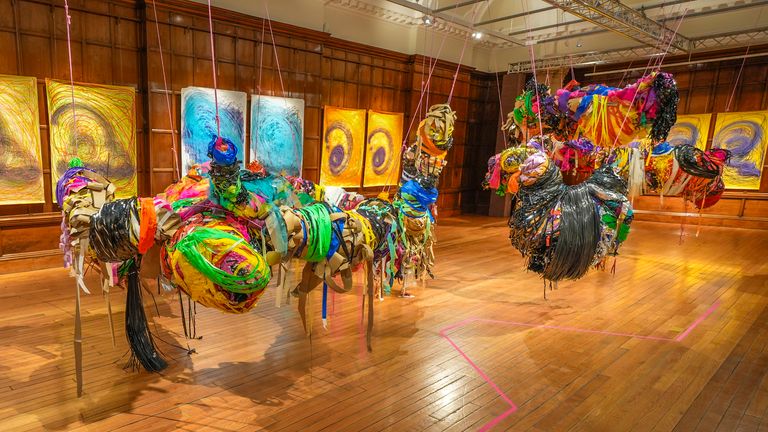
Nnena Kalu’s nominated Turner Prize works. Pic: PA
Kalu is also a resident artist at ActionSpace’s studio, which supports learning disabled artists across London at Studio Voltaire, and beat out fellow shortlisted artists Rene Matic, Mohammed Sami and Zadie Xa.
The works by the four artists are currently available to see at a free exhibition at Bradford’s Cartwright Hall Art Gallery until 22 February.
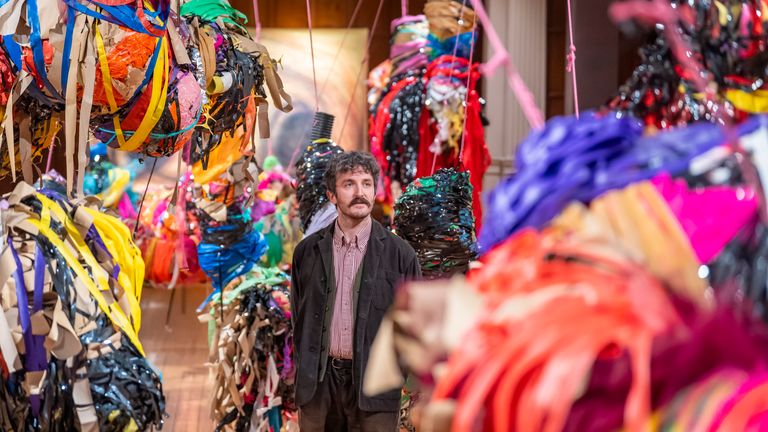
Jonathan Orrell views work by Nnena Kalu for the Turner Prize. Pic: PA
Named after British painter JMW Turner, this year’s prize marked the 250th anniversary of his birth.
Read more from Sky News:
Storm Bram brings 90mph winds, rain and flooding
‘Illegal, industrial-scale waste operation’ suspected in London
Previous winners include artist Damien Hirst in 1995 and filmmaker Sir Steve McQueen in 1999, while last year’s winner, Jasleen Kaur, picked up the prize for Alter Altar – which covered a red sports car with a giant ornamental doily mat.
Entertainment
Rappers Bob Vylan sue Irish broadcaster RTE over claim lead singer led ‘antisemitic chants’ at Glastonbury gig

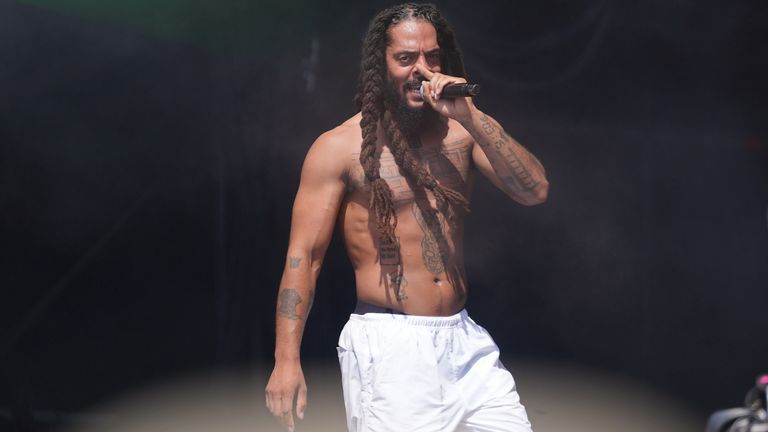
Punk-rap duo Bob Vylan are suing Irish national broadcaster RTE for defamation, claiming it misrepresented chants led by the band when they played this year’s Glastonbury festival.
The group, which performed at Dublin’s Vicar Street last month, claim they were defamed in a report by RTE News that said the lead singer led antisemitic chants when they played the Somerset festival in June.
During their performance, singer Pascal Robinson-Foster, whose stage name is Bobby Vylan, led a chant of “death, death, to the IDF [Israel Defence Forces]”.
File pic: PA
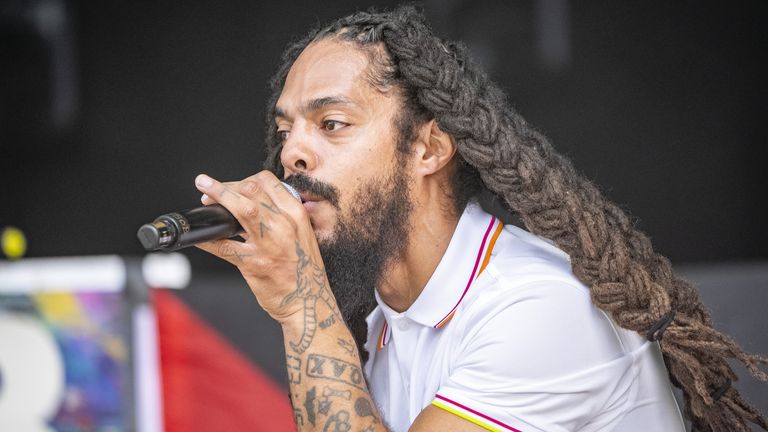
Pic: PA
It provoked widespread criticism of the artist, including from Glastonbury organiser Emily Eavis, and the BBC, which live streamed their show.
Phoenix Law launched legal action on behalf of Robinson-Foster and drummer Wade Laurence George at Ireland’s High Court on Monday, according to court records.
The firm said: “The proceedings arise from a broadcast aired by RTE News following Bob Vylan’s performance at Glastonbury Festival on 28 June 2025.
“During this broadcast, comments were made alleging that the lead singer of Bob Vylan led antisemitic chants. These allegations are categorically denied by our clients and are entirely untrue.”
Phoenix Law said Bob Vylan had made statements expressing support for Palestinian self-determination and criticising military actions by the IDF (Israel Defence Forces).
His comments did not target Jewish people or express hatred towards any group, the firm said, suggesting they were “politically charged but not antisemitic in nature”.
Solicitor Darragh Mackin said the pair “are no stranger to utilising their freedom of expression to speak out against the genocide in Gaza“.
Mr Mackin said there was “a fundamental distinction between speaking critically about the role of the Israeli state forces, and being antisemitic”.
“The former is speech within the confines of political expression, whereas the latter is a form of hatred directed towards Jewish people,” he added.
Read more on Sky News:
Who are Bob Vylan?
The BBC apologised, including to the Jewish community, and said it regretted not pulling the live stream of the set and promised not to live stream “high-risk” acts in future.
It partially upheld complaints made over the broadcast, accepting the live stream broke the corporation’s editorial guidelines.
Ofcom’s chief executive, Dame Melanie Dawes, said the BBC needed to “get a grip quicker” on handling such controversies and complete its internal reports and investigations sooner.
Last month, the Metropolitan Police said detectives would take no further action over similar alleged chants made at a Bob Vylan gig in London in May.
The individual was not arrested but an investigation was ongoing, the Met said.
Avon and Somerset Police said a man, in his 30s, understood to be Mr Robinson-Foster, had voluntarily attended an interview in relation to the band’s Glastonbury performance. Enquiries are ongoing, the force said on Tuesday.
The US condemned the act’s “hateful tirade”, revoking their visas, while several festivals cancelled their upcoming appearances.
Speaking to Louis Theroux in October, Bobby Vylan said he had no regrets about the chants and would do it again “tomorrow”.
Sky News has contacted RTE for comment.
-
 Sports2 years ago
Story injured on diving stop, exits Red Sox game
-
 Sports3 years ago
‘Storybook stuff’: Inside the night Bryce Harper sent the Phillies to the World Series
-
 Sports2 years ago
Game 1 of WS least-watched in recorded history
-
 Sports3 years ago
Button battles heat exhaustion in NASCAR debut
-
 Sports3 years ago
MLB Rank 2023: Ranking baseball’s top 100 players
-
Sports4 years ago
Team Europe easily wins 4th straight Laver Cup
-
 Environment3 years ago
Japan and South Korea have a lot at stake in a free and open South China Sea
-
 Environment1 year ago
Here are the best electric bikes you can buy at every price level in October 2024