

The Streets’ Mike Skinner on his film debut The Darker The Shadow, The Brighter The Light: ‘It’s been a nightmare – an obsession’

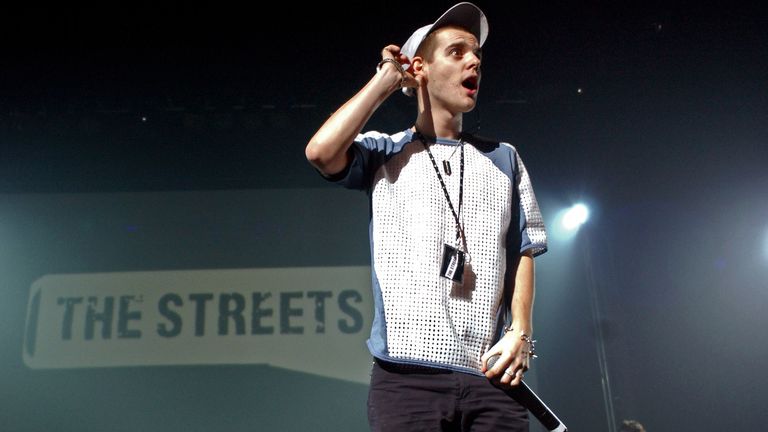
You’re listening to The Streets, Mike Skinner told us back in 2001. Back then he was launching Original Pirate Material, the era-defining debut album that would become a cult classic and a best-seller, despite his lyrical assertion otherwise.
Now, we will soon be watching on the big screen, too, as Skinner releases his debut film The Darker The Shadow, The Brighter The Light, billed as a “tripped out neo-noir” murder mystery. The story follows the “seemingly mundane life” of a down-on-his-luck DJ and has been entirely crafted by the musician, who wrote, directed, filmed, edited and created the score for the project, and is also its star.
From a lyricist whose nuanced lines about life’s mundanities turned the banal into the exhilarating – from video shops and texting girls to scrambled eggs and fried tomato (plenty of) – it sounds promising. Of course, there is an album, too – the first full-length record from The Streets in more than 10 years (None Of Us Are Getting Out Of This Life Alive, released in 2020, was a mix-tape of collaborations).
‘I’m a DJ in the film and that part of the film is true’
“It’s a musical but the songs are the voiceover,” Skinner told Sky News at the premiere for the film, held in London. But don’t expect “jazz hands or dancing around on lampposts – that’s the next film”, he jokes. “It’s a very simple story that started out almost like a film noir type thing, but then got carried away.”
Scenes were shot in London venues such as Visions and Hoxton Hall, as well as Manchester’s Warehouse Project and Club Liv. “All of the places in the film are nightclubs where I have been DJing, so I’m a DJ in the film and that part of the film is true. But I wasn’t trying to be overly clever. I was just trying to make a film that would be easy and cheap.”
Skinner called time on The Streets in 2011 before announcing a reunion tour in 2017. His other projects, such as The D.O.T, have been low-profile in comparison, and he has been DJing for years. “I think music is about the other people you’re around, which is what makes it so intense when you’re a teenager, right, because the music represents these emotional times that you’re having. In a weird way, I actually think DJing is a bit like that, really. Because, you’re forced to be in rooms with people listening to music very loud.”
So the premise for the film sounds like it could be based in truth, apart from, presumably, the murder-mystery part. “It’s not autobiographical at all, apart from the people and the places, if that makes sense,” he says. “There’s elements of it that are really happening – when I’m DJing, that’s just someone filming me when I’m DJing. But it’s… I’ve just crafted a very silly story on to the top of what is very banal, and nocturnal.”
Concept similar to A Grand Don’t Come For Free
Skinner pictured at a gig in Brixton in 2003
The film was planned “as being a bit like my second album”, Skinner says. A Grand Don’t Come For Free, the album that saw his fame skyrocket, was a concept album telling the story of a guy who loses £1,000, featuring hits including Fit But You Know It, Dry Your Eyes, and Blinded By The Lights.
“This is the same, really,” he says. “It’s kind of what I’ve been doing lately, but turned into a musical.”
The music has been ready for years – “this project’s seven years old, or 10 years, depending on how you define it… I’ve been sitting on the music”.
Read more from Sky News:
‘I can enjoy the past more knowing I have something people want to hear now’
Seizures and synesthesia: Soundtracking an epileptic brain
Bringing back The Streets, starting with a reunion tour, has been “great”, Skinner says. In fact, that’s been the easy bit. The film was harder to get off the ground. He was determined, financing the project himself when he struggled to get backing.
“Knowing that I’m working on this film and then working on this film has been a nightmare. It’s been an obsession… I kind of did everything myself so it just didn’t stop, really. The tunnel was very long, very dark, and there was no light – apart from a train, maybe.”
Click to subscribe to Backstage wherever you get your podcasts
‘I didn’t sleep for a week’
Skinner is a perfectionist. “You have to be. But it was more… we did try to get funding. No one wanted to give us any money. That was 2019. I mean, established directors can’t make films, you know, so I’ve not got a chance in hell, really. I kind of knew that. End of 2019 I just thought, I’ve just got to do this myself or it’s not going to get done. And it’s really hard.”
Now, with the film about to launch, he admits he feels “completely overwhelmed”, having struggled the most with the finishing touches in the days leading up to the premiere. “I’ve kind of gone from literally sitting in my pants, just tearing my hair out, to like three days later, having make-up put on me and talking to you.”
He adds: “It was completely bonkers. I didn’t sleep literally for a week. I could have gone on, to be honest, I could have gone on for another six weeks. But, you know, you don’t finish a work of art. You just abandon it.”
Skinner is touring The Darker The Shadow, The Brighter The Light with Q&A sessions at Everyman cinemas, starting in Plymouth on 19 September and ending in London on 6 October

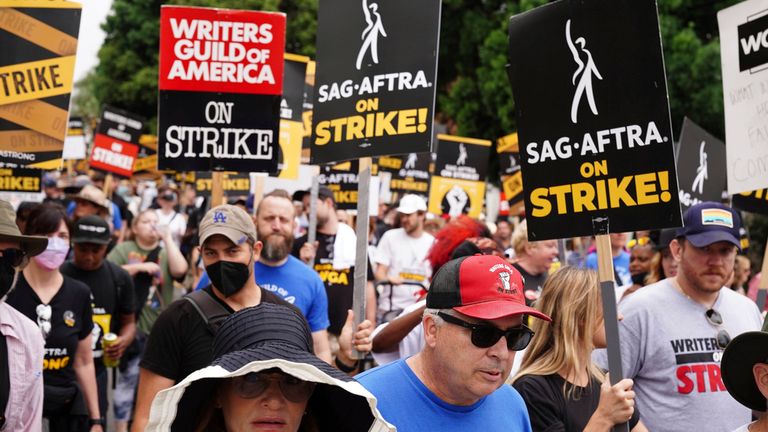
Thousands of members of actors’ trade union Equity are being asked whether they would support industrial action over artificial intelligence protections.
The organisation has launched an indicative ballot among about 7,000 members working in film and TV.
Performers are being asked whether they are prepared to refuse to be digitally scanned on set in order to secure adequate artificial intelligence protections.
It will be the first time the performing arts and entertainment trade union has asked this whole section of its membership to vote in a ballot.
The Hollywood strikes took place in 2023. File pic: AP
The announcement follows the Hollywood strikes in 2023, when members of Equity’s sister union in the US, SAG-AFTRA, and writers, went on strike over issues including AI.
Video game actors in the US also protested over the use of AI, ending almost a year of industrial action earlier in 2025.
Equity’s ballot opens on Thursday and runs for two weeks, and will show the level of support the union has for action short of a strike.
Another statutory ballot would have to be made before any industrial action is taken.
“While tech companies get away with stealing artists’ likeness or work, and the government and decision makers fret over whether to act, unions including Equity are at the forefront of the fight to ensure working people are protected from artificial intelligence misuse,” Equity general secretary Paul W Fleming said in a statement.
“If bosses can’t ensure someone’s likeness and work won’t be used without their consent, why should performers consent to be digitally scanned in the first place?”
Mr Fleming said the ballot would give members the opportunity to “send a clear message to the industry: that it is a basic right of performers to have autonomy over their own personhood and identity”.
The union has no choice but to recommend members support industrial action, he said.
“It’s time for the bosses to step away from the brink and offer us a package, including on AI protections, which respects our members,” added Mr Fleming.
The hotly anticipated Spotify Wrapped is revealing our top tracks, artists and albums for 2025.
But how does the streaming service calculate personalised summaries of users’ listening habits and rank the UK’s hottest artists?
Here’s a look at how your data is used.
The platform describes the annual statistics as “a chance to look back on your year in sound”.
It says data is captured between January and mid-November on every account, although it mostly excludes anything streamed in private mode. (Don’t worry, your passion for the Spice Girls can be kept secret.)
Wrapped presents personalised listening statistics, which Spotify calls the “real story of your year of listening”, alongside global figures for comparison.
The streaming service says Minutes Listened reflects the actual time spent listening to audio on the platform.
Once a user streams at least 30 tracks, Spotify generates a list of Your Top Songs. Similarly, Your Top Artists ranks artists based on total minutes listening to a particular performer.
Other metrics identify the top genres users have played, as well as podcasts and audiobooks ranked by total minutes listened. And if you’ve listened to at least 70% of tracks on a record, you’ll see top albums too.
Spotify also creates Your Listening Age, a guesstimate of your age based on the era of the music “you feel most connected to”.
The streaming service says the statistic is calculated using a five-year span of music which users engaged with more than other listeners of a similar age.
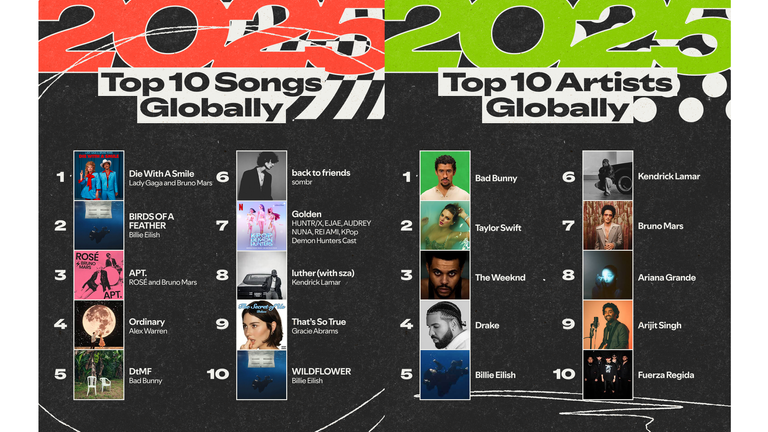
Spotify has been summing up 2025’s most listened to tracks. Pic: Spotify
Swift vs Bunny
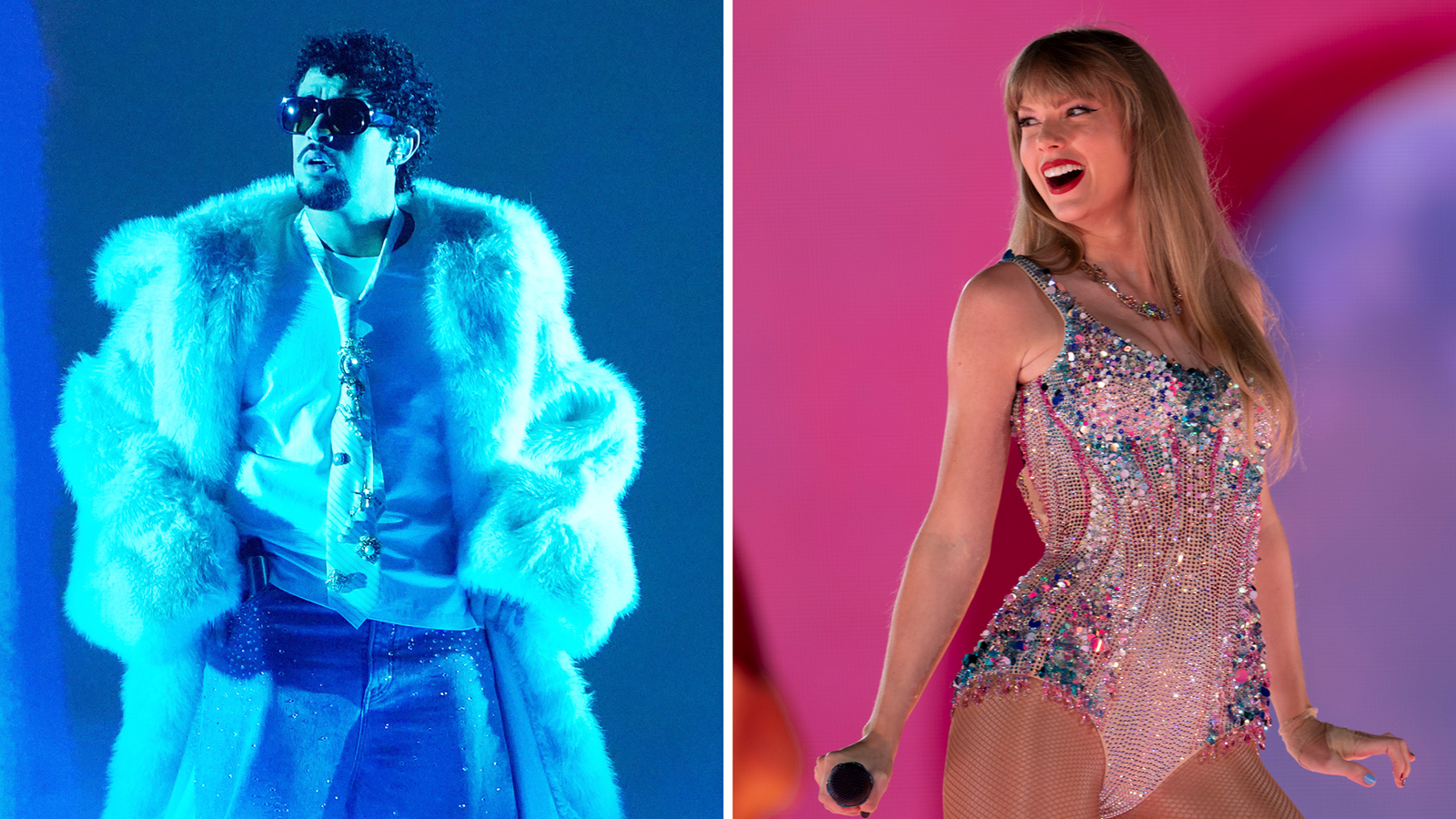
Pop superstar Taylor Swift has been named the UK’s most-streamed artist on Spotify for the third year in a row.
But she dropped out of the top spot in the global rankings, coming second to Puerto Rican superstar Bad Bunny, who secured more than 19.8 billion streams. Third were The Weeknd, followed by Drake and Billie Eilish.
Bad Bunny’s LP Debi Tirar Mas Fotos was the most listened-to album worldwide.
Read more from Sky News:
Sabrina Carpenter fury at video
Drake’s lawsuit dismissed
Spotify hikes UK prices
Spotify revealed Drake was the UK’s second most-listened to artist, followed by Sabrina Carpenter in third, The Weeknd in fourth and Billie Eilish in fifth.
Despite being the most listened-to artist, Swift failed to break into the UK’s top five most listened-to songs and albums of the year.
Alex Warren’s Ordinary was the most-streamed song, and Short ‘N’ Sweet, released by Carpenter last year, the top album.

-
 Sports2 years ago
Story injured on diving stop, exits Red Sox game
-
 Sports3 years ago
‘Storybook stuff’: Inside the night Bryce Harper sent the Phillies to the World Series
-
 Sports2 years ago
Game 1 of WS least-watched in recorded history
-
 Sports3 years ago
Button battles heat exhaustion in NASCAR debut
-
 Sports3 years ago
MLB Rank 2023: Ranking baseball’s top 100 players
-
Sports4 years ago
Team Europe easily wins 4th straight Laver Cup
-
 Environment3 years ago
Japan and South Korea have a lot at stake in a free and open South China Sea
-
 Environment1 year ago
Here are the best electric bikes you can buy at every price level in October 2024