On Wednesday, Sept. 20, the United States House Financial Services Committee marked up two bills to curb the issuance of a central bank digital currency (CBDC). One of the bills would stop the Federal Reserve from running any test programs on CBDCs without congressional approval, while the other would stop federal banks from using CBDCs for some services and products.
The principal political adversaries to a digital dollar are heavyweights such as Robert F. Kennedy Jr. and Florida governor Ron DeSantis, who have thrown their hats into the ring to become president a year from November.
In May, Cointelegraph reported that according to its own research, more than 130 countries were at some stage of research into a CBDC, and only eight had rejected the idea outright. These countries are diverse, from France and Switzerland to Haiti and Bhutan. So, the question must be asked: Why would a country like the United States be so opposed to having its own digital currency?
The idea of a CBDC in itself is nothing too taxing. In essence, digital dollars would be based on blockchain technology rather than having traditional dollars moving around between accounts. That would dramatically decrease transfer times, cut fees, and do away with the “middlemen” — the intermediaries along the way who slow things down and take a cut for themselves.
The Federal Deposit Insurance Corporation found that in 2021, there were still 5.9 million “unbanked’ households in the United States, a massive number by any standard.
A CBDC would mean that the Federal Reserve would effectively oversee all the bank transfers in the country, as there would be no alternative. And having everything under one roof means one mistake or failure would affect everyone rather than be limited to one bank, for instance.
But perhaps the biggest argument against a CBDC is that, for cryptocurrency purists, having a central institution overseeing a currency is the very thing crypto was designed to avoid. Why now make a U-turn?
Political motivations play a significant role in the discussion in the United States. In March 2022, President Joseph Biden said his administration would “place the highest urgency on research and development efforts into the potential design and deployment options of a United States CBDC.”
This provided fodder for the Republican party to come out against the plan, citing invasion of privacy and claiming it was another form of government control. DeSantis even came out with an Orwellian prediction of the government stopping its citizens from buying fossil fuels or guns if such legislation were in place.
This is not to say that the U.S. hasn’t looked into a CBDC, as it has extensively.
In 2020, the Federal Reserve launched Project Hamilton to study the viability of a CBDC. By 2022, it had developed a system that took elements from the workings of Bitcoin but moved away from its rigid blockchain backbone. The result was a system that can process 1.7 million transactions per second, light years ahead of the Bitcoin blockchain and quicker even than Visa, which can deal with about 65,000 transactions per second.
David Millar, data center coordinator at Santander, told Cointelegraph: “The leaps forward they made during Project Hamilton were truly staggering. When we heard of the progress they were making, we believed that our entire infrastructure would need to be completely revamped within the next five years.”
Nevertheless, the project completed its initial phase in December 2022 and went no further. Once again, voices of dissent from Congress attacked the project, saying it had been carried out solely with academics and the public sector in mind and the average citizen would not benefit. Millar added:
“The time and effort that went into Hamilton and the results they produced; it’s a tragedy that most of it will never see the light of day.”
The issue of privacy is one of the most prominent foes of the digital dollar. The main argument of the dissenters is that if there is to be a digital dollar, it should effectively be like the cash dollar is now, with its benefits of anonymity coupled with the power and speed of a cryptocurrency. Those who favor a digital dollar argue that we already have such a thing, but it’s just not called that yet. Credit card money is digital for all intents and purposes, and are any of us mailing cash to Amazon to pay for things?
The world is moving toward a cashless society, and the U.S. is no exception. In 2022, only 18% of all U.S. payments were made in cash, down from 31% in 2016.
The U.S. is also a country of strange contradictions. While it surges ahead in many areas, such as technology, its banking system remains rooted in the traditional, with check payments still being the norm. Dragging a whole nation away from that is a tall order.
So, what does the future hold for a potential U.S. CBDC? Well, very little. Project Hamilton closed with no indication of a second phase, and according to Darrell Duffie, a professor of finance at Stanford’s Graduate School of Business, while work is continuing, it has slowed to a snail’s pace, and “nobody is charging ahead openly.”
It seems for the foreseeable future, this will be one part of the cryptosphere where the U.S. is not a pioneer.
South Korea is preparing to impose bank-level, no-fault liability rules on crypto exchanges, holding exchanges to the same standards as traditional financial institutions amid the recent breach at Upbit.
The Financial Services Commission (FSC) is reviewing new provisions that would require exchanges to compensate customers for losses stemming from hacks or system failures, even when the platform is not at fault, The Korea Times reported on Sunday, citing officials and local market analysts.
The no-fault compensation model is currently applied only to banks and electronic payment firms under Korea’s Electronic Financial Transactions Act.
The regulatory push follows a Nov. 27 incident involving Upbit, operated by Dunamu, in which more than 104 billion Solana-based tokens, worth approximately 44.5 billion won ($30.1 million), were transferred to external wallets in under an hour.
Regulators are also reacting to a pattern of recurring outages. Data submitted to lawmakers by the Financial Supervisory Service (FSS) shows the country’s five major exchanges, Upbit, Bithumb, Coinone, Korbit and Gopax, reported 20 system failures since 2023, affecting over 900 users and causing more than 5 billion won in combined losses. Upbit alone recorded six failures impacting 600 customers.
The upcoming legislative revision is expected to mandate stricter IT security requirements, higher operational standards and tougher penalties. Lawmakers are weighing a rule that would allow fines of up to 3% of annual revenue for hacking incidents, the same threshold used for banks. Currently, crypto exchanges face a maximum fine of $3.4 million.
The Upbit breach has also drawn political scrutiny over delayed reporting. Although the hack was detected shortly after 5 am, the exchange did not notify the FSS until nearly 11 am. Some lawmakers have alleged the delay was intentional, occurring minutes after Dunamu finalized a merger with Naver Financial.
As Cointelegraph reported, South Korean lawmakers are also pressuring financial regulators to deliver a draft stablecoin bill by Dec. 10, warning they will push ahead without the government if the deadline is missed.
The ruling party’s ultimatum follows slow progress and repeated delays, with officials hoping to bring the bill to debate during the National Assembly’s extraordinary session in January 2026.
Millionaire Tory donor Malcolm Offord has defected to Reform UK, saying he would be campaigning “tirelessly” to “remove this rotten SNP government”.
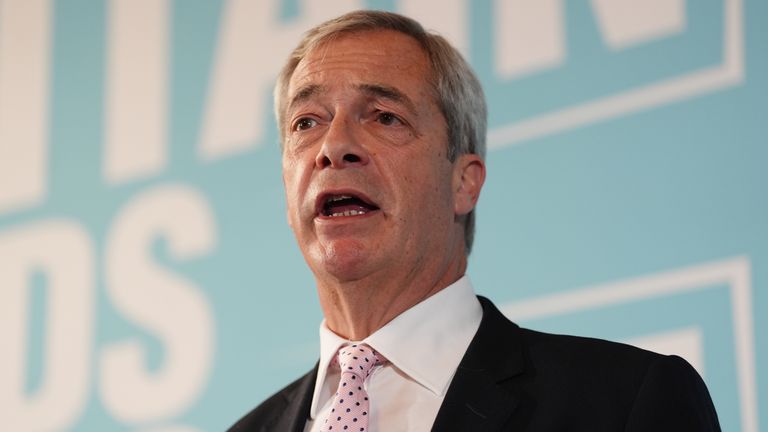
Nigel Farage announced the former Conservative life peer’s defection during a rally in the Scottish town of Falkirk, where regular anti-immigration protests have taken place outside the Cladhan Hotel – which is being used to house asylum seekers.
Mr Farage, Reform UK’s leader, said he was “delighted” to welcome Greenock-born Lord Offord to Reform, describing his defection as “a brave and historic act”.
He added: “He will take Reform UK Scotland to a new level.”
During a speech, Lord Offord, who previously donated nearly £150,000 to the Tories, said he would be quitting the Conservative Party and giving up his place in the House of Lords as he prepares to campaign for a seat in Holyrood in May.
The 61-year-old said he wanted to restore Scotland to a “prosperous, happy, healthy country”.
“Scotland needs Reform and Reform is coming to Scotland,” he told the rally.
“Today I can announce that I am resigning from the Conservative Party. Today I am joining Reform UK and today I announce my intention to stand for Reform in the Holyrood election in May next year.
“And that means that from today, for the next five months, day and night, I shall be campaigning with all of you tirelessly for two objectives.
“The first objective is to remove this rotten SNP government after 18 years, and the second is to present a positive vision for Scotland inside the UK, to restore Scotland to being a prosperous, proud, healthy and happy country.”
The latest defection comes as Mr Farage finds himself at the centre of allegations of racism dating back to his time in school.
Please use Chrome browser for a more accessible video player
4:09
Claims made against Nigel Farage
Sky News reported on Saturday that a former schoolfriend of Mr Farage claimed he sang antisemitic songs to Jewish schoolmates – and had a “big issue with anyone called Patel”.
Jean-Pierre Lihou, 61, was initially friends with the Reform UK leader when he arrived at Dulwich College in the 1970s, at the time when Mr Farage is accused of saying antisemitic and other racist remarks by more than a dozen pupils.
Mr Farage has said he “never directly racially abused anybody” at Dulwich and said there is a “strong political element” to the allegations coming out 49 years later.
Reform’s deputy leader Richard Tice has called the ex-classmates “liars”.
A Reform UK spokesman accused Sky News of “scraping the barrel” and being “desperate to stop us winning the next election”.

The European Commission’s proposal to expand the powers of the European Securities and Markets Authority (ESMA) is raising concerns about the centralization of the bloc’s licensing regime, despite signaling deeper institutional ambitions for its capital markets structure.
On Thursday, the Commission published a package proposing to “direct supervisory competences” for key pieces of market infrastructure, including crypto-asset service providers (CASPs), trading venues and central counterparties to ESMA, Cointelegraph reported.
Concerningly, the ESMA’s jurisdiction would extend to both the supervision and licensing of all European crypto and financial technology (fintech) firms, potentially leading to slower licensing regimes and hindering startup development, according to Faustine Fleuret, head of public affairs at decentralized lending protocol Morpho.
“I am even more concerned that the proposal makes ESMA responsible for both the authorisation and the supervision of CASPs, not only the supervision,” she told Cointelegraph.
The proposal still requires approval from the European Parliament and the Council, which are currently under negotiation.
If adopted, ESMA’s role in overseeing EU capital markets would more closely resemble the centralized framework of the US Securities and Exchange Commission, a concept first proposed by European Central Bank (ECB) President Christine Lagarde in 2023.
EU plan to centralize licensing under ESMA creates crypto and fintech slowdown concerns
The proposal to “centralize” this oversight under a single regulatory body seeks to address the differences in national supervisory practices and uneven licensing regimes, but risks slowing down overall crypto industry development, Elisenda Fabrega, general counsel at Brickken asset tokenization platform, told Cointelegraph.
“Without adequate resources, this mandate may become unmanageable, leading to delays or overly cautious assessments that could disproportionately affect smaller or innovative firms.”
“Ultimately, the effectiveness of this reform will depend less on its legal form and more on its institutional execution,” including ESMA’s operational capacity, independence and cooperation “channels” with member states, she said.
Global stock market value by country. Source: Visual Capitalist
The broader package aims to boost wealth creation for EU citizens by making the bloc’s capital markets more competitive with those of the US.
The US stock market is worth approximately $62 trillion, or 48% of the global equity market, while the EU stock market’s cumulative value sits around $11 trillion, representing 9% of the global share, according to data from Visual Capitalist.