
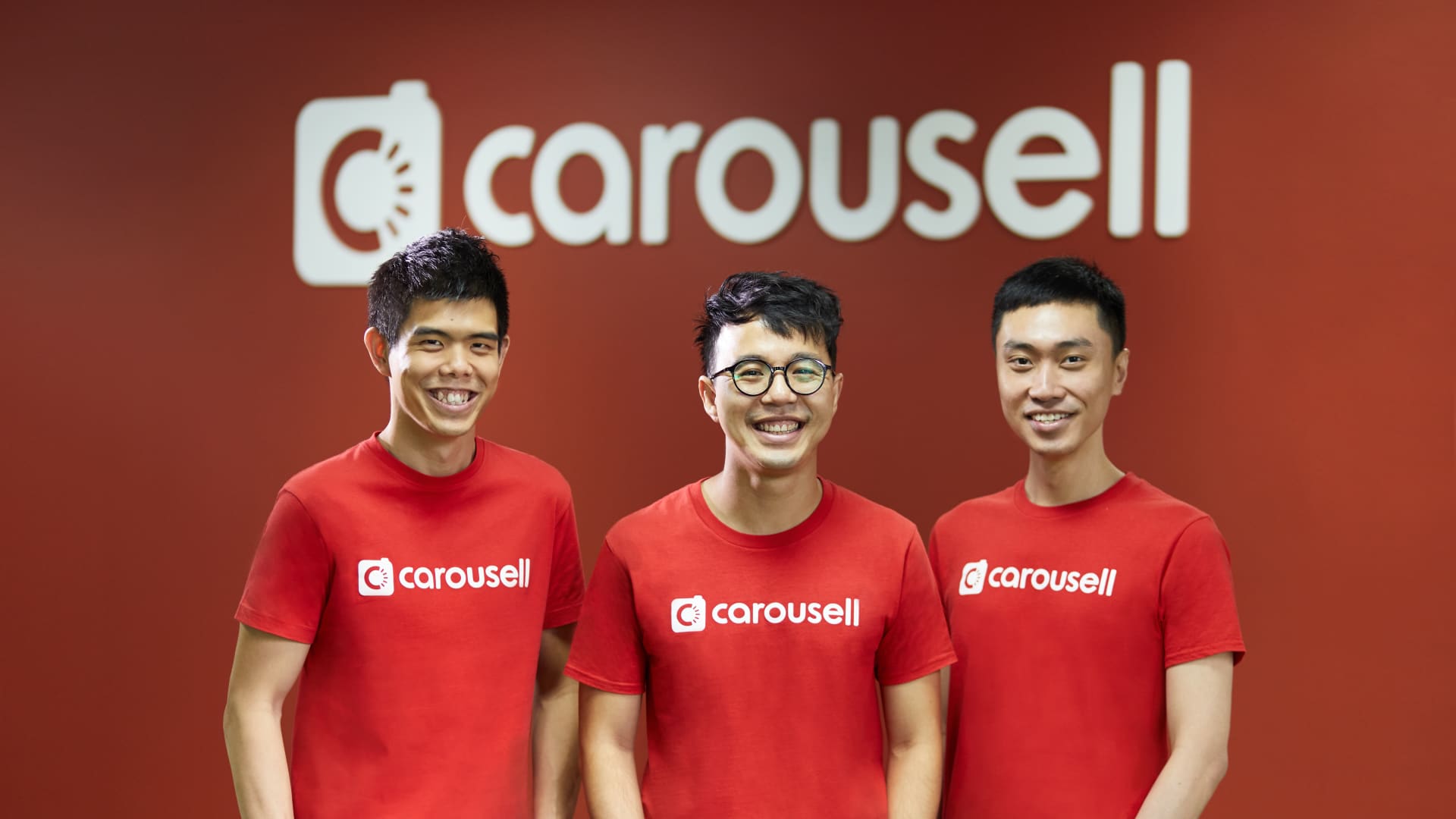
Carousell says it’s ‘on track’ to profitability, plans to reduce losses this year

Secondhand goods marketplace Carousell expects to “healthily” reduce its losses this year, putting it on track to profitability, the firm’s CEO told CNBC.
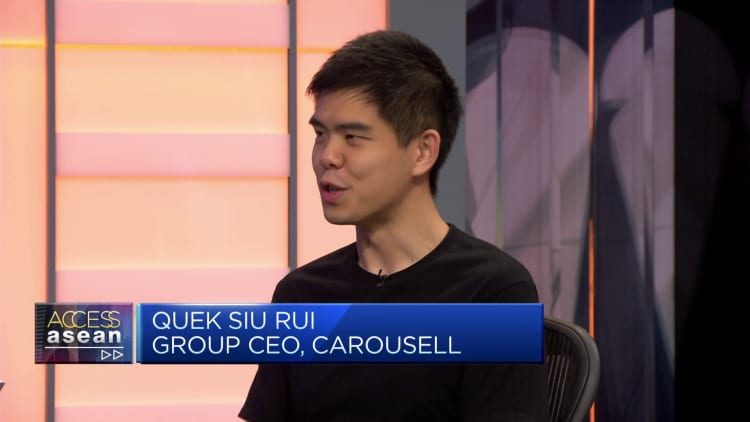
“This year, we continue to expect revenue to grow healthily. And I think in a very promising sign, we actually are going to be healthily reducing our losses this year as well,” said Quek Siu Rui, co-founder and CEO of Carousell said Monday, adding that the firm is “on track” with its plan to profitability.
In 2022, the Singapore-based company posted $82.5 million in revenue, a 67% jump from the year before, according to regulatory filings. However, losses in 2022 widened 57% year-on-year with higher expenses.
The Singapore-based firm was founded in 2012 as an online classified advertisements marketplace where users can list and sell their used goods for money.
“We acknowledge that the recommerce opportunity is a really big one. We are actually investing to grow these different initiatives and strategies,” Quek said on CNBC’s “Squawk Box Asia,” referring to the sale of previously owned goods, whether used or brand new.
Research shows that the global circular economy — which seeks to reduce waste and promote recycling and reusing — could generate $4.5 trillion in additional economic output by 2030.
Southeast Asia expansion
From automobiles to fashion, Carousell has been aggressively expanding its presence across Southeast Asia.
In 2019, it agreed to merge with Telenor Group’s classifieds firm 701Search, which operates marketplaces Mudah in Malaysia, Chợ Tốt in Vietnam, and OneKyat in Myanmar. In the same year, Carousell acquired OLX Philippines — which claimed to be the largest online classifieds site in The Philippines.
It also bought online automotive platform OneShift in 2018 and authenticated sneakers and streetwear marketplace Ox Street in 2021, and launched the Ox Luxe service which allows users to buy, sell, and consign pre-owned luxury items such as handbags and watches.
Last year, Carousell acquired Singapore-based second-hand fashion retailer Refash and Indonesian electronics recommerce platform Laku6 to bolster its expansion into the fashion and electronics markets.
“We feel confident that we can actually continue to generate healthy growth towards this very meaningful direction of recommerce growth,” Quek told CNBC.
“[With the] support of our investors, we are actually very well capitalized to execute on these strategies. So we feel very confident about our capital position.”
Cost cutting
Carousell last raised $100 million in a September 2021 funding round, taking its valuation to $1.1 billion. Media reports last year said the company dropped SPAC merger talks with U.S.-headquartered private equity firm L Catterton amid market volatility.
A SPAC, or special purpose acquisition company, is a shell company that raises capital in an IPO and uses the cash to merge with a private company in order to take it public.
Challenging macroeconomic conditions such as high interest rates and soaring inflation have caused companies to cancel or delay their IPO plans.


Inside Horizon Quantum’s office in Singapore on Dec. 3, 2025. The software firm claimed it is the first private company to deploy a commercial quantum computer in the city-state.
Sha Ying | CNBC International
Singapore-based software firm Horizon Quantum on Wednesday said it has become the first private company to run a quantum computer for commercial use in the city-state, marking a milestone ahead of its plans to list in the U.S.
The start-up, founded in 2018 by quantum researcher Joe Fitzsimons, said the machine is now fully operational. It integrates components from quantum computing suppliers, including Maybell Quantum, Quantum Machines and Rigetti Computing.
According to Horizon Quantum, the new computer also makes it the first pure-play quantum software firm to own its own quantum computer — an integration it hopes will help advance the promising technology.
“Our focus is on helping developers to start harnessing quantum computers to do real-world work,” Fitzsimons, the CEO, told CNBC. “How do we take full advantage of these systems? How do we program them?”
Horizon Quantum builds the software tools and infrastructure needed to power applications for quantum computing systems.
“Although we’re very much focused on the software side, it’s really important to understand how the stack works down to the physical level … that’s the reason we have a test bed now,” Fitzsimons said.
Quantum race
Horizon Quantum hopes to use its new hardware to accelerate the development of real-world quantum applications across industries, from pharmaceuticals to finance.
Quantum systems aim to tackle problems too complex for traditional machines by leveraging principles of quantum mechanics.
For example, designing new drugs, which requires simulating molecular interactions, or running millions of scenarios to assess portfolio risk, can be slow and computationally costly for conventional machines. Quantum computing is expected to provide faster, more accurate models to tackle these problems.
A top executive at Google working on quantum computers told CNBC in March that he believes the technology is only five years away from running practical applications.
Still, today’s quantum systems remain in the nascent stages of development and pose many engineering and programming challenges.
Investment in the space has been rising, however, as major tech companies report technological breakthroughs. Alphabet, Microsoft, Amazon and IBM, along with the U.S. government, are already pouring millions into quantum computing.
Investor attention also received a bump in June after Nvidia chief executive Jensen Huang offered upbeat remarks, saying quantum computing is nearing an “inflection point” and that practical uses may arrive sooner than he had expected.
Nasdaq listing
Horizon Quantum’s announcement comes ahead of a merger with dMY Squared Technology Group Inc., a special purpose acquisition company. The deal, agreed upon in September, aims to take Horizon public on the Nasdaq under the ticker “HQ.”
The software firm said in September that the transaction valued the company at around $503 million and was expected to close in the first quarter of 2026.
The launch of its quantum computer also helps cement Singapore’s ambition to be a regional quantum computing hub. The city-state has invested heavily in the technology for years, setting up its first quantum research center in 2007.
Before Horizon Quantum’s system came online, Singapore reportedly had one quantum computer, used primarily for research purposes. Meanwhile, U.S.-based firm Quantinuum plans to deploy another commercial system in 2026.
Singapore’s National Quantum Strategy, unveiled in May 2024, committed 300 million Singapore dollars over five years to expand the sector, with a significant portion directed toward building local quantum computer processors.
In May 2024, the National Quantum Strategy (NQS), Singapore’s national quantum initiative, pledged around S$300 million over five years to strengthen development in the sector, with a significant portion directed toward building local quantum computer processors.


Artificial intelligence has created a device that turns moon dust into energy.
The moon vacuum, which was unveiled on Wednesday by Blue Origin at Amazon‘s re:Invent 2025 conference in Las Vegas, was built using critical technology from startup Istari Digital.
“So what it does is sucks up moon dust and it extracts the heat from it so it can be used as an energy source, like turning moon dust into a battery,” Istari CEO Will Roper told CNBC’s Morgan Brennan.
Spacecraft carrying out missions on the lunar surface are typically constrained by lunar night, the two-week period every 28 days during which the moon is cast in darkness and temperatures experience extreme drops, crippling hardware and rendering it useless unless a strong, long-lasting power source is present.
“Kind of like vacuuming at home, but creating your own electricity while you do it,” he added.
The battery was completely designed by AI, said Roper, who was assistant secretary of the Air Force under President Donald Trump‘s first term and is known for transforming the acquisition process at both the Air Force and, at the time, the newly created Space Force.
A major part of the breakthrough in Istari’s technology is the way in which it handles and limits AI hallucinations.
Roper said the platform takes all the requirements a part needs and creates guardrails or a “fence around the playground” that the AI can’t leave while coming up with designs.
“Within that playground, AI can generate to its heart’s content,” he said.
“In the case of Blue Origin’s moon battery, [it] doesn’t tell you the design was a good one, but it tells us that all of the requirements were met, the standards were met, things like that that you got to check before you go operational,” he added.
Istari is backed by former Google CEO Eric Schmidt and already works with the U.S. government, including as a prime contractor with Lockheed Martin on the experimental x-56A unmanned aircraft.
Watch the full interview above and go deeper into the business of the stars with the Manifest Space podcast.

Technology
Nvidia CEO Jensen Huang talks chip restrictions with Trump, blasts state-by-state AI regulations


Nvidia CEO Jensen Huang said he met with President Donald Trump on Wednesday and that the two men discussed chip export restrictions, as lawmakers consider a proposal to limit exports of advanced artificial intelligence chips to nations like China.
“I’ve said it repeatedly that we support export controls, and that we should ensure that American companies have the best and the most and first,” Huang told reporters on Capitol Hill.
Lawmakers were considering including the Guaranteeing Access and Innovation for National Artificial Intelligence Act in a major defense package, known as the National Defense Authorization Act. The GAIN AI Act would require chipmakers like Nvidia and Advanced Micro Devices to give U.S. companies first pick on their AI chips before selling them in countries like China.
The proposal isn’t expected to be part of the NDAA, Bloomberg reported, citing a person familiar with the matter.
Huang said it was “wise” that the proposal is being left out of the annual defense policy bill.
“The GAIN AI Act is even more detrimental to the United States than the AI Diffusion Act,” Huang said.
Nvidia’s CEO also criticized the idea of establishing a patchwork of state laws regulating AI. The notion of state-by-state regulation has generated pushback from tech companies and spurred the creation of a super PAC called “Leading the Future,” which is backed by the AI industry.
“State-by-state AI regulation would drag this industry into a halt and it would create a national security concern, as we need to make sure that the United States advances AI technology as quickly as possible,” Huang said. “A federal AI regulation is the wisest.”
Trump last month urged legislators to include a provision in the NDAA that would preempt state AI laws in favor of “one federal standard.”
But House Majority Leader Steve Scalise (R-LA) told CNBC’s Emily Wilkins on Tuesday the provision won’t make it into the bill, citing a lack of sufficient support. He and other lawmakers will continue to look for ways to establish a national standard on AI, Scalise added.
WATCH: Nvidia currying favor to be able to sell chips in China

-
 Sports2 years ago
Story injured on diving stop, exits Red Sox game
-
 Sports3 years ago
‘Storybook stuff’: Inside the night Bryce Harper sent the Phillies to the World Series
-
 Sports2 years ago
Game 1 of WS least-watched in recorded history
-
 Sports3 years ago
Button battles heat exhaustion in NASCAR debut
-
 Sports3 years ago
MLB Rank 2023: Ranking baseball’s top 100 players
-
Sports4 years ago
Team Europe easily wins 4th straight Laver Cup
-
 Environment3 years ago
Japan and South Korea have a lot at stake in a free and open South China Sea
-
 Environment1 year ago
Here are the best electric bikes you can buy at every price level in October 2024