Connect with us

Published

on

Bill Ackman has grown Pershing Square Capital Management to more than $16 billion from $54 million since he founded the fund nearly two decades ago. The 57-year-old activist investor speaks with On The Money about his return to office policy, his possible presidential picks and why hes still bullish on New York City.

Lydia: You are among the big names on Wall Street who didn’t move to Florida. Why?

Bill: The short answer is that I love New York City. My desire to be successful is founded on a desire to be independent. It always seemed crazy to me to sacrifice that independence to save money on taxes. If you make $100 million some people in finance make even more than that you can save $25 million of that by living somewhere cheaper.

Some people choose to manage their lives that way. I do think it’s incumbent upon New York City to make this a desirable place to live and we have to make it an attractive place to do business. If one super wealthy person leaves the city thats really bad for the revenue. I dont think it’s smart to push taxes higher I think that would actually generate less revenue.

Lydia: There have been some top players in finance like Ken Griffin who have made a show of moving to Miami and talking about how smart it is for their business. But do you think that trend will be reversed? Will we see a lot of headlines in the next year about people moving back?

Bill: I think it’s a great thing that [Citadel founder] Ken Griffin is building a major campus, if you will, in New York City on Park Avenue. I think thats an amazing thing for NYC whether it’s his primary office or not, and it speaks to the fact that a lot of the youngest, most talented people want to be here. My nephew graduated from Harvard and many of his classmates moved here even before they had a job. The city is still a big draw for young people and if this is where the talented, young people want to be, then the companies will have to have a major presence here.

Lydia: Given the younger generation wants flexibility, is it realistic to expect people to return to the office five days a week? On the flip side, can New York City flourish if you dont have people back in Midtown and back in office buildings?

Bill: Everyone wants more flexible work whether its a school play, a sports game you dont want to miss and we have technology that lets you do that. What weve done at Pershing Square is bring people back five days a week 10 months a year. Of course if theres something you need to do like a doctors appointment or working from home one day, use your best judgment. And then we give people July and August to work from anywhere with the caveat that if there’s something where we need to bring everyone together, you show up. Weve experimented with that for two years and thats worked well, people like the balance, and it works for our business.

Lydia: And you believe New York will still be a place where businesses want to operate? 

Bill: I think if NYC became an unsafe place the images you see of San Francisco where you have open air drug users lying on the street that would be very damaging and could be a tipping point for people leaving the city.

You have to manage the city and its population effectively. In San Francisco you have homeless people acting in a threatening and hostile way thats led to the emptying out and death spiral of San Francisco. Again you want to manage a city so that it is pro-business and pro-resident and you want to show care for people who are less fortunate, but that doesnt mean they can defecate on the street and threaten parents or kids.

Lydia: Is NYC poised to go into that kind of death spiral?

Bill: No, I dont think so. We have a mayor who has for obvious reasons respect for the police force and I think they respect him. I think thats really important. The whole defunding the police movement was not a good one. Bail reform went too far. If you believe the statistic, it’s several hundred people committing the vast majority of street crime and those people should be locked up.

Lydia: The new movie Dumb Money and the meme stock craze clearly a cautionary tale of a short bet gone wrong. What do you make of that film?

Essential weekly read to fuel business lunches.

Please provide a valid email address.

By clicking above you agree to the Terms of Use and Privacy Policy.

Thanks for signing up!
Never miss a story.

Bill: We are among the most famous short sellers but thats because we shorted two stocks in the last twenty years. One short theres a movie about Herbalife [Betting on Zero] and the other short theres a book about MBIA [Confidence Game]. But we dont short stocks for precisely the reason you say. We gave up that business a long time ago because its too risky. Even when youre right you can lose a lot of money. Of course, short sellers can do amazing research.

Lydia: Youve publicly applauded the work Hindenburg has done on Carl Icahns firm. How are you thinking about Icahn now? Do you think the report captured whats going on at his firm?

Bill: What Hindenburg said has been proven out.

Lydia: Youve expressed support for a lot of different 2024 presidential candidates. Anyone else you plan to support? 

Bill: Id love Jamie Dimon to be president but hes made it clear hes not going to run. Id love for a candidate of his quality to run. I think Biden-Trump part II is not the best option for America. It would be great for us to be brought together by a more centrist candidate that members of both parties can vote for. 

Lydia: What about Vivek or RFK Jr. youve tweeted support for?

Bill: Id like to see multiple alternatives. Ive been supportive of Vivek because I know him and hes super smart and capable. I wish he was a more centrist candidate. Ive not yet met RFK but hopefully will have an opportunity to do so. But I still havent found my ideal candidate. Biden should step aside and that would create a flurry of alternative candidates. People are afraid to run against the president and I think theres some possibility of that happening.

Continue Reading

Business

Bank of England warns of heightened risks but trims banks’ reserve requirements

Published

on

By

Bank of England warns of heightened risks but trims banks' reserve requirements

The Bank of England has warned of heightened risks to the UK’s financial system but cut the amount of money that banks need to hold in reserve in case of shock.

The twice-yearly financial stability report highlights a series of pressures, from higher government borrowing costs to risks around lending to major tech firms and record stock market valuations – particularly in areas exposed to artificial intelligence (AI).

“Risks to financial stability have increased during 2025,” the Bank‘s financial policy committee (FPC) said.

“Global risks remain elevated and material uncertainty in the global macroeconomic outlook persists. Key sources of risk include geopolitical tensions, fragmentation of trade and financial markets, and pressures on sovereign debt markets.

Money latest: My supermarket delivery row

“Elevated geopolitical tensions increase the likelihood of cyberattacks and other operational disruptions.

“In the FPC’s judgement, many risky asset valuations remain materially stretched, particularly for technology companies focused on AI.

More from Money

“Equity valuations in the US are close to the most stretched they have been since the dot-com bubble, and in the UK since the global financial crisis (GFC). This heightens the risk of a sharp correction.”

Its concern extended to the growing trend of tech firms using debt finance to fund investment.

Please use Chrome browser for a more accessible video player

Could the AI bubble burst?

The Bank, which joined the International Monetary Fund in warning over an AI-led bubble in October, delivered its verdict at a time when UK regulators are under pressure from the government to place a greater focus on supporting economic growth.

It is understood, for example, the UK’s ringfencing regime – that sees retail banking separated from more risky investment banking operations within major lenders – is the subject of a review between the Bank and government.

Efforts by the chancellor to grow the economy will be potentially helped by the Bank’s decision today to lower capital requirements – the reserves banks must hold to help them withstand shocks in the financial system such as the global crisis of 2008/9.

The sector’s main capital requirement was cut by the Bank from 14% to 13%.

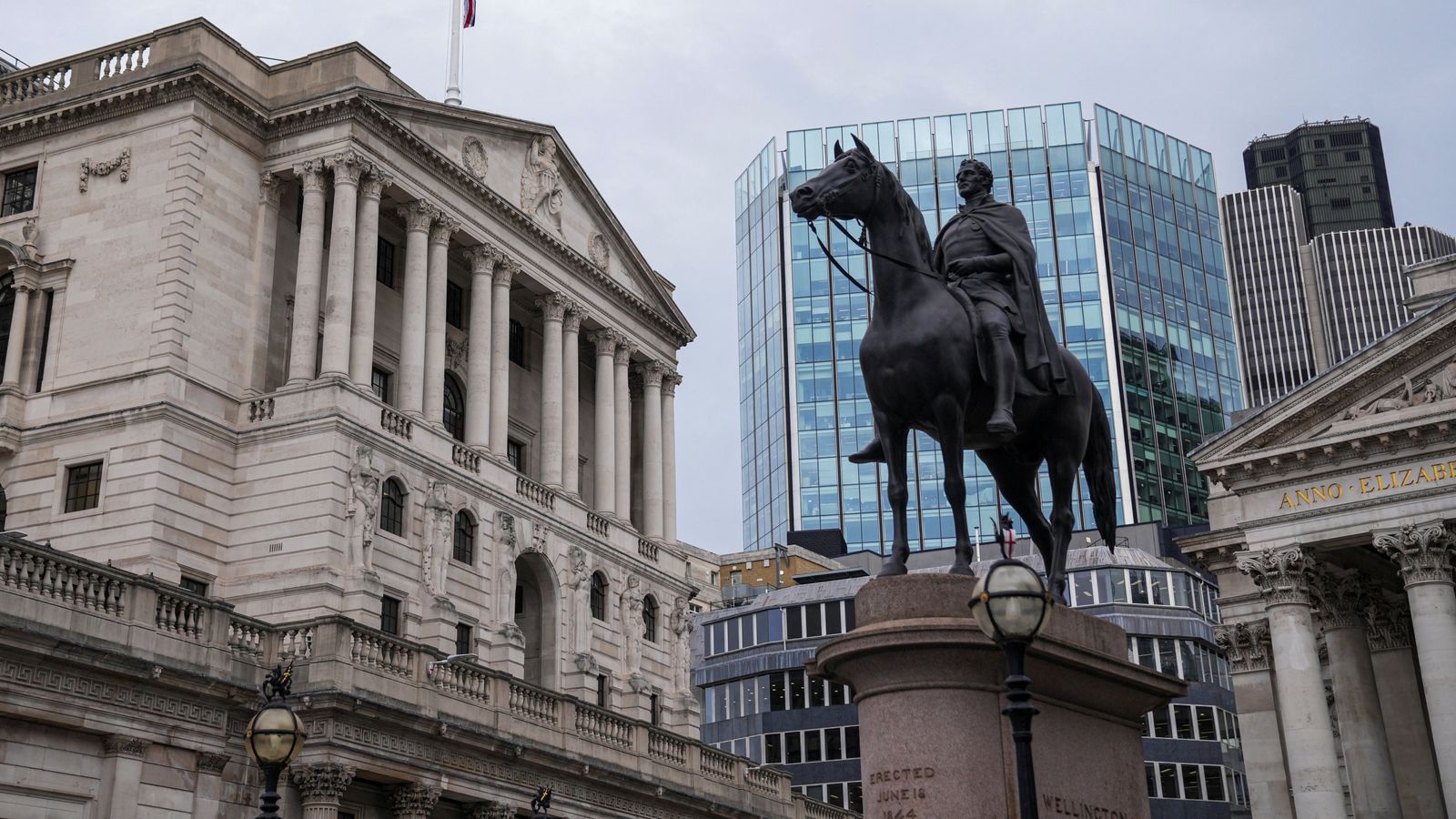
The Bank said that almost four million households face higher mortgage costs as fixed-term deals end. Pic: iStock
Image:
The Bank said that almost four million households face higher mortgage costs as fixed-term deals end. Pic: iStock

Such a move was urged, not only by the government, but by businesses to bolster UK lending and competitiveness.

The relaxation of the buffer does not take effect until 2027.

It was announced alongside confirmation that the country’s biggest lenders – Barclays, HSBC, Lloyds, NatWest, Santander UK, Standard Chartered and Nationwide building society – had passed the Bank’s latest stress tests.

The shocks each was exposed to included a 5% contraction in UK economic output, a 28% drop in house prices and Bank rate at 8%.

Despite the growing risks identified by the FPC, the Bank said that each was strong enough to support households and businesses even in the event of such scenarios, given the healthy state of their reserves.

It is widely expected that the gradual reduction in Bank rate will continue next year, assuming the outlook for inflation remains on a downwards trajectory, helping wider borrowing costs – a source of record bank profitability – decline.

The Bank said that three million households were expected to see their mortgage payments decrease in the next three years but that 3.9 million were forecast to refinance onto higher rates.

As such, it projected a £64 (8%) rise in costs for a typical owner-occupier mortgage customer rolling off a fixed rate deal in the next two years.

Banking stocks, which have enjoyed strong gains this year, were up when the FTSE 100 opened for business despite wider market caution globally which is aligned with the risks spoken of in the financial stability report.

Matt Britzman, senior equity analyst at Hargreaves Lansdown, said: “UK banks are offering a dose of optimism this morning in what’s turning out to be a good couple of weeks for the major lenders.

“The UK’s seven biggest banks sailed through the latest stress test, reaffirming their resilience and earning a regulatory nod to ease capital buffers.

“Most banks already hold capital well above the minimum by choice, so any shift in strategy may take time – but in theory, it frees up extra capital for lending or capital returns.

“However they use the new freedom, this is another clear signal that the UK banking sector is in robust health. This was largely expected, but the confirmation should still be taken well, especially after dodging tax hikes in last week’s budget.”

Continue Reading

World

More than 800,000 young children seeing social media content ‘designed to hook adults’, figures show


Published

on

By

More than 800,000 young children seeing social media content 'designed to hook adults', figures show

Children as young as three are “being fed content and algorithms designed to hook adults” on social media, a former education minister has warned.

Lord John Nash said analysis by the Centre for Social Justice (CSJ) suggesting more than 800,000 UK children aged between three and five were already engaging with social media was “deeply alarming”.

The peer, who served as minister for the school system between 2013 and 2017, said that “children who haven’t yet learned to read [are] being fed content and algorithms designed to hook adults”, which, he said, “should concern us all”.

He called for “a major public health campaign so parents better understand the damage being done, and legislation that raises the age limit for social media to 16 whilst holding tech giants to account when they fail to keep children off their platforms”.

The CSJ reached the figure by applying the latest population data to previous research by Ofcom.

The internet and communications watchdog found that almost four in 10 parents of a three to five year-old reported that their child uses at least one social media app or site.

With roughly 2.2 million children in this age group as of 2024, the CSJ said this suggests there could be 814,000 users of social media between three and five years old, a rise of around 220,000 users from the year before.

More on Australia

Lord Nash is among those who have demanded the Children’s Wellbeing and Schools Bill ban under-16s from having access to social media, something that will become law in Australia next month.

From 10 December, social media platforms will have to take reasonable steps to prevent under-16s from having a social media account, in effect blocking them from platforms such as Meta’s Instagram, TikTok and Snap’s Snapchat.

Ministers hope it will protect children from harmful content and online predators.

But one teenager who is against the idea is suing the Australian government as, he says, the measure would make the internet more dangerous for young people, many of whom would ignore the ban.

Read more on Sky News:
Call to trial four-day week for teachers
Primary school tests ‘devastating’
AI to tackle truancy

Noah Jones, 15, co-plaintiff in a High Court case said a better plan would be “cutting off the bad things about social media”, adding, “I most likely will get around the ban. I know a lot of my mates will”.

UK campaigners have called for stronger policies to stop students using phones in schools, which already have the power to ban phones.

The CSJ wants to see smartphones banned in all schools “to break the 24-hour cycle of phone use”, and said a public health campaign is needed “to highlight the harms of social media”.

Last week Health Secretary Wes Streeting said he worries “about the mind-numbing impact of doomscrolling on social media on young minds and our neurodevelopment”.

Continue Reading

World

Sudan’s RSF says it has captured Babanusa in West Kordofan

Published

on

By

Sudan's RSF says it has captured Babanusa in West Kordofan

Sudan’s paramilitary Rapid Support Forces says it has captured Babanusa, a transport junction in the south of the country, just a month after the fall of Al Fashir to the same group.

The RSF said in a statement the seizure of the city in West Kordofan state came as it repelled “a surprise attack” by the Sudanese army in what it called “a clear violation of the humanitarian truce”.

The paramilitary group added it had “liberated” the city in the state, which has become the latest frontline in the war in Sudan.

Please use Chrome browser for a more accessible video player

Sky’s Yousra Elbagir explains the unfolding humanitarian crisis

It comes just over a month after the Sudanese Armed Forces (SAF) withdrew from military positions in the heart of Al Fashir, the capital of North Darfur, and the symbolic site was captured by the RSF with no resistance.

The RSF claimed at the time it had taken over the city and completed its military control of the Darfur region, where the administration of former US president Joe Biden has accused the group of committing genocide.
Please use Chrome browser for a more accessible video player

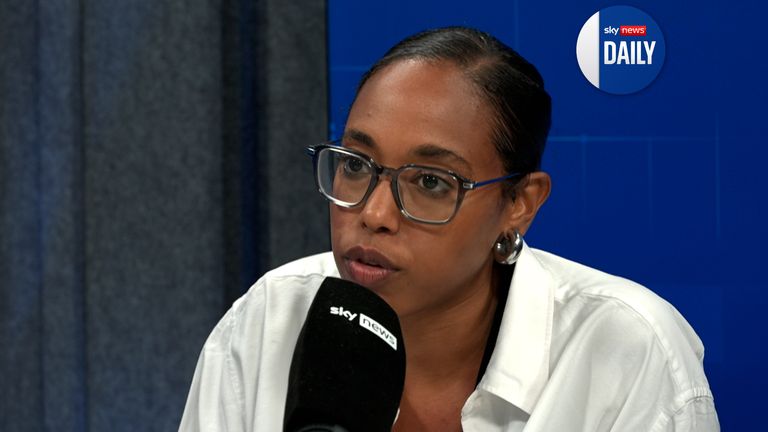
Sky’s Africa correspondent Yousra Elbagir on why evidence suggests there is a genocide in Sudan.

The war between the Sudanese army and the RSF – who were once allies – started in Khartoum in April 2023 but has spread across the country.

About 12 million people are believed to have been displaced and at least 40,000 killed in the civil war, according to the World Health Organization (WHO) – but aid groups say the true death toll could be far greater.

More on Sudan

Tom Fletcher, the UN’s under-secretary-general for humanitarian affairs, recently told Sky’s The World With Yalda Hakim the situation was “horrifying”.

“It’s utterly grim right now – it’s the epicentre of suffering in the world,” he said of Sudan.

Read more:
Tens of thousands killed in two days in Sudan city

Sudan’s war: Is it a genocide?

The United States, the United Arab Emirates, Egypt and Saudi Arabia – known as the Quad – earlier in November proposed a plan for a three-month truce followed by peace talks.

The RSF responded by saying it had accepted the plan, but soon after attacked army territory with a barrage of drone strikes.

Continue Reading

Trending