
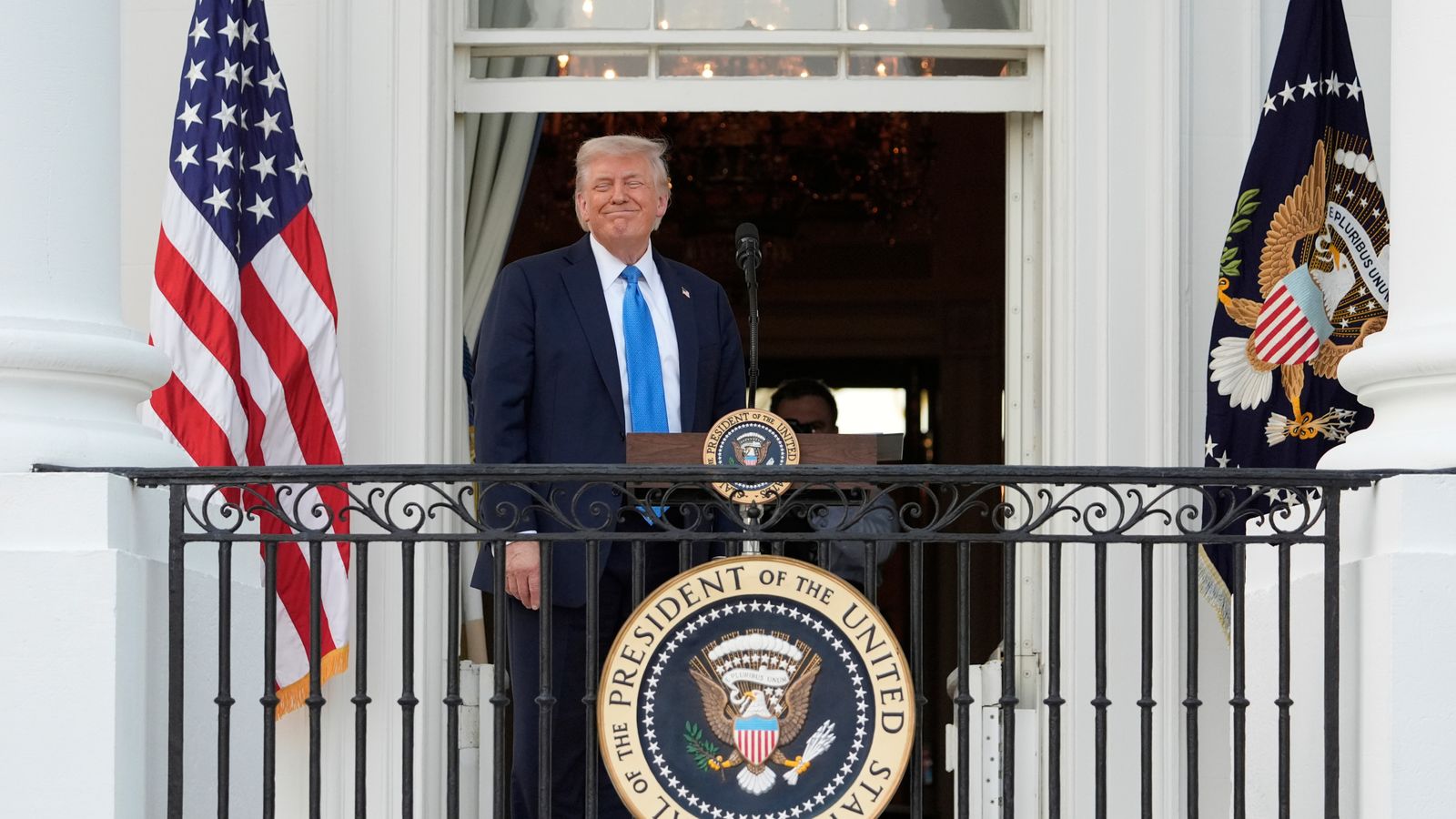
President Trump’s “America First” agenda has been spelt out in a new White House National Security Strategy that should make stark reading for allies and foes of the United States alike.
The new 33-page document outlines an upending of American foreign policy objectives and priorities which have stood largely unchanged through different administrations stretching back decades.
The document says American strategy went “astray” over many years. It seeks to reframe America’s strategic interests as being far narrower now than at any time in its modern history.
Among the key points, the document says:
• Europe faces “civilizational erasure” and could be “unrecognisable in 20 years or less”
• “Certain NATO members will become majority non-European” within a few decades
• America will “shift away” from the “burden” of the Middle East seeing it now as a “source and destination of international investment”
• In the Western hemisphere, America should pursue a policy of “enlist and expand… restoring American pre-eminence”
• In Africa, American policy focus should be on trade not “providing and spreading liberal ideology”
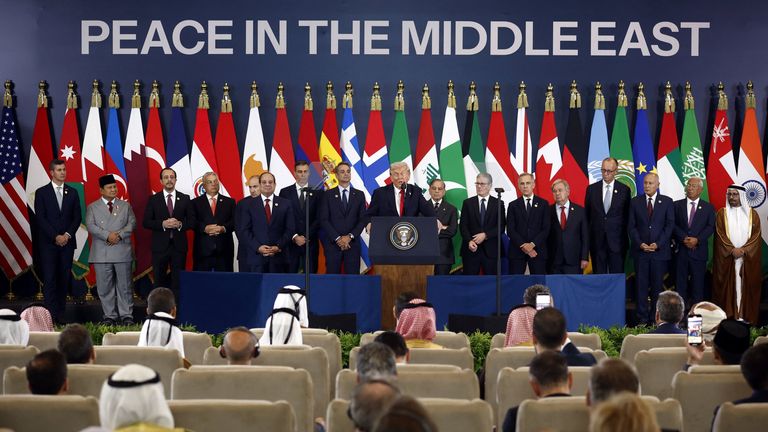
America will ‘shift away’ from the ‘burden’ of the Middle East. Pic: Reuters
In black-and-white, the text articulates a dramatic strategic shift which has been playing out at lightning speed over the past year.
The document underlines the end of the concept of America as an arbiter of the democratic rules-based order.
“American foreign policy elites convinced themselves that permanent American domination of the entire world was in the best interests of our country. Yet the affairs of other countries are our concern only if their activities directly threaten our interests,” the paper says.
Every US administration publishes at least one National Security Strategy during a presidential term.
The focus of this one is starkly different from that published by President Biden in 2022.
It’s also notably different from the document which President Trump published during his first term. His 2017 paper cast the world as a contest between “repressive regimes” and “free societies”.
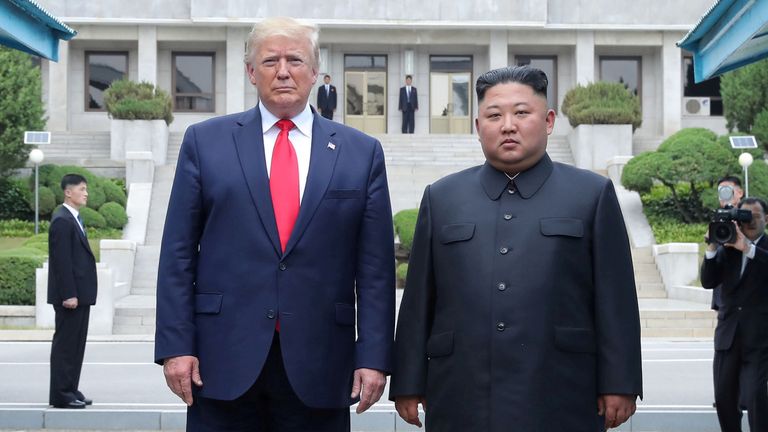
Trump doesn’t want the US to be the arbiter of the democratic rules-based order. Pic: Reuters
This new one places the necessity to do trade above the imposition of values.
“We seek good relations and peaceful commercial relations with the nations of the world without imposing on them democratic or other social change that differs widely from their traditions and histories.”
Mass migration and Europe
The new document is highly critical of mass migration.
It warns that uncontrolled migration is destroying the concept of nation states which could impact America’s strategic alliances and the countries it counts as reliable allies.
The paper is particularly critical of Europe, of the European Union as a concept and of individual European nations.
“Should present trends continue, the continent will be unrecognizable in 20 years or less,” the paper says.
It continues: “As such, it is far from obvious whether certain European countries will have economies and militaries strong enough to remain reliable allies.
“Many of these nations are currently doubling down on their present path. We want Europe to remain European, to regain its civilizational self-confidence, and to abandon its failed focus on regulatory suffocation.”
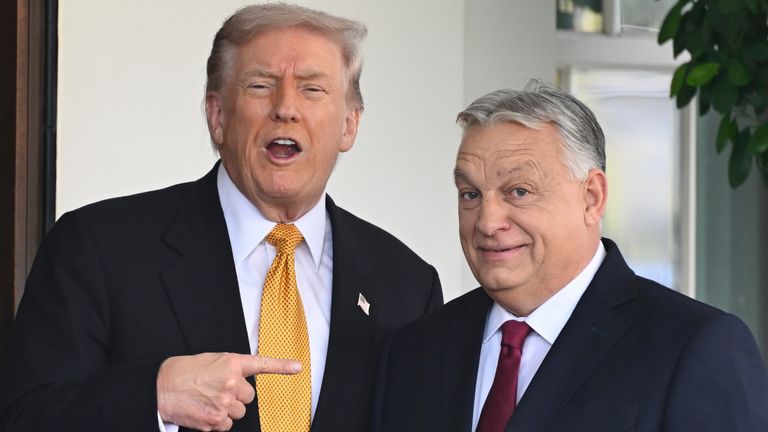
Trump will seek to support ‘patriotic European parties’. Pic: AP
The document’s language around the politics of governing parties across Europe is particularly stark.
Regarding Ukraine, the document says: “The Trump Administration finds itself at odds with European officials who hold unrealistic expectations for the war perched in unstable minority governments, many of which trample on basic principles of democracy to suppress opposition.
“A large European majority wants peace, yet that desire is not translated into policy, in large measure because of those government’s subversion of democratic processes.”
👉 Tap to follow Trump100 wherever you get your podcasts👈
The document outlines how his administration will seek to support “patriotic European parties”.
This is entirely in line with President Trump’s rhetoric but still represents a major departure from the longstanding principle of not interfering in the politics of allies.
It says: “American diplomacy should continue to stand up for genuine democracy, freedom of expression, and unapologetic celebrations of European nations’ individual character and history.
“America encourages its political allies in Europe to promote this revival of spirit, and the growing influence of patriotic European parties indeed gives cause for great optimism.”

Trump has at times had a fiery relationship with Ukraine’s President Zelenskyy. Pic: Reuters
Ukraine and Russia
On European-Russia relations, the document raises the prospect of war but curiously does not presume that such a conflict would involve America.
“Managing European relations with Russia will require significant US diplomatic engagement, both to reestablish conditions of strategic stability across the Eurasian landmass, and to mitigate the risk of conflict between Russia and European states.”
Read more from Sky News:
Germany introduces controversial military service law
Netflix agrees $72bn deal for Warner Bros studios
By contrast, President Biden’s National Security Strategy, published in 2022, underlined repeatedly the “iron-clad” commitment the United States had to Europe’s security.
Chinese risk and opportunity
The document presents Asia and the Indo-Pacific region as a source of opportunity for strategic and economic cooperation.

Maintaining US military strength over China is also outlined. Pic: Reuters
“President Trump is building alliances and strengthening partnerships in the Indo-Pacific that will be the bedrock of security and prosperity long into the future…”
And specifically on China, the paper presents a goal of “economic vitality” achieved through a balanced economic relationship between the two countries combined with an “ongoing focus on deterrence to prevent war”.
Deterrence would be achieved, it outlines, by maintaining preeminent military strength over China.
It says: “This combined approach can become a virtuous cycle as strong American deterrence opens up space for more disciplined economic action, while more disciplined economic action leads to greater American resources to sustain deterrence in the long term.”
Hemispheres of influence
In line with President Trump’s focus on spheres of influence, particular focus is given to the western hemisphere.
There are clear references to the impact of drugs from south and central America into the US and more subtle references to control of the arctic.
“The United States will reassert and enforce the Monroe Doctrine to restore American pre-eminence in the Western Hemisphere, and to protect our homeland and our access to key geographies throughout the region,” the paper says.
It continues: “We will deny non-Hemispheric competitors the ability to position forces or other threatening capabilities, or to own or control strategically vital assets, in our hemisphere.”
Environment
The UK wants to unlock a ‘golden age of nuclear’ but faces key challenges in reviving historic lead


The Sizewell A and B nuclear power stations, operated by Electricite de France SA (EDF), in Sizewell, UK, on Friday, Jan. 26, 2024. Photographer: Chris Ratcliffe/Bloomberg via Getty Images
Bloomberg | Bloomberg | Getty Images
The U.K. was the birthplace of commercial nuclear energy, but now generates just a fraction of its power from it — big investments are underway to change that.
The country once had more nuclear power stations than the U.S., USSR and France — combined. It was a global producer until 1970 but hasn’t completed a new reactor since Sizewell B in 1995.
Today, the country takes the crown not for being a leader in atomic energy, but for being the most expensive place in the world to build nuclear projects.
Nuclear energy accounted for just 14% of the U.K.’s power supply in 2023, according to the most recent data from the International Energy Agency, trailing its European peers and well behind frontrunner France at 65%.
There is ambition to change that and have a quarter of the U.K.’s power come from nuclear by 2050. Nuclear is considered an attractive bet gas it’s a low-carbon, constant energy source that can act as a baseload to complement intermittent sources like renewables.
“There’s a very clear momentum that has been observed,” Doreen Abeysundra, founder of consultancy Fresco Cleantech, told CNBC. It’s in part due to geopolitical tensions, which pushed energy security and independence onto public agendas.
However, the U.K.’s Nuclear Regulatory Taskforce called for urgent reforms after identifying “systemic failures” in the country’s nuclear framework. It found that fragmented regulation, flawed legislation and weak incentives led the U.K. to fall behind as a nuclear powerhouse. The government committed to implementing the taskforce’s guidance and is expected to present a plan to do so within three months.
Going big – or small
The U.K. is spreading its bets across tried-and-tested large nuclear projects and smaller, next-generation reactors known as small module reactors (SMRs).
British company Rolls-Royce has been selected as the country’s preferred partner for SMRs, which are effectively containerized nuclear reactors designed to be manufactured in a factory. Many include passive cooling techniques, which supporters argue makes them safer and cheaper.
Nuclear has long come under fire by environmentalists due to radioactive waste and disasters like Chernobyl. Indeed, the U.K.’s first commercial plant Windscale became its worst nuclear accident in history when it melted down in 1957.
On October 10, 1957, Windscale became the site of the worst nuclear accident in British history, and the worst in the world until Three Mile Island 22 years later. A facility had been built there to produce plutonium, but when the US successfully designed a nuclear bomb that used tritium, the facility was used to produce it for the UK. However, this required running the reactor at a higher temperature than its design could sustain, and it eventually caught fire. Operators at first worried that e
Photo: George Freston | Hulton Archive | Getty Images
Most SMRs use light water reactor technology – think of the planned large-scale nuclear plant Sizewell C, just “shrunk down,” said Abeysundra – which is tried and tested.
Other designs, known as “advanced” reactors, are more experimental. For example, those that change the cooling solution or solvent, which is typically used in the process of separating and purifying nuclear materials.
The U.K.’s first SMR will be at Wylfa, in Wales, though no timeline has been given for its completion. The site will house three SMRs and grow over time.
In September, the country signed a deal with the U.S. to enable stronger commercial ties on nuclear power and streamline licensing for firms that want to build on the opposite side of the Atlantic.
However, “the first thing is, there is not, at the moment, a single SMR actively producing electricity under four revenues. They will all come at best in the 30s,” Ludovico Cappelli, portfolio manager of Listed Infrastructure at Van Lanschot Kempen, told CNBC.
While SMRs are a “game changer” thanks to their ability to power individual factories or small towns, their days of commercial operation are too far away, he said. From an investment standpoint, “that is still a bit scary,” he added.
To secure the large baseloads needed to offset the intermittency of renewables, “we’re still looking at big power stations,” added Paul Jackson, Invesco’s EMEA global market strategist.
Nuclear share of total electricity (2023)
IEA
SMRs “probably” do have a role — “they can clearly be more nimble” — but it will take time to roll them out, Jackson said, casting doubt on the U.K.’s ability to be a leader in nuclear, as France and China are already miles ahead.
The U.K. government body Great British Energy-Nuclear is set to identify sites for an additional large-scale plant, having already acquired one in Gloucestershire, in the west of England, as well as the site in Wales.
“We are reversing a legacy of no new nuclear power being delivered to unlock a golden age of nuclear, securing thousands of good, skilled jobs and billions in investment,” a spokesperson for the U.K. government’s Department for Energy Security and Net Zero told CNBC.
“Sizewell C will deliver clean electricity for the equivalent of six million of today’s households for at least six decades, and the UK’s first small modular reactors at Wylfa will power the equivalent of three million homes, bringing energy security,” they added.
Innovation in funding
The U.K. has a strong legacy to build on. It pioneered fresh funding mechanisms to make large-scale nuclear projects investible so that they are less reliant on direct government funding, such as a Contract for Differences, which was used for Hinkley Point C.
The mechanism guarantees a fixed price for the electricity generated over a long period of time in order to de-risk investments in an industry that’s known for running over time and budget. Hinkley Point C was initially expected to cost £18 billion (over $24 billion) but the bill has slowly crept up.
“That fixes one part of the equation, the price risk,” Cappelli said of nuclear investments, but the second risk is construction delays.
The Regulated Asset Base (RAB), first used for nuclear at Sizewell C, attempts to reconcile this. Investors get paid from the day they cut a check for a nuclear project, rather than the day it starts operating. Sizewell C is expected to cost £38 billion to build.
Private market investors are increasingly interested in next-generation nuclear as a way to offset soaring energy demands from AI, resulting in a host of young companies trying to build out facilities. Perhaps the most famous is Oklo, a U.S. firm that was taken public by a Special Purpose Acquisition Company (SPAC) founded by OpenAI’s Sam Altman.
Rendering of a proposed Oklo commercial advanced fission power plant in the U.S.
Courtesy: Oklo Inc.
The U.K.’s advanced modular reactor hopeful Newcleo, which uses lead for cooling, moved its headquarters from London to Paris in 2024 — a strategic move to deepen its European footprint. At the time, it told World Nuclear News that it still plans to have a commercial reactor up and running in the U.K. by 2033, but the firm has since scaled back its British efforts.
Meanwhile, Tokamak Energy and First Light Fusion call the U.K. home. They both focus on nuclear fusion, the process of generating power by combining atoms, though this technology is yet to get out of the lab. All of today’s nuclear power comes from fission, where atoms are spit. The U.K. announced £2.5 billion for a world-first fusion prototype in June.
The next generation of engineers
The U.K. faces challenges in access to relevant talent, which is crucial for scaling projects effectively. The country is heralded for its world-class universities and technical know-how, “but that is very much book knowledge,” said Van Lanschot Kempen’s Cappelli.
“What we need is real on-the-ground expertise, and that we are probably lacking for the simple reason that we haven’t been doing it for a very long time,” he said.
For Abeysundra, there’s one area where the U.K. stands out: its mindset. “There is so much knowledge, innovation, and that can-do attitude, which I don’t see as much in other nations,” she said, pointing to the U.K.’s trailblazing role in the Industrial Revolution and establishment of offshore wind energy.
The U.K. government positioned nuclear energy as a key element of the future clean energy workforce in its Clean Energy Jobs Plan released in October, while its national roadmap for nuclear skills, set out in 2024, focuses on apprenticeships, PhDs and upskilling mid-career workers. Industry-led initiatives such as the Energy Skills Passport also support the likes of oil and gas workers to gain green skills.
Securing the supply chain
Perhaps the toughest issue, however, is the supply chain.
Uranium, the fuel used to make a nuclear reaction, is dominated by just four countries, including Russia. Global demand for uranium could rise by nearly a third by 2030 and more than double by 2040, according to the World Nuclear Association, adding further reliance on a select few countries and pressure on developers.
The U.K. government has allocated funding to build up the supply chain and has committed to preventing the import of nuclear fuel from Russia by 2028. Fuel for Sizewell C will come from European or “Western suppliers,” Cappelli noted.
However, for him, it poses the question: How secure is nuclear energy really? “We have to build nuclear power plants, but we need to build the value chain,” Cappelli added.
Workers, expertise and funding are required for nuclear energy, but the supply chain is also key, he said. Otherwise, there will be “the same issues that we had with gas,” a nod to the U.K.’s reliance on just one supplier. Instead of gas, it will be with uranium.
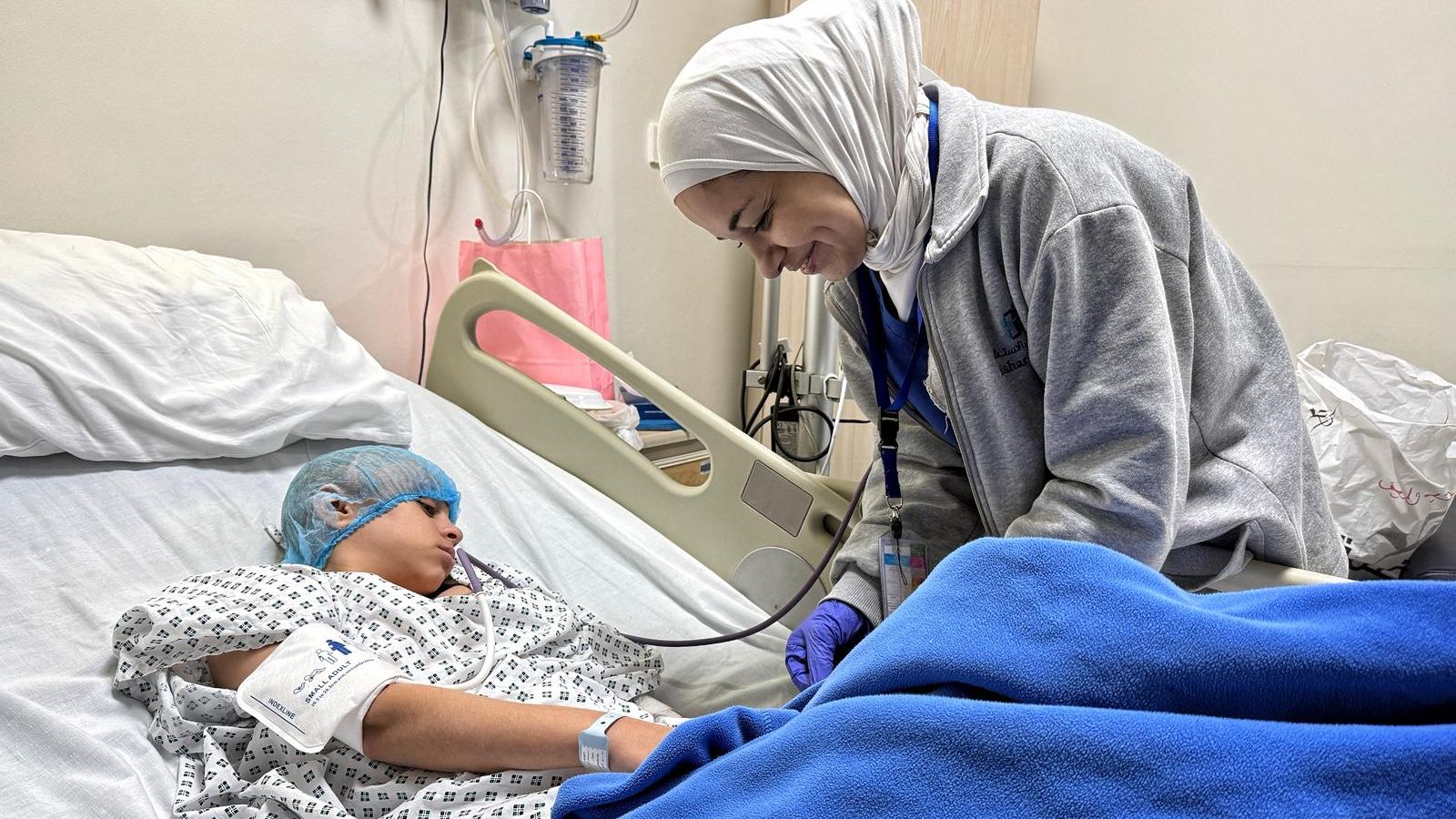
The 3D picture we’re shown of Maryam’s skull shows a gaping hole.
It’s astonishing the young girl from Gaza even survived an Israeli bombing near her home.
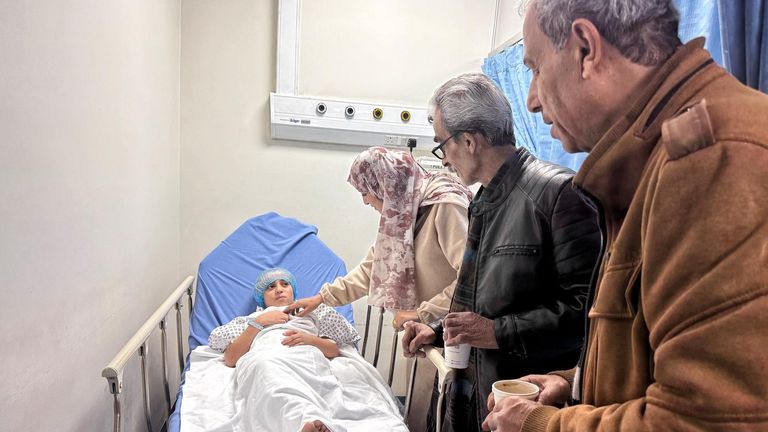
But she’s sitting up in her hospital bed in the Jordanian capital Amman, as we look on and she’s smiling and joking during a call with her father who remains in the Palestinian territory.
“I’m okay,” she says cheerily, “how are you?”
She’s heard overnight there’s been severe flooding in Gaza and the tents and makeshift shelters which tens of thousands are living in, are now soaked and under water.
But her father is focussed on how his 12-year-old daughter is feeling ahead of yet another life-saving brain operation.
Maryam is a rarity.
She is one of a few hundred patients who’ve been allowed by the Israeli authorities to leave the Gaza Strip to receive critical medical help since the October 2025 agreement signed between Israel and Hamas, which was aimed at ending hostilities.

The World Health Organisation (WHO) says they’ve identified nearly 16,000 medical cases needing urgent critical care outside Gaza.
WHO data documented a total of 217 patients who left Gaza for medical care in other countries between the dates of 13 October and 26 November 2025.
Since then, Israel’s Coordination of Government Activities in the Territories (COGAT) has said a further 72 patients and caregivers from Gaza have departed the Israeli-occupied area for Jordan.
But behind them, they left a long queue of ill and wounded people in desperate need of the sort of specialised medical help Maryam Ibrahim is receiving in Jordan.

Alex Crawford and Dr Samer Elbabaa
Having survived the bombing and having survived the craniectomy (removing her fractured skull), Maryam’s next challenge was surviving the wait to receive permission to leave Gaza for the surgery which offered her a chance of long-term survival.
She waited almost half a year for this operation: an operation considered vital.
Without it, Maryam’s brain was unprotected. Any stumble or accident risked irreversibly injuring her brain and negatively impacting her neurological functions – a risk which was considerably heightened given where she’s living.
The Palestine Children’s Relief Fund (PCRF) which has funded her medical care in Jordan says they’ve “witnessed at first hand the catastrophic toll of this conflict on children’s health and well-being.
“Thousands have been orphaned, maimed or left with lifelong trauma. Entire hospitals and health centres have been destroyed leaving an entire population of children without access to even the most basic medical care.”
While humanitarian organisations continue to encounter challenges in organising evacuations from Gaza, two British surgeons were amongst a group of medics refused permission by the Israeli authorities to enter the territory.
Dr Victoria Rose, a plastic and reconstructive surgeon with the IDEALS charity, told Sky News: “WHO calculated that in 2025, only 47% of emergency medical teams were granted entry to Gaza.
“This is at a time when hundreds of local doctors have been detained by the IDF with many still unaccounted for. Gaza does not have the manpower to cope with the numbers of injured.”

Maryam
Read more:
More children from Gaza to be brought to UK for urgent treatment
Rafah crossing to open ‘in coming days’, says Israel
Maryam’s case received widespread publicity after the intervention of the popular American children’s educator and YouTuber Rachel Griffin Accurso known as “Ms Rachel”.
She highlighted her case by talking to the little girl via Instagram after Maryam posted about how she was being bullied for her unusual appearance because of her cranial injury.
Maryam’s family realise she’s been unusually fortunate to receive this specialised care, but they know too that as soon as Maryam is well enough, the little girl will be returned to Gaza and an unpredictable future.
The Israeli authorities continue to insist via X that they are helping to organise humanitarian aid into Gaza and are committed to “facilitating a humanitarian-medical response” – which includes establishing field hospitals.
They have repeatedly suggested that it is the lack of coordination on the part of various countries and organisations which is the issue – but this runs counter to what multiple humanitarian groups and individuals have experienced.
-
 Sports2 years ago
Story injured on diving stop, exits Red Sox game
-
 Sports3 years ago
‘Storybook stuff’: Inside the night Bryce Harper sent the Phillies to the World Series
-
 Sports2 years ago
Game 1 of WS least-watched in recorded history
-
 Sports3 years ago
Button battles heat exhaustion in NASCAR debut
-
 Sports3 years ago
MLB Rank 2023: Ranking baseball’s top 100 players
-
Sports4 years ago
Team Europe easily wins 4th straight Laver Cup
-
 Environment3 years ago
Japan and South Korea have a lot at stake in a free and open South China Sea
-
 Environment1 year ago
Here are the best electric bikes you can buy at every price level in October 2024