

3AC fugitives in disarray as OPNX faces new peril: Asia Express


Our weekly roundup of news from East Asia curates the industry’s most important developments.
3AC creditors strike back
On Sept. 29, Su Zhu, co-founder of defunct Singaporean hedge fund Three Arrows Capital (3AC) — which prior to its collapse last June managed more than $10 billion in digital assets — was apprehended at Singapore’s Changi International Airport while attempting to flee the country following the issuance of a committal order.
Just days prior to his arrest, Singaporean courts issued an arrest warrant for Zhu after his “deliberate failure to comply with a court order obtained which, in essence, compelled him to cooperate with the liquidator’s investigations and account for his activities as one of the founders of 3AC and its former investment manager.” Zhu, a Singaporean national, was sentenced to four months in prison for the breach.
Teneo, the appointed liquidator for 3AC, said in an email statement that creditors would “seek to engage with him on matters relating to 3AC, focusing on the recovery of assets that are either the property of 3AC or that have been acquired using 3AC’s funds” during his time in prison.
“The liquidators will pursue all opportunities to ensure Mr. Zhu complies in full with the court order made against him for provision of information and documents relating to 3AC and its former investment manager during the course of his imprisonment and thereafter,” Teneo wrote.
The filing revealed that Kyle Livingston Davies, 3AC’s co-founder and a naturalized Singaporean citizen, was also sentenced to four months imprisonment for contempt of court. However, his current whereabouts remain unknown. Cointelegraph previously reported that Davies had fled to Dubai earlier this year and opened a restaurant there.
Recently, the Monetary Authority of Singapore barred both Zhu and Davies from conducting enterprise investment activity in the city-state for nine years due to regulatory violations, such as exceeding 3AC’s statutory assets under management limit.
In July 2022, 3AC filed for bankruptcy after a series of failed leveraged trades on the Terra ecosystem left the hedge fund emptied of assets and left creditors with over $3.5 billion in claims. The event caused a chain reaction that led to the bankruptcy of 3AC’s counterparties, such as Celsius, Voyager and FTX. Prior to the “counterattack,” 3AC creditors had suffered a humiliating setback where over one year of bankruptcy proceedings were halted by a U.S. judge due to a clerical error.

At one point in the last year, Davies publicly boasted that there were “no pending lawsuits or regulatory action against him.” After the collapse of 3AC, both Zhu and Davies embarked on alternative entrepreneurial ventures. Aside from Davies’ restaurant, Zhu’s $36 million luxury Yarwood Homestead in Singapore, purchased just months before 3AC’s collapse, had been converted into an eco-farm. Local media writes:
“Based on the principles of ecological design and agroecology, the company transformed the garden into a farmland, an ecosystem that includes agriculture and aquaculture, producing local vegetables, herbs, fruits, fish, chickens and ducks.”
The farm is owned by Su Zhu’s wife, Evelyn Tan, through her company Abundunt Cities. “Yarwood Homestead is open to curious gardeners, citizen scientists, and the community on an invitation-only basis. We also run a private dining experience to help us test recipes for native edibles through our Native Edibles R&D Kitchen,” an excerpt from its website reads.

A second wave
When it rains, it pours.
In January, Zhu and Davies’ novel exchange OPNX — a platform based in Hong Kong for trading bankruptcy claims on fallen crypto companies such as 3AC and FTX — was spearheaded into development after soliciting $25 million from various investors. The platform launched in April with just $13.64 in trading volume on its debut. By June, the firm claimed it had reached nearly $50 million in daily trading volume.
However, holders of OPNX did not appear to have enjoyed news of Zhu’s arrest and Davies’ indictment. On the day of the announcement, the Open Exchange Token fell nearly 60% in a single day to $0.01. The token has lost 79% of its value in the past month and has a fully diluted market capitalization of just $77 million, compared with over $300 million in June.
Read also
In July, OPNX announced that it had onboarded tokenized claims of FTX and Celsius. Per design, claims would be converted into collateral in the form of OPNX’s native reborn OX (reOX) tokens or oUSD, its credit currency. Users could then trade crypto futures using reOX as collateral.
However, the firm’s claims dashboard remains dysfunctional at the time of publication. Leslie Lamb, OPNX’s CEO, had tried to distance the firm from Davies and Zhu, claiming that they are “no longer involved in [its] operations.” In August, all three executives were fined the equivalent of $2.7 million by Dubai’s Virtual Asset Regulatory Authority for running OPNX as an unlicensed exchange in the Emirate.
Prior to Zhu’s arrest, 3AC Ventures, a venture capital fund created by the duo in June, appeared to be doing quite well. Its investments have since expanded to a project called “Gamerlan” since its initial investment in Raise. “3AC Ventures is focused on superior risk-adjusted returns without leverage,” its creators proclaimed.
Regardless, creditors have made it clear that their priority is in “recovering the assets of 3AC and maximising returns for its creditors,” which could also include former 3AC assets that are used to create new entities. Teneo has since recovered several nonfungible tokens owned by 3AC and auctioned them via Sotheby’s, netting a total of $13.4 million. The proceedings are still ongoing.
Subscribe
The most engaging reads in blockchain. Delivered once a
week.


Politics
Angela Rayner calls on MPs to sit ‘through the night’ to get workers’ rights bill through parliament
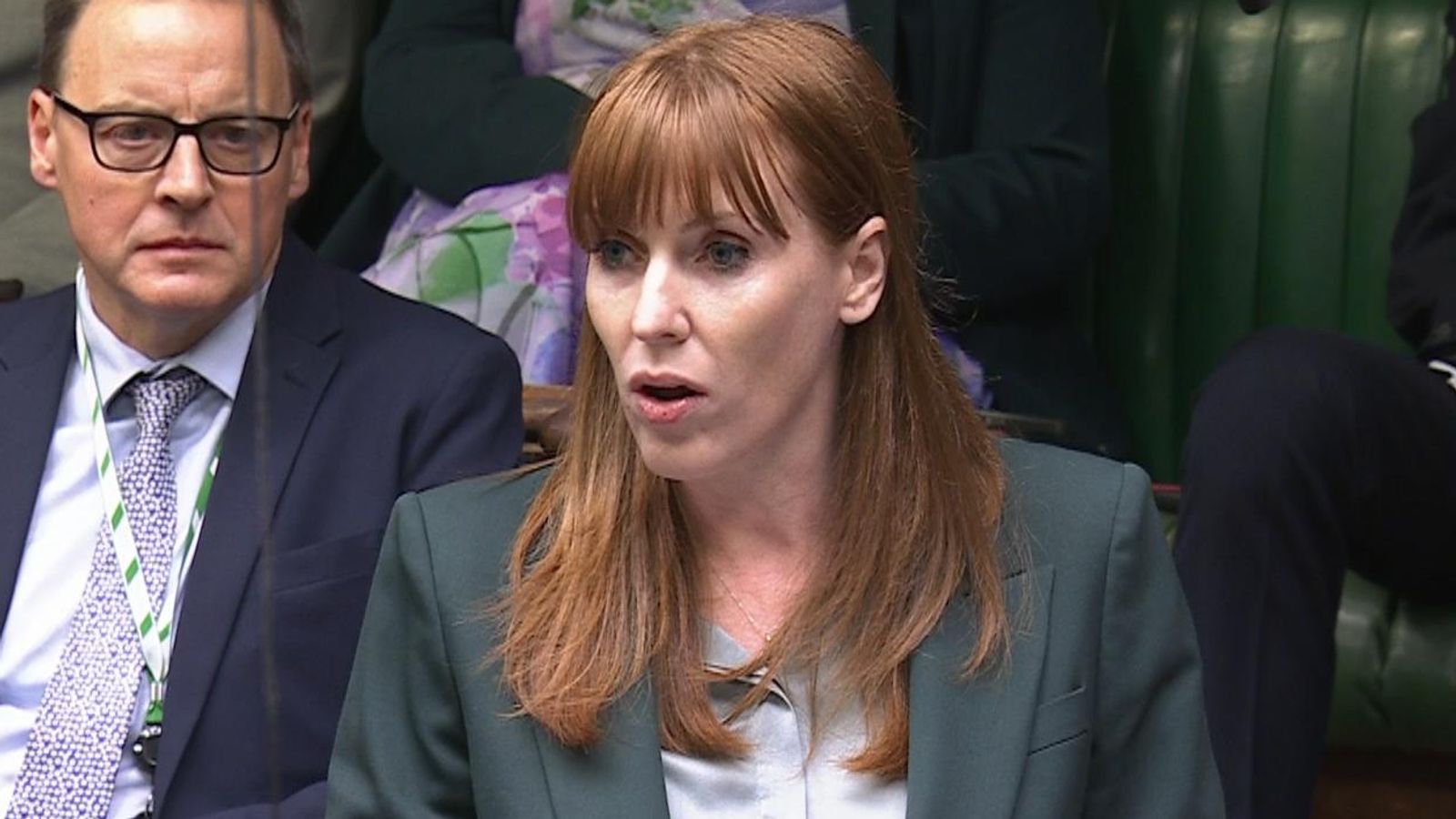

Angela Rayner has issued an angry call to MPs to sit “through the night” to stop hereditary peers delaying her flagship employment rights bill.
In an outburst at the start of the latest “ping pong” between the Lords and Commons, she said: “What’s wrong with protecting people from unfair dismissal?”
The former deputy prime minister hit out at the delaying tactics of the House of Lords, with the clock ticking only days before parliament’s Christmas recess.
The bill now goes back to the Lords on Tuesday, when ministers hope peers will drop their opposition so the bill can receive royal assent by the time parliament rises on Thursday.
Ms Rayner’s attack on hereditary peers followed a government defeat in the Lords by 24 votes last week, just days before Sir Keir Starmer created 25 new Labour peers.
“What message does this send to the British public, when 33 hereditary peers have tried to defeat the government by 24 votes on a manifesto promise on sick pay, for example, which will miss the deadline for April for some of the lowest earners from some of the wealthiest?” she declared.
“Shouldn’t we get on, go through the night if we have to, and get this bill passed?”
And employment minister Kate Dearden told MPs: “We have been in ping pong for far too long, and further delay is not in anyone’s best interest.”
Rayner makes speech on Employment Rights Bill
At the end of an hour-long debate, MPs voted by 311 votes to 96, a majority of 215, to remove a cap on unfair dismissal compensation, overturning a vote in the Lords last week.
In its attempts to get the bill through the Lords, ministers have abandoned day one protection against unfair dismissal and, after a deal with trade unions, replaced it with a six-month qualifying period.
But at the same time the government introduced an 11th hour measure to scrap compensation caps for unfair dismissal, which is currently 52 weeks’ pay or £118,223, whichever is lower.
Read more: Starmer insists budget leaks and leadership speculation did not come from him

Tory MP Andrew Griffith attacked plans to lift a compensation cap. Pic: PA
Shadow business secretary Andrew Griffith, who has led Tory opposition to the bill, attacked the removal of a cap.
“It wasn’t in the manifesto, it wasn’t in the bill, it wasn’t in the impact assessment,” he protested.
Earlier, in a boost for the government, six business groups urged peers to back down and end the parliamentary “ping pong” between the Commons and the Lords.
The groups, including the Confederation of British Industry (CBI) and the British Chamber of Commerce (BCC), fear the six-month unfair dismissal compromise agreed with the unions could be at risk.
“To avoid losing the six-month qualifying period, we therefore believe that now is the time for parliament to pass the bill,” they urged in a letter to Business Secretary Peter Kyle.
Mr Kyle said “all parties… have made difficult but necessary compromises to bring this bill forward” and urged “everyone” to recognise business groups and trade unions want it passed “without further delay”.

Politics
Specialist teams and online investigators deployed across England and Wales to tackle ‘national emergency’ of violence against women and girls


Specialist investigation teams for rape and sexual offences are to be created across England and Wales as the home secretary declares violence against women and girls a “national emergency”.
Shabana Mahmood said the dedicated units will be in place across every force by 2029 as part of Labour’s violence against women and girls (VAWG) strategy due to be launched later this week.
The use of Domestic Abuse Protection Orders (DAPOs), which had been trialled in several areas, will also be rolled out across England and Wales. They are designed to target abusers by imposing curfews, electronic tags and exclusion zones.
The orders cover all forms of domestic abuse, including economic abuse, coercive and controlling behaviour, stalking and ‘honour’-based abuse. Breaching the terms can carry a prison term of up to five years.
Govt ‘thinking again’ on abuse strategy
Nearly £2m will also be spent funding a network of officers to target offenders operating within the online space.
Teams will use covert and intelligence techniques to tackle violence against women and girls via apps and websites.
A similar undercover network funded by the Home Office to examine child sexual abuse has arrested over 1,700 perpetrators.
Abuse is ‘national emergency’
Ms Mahmood said in a statement: “This government has declared violence against women and girls a national emergency.
“For too long, these crimes have been considered a fact of life. That’s not good enough. We will halve it in a decade.
“Today, we announce a range of measures to bear down on abusers, stopping them in their tracks. Rapists, sex offenders and abusers will have nowhere to hide.”
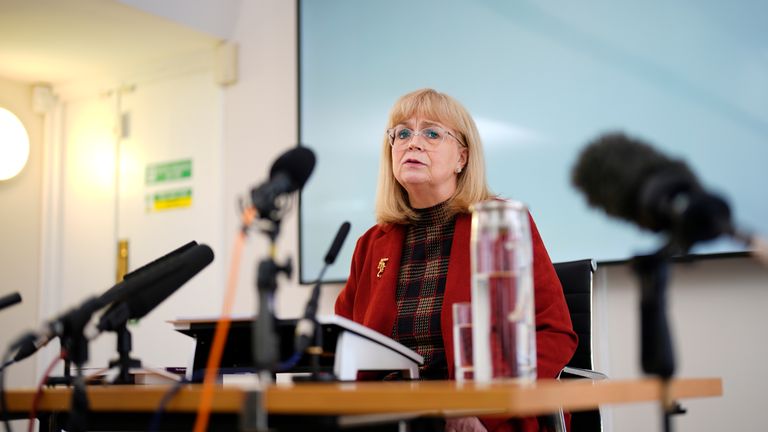
Angiolini Inquiry: Recommendations are ‘not difficult’
The target to halve violence against women and girls in a decade is a Labour manifesto pledge.
The government said the measures build on existing policy, including facial recognition technology to identify offenders, improving protections for stalking victims, making strangulation a criminal offence and establishing domestic abuse specialists in 999 control rooms.
Read more from Sky News:
Demands for violence and abuse reforms
Women still feel unsafe on streets
Minister ‘clarifies’ violence strategy
Labour has ‘failed women’
But the Conservatives said Labour had “failed women” and “broken its promises” by delaying the publication of the violence against women and girls strategy.
Shadow home secretary Chris Philp said that Labour “shrinks from uncomfortable truths, voting against tougher sentences and presiding over falling sex-offender convictions. At every turn, Labour has failed women”.
Home Secretary Shabana Mahmood will be on Sunday Morning with Trevor Phillips on Sky News this morning from 8.30am.
-
 Sports2 years ago
Story injured on diving stop, exits Red Sox game
-
 Sports3 years ago
‘Storybook stuff’: Inside the night Bryce Harper sent the Phillies to the World Series
-
 Sports2 years ago
Game 1 of WS least-watched in recorded history
-
 Sports3 years ago
Button battles heat exhaustion in NASCAR debut
-
 Sports3 years ago
MLB Rank 2023: Ranking baseball’s top 100 players
-
Sports4 years ago
Team Europe easily wins 4th straight Laver Cup
-
 Environment3 years ago
Japan and South Korea have a lot at stake in a free and open South China Sea
-
 Environment1 year ago
Here are the best electric bikes you can buy at every price level in October 2024