
Connect with us

Published

on

Paul Krugman’s assertion that “the war on inflation is over” if you exclude food, energy, shelter, and used cars is being mocked online.

The Nobel Prize-winning economist and New York Times columnist posted the comment on his X social media account on Thursday.

“The war on inflation is over,” Krugman wrote in the caption, adding: “We won, at very little cost.”

Krugman attached a graph titled “CPI ex food, energy, shelter and used cars” that showed a declining rate stretching from 7% in January of last year to slightly below 2% in September.

The reaction on X to Krugman’s post was scathing, with critics noting that the Labor Department’s consumer price index (CPI) — the most widely used by economists to gauge prices faced by consumers — factors in those day-to-day living expenses.

“This is fantastic news for all Americans who dont need food, a place to live, or fuel & electricity,” wrote Tim Murtaugh.

The war on inflation is over. We won, at very little cost pic.twitter.com/opumf3nEvL

Another X user wrote: “What a joke. The items left out are what people spend the most money on.”

“Paul Krugman is NOT an economist. He is an unabashed propagandist for the Biden regime,” another X user commented.

US inflation rose 3.7% in September, more than economists expected and still well above the Federal Reserves 2% target, as the central bank weighs whether to hike interest rates again by years end.

In a subsequent post on X, Krugman appeared to walk back his claim.

“I was too flip here,” the Times columnist wrote.

“I’ve been using this particular measure for a while, so want to be consistent. But it has flaws (medical insurance too optimistic). But almost every measure now <3 percent.”

Krugman argued that “we do seem quite close to prepandemic inflation” when factoring in “the whole distribution” of price increases.

To bolster his claim, Krugman cited the personal consumption expenditures price index (PCE), which leaves out food and gas prices.

Krugman wrote that PCE inflation was “closing in on 2 percent.”

I was too flip here. I've been using this particular measure for a while, so want to be consistent. But it has flaws (medical insurance too optimistic). But almost every measure now <3 percent. 1/ https://t.co/fNN1dM42JC

“People have been reluctant to call this,” he wrote.

“But the data really want to tell us that inflation has very nearly normalized.”

On a monthly basis, inflation slowed to 0.4% from 0.6% in August, partly because of lower pressure from energy prices.

However, core CPI a number that excludes volatile food and energy prices and serves as a closely watched gauge among policymakers for long-term trends held steady at 0.3% month to month and rose 4.1% from a year ago, in line with expectations.

The gasoline indexs 2.1% advance was also a large contributor to the CPI, the data showed, though the federal agency said shelters 0.2% increase accounted for over half of the increase.

Additional Reporting by Shannon Thaler

Continue Reading

Business

COVID schemes’ fraud and error cost taxpayers £11bn

Published

on

By

COVID schemes' fraud and error cost taxpayers £11bn

COVID-19 fraud and error cost the taxpayer nearly £11bn, a government watchdog has found.

Pandemic support programmes such as furlough, bounce-back loans, support grants and Eat Out to Help Out led to £10.9bn in fraud and error, COVID Counter-Fraud Commissioner Tom Hayhoe’s final report has concluded.

Lack of government data to target economic support made it “easy” for fraudsters to claim under more than one scheme and secure dual funding, the report said.

Weak accountability, bad quality data and poor contracting were identified as the primary causes of the loss.

The government has said the sum is enough to fund daily free school meals for the UK’s 2.7 million eligible children for eight years.

An earlier report from Mr Hayhoe for the Treasury in June found that failed personal protective equipment (PPE) contracts during the pandemic cost the British taxpayer £1.4 billion, with £762 million spent on unused protective equipment unlikely ever to be recovered.

Factors behind the lost money had included government over-ordering of PPE, and delays in checking it.

More on Covid-19

This breaking news story is being updated and more details will be published shortly.

Please refresh the page for the latest version.

You can receive breaking news alerts on a smartphone or tablet via the Sky News app. You can also follow us on WhatsApp and subscribe to our YouTube channel to keep up with the latest news.

Continue Reading

Politics

COVID schemes’ fraud and error cost taxpayers £11bn

Published

on

By

COVID schemes' fraud and error cost taxpayers £11bn

COVID-19 fraud and error cost the taxpayer nearly £11bn, a government watchdog has found.

Pandemic support programmes such as furlough, bounce-back loans, support grants and Eat Out to Help Out led to £10.9bn in fraud and error, COVID Counter-Fraud Commissioner Tom Hayhoe’s final report has concluded.

Lack of government data to target economic support made it “easy” for fraudsters to claim under more than one scheme and secure dual funding, the report said.

Weak accountability, bad quality data and poor contracting were identified as the primary causes of the loss.

The government has said the sum is enough to fund daily free school meals for the UK’s 2.7 million eligible children for eight years.

An earlier report from Mr Hayhoe for the Treasury in June found that failed personal protective equipment (PPE) contracts during the pandemic cost the British taxpayer £1.4 billion, with £762 million spent on unused protective equipment unlikely ever to be recovered.

Factors behind the lost money had included government over-ordering of PPE, and delays in checking it.

More on Covid-19

This breaking news story is being updated and more details will be published shortly.

Please refresh the page for the latest version.

You can receive breaking news alerts on a smartphone or tablet via the Sky News app. You can also follow us on WhatsApp and subscribe to our YouTube channel to keep up with the latest news.

Continue Reading

US

Luigi Mangione had handgun, silencer and ‘manifesto’ in backpack during arrest, police say

Published

on

By

Luigi Mangione had handgun, silencer and 'manifesto' in backpack during arrest, police say

Police officers found a handgun, a silencer and a red notebook described as a “manifesto” when they arrested Luigi Mangione.

The 27-year-old was arrested in December 2024 and charged with killing UnitedHealthcare chief executive Brian Thompson in New York City.

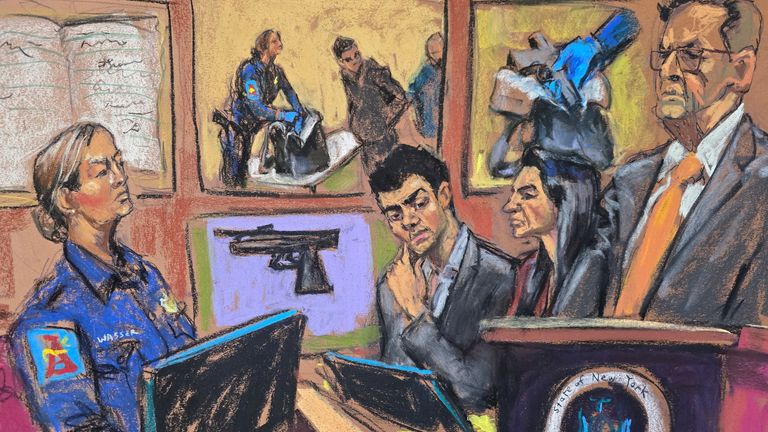
Mangione‘s lawyers want to block prosecutors from showing or telling jurors at his eventual trial in Manhattan about statements he allegedly made and items they said police seized from his backpack during his arrest at a McDonald’s in Pennsylvania.

The objects include a 9mm handgun prosecutors say matches the one used in the killing, a silencer, a magazine with bullets wrapped in underwear and a notebook in which they say Mangione described his intent to “wack” a healthcare executive.

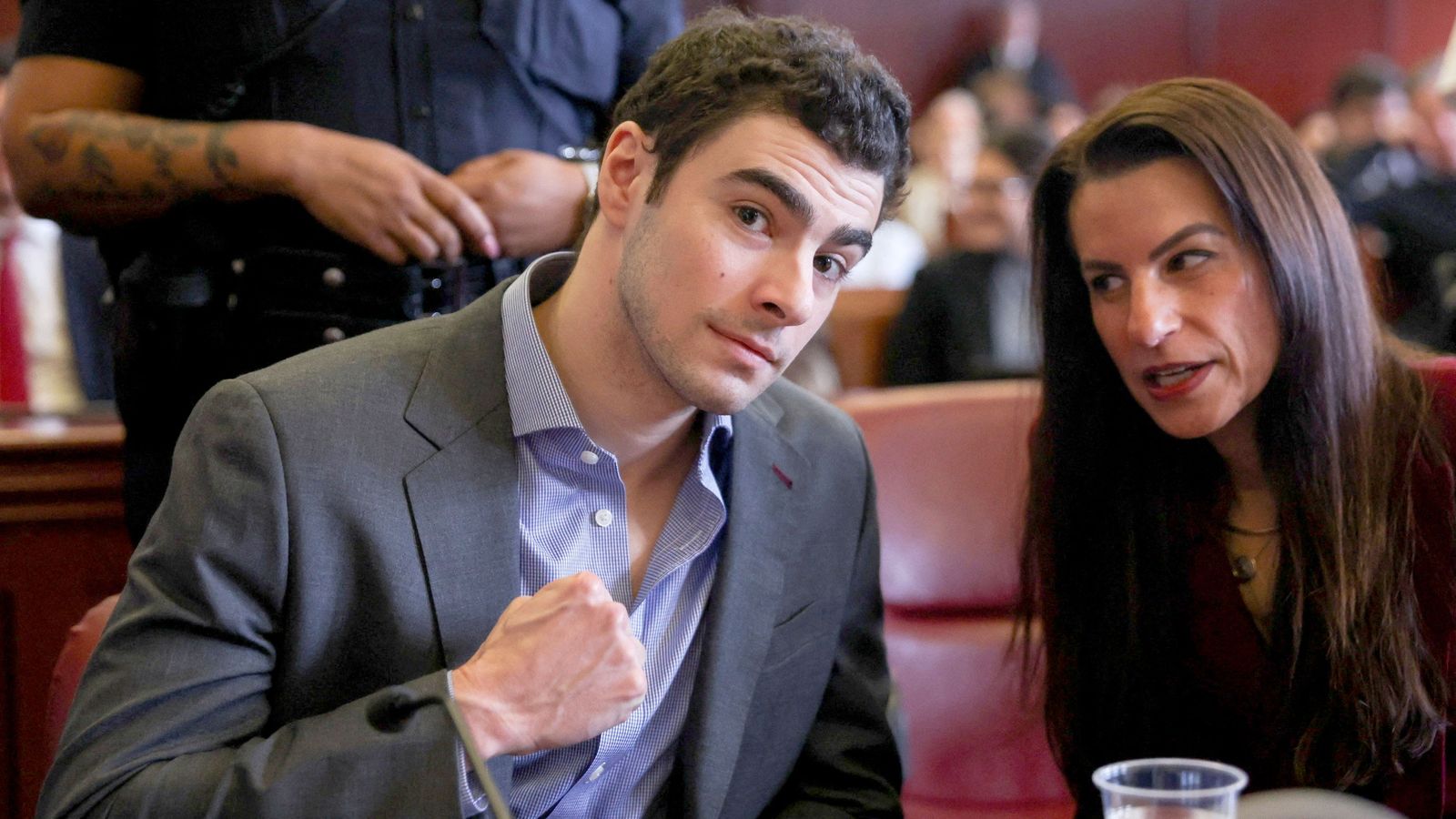
Mangione with his attorney. Pic: Reuters
Image:
Mangione with his attorney. Pic: Reuters

The defence contends the items should be excluded because police did not get a warrant before searching Mangione’s backpack.

Prosecutors deny claims Mangione was illegally searched and questioned.

They also want to suppress some statements he made to police, such as allegedly giving a false name, because officers asked him questions before telling him he had a right to remain silent.

Last week, Mangione watched surveillance videos of the killing of Mr Thompson, 50, as he walked to a New York City hotel for his company’s annual investor conference.

Mangione has pleaded not guilty to state and federal murder charges.

The state charges carry the possibility of life in prison, while federal prosecutors are seeking the death penalty.

This week’s hearing concerns only the state case, but Mangione’s lawyers want to bar evidence from both cases.

Read more:
The reality of Trump’s trade war
Paramount launches hostile takeover bid for Warner Bros

In September, a judge dismissed two terrorism counts against Mangione, finding prosecutors had not presented enough evidence Mangione intended to intimidate health insurance workers or influence government policy.

Trial dates are yet to be set in either the state or federal cases.

Continue Reading

Trending





