
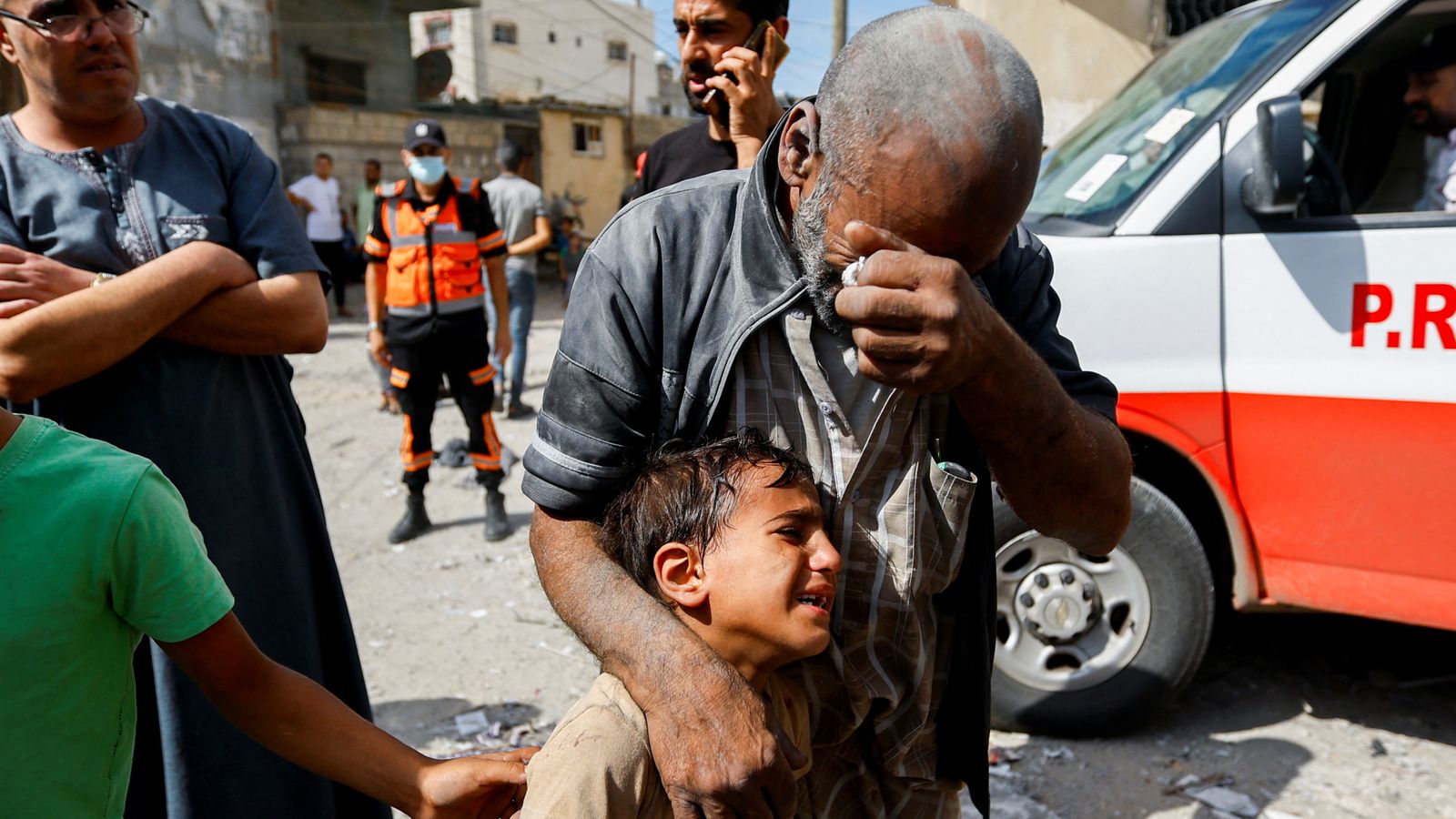
Israel-Hamas war: Gaza’s only cancer hospital forced to close – as dozens killed in Israeli strikes

The only cancer hospital in Gaza has been forced to shut down due to fuel shortages – as dozens were killed in Israeli strikes.
Amid a worsening humanitarian crisis in the Palestinian enclave, the Turkish Friendship Hospital – which is home to the area’s only oncology unit – will stop “large parts of its services”, a statement from its director-general Dr Sobhi Skik said.
The remaining part of the hospital will shut down “within 48 hours at the latest”, he added.
Follow live: Israel hints at ‘something different’ to ground offensive
Israel has besieged and bombed Gaza since the Hamas militant attack on southern Israel on 7 October.
More than 1,300 people, mostly civilians, died in the Hamas attack, with about 200 hostages held captive in Gaza.
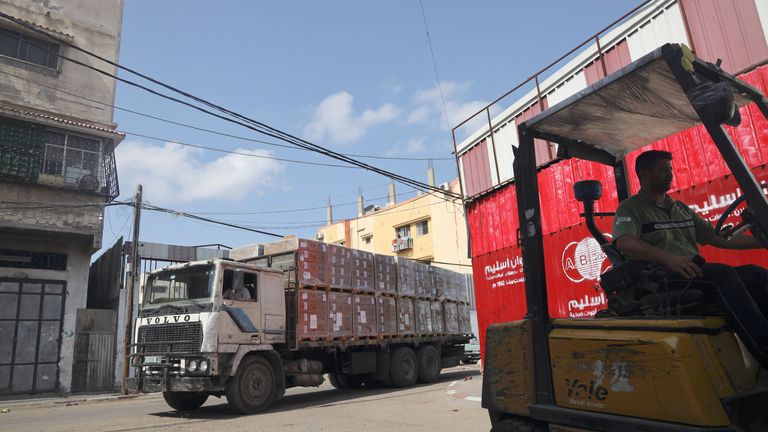
Urgent shipment of medicine from UNICEF into Gaza. Pic: UNICEF
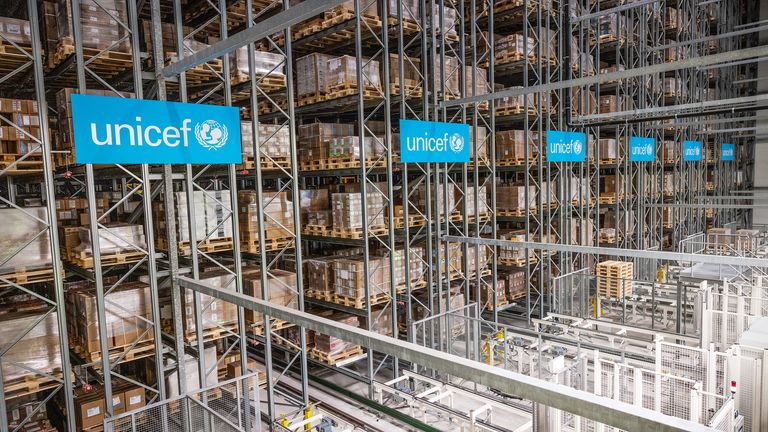
Pic: UNICEF

Supplies being prepared by UNICEF. Pic: UNICEF
At least 2,800 people in Gaza have died and 10,850 others have been injured, according to the territory’s health ministry.
Hundreds are feared buried under the rubble, and more than a million Palestinians have fled their homes, and aid agencies have warned of a deteriorating humanitarian crisis.
Concerns about dehydration and diseases were high as water and sanitation services had collapsed.
The UN agency for Palestinian refugees, UNRWA, said only around 14 percent of Gazans had access to water
“People will start dying without water,” it said said.
On Wednesday, Israel has bombed areas of southern Gaza – where many Palestinians were fleeing ahead of an expected invasion.
At least 80 were killed in those strikes in the south, the Hamas-run government said.
The Israeli military said it was targeting Hamas hideouts, infrastructure and command centres.
“When we see a target, when we see something moving that is Hamas, we’ll take care of it. We’ll handle it,” said Richard Hecht, an Israeli military spokesman.
IDF releases footage of military strike
Other key developments:
• A 13-year-old British girl missing with her sister after the Hamas attack is confirmed to have died
• Director of Rafah border crossing killed
• The UN operation in Gaza “on verge of collapse”, an official says
• US President Joe Biden is expected to visit Israel on Wednesday
• Violence is rising in the West Bank as number of Palestinians killed reaches 61
• Israel says it may do “something different” to its expected ground offensive
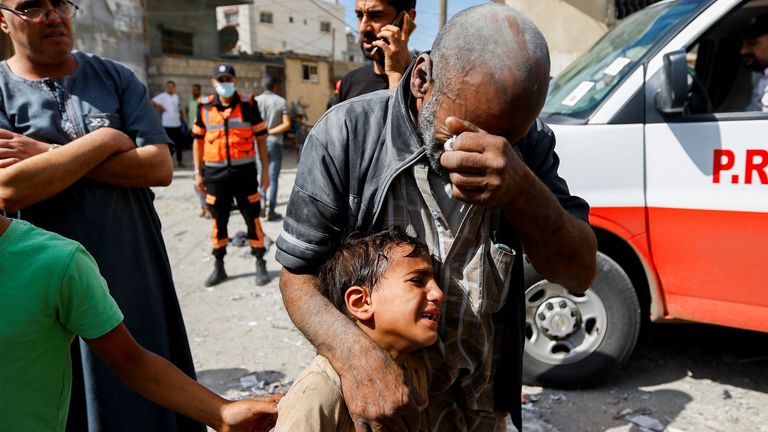
Palestinians react, at the site of Israeli strikes on houses, in Rafah in the southern Gaza Strip
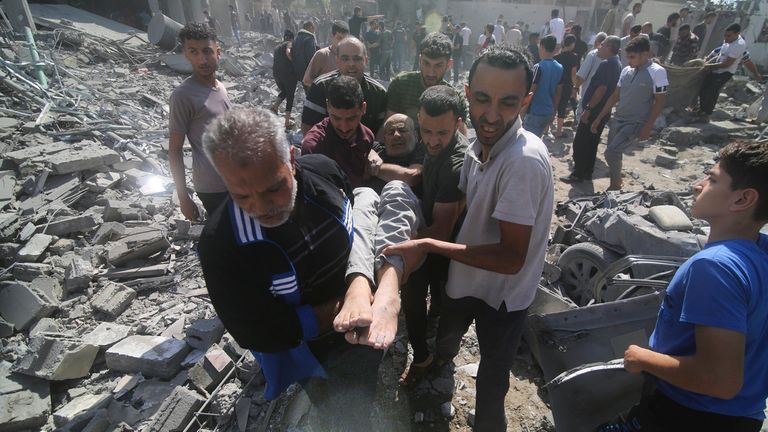
Palestinians evacuate wounded in the Israeli bombardment of Rafah
The World Health Organization (WHO) says 115 health facilities have been attacked in Gaza during the conflict and warned of a long-term humanitarian crisis in the Palestinian territory.
The WHO also said it had supplies ready for Gaza near the Rafah crossing at the border with Egypt.
The crossing had been expected to be open to allow humanitarian aid in on Monday – but it remained closed.
It came before the director in charge of the Rafah crossing was killed.
Reports suggest Major General Fouad Abu Butihan died after Israeli strikes hit his home, however these have not been verified.
Meanwhile, Hamas confirmed one of its senior armed commanders was killed in an Israeli airstrike.
Ayman Nofal was “killed as a result of a barbaric Zionist bombing that targeted the Bureij camp in the central Gaza Strip”, Hamas said.
Meanwhile, the United Nations human rights office has warned that Israel’s siege of Gaza and its evacuation order could amount to the international crime of the forcible transfer of civilians.
Read more:
US influence in Middle East being put to the test – analysis
Families in fear after children taken hostage by militants
Satellite images show homes destroyed by Gaza
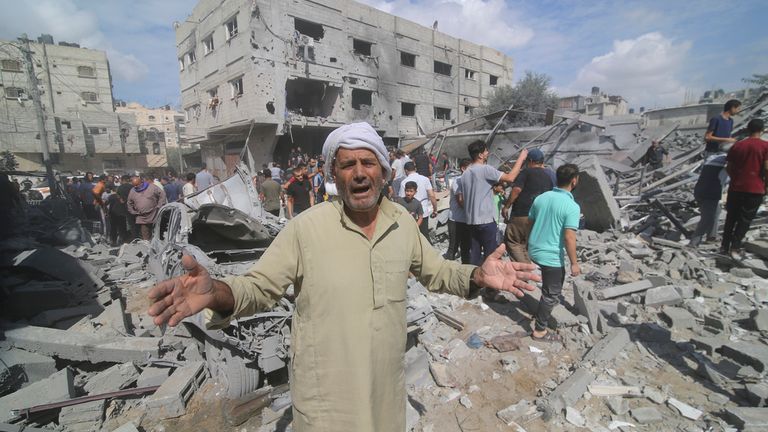
Palestinians look for survivors of the Israeli bombardment of Rafah. Pic: AP
Fears of an escalation
Amid fears the conflict might escalate, President Joe Biden is expected in the region on Wednesday.
Israel’s military said it had killed four people who tried to cross into the country from Lebanon to plant an explosive.
And Iran told Israel it should expect “pre-emptive action” in the coming hours in response to its strikes on Gaza.
The country said “all options are open” to the so-called resistance front to respond to Israel’s “war crimes”.
Iran’s foreign minister Hossein Amirabdollahian said: “The resistance front is capable of waging a long-term war with the enemy… in the coming hours, we can expect a pre-emptive action by the resistance front.
“Leaders of the resistance will not allow the Zionist regime to take any action in Gaza.”
Iran’s foreign minister did not expand on what he meant by resistance front, but the term Axis of Resistance can refer to a loose alliance among Iran, Palestinian militant groups, Syria, the Lebanese militant group Hezbollah and other factions.
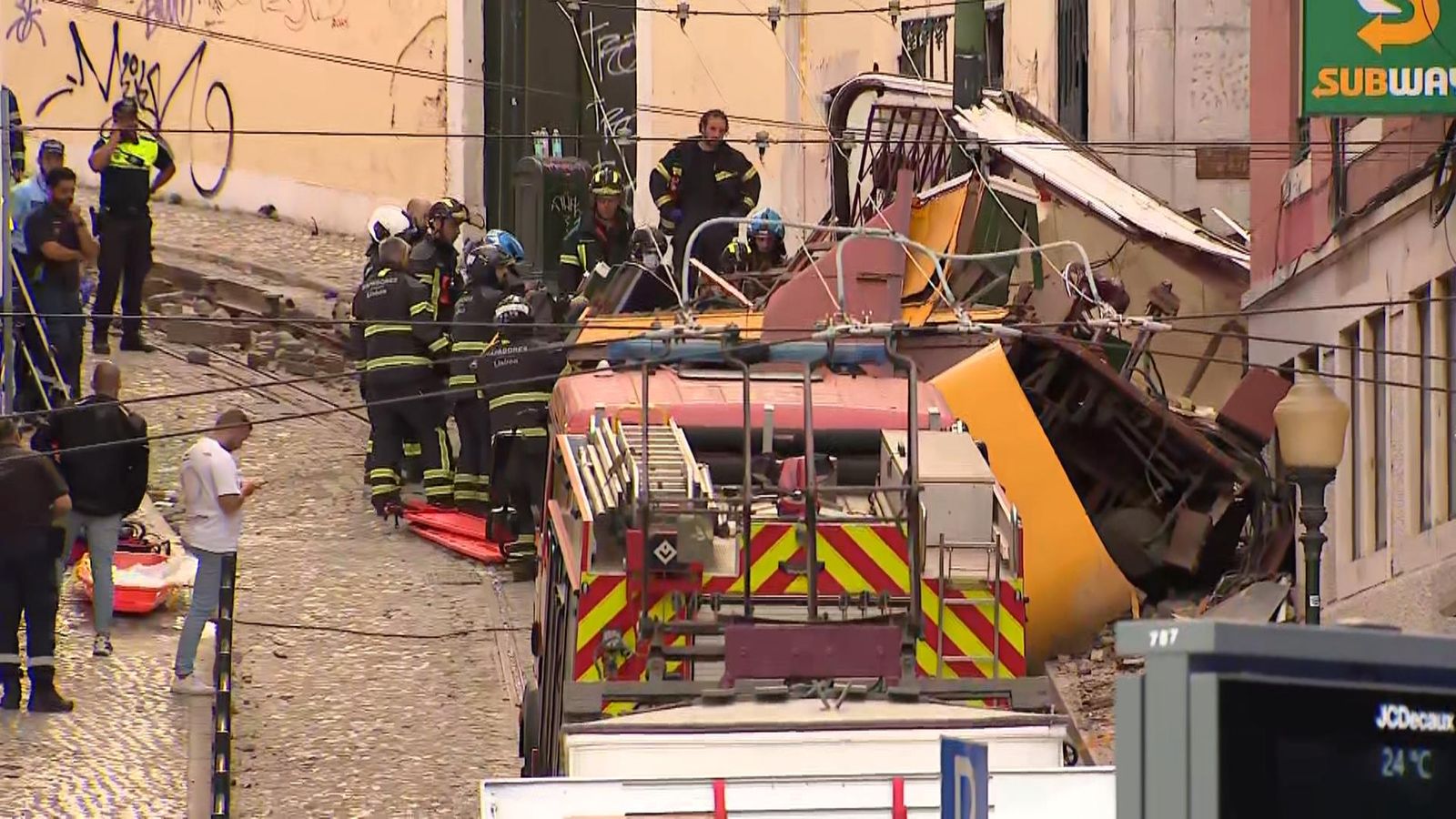
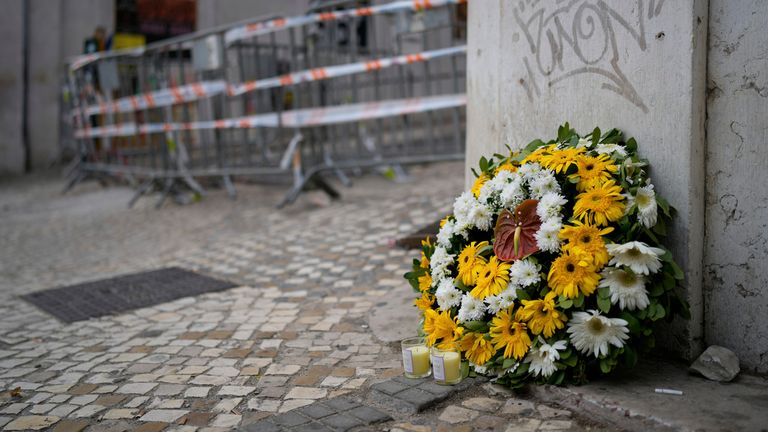
A report into the deadly Lisbon Gloria funicular crash has said the cable linking the two carriages snapped.
The carriages of the city’s iconic Gloria funicular had travelled no more than six metres when they “suddenly lost the balancing force of the connecting cable”.
The vehicle’s brake‑guard immediately “activated the pneumatic brake as well as the manual brake”, the Office for the Prevention and Investigation of Aircraft Accidents and Railway Accidents said.
Flowers for the victims in Lisbon. Pic: AP
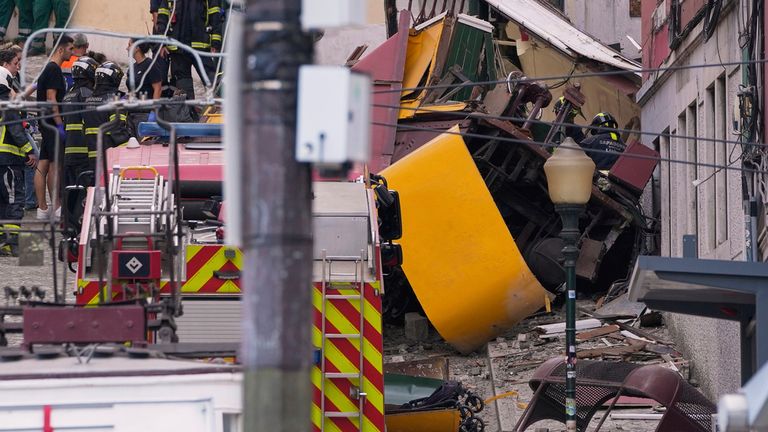
Pic: AP
But the measures “had no effect in reducing the vehicle’s speed”, as it accelerated and crashed at around 60kmh (37mph), and the disaster unfolded in less than 50 seconds.
Questions have been asked about the maintenance of the equipment, but the report said that, based on the evidence seen so far, it was up to date.
A scheduled visual inspection had been carried out on the morning of the accident, but the area where the cable broke “is not visible without dismantling.”
The Gloria funicular is a national monument that dates from 1914 and is very popular with tourists visiting the Portuguese capital.
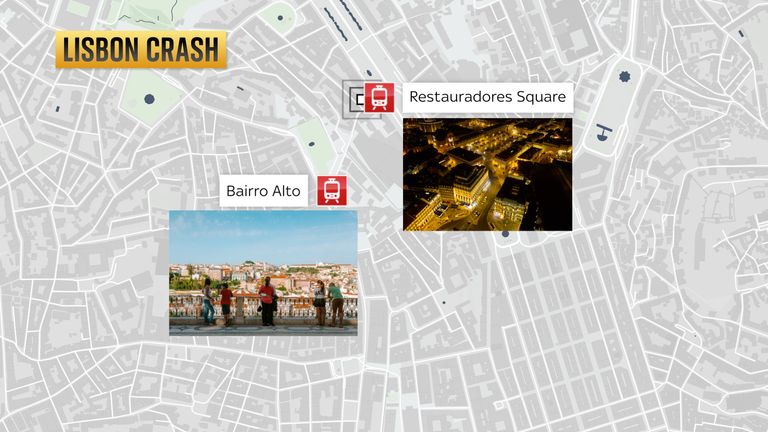
The Gloria funicular connects Lisbon’s Restauradores Square to the Bairro Alto viewpoint
It operates between Restauradores Square in downtown Lisbon and the Bairro Alto neighbourhood.
The journey is just 276m (905ft) and takes just over a minute, but it operates up a steep hill, with two carriages travelling in opposite directions.
How the disaster unfolded
At around 6pm on Wednesday, Cabin No.2, at the bottom of the funicular, “jerked backward sharply”, the report said.
“After moving roughly 10 metres, its movement stopped as it partially left the tracks and its trolley became buried at the lower end of the cable channel.”
Cabin No.1, at the top, “continued descending and accelerated” before derailing and smashing “sideways into the wall of a building on the left side, destroying the wooden box [from which the carriage is constructed]”.
It crashed into a cast‑iron streetlamp and a support pole, causing “significant damage” before hitting “the corner of another building”.
Cable failed at top
Analysis of the wreckage showed the cable connecting the cabins failed where it was attached inside the upper trolley of cabin No.1 at the top.
The cable’s specified useful life is 600 days and at the time of the accident, it had been used for 337 days, leaving another 263 days before needing to be replaced.
The operating company regards this life expectancy as having “a significant safety margin”.
The exact number of people aboard each cabin when it crashed has not been confirmed.
Britons killed in disaster
Kayleigh Smith, 36, and William Nelson, 44, died alongside 14 others in Wednesday’s incident, including another British victim who has not yet been named.
Read more on Sky News:
Clashes at Palestine Action protest
The saint of the internet age
Donatella Versace among Armani mourners
Five Portuguese citizens died when the packed carriage plummeted out of control – four of them workers at a charity on the hill – but most victims were foreigners.
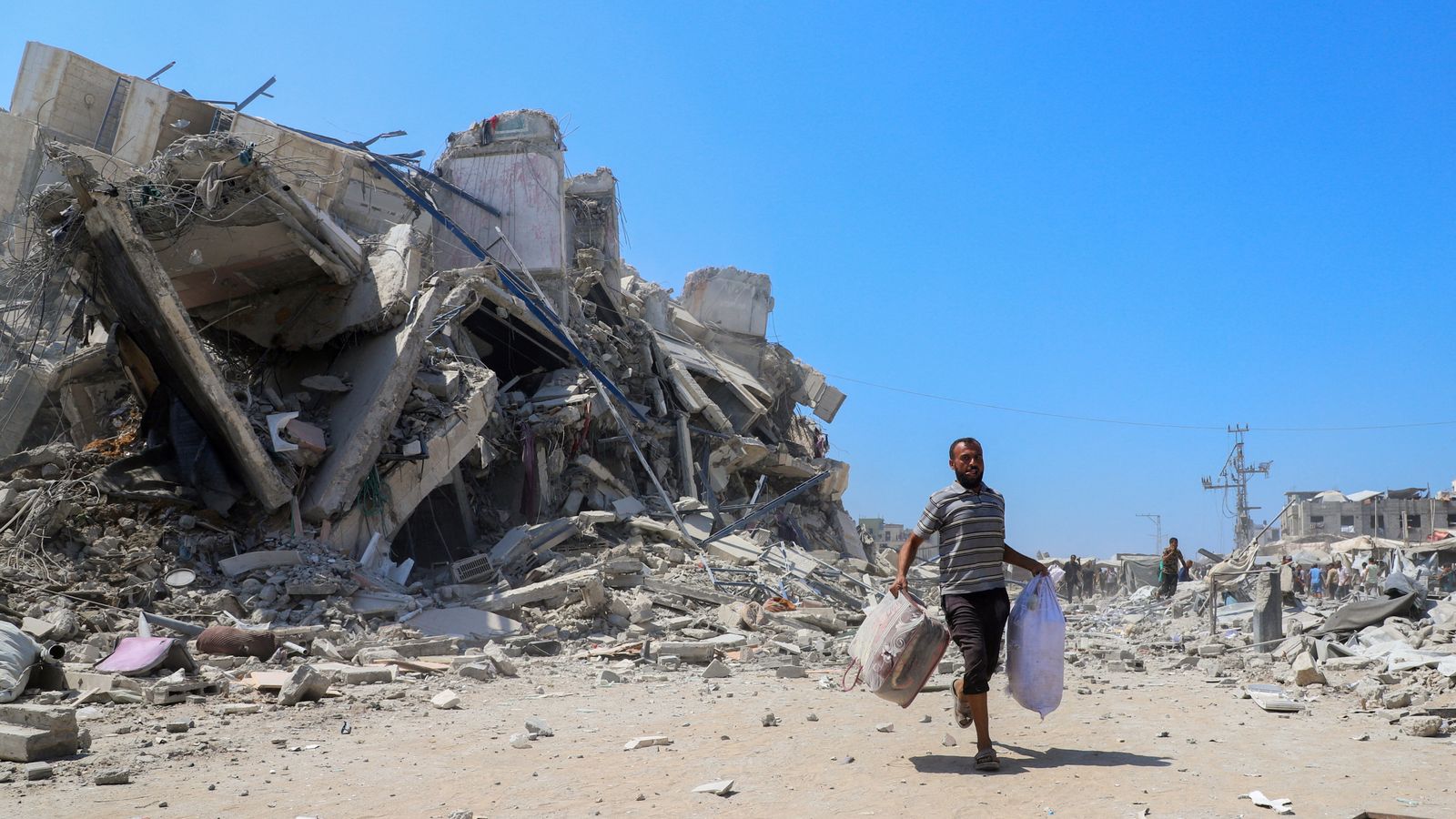
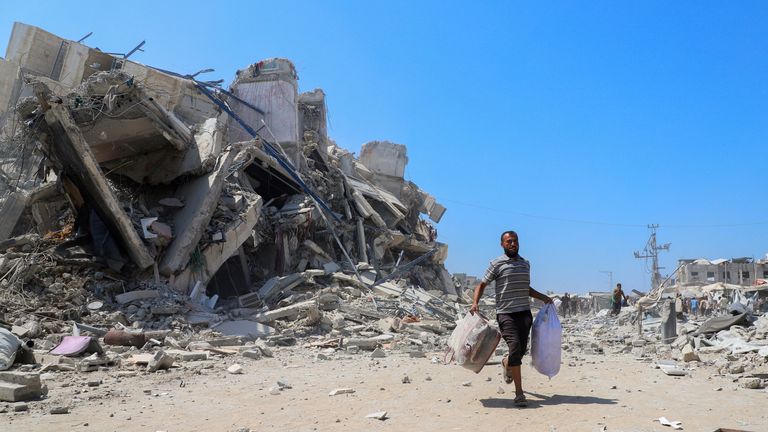
Any remaining residents in Gaza’s largest city should leave for a designated area in the south, Israel’s military has warned.
Israeli forces are carrying out an offensive on suburbs of Gaza City, in the territory’s north, as part of plans to capture it – raising concern over an already-devastating humanitarian crisis.
While Prime Minister Benjamin Netanyahu has faced pressure to stop the attack and allow more aid in, the military has announced a new humanitarian zone in the south.
Spokesperson Avichay Adraee said Gaza City residents should head to a designated coastal area of Khan Younis.
There, he said they would be able to receive food, medical care and shelter.
On Thursday, Israel said it has control of around 40% of Gaza City and 75% of the entire territory of Gaza.
Many of the city’s residents had already been displaced earlier in the war, only to return later. Some of them have said they will refuse to move again.
That’s despite the military claiming it is within a few kilometres of the city centre, coming after weeks of heavy strikes.
But the war in Gaza has left Israel increasingly isolated in the diplomatic sphere, with some of its closest allies condemning the campaign that’s devastated the territory.
Just two weeks ago, a famine was declared in Gaza City and surrounding areas by the Integrated Food Security Phase Classification, a globally recognised system for classifying the severity of food insecurity.
A resident runs with his belongings in Gaza City. Pic: Reuters
There is also concern within Israel, where calls have grown to stop the war and secure the release of the remaining 48 hostages.
Israel believes 20 of those hostages are still alive.
Even as relatives of those hostages lead protests, Mr Netanyahu continues to push for an all-or-nothing deal to release all hostages and defeat Hamas.
Read more:
Israel strikes high-rise building in Gaza City
West Bank family describe daily harassment
On Friday, Donald Trump said Washington is in “very deep” negotiations with Hamas to release the captives.
“We said let them all out, right now let them all out. And much better things will happen for them but if you don’t let them all out, it’s going to be a tough situation, it’s going to be nasty,” he added.
Hamas is “asking for some things that are fine”, he said, without elaborating.
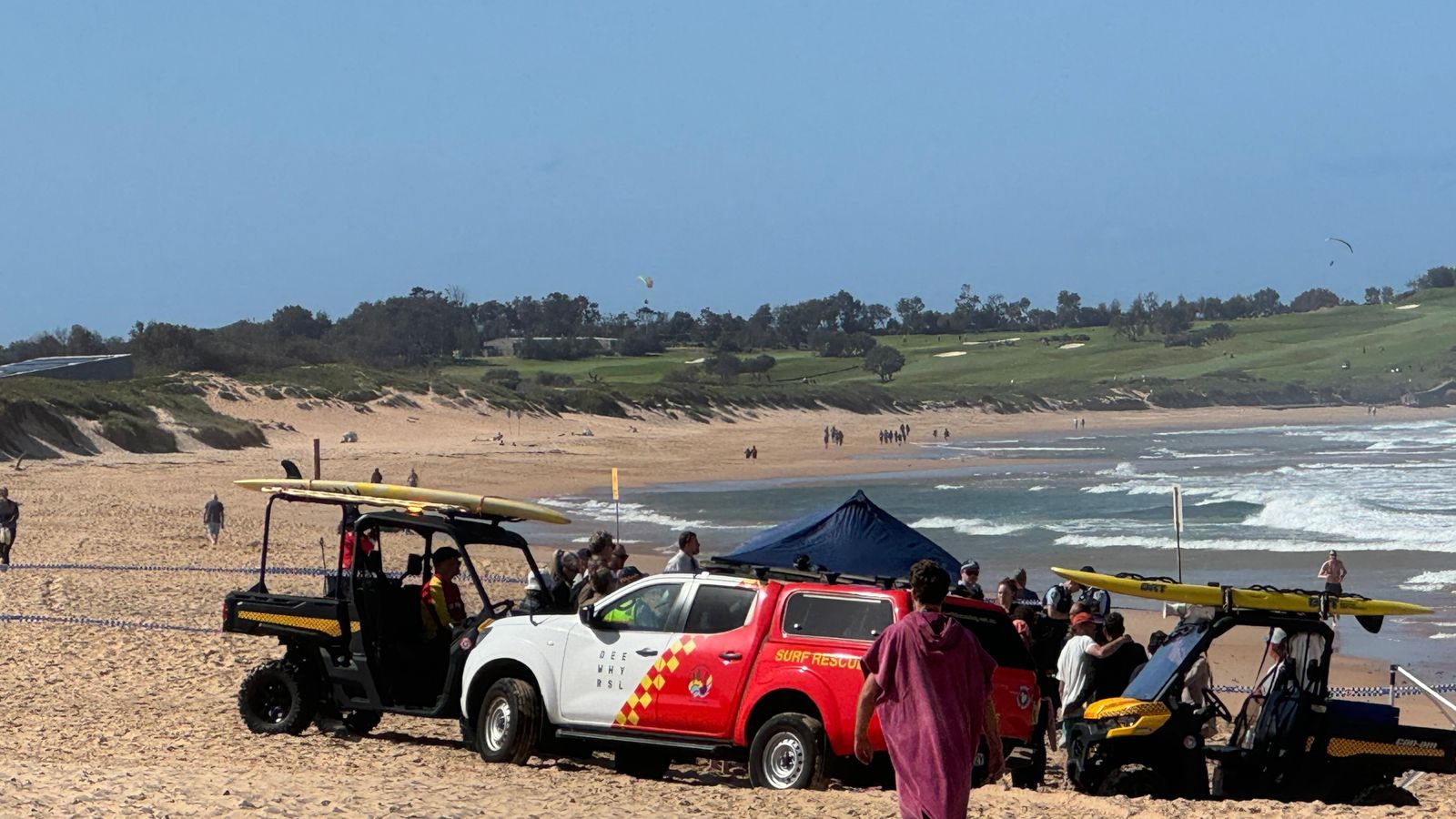
A man was heard screaming in the water moments before he died after a shark attack in Sydney, witnesses have said.
Emergency services responded to reports that a man in his 50s had suffered critical injuries at Long Reef Beach shortly after 10am (1am in the UK) on Saturday.
The man, whose identity has yet to be confirmed, was brought to shore but died at the scene, authorities have said.
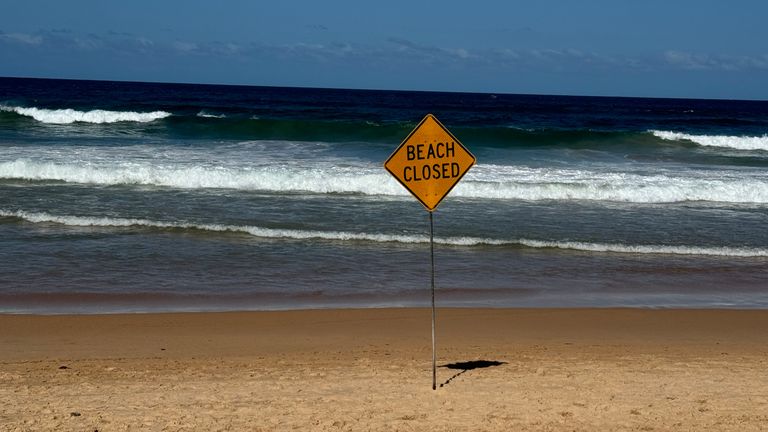
Two sections of a surfboard have been recovered and taken for examination, and beaches near the area are closed as drones search for the animal.
Police are liaising with wildlife experts to determine the species of shark involved.
Pic: Sky News Australia
Surfer screamed ‘don’t bite me’
Speaking to Sky News Australia, witness Mark Morgenthal said he saw the attack and that the shark was one of the biggest he had ever seen.
“There was a guy screaming, ‘I don’t want to get bitten, I don’t want to get bitten, don’t bite me,’ and I saw the dorsal fin of the shark come up, and it was huge,” Mr Morgenthal said.
“Then I saw the tail fin come up and start kicking, and the distance between the dorsal fin and the tail fin looked to be about four metres, so it actually looked like a six-metre shark.”
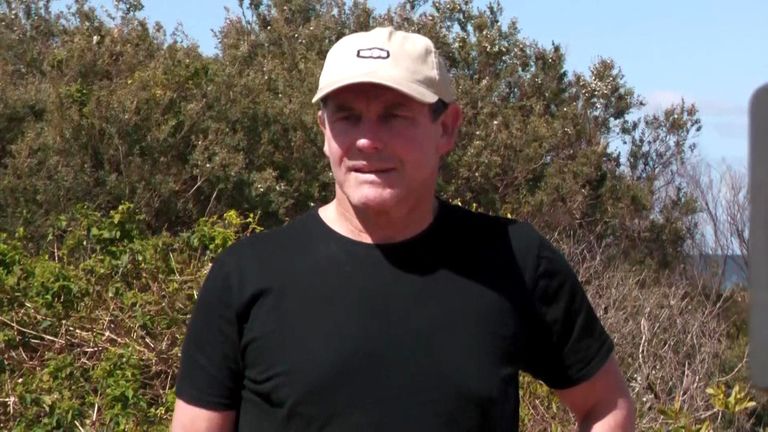
Mark Morgenthal said it ‘looked like a six metre shark’ in the attack. Pic: Sky News Australia
Victim was a father and experienced surfer
New South Wales Police Superintendent John Duncan said at a press conference that the victim was 57 years old, calling the incident a “terrible tragedy”.
“The gentleman had gone out about 9.30 this morning with some of his friends, about five or six of his mates,” he added. “He’s an experienced surfer that we understand.
“Unfortunately, it would appear that a large, what we believe to be a shark, has attacked him. And as a result of that, he lost a number of limbs.
“His colleagues managed to make it back to the beach safely, and a short time later, his body was found floating in the surf, and a couple of other people went out and recovered it.”
Mr Duncan added that officers “understand he leaves behind a wife and a young daughter… and obviously tomorrow being Father’s Day is particularly critical and particularly tragic”.

Listen to The World with Richard Engel and Yalda Hakim every Wednesday
Local surfer and eyewitness Bill Sakula also told reporters at the beach: “It’s going to send shockwaves through the community.
“Everyone is going to be a little bit nervous for a while.”
Read more:
British couple killed in Lisbon funicular crash named
How relationships can be rocked by serious illness
Mandelson calls Trump a maverick ‘risk taker’
Surf Life Saving NSW has deployed a drone to search for further shark activity.
Its chief executive Steve Pearce said: “Our deepest condolences go to the family of the man involved in this terrible tragedy.”
Shark attacks are very rare, with this incident widely thought to be the first in New South Wales this year.
The last time a person in Sydney was killed in a shark attack was in February 2022 – the city’s first fatal shark attack since 1963.
-
 Sports3 years ago
‘Storybook stuff’: Inside the night Bryce Harper sent the Phillies to the World Series
-
 Sports1 year ago
Story injured on diving stop, exits Red Sox game
-
 Sports2 years ago
Game 1 of WS least-watched in recorded history
-
 Sports2 years ago
MLB Rank 2023: Ranking baseball’s top 100 players
-
 Sports2 years ago
Button battles heat exhaustion in NASCAR debut
-
Sports4 years ago
Team Europe easily wins 4th straight Laver Cup
-
 Environment2 years ago
Japan and South Korea have a lot at stake in a free and open South China Sea
-
 Environment11 months ago
Here are the best electric bikes you can buy at every price level in October 2024