
Connect with us

Published

on

President Joe Bidens core foreign-policy argument has been that his steady engagement with international allies can produce better results for America than the impulsive unilateralism of his predecessor Donald Trump. The eruption of violence in Israel is testing that proposition under the most difficult circumstances.

The initial reactions of Biden and Trump to the attack have produced exactly the kind of personal contrast Biden supporters want to project. On Tuesday, Biden delivered a powerful speech that was impassioned but measured in denouncing the Hamas terror attacks and declaring unshakable U.S. support for Israel. Last night, in a rambling address in Florida, Trump praised the skill of Israels enemies, criticized Israels intelligence and defense capabilities, and complained that Israeli Prime Minister Benjamin Netanyahu had tried to claim credit for a U.S. operation that killed a top Iranian general while Trump was president.

At this somber moment, Trump delivered exactly the sort of erratic, self-absorbed performance that his critics have said make him unreliable in a crisis. Trumps remarks seemed designed to validate what Senator Chris Murphy, a Democrat from Connecticut who chairs the Senate Foreign Relations subcommittee that focuses on the Middle East, had told me in an interview a few hours before the former presidents speech. This is the most delicate moment in the Middle East in decades, Murphy said. The path forward to negotiate this hostage crisis, while also preventing other fronts from opening up against Israel, necessitates A-plus-level diplomacy. And you obviously never saw C-plus-level diplomacy from Trump.

Franklin Foer: Biden will be guided by his Zionism

The crisis is highlighting more than the distance in personal demeanor between the two men. Two lines in Bidens speech on Tuesday point toward the policy debate that could be ahead in a potential 2024 rematch over how to best promote international stability and advance Americas interests in the world.

Biden emphasized his efforts to coordinate support for Israel from U.S. allies within and beyond the region. And although Biden did not directly urge Israel to exercise restraint in its ongoing military operations against Hamas, he did call for caution. Referring to his conversation with Netanyahu, Biden said, We also discussed how democracies like Israel and the United States are stronger and more secure when we act according to the rule of law. White House officials acknowledged this as a subtle warning that the U.S. was not giving Israel carte blanche to ignore civilian casualties as it pursues its military objectives in Gaza.

Both of Bidens comments point to crucial distinctions between his view and Trumps of the U.S. role in the world. Whereas Trump relentlessly disparaged U.S. alliances, Biden has viewed them as an important mechanism for multiplying Americas influence and impactby organizing the broad international assistance to Ukraine, for instance. And whereas Trump repeatedly moved to withdraw the U.S. from international institutions and agreements, Biden continues to assert that preserving a rules-based international order will enhance security for America and its allies.

Even more than in 2016, Trump in his 2024 campaign is putting forward a vision of a fortress America. In almost all of his foreign-policy proposals, he promises to reduce American reliance on the outside world. He has promised to make the U.S. energy independent and to implement a four-year plan to phase out all Chinese imports of essential goods and gain total independence from China. Like several of his rivals for the 2024 GOP nomination, Trump has threatened to launch military operations against drug cartels in Mexico without approval from the Mexican government. John Bolton, one of Trumps national security advisers in the White House, has said he believes that the former president would seek to withdraw from NATO in a second term. Walls, literal and metaphorical, remain central to Trumps vision: He says that, if reelected, hell finish his wall across the Southwest border, and last weekend he suggested that the Hamas attack was justification to restore his ban on travel to the U.S. from several Muslim-majority nations.

Biden, by contrast, maintains that America can best protect its interests by building bridges. Hes focused on reviving traditional alliances, including extending them into new priorities such as friend-shoring. He has also sought to engage diplomatically even with rival or adversarial regimes, for instance, by attempting to find common ground with China over climate change.

These differences in approach likely will be muted in the early stages of Israels conflict with Hamas. Striking at Islamic terrorists is one form of international engagement that still attracts broad support from Republican leaders. And in the Middle East, Biden has not diverged from Trumps strategy as dramatically as in other parts of the world. After Trump severely limited contact with the Palestinian Authority, Biden has restored some U.S. engagement, but the president hasnt pushed Israel to engage in full-fledged peace negotiations, as did his two most recent Democratic predecessors, Bill Clinton and Barack Obama. Instead, Biden has continued Trumps efforts to normalize relations between Israel and surrounding Sunni nations around their common interest in countering Shiite Iran. (Hamass brutal attack may have been intended partly to derail the ongoing negotiations among the U.S., Israel, and Saudi Arabia that represent the crucial next stage of that project.) Since the attack last weekend, Trump has claimed that Hamas would not have dared to launch the incursion if he were still president, but he has not offered any substantive alternative to Bidens response.

Yet the difference between how Biden and Trump approach international challenges is likely to resurface before this crisis ends. Even while trying to construct alliances to constrain Iran, Biden has also sought to engage the regime through negotiations on both its nuclear program and the release of American prisoners. Republicans have denounced each of those efforts; Trump and other GOP leaders have argued, without evidence, that Bidens agreement to allow Iran to access $6 billion in its oil revenue held abroad provided the mullahs with more leeway to fund terrorist groups like Hamas. And although both parties are now stressing Israels right to defend itself, if Israel does invade Gaza, Biden will likely eventually pressure Netanyahu to stop the fighting and limit civilian losses well before Trump or any other influential Republican does.

Murphy points toward another distinction: Biden has put more emphasis than Trump on fostering dialogue with a broad range of nations across the region. Trumps style was to pick sides, and that meant making enemies and adversaries unnecessarily; that is very different from Bidens approach, Murphy told me. We dont know whether anyone in the region right now can talk sense into Hamas, Murphy said, but this president has been very careful to keep lines of communication open in the region, and thats because he knows through experience that moments can come, like this, where you need all hands on deck and where you need open lines to all the major players.

Read: The Middle East region is quieter today than it has been in two decades

In multiple national polls, Republican and Democratic voters now express almost mirror-image views on whether and how the U.S. should interact with the world. For the first time in its annual polling since 1974, the Chicago Council on Global Affairs this year found that a majority of Republicans said the U.S. would be best served if we stay out of world affairs, according to upcoming results shared exclusively with The Atlantic. By contrast, seven in 10 Democrats said that the U.S. should take an active part in world affairs.

Not only do fewer Republicans than Democrats support an active role for the U.S. in world affairs, but less of the GOP wants the U.S. to compromise with allies whe it does engage. In national polling earlier this year by the nonpartisan Pew Research Center, about eight in 10 Democrats said America should take its allies interests into account when dealing with major international issues. Again in sharp contrast, nearly three-fifths of GOP partisans said the U.S. instead should follow its own interests.

As president, Trump both reflected and reinforced these views among Republican voters. Trump withdrew the U.S. from the World Health Organization, the United Nations Human Rights Council, the Paris climate accord, and the nuclear deal with Iran that Obama negotiated, while also terminating Obamas Trans-Pacific Partnership trade talks. Biden effectively reversed all of those decisions. He rejoined both the Paris Agreement and the WHO on his first days in office, and he brought the U.S. back into the Human Rights Council later in 2021. Although Biden did not resuscitate the TPP specifically, he has advanced a successor agreement among nations across the region called the Indo-Pacific Economic Framework. Biden has also sought to restart negotiations with Iran over its nuclear program, though with little success.

Peter Feaver, a public-policy and political-science professor at Duke University, told me he believes that Trump wasnt alone among U.S. presidents in complaining that allies were not fully pulling their weight. What makes Trump unique, Feaver said, is that he didnt see the other side of the ledger. Most other presidents recognized, notwithstanding our [frustrations], it is still better to work with allies and that the U.S. capacity to mobilize a stronger, more action-focused coalition of allies than our adversaries could was a central part of our strength, said Feaver, who served as a special adviser on the National Security Council for George W. Bush. Thats the thing that Trump never really understood: He got the downsides of allies, but not the upsides. And he did not realize you do not get any benefits from allies if you approach them in the hyper-transactional style that he would do.

Biden, Feaver believes, was assured an enthusiastic reception from U.S. allies because he followed the belligerent Trump. But Bidens commitment to restoring alliances, Feaver maintains, has delivered results. Theres no question in my mind that Biden got better results from the NATO alliance [on Ukraine] in the first six months than the Trump team would have done, Feaver said.

As the Middle East erupts again, the biggest diplomatic hurdle for Biden wont be marshaling international support for Israel while it begins military operations; it will be sustaining focus on what happens when they end, James Steinberg, the dean of the Johns Hopkins School of Advanced International Studies, told me. The challenge here is how do you both reassure Israel and send an unmistakably tough message to Hamas and Iran without leading to an escalation in this crisis, said Steinberg, who served as deputy secretary of state for Obama and deputy national security adviser for Clinton. Thats where the real skill will come: Without undercutting the strong message of deterrence and support for Israel, can they figure out a way to defuse the crisis? Because it could just get worse, and it could widen.

In a 2024 rematch, the challenge for Biden would be convincing most Americans that his bridges can keep them safer than Trumps walls. In a recent Gallup Poll, Americans gave Republicans a 22-percentage-point advantage when asked which party could keep the nation safe from international terrorism and military threats. Republicans usually lead on that measure, but the current advantage was one of the GOPs widest since Gallup began asking the question, in 2002.

This new crisis will test Biden on exceedingly arduous terrain. Like Clinton and Obama, Biden has had a contentious relationship with Netanyahu, who has grounded his governing coalition in the far-right extremes of Israeli politics and openly identified over the years with the GOP in American politics. In this uneasy partnership with Netanyahu, Biden must now juggle many goals: supporting the Israeli prime minister, but also potentially restraining him, while avoiding a wider war and preserving his long-term goal of a Saudi-Israeli dtente that would reshape the region. It is exactly the sort of complex international puzzle that Biden has promised he can manage better than Trump. This terrible crucible is providing the president with another opportunity to prove it.

Continue Reading

US

Images of Trump among documents removed from latest Epstein files release

Published

on

By

Images of Trump among documents removed from latest Epstein files release

Pictures of Donald Trump are included among at least 16 documents that have disappeared from the Epstein files released by the Department of Justice (DOJ).

The Democrats from the House Oversight Committee drew attention to the apparent removal of an image showing two printed pictures of Mr Trump in a desk draw.

One picture has Mr Trump standing surrounded by women in bathing suits, while the second appears to be an already known picture – partly obscured – of him, his wife Melania, Ghislaine Maxwell and Jeffrey Epstein.

After the Democrats flagged the missing image on Saturday, Sky News went back to the files online and confirmed that it did appear to be missing, despite the fact they downloaded it when the files were initially released on Friday.

List of documents online now shows a gap where the file ending '468' was on Friday
Image:
List of documents online now shows a gap where the file ending ‘468’ was on Friday

The file ending '468' seen in Sky News's downloads from Friday
Image:
The file ending ‘468’ seen in Sky News’s downloads from Friday

The other photos removed from the trove of documents were almost all nude paintings of women in Epstein’s home.

Mr Trump has not commented on the release of the files and has not been accused of wrongdoing in connection with Epstein’s case.

Sky News has contacted the DOJ for comment.

Questions over heavy redactions

Pic: New York State Division of Criminal Justice Services/Handout via Reuters
Image:
Pic: New York State Division of Criminal Justice Services/Handout via Reuters

Thousands of documents relating to the dead paedophile financier were made public by the DOJ on Friday – hours before a legal deadline following the passing of the Epstein Files Transparency Act.

Many of the pages were either partially or fully redacted, which the DOJ says is to protect the more than 1,200 victims and their families identified in them.

Some of Epstein’s victims, legal experts and members of the public have questioned whether this is the sole reason for the redactions, while the Oversight Democrats have claimed: “This is a White House cover-up.”

Ashley Rubright, who was abused for several years after meeting Epstein in Palm Beach when she was 15, told Sky News: “Seeing […] completely redacted pages, there’s no way that that’s just to protect the victims’ identities, and there better be a good reason. I just don’t know if we’ll ever know what that is.”


Epstein ‘was a monster’: Survivors speak to Sky News

Gloria Allred, a lawyer who has represented some of Epstein’s victims, says she has been told that despite the heavy redactions, some compromising pictures of survivors and their names were left in the files released on Friday.

“We have had to notify the Department of Justice about names that should have been redacted that weren’t redacted,” she told Sky News.

“So this is further trauma to survivors, and apparently also some of the images of some of the survivors appear not to have been redacted, and they are nude or not completely dressed.

“This is a major concern because the law clearly indicates, and the judges have indicated, that the names and any identifying information of the survivors must be redacted.”

Read more:
Epstein victims react to partial release of files
Links between Epstein and the UK revealed in new files

In a letter to the judges overseeing the Epstein and Ghislaine Maxwell cases, US attorney for the Southern District of New York Jay Clayton acknowledged that a review “of this size and scope is vulnerable to machine error [or] instances of human error”.

He also said the DOJ had opted to redact the faces of women in photographs with Epstein “even where not all the women are known to be victims,” as it was not viewed as practical for the DOJ to identify every person in all the photos.

The methodology has led to some confusion and misled speculation online.
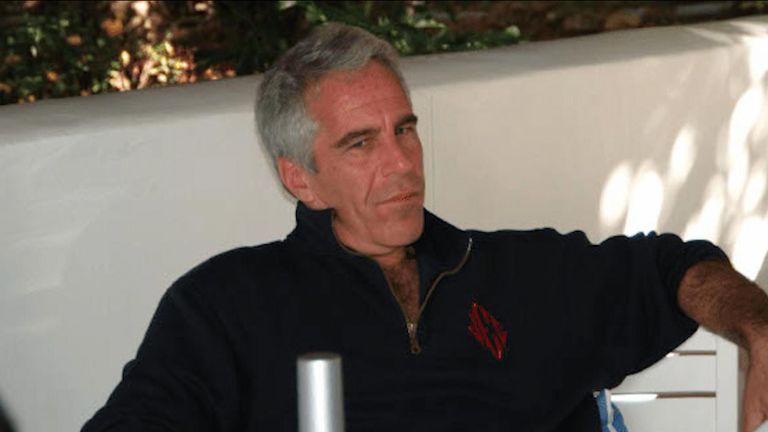
Epstein died in prison in 2019 while awaiting trial on federal sex trafficking charges
Image:
Epstein died in prison in 2019 while awaiting trial on federal sex trafficking charges

Many celebrities and public figures appear with Epstein in the photos published by the DOJ, often included without context.

There is no suggestion that these pictures imply anyone has done anything wrong, and many of those featured in them have denied any wrongdoing in relation to Epstein.

Through its release, the Trump administration has claimed to be the most transparent in history, despite the fact Congress forced their hand by voting to make the files public by 19 December.

But some have been held back, with Todd Blanche, deputy attorney general and a former personal lawyer for Donald Trump, saying more would follow in the coming weeks.

Many Democrats and some Republicans have criticised the partial release as failing to “comply with law,” as have lawyers including Ms Allred.

“So clearly, the law has been violated. And it’s the Department of Justice letting down the survivors once again,” she said.

She labelled the incomplete release of the files a “distraction”, adding: “This is not over, and it won’t be over until we get the truth and transparency for the survivors.”

Continue Reading

Technology

AI was behind over 50,000 layoffs in 2025 — here are the top firms to cite it for job cuts

Published

on

By

AI was behind over 50,000 layoffs in 2025 — here are the top firms to cite it for job cuts

Sad female worker carrying her belongings while leaving the office after being fired

Isbjorn | Istock | Getty Images

Layoffs have been a defining feature of the job market in 2025, with several major companies announcing thousands of job cuts driven by artificial intelligence.

In fact, AI was responsible for almost 55,000 layoffs in the U.S. this year, according to consulting firm Challenger, Gray & Christmas.

There were in total 1.17 million job cuts through 2025, the highest level since the Covid-19 pandemic in 2020 when there were 2.2 million layoffs announced by the end of the year.

In October, U.S. employers announced 153,000 job cuts, and there were over 71,000 job cuts in November, with AI being cited for over 6,000 for the month, per Challenger.

At a time when inflation bites, tariffs are adding to expenses, and firms are looking to carry out cost-cutting measures, AI has presented an attractive, short-term solution to the problem.

The Massachusetts Institute of Technology released a study in November showing that AI can already do the job of 11.7% of the U.S. labor market and save as much as $1.2 trillion in wages across finance, healthcare, and other professional services.

Not everyone is convinced that AI is the real reason behind the dramatic job cuts, as Fabian Stephany, assistant professor of AI and work at the Oxford Internet Institute, previously told CNBC, that it might be an excuse.

Stephany said many companies that performed well during the pandemic “significantly overhired” and the recent layoffs might just be a “market clearance.”

“It’s to some extent firing people that for whom there had not been a sustainable long term perspective and instead of saying ‘we miscalculated this two, three years ago, they can now come to the scapegoating, and that is saying ‘it’s because of AI though,'” he added.

Here are the top firms that cited AI as part of their layoff and restructuring strategy in 2025.

Amazon

Amazon CEO Andy Jassy speaks during a keynote address at AWS re:Invent 2024, a conference hosted by Amazon Web Services, at The Venetian Las Vegas on December 3, 2024 in Las Vegas, Nevada.

Noah Berger | Getty Images

In October, Amazon announced the largest ever round of layoffs in its history, slashing 14,000 corporate roles, as it looks to invest in its “biggest bets” which includes AI.

“This generation of AI is the most transformative technology we’ve seen since the Internet, and it’s enabling companies to innovate much faster than ever before… we’re convinced that we need to be organized more leanly, with fewer layers and more ownership, to move as quickly as possible for our customers and business,” Beth Galetti, senior vice president of people experience and technology at Amazon, wrote in a blog post.

Amazon CEO Andy Jassy warned of the cuts earlier this year, telling employees that AI will shrink the company’s workforce and that the tech giant will need “fewer people doing some of the jobs that are being done today, and more people doing other types of jobs.”

Microsoft

Microsoft CEO Satya Nadella appears at the CES event in Las Vegas on Jan. 9, 2024. The event typically doubles as a preview of how tech giants and startups will market their wares in the coming year and if early announcements are any indication, AI-branded products will become the new “smart” gadgets of 2024.

David Paul Morris | Bloomberg | Getty Images

Microsoft has cut a total of around 15,000 jobs through 2025, and its most recent announcement in July saw 9,000 roles on the chopping block.

CEO Satya Nadella wrote in a memo to employees that the company needed to “reimagine” its “mission for a new era,” and went on to tout the significance of AI to the company.

“What does empowerment look like in the era of AI? It’s not just about building tools for specific roles or tasks. It’s about building tools that empower everyone to create their own tools. That’s the shift we are driving — from a software factory to an intelligence engine empowering every person and organization to build whatever they need to achieve,” Nadella said.

Salesforce

Marc Benioff, chief executive officer of Salesforce Inc., during the US-Saudi Investment Forum at the Kennedy Center in Washington, DC, US, on Wednesday, Nov. 19, 2025.

Stefani Reynolds | Bloomberg | Getty Images

IBM

CEO of IBM Arvind Krishna looks on during a roundtable discussion hosted by U.S. President Donald Trump in the Roosevelt Room at the White House on Dec. 10, 2025 in Washington, DC.

Alex Wong | Getty Images

Global tech giant IBM’s CEO Arvind Krishna told the Wall Street Journal in May that AI chatbots had taken over the jobs of a few hundred human resources workers.

However, unlike other companies that had cited AI in job cuts, Krishna admitted that the firm had increased hiring in other areas that required more critical thinking, such as software engineering, sales, and marketing.

In November, the company announced a 1% global cut, which could impact nearly 3,000 employees.

Crowdstrike

Founder and CEO of CrowdStrike George Kurtz speaks during the Live Keynote Pregame during the Nvidia GTC (GPU Technology Conference) in Washington, DC, on Oct. 28, 2025.

Jim Watson | AFP | Getty Images

Cybersecurity software maker CrowdStrike said in May that it’s laying off 5% of its workforce or 500 employees, and directly attributed the cuts to AI.

“AI has always been foundational to how we operate,” co-founder and CEO George Kurtz wrote in a memo included in a securities filing. “AI flattens our hiring curve, and helps us innovate from idea to product faster. It streamlines go-to-market, improves customer outcomes, and drives efficiencies across both the front and back office. AI is a force multiplier throughout the business.”

Workday

Carl Eschenbach, CEO of Workday speaks on CNBC’s Squawk Box outside the World Economic Forum in Davos, Switzerland on Jan. 23, 2025.

Gerry Miller | CNBC 

In February, HR platform Workday was one of the first companies this year to say its cutting 8.5% of its workforce, amounting to around 1,750 jobs, as the company invests more in AI.

Workday CEO Carl Eschenbach said the layoffs were needed to prioritize AI investment and to free up resources.

Continue Reading

Politics

US lawmakers propose tax break for small stablecoin payments, staking rewards

Published

on

By

US lawmakers propose tax break for small stablecoin payments, staking rewards

US lawmakers have introduced a discussion draft that would ease the tax burden on everyday crypto users by exempting small stablecoin transactions from capital gains taxes and offering a new deferral option for staking and mining rewards.

The proposal, introduced by Representatives Max Miller of Ohio and Steven Horsford of Nevada, seeks to amend the Internal Revenue Code to reflect the growing use of digital assets in payments. The draft is set “to eliminate low-value gain recognition arising from routine consumer payment use of regulated payment stablecoins,” per the draft.

Under the draft, users would not be required to recognize gains or losses on stablecoin transactions of up to $200, provided the asset is issued by a permitted issuer under the GENIUS Act, pegged to the US dollar and maintains a tight trading range around $1.

The bill includes safeguards to prevent abuse. The exemption would not apply if a stablecoin trades outside a narrow price band, and brokers or dealers would be excluded from the benefit. Treasury would also retain authority to issue anti-abuse rules and reporting requirements.

Draft bill explains the reasoning behind tax breaks. Source: House

Related: Crypto Biz: Bank stablecoins get a rulebook; Bitcoin gets a land grab

US bill defers taxes on crypto staking rewards

Beyond payments, the proposal addresses long-standing concerns around “phantom income” from staking and mining. Taxpayers would be allowed to elect to defer income recognition on staking or mining rewards for up to five years, rather than being taxed immediately upon receipt.

“This provision is intended to reflect a necessary compromise between immediate taxation upon dominion & control and full deferral until disposition,” the draft said.

The draft also extends existing securities lending tax treatment to certain digital asset lending arrangements, applies wash sale rules to actively traded crypto assets, and allows traders and dealers to elect mark-to-market accounting for digital assets.

Related: Galaxy predicts stablecoins will overtake ACH transaction volume in 2026

Crypto groups urge Senate to rethink stablecoin rewards ban

Last week, the Blockchain Association sent a letter to the US Senate Banking Committee, signed by more than 125 crypto companies and industry groups, opposing efforts to extend restrictions on stablecoin rewards to third-party platforms.