
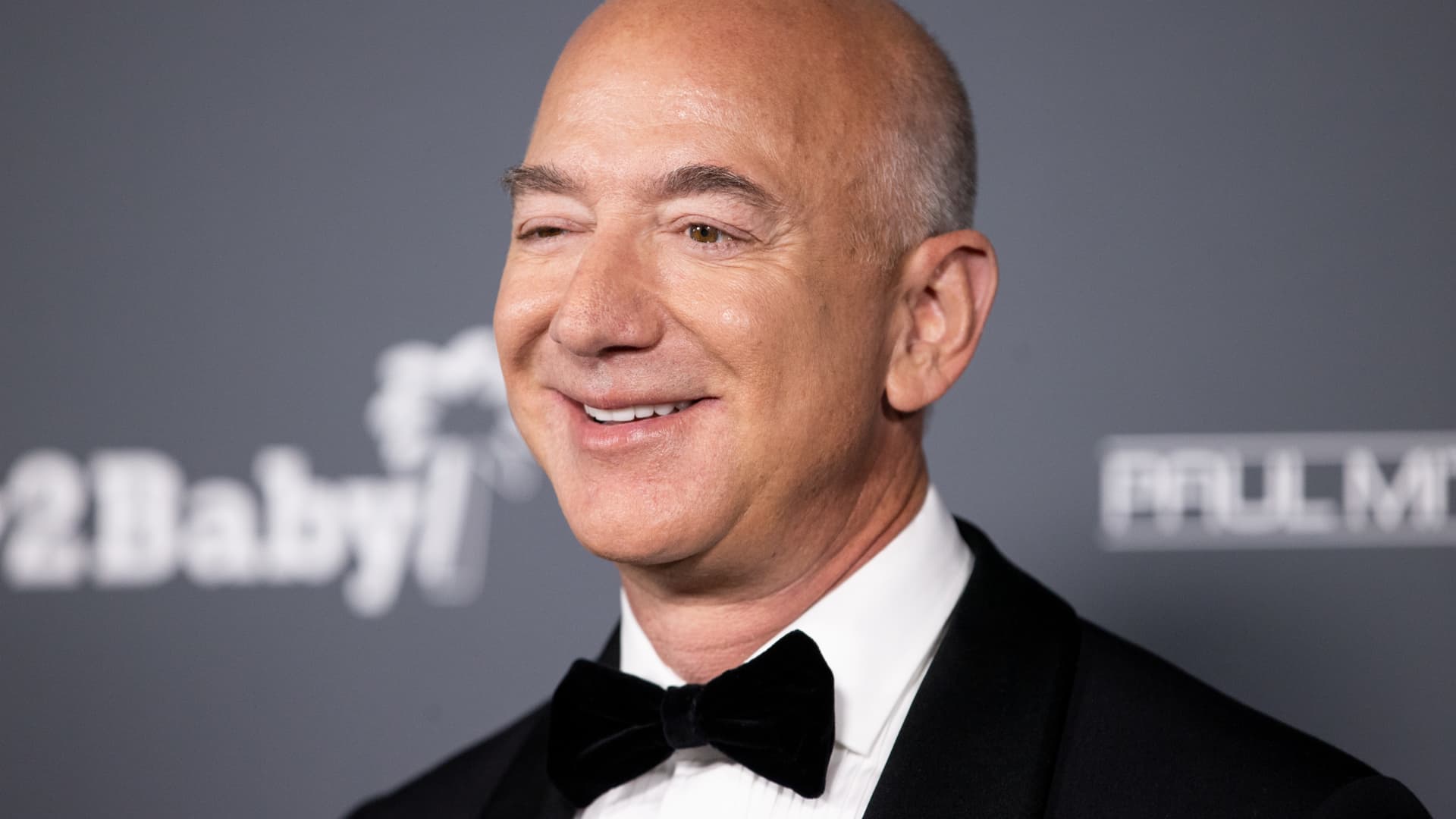
Amazon founder Jeff Bezos is leaving Seattle for Miami


Emma McIntyre | Getty Images Entertainment | Getty Images
Jeff Bezos, who founded Amazon out of his Seattle garage in 1994, is leaving the city and moving to Miami to be near his parents and his space company Blue Origin.
Bezos announced the decision in an Instagram post late Thursday, which included a video of him touring one of Amazon’s earliest offices, the garage of his rented home in the Seattle suburb of Bellevue, Washington. It was there that Bezos in 1995 launched Amazon as an online bookseller, before transforming the company into a retail and cloud computing giant.
“I’ve lived in Seattle longer than I’ve lived anywhere else and have so many amazing memories here,” Bezos wrote. “As exciting as the move is, it’s an emotional decision for me. Seattle, you will always have a piece of my heart.”
Amazon’s rapid growth reshaped Seattle, particularly its South Lake Union area, where the company’s headquarters sits. Its rise helped turn Seattle into a tech hub, leading to an influx of highly paid tech workers, but also higher rents and homelessness.
Bezos stepped down as Amazon’s CEO in 2021, turning the helm over to former cloud boss Andy Jassy. Bezos transitioned to executive chairman of Amazon’s board.
After stepping down as Amazon CEO, Bezos has spent more time on personal ambitions like the Earth Fund and Blue Origin, as well as The Washington Post, which he acquired in 2013.
His presence has extended beyond Seattle for some time. Bezos recently spent $150 million for two adjoining properties in Miami’s Indian Creek Village, often referred to as the “billionaire bunker.” He owns other properties around the world.
WATCH: Will Temu kill Amazon? How the Chinese shopping app’s rapid growth could crack Amazon’s dominance


Firefly’s CEO Jason Kim reacts during the company’s IPO at the Nasdaq MarketSite in New York City, U.S., August 7, 2025.
Jeenah Moon | Reuters
Last week’s liftoff also coincided with President Donald Trump‘s “space superiority” executive order, signed on Friday, that aims to create a permanent U.S. base on the moon.
Investors have also gained more clarity on the future of NASA following a whirlwind drama since Trump won the election.
Last week, the Senate confirmed Jared Isaacman as NASA administrator more than a year after he was first nominated to the position.
Trump withdrew the nomination from the Elon Musk ally earlier this year amid a public fallout, but renominated Isaacman in November.
Transportation Secretary Sean Duffy was tapped to temporarily run the space agency in the interim.


Google parent Alphabet on Monday announced it will acquire Intersect, a data center and energy infrastructure company, for $4.75 billion in cash in addition to the assumption of debt.
Alphabet said Intersect’s operations will remain independent, but that the acquisition will help bring more data center and generation capacity online faster.
In recent years, Google has been embroiled in a fierce competition with artificial intelligence rivals, namely OpenAI, which kick-started the generative AI boom with the launch of its ChatGPT chatbot in 2022. OpenAI has made more than $1.4 trillion of infrastructure commitments to build out the data centers it needs to meet growing demand for its technology.
With its acquisition of Intersect, Google is looking to keep up.
“Intersect will help us expand capacity, operate more nimbly in building new power generation in lockstep with new data center load, and reimagine energy solutions to drive US innovation and leadership,” Sundar Pichai, CEO of Google and Alphabet, said in a statement.
Google already had a minority stake in Intersect from a funding round that was announced last December. In a release at the time, Intersect said its strategic partnership with Google and TPG Rise Climate aimed to develop gigawatts of data center capacity across the U.S., including a $20 billion investment in renewable power infrastructure by the end of the decade.
Alphabet said Monday that Intersect will work closely with Google’s technical infrastructure team, including on the companies’ co-located power site and data center in Haskell County, Texas. Google previously announced a $40 billion investment in Texas through 2027, which includes new data center campuses in the state’s Haskell and Armstrong counties.
Intersect’s operating and in-development assets in California and its existing operating assets in Texas are not part of the acquisition, Alphabet said. Intersect’s existing investors including TPG Rise Climate, Climate Adaptive Infrastructure and Greenbelt Capital Partners will support those assets, and they will continue to operate as an independent company.
Alphabet’s acquisition of Intersect is expected to close in the first half of 2026, but it is still subject to customary closing conditions.
WATCH: Here’s what’s happening to electricity bills in states with the most data centers

-
 Sports2 years ago
Story injured on diving stop, exits Red Sox game
-
 Sports3 years ago
‘Storybook stuff’: Inside the night Bryce Harper sent the Phillies to the World Series
-
 Sports2 years ago
Game 1 of WS least-watched in recorded history
-
 Sports3 years ago
Button battles heat exhaustion in NASCAR debut
-
 Sports3 years ago
MLB Rank 2023: Ranking baseball’s top 100 players
-
Sports4 years ago
Team Europe easily wins 4th straight Laver Cup
-
 Environment3 years ago
Japan and South Korea have a lot at stake in a free and open South China Sea
-
 Environment1 year ago
Here are the best electric bikes you can buy at every price level in October 2024