
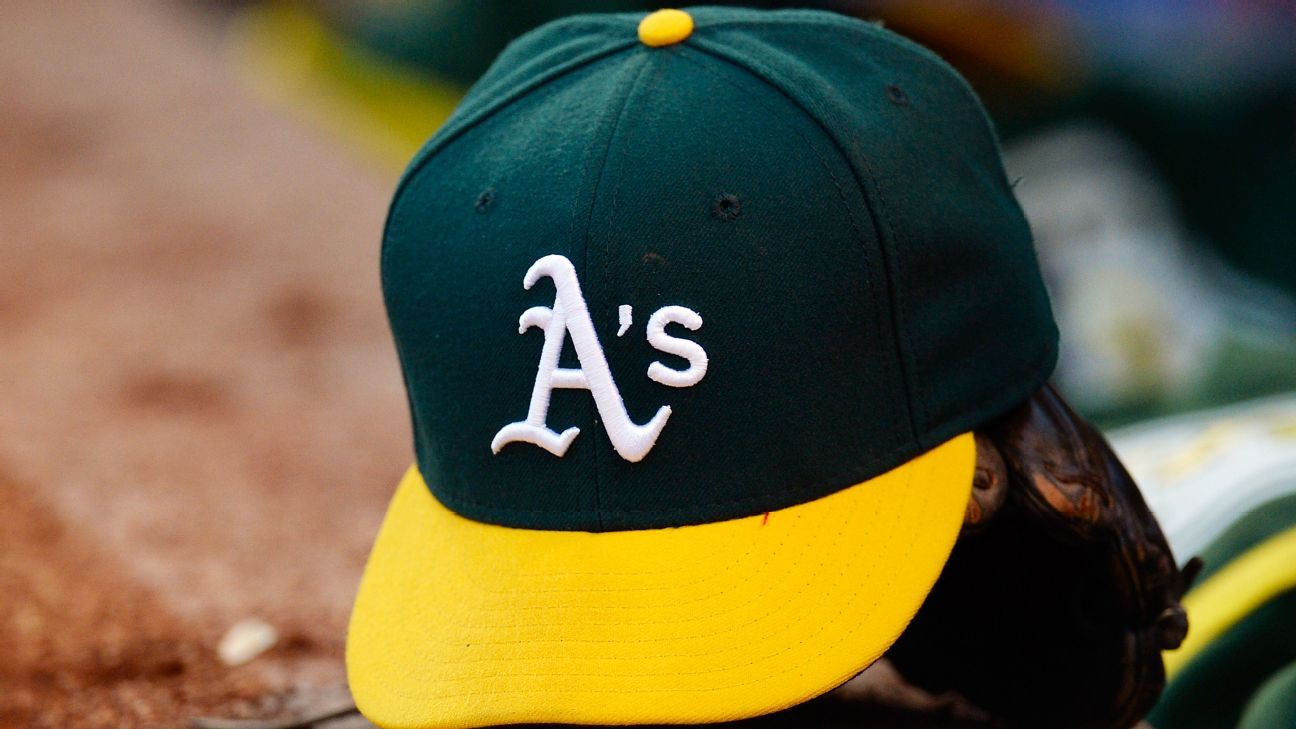
Owners greenlight Athletics’ move to Las Vegas


-
Jeff Passan, ESPN
ARLINGTON, Texas — Major League Baseball owners voted unanimously Thursday to allow the Oakland Athletics to move to Las Vegas, paving the way for the second relocation of a baseball team in the past half-century.
The potential move, which comes after more than two decades of failed efforts to secure a new stadium in the city to replace the aging Oakland Coliseum, needed backing from three-quarters of teams at the quarterly owners meetings. It received unanimous support despite unanswered questions about the team’s near-term future and stadium plans.
“Today is an incredibly difficult day for Oakland A’s fans,” Athletics owner John Fisher said. “It’s a great day for Las Vegas.”
MLB commissioner Rob Manfred echoed Fisher’s sentiments, saying: “I know — I know — this is a terrible day for fans in Oakland. I understand that. And that’s why we’ve always had a policy of doing everything humanly possible to avoid a relocation. And I truly believe we did that in this case. I think it’s beyond debate, that the status quo in Oakland was untenable. Those of you who have been in the building understand what I’m talking about. And I absolutely am convinced that there was not a viable path forward in Oakland.”
The move is not yet finalized. Legal challenges from a teachers union in Nevada regarding the $380 million the state has committed to the construction of a $1.5 billion stadium on the Las Vegas Strip still could scuttle the move, but winning approval from owners marks a significant step toward Oakland losing its last major men’s professional sports team.
Prior to the Montreal Expos moving to Washington, D.C., in 2005, the last MLB team to relocate was the Washington Senators, who became the Texas Rangers in 1972. The Athletics moved to Oakland from Kansas City in 1968 and have won four World Series in their 56 seasons in the city.
After announcing in 2021 plans to pursue a “parallel path” in which it would weigh stadium deals in Oakland and Las Vegas, the team chose Vegas in April 2023, with Manfred saying MLB would waive its relocation fee, estimated to be around $300 million.
The backlash from A’s fans was immediate and consistent. Chants of “sell the team” directed at Fisher — a Gap heir who bought the franchise in 2005 — served as background noise at most home games for the A’s, who went an MLB-worst 50-112 in 2023 and carried the league’s lowest payroll. More than 27,000 fans showed up in June for a so-called “reverse boycott,” during which they implored Fisher to sell.
After giving a short statement Thursday, Fisher left a news conference without taking questions.
Asked whether he considered Fisher a good owner, Manfred pointed to the A’s on-field success (seven playoff appearances since 2005), pegged the low payrolls (never higher than 18th in his 19 years owning the team) to the stadium’s poor conditions and said: “My answer is, over the long haul, yes, I think he’s been a good owner.”
In a letter sent to half the MLB owners last week, Oakland Mayor Sheng Thao said the city had procured $928 million in funding for a stadium and surrounding development and wanted to keep the team.
The Athletics’ lease with the Oakland Coliseum expires after the 2024 season, and the team has yet to solidify plans for where it will play before the Las Vegas stadium is ready in 2028. Manfred said extending the lease in Oakland is an option, though the city — which owns half the stadium, while the Athletics own the other half — has said in order to do so that it would need to keep the A’s name and move to the front of the line for a potential expansion franchise.
“We are disappointed by the outcome of this vote,” Thao said in a statement. “But we do not see this as the end of the road. We all know there is a long way to go before shovels in the ground and that there are a number of unresolved issues surrounding this move. I have also made it clear to the commissioner that the A’s branding and name should stay in Oakland and we will continue to work to pursue expansion opportunities. Baseball has a home in Oakland even if the A’s ownership relocates.”
The lack of a home for three seasons is far from the only reservation about the Athletics’ move. Not only would they be leaving for a smaller media market, but the team would also remain a revenue-sharing recipient, a point of contention in recent years. The new stadium, located at the site of the old Tropicana hotel, is slated to be built on a 9-acre parcel, which would be one of the smallest in MLB. While the A’s released renderings of a Las Vegas stadium, they did not include a dome or retractable roof, which would be necessary to combat the city’s summer heat.
Nonetheless, the vote received unfettered support after the league’s relocation committee championed it. Manfred adopted the recommendation, the league’s executive council voted unanimously to greenlight it, and the remainder of owners joined Thursday.
Uncertainty regarding the Athletics’ future had hung over the league since 2001, when the team first sought to build a new stadium. An attempt in 2005 to move to nearby Fremont fell apart, and efforts to pursue a stadium in San Jose were blocked by the San Francisco Giants, whose territorial rights extend to the southern part of the Bay Area.
Potential stadium plans in Oakland stalled, with the team and league blaming politicians and vice versa. The most promising deal was for a massive reimagining of Howard Terminal in the Port of Oakland, a 55-acre parcel that would have developed 6 million square feet of commercial buildings, residential units and a 35,000-seat stadium. The $12 billion price tag, however, proved too large, and Las Vegas — which already had taken the Raiders from Oakland in 2020 — swooped in to do the same with the A’s.
Securing public funding wasn’t easy. The A’s initially sought $500 million in public money. On June 14, the Nevada Senate passed a $380 million bill after the A’s agreed to allow for the use of a suite at the stadium for community groups, pledged an annual $1.5 million donation to the community and offered resources to help mitigate homelessness in Las Vegas. Nevada Gov. Joe Lombardo signed the bill into law two days later.
The lack of a relocation fee, Manfred said, was a “really important” element of the deal.
“We felt that a relocation fee in this particular situation was inappropriate, where there was significant expenditures by John Fisher and his family to get the stadium built,” Manfred said. “It’s a billion-and-a-half-dollar project. That was really important. We also felt that, in terms of the public support that was available, the waving of relocation fee made that support stronger. We wanted to go into the market in a way that the people in the market felt like we were making an investment in them and looking to grow the game.”
A political action committee, Schools Over Stadiums, is pursuing a referendum for the public to vote on the stadium funding in November 2024. A judge recently rejected the referendum, saying the language in the petition submitted by Schools Over Stadiums was “legally deficient.” The PAC plans to appeal to the Nevada Supreme Court, and if that effort fails, it could refile a petition. If successful, Schools Over Stadiums would need to collect 102,568 signatures — 25,647 from each of Nevada’s four congressional districts — by July to ensure the referendum is on the ballot.
In the meantime, the A’s still need to finalize plans on the construction of a 33,000-seat stadium in Las Vegas, which would be the smallest in MLB by nearly 2,000 seats and rely heavily on tourism to fill the ballpark. The lack of plans did not dissuade owners, nor did the objections of fan groups that lobbied them to reject the move.
On Tuesday night, two days before the vote, three A’s fans wearing T-shirts that read “SELL” sat near Fisher at the restaurant at the Live! By Loews hotel where the owners meetings were held. As Fisher stood up to leave a few minutes later, one fan said, loud enough for Fisher to hear: “Keep the A’s in Oakland. Do the right thing.”
Walking away, Fisher muttered under his breath: “I am doing the right thing.”


-
ESPN staff

College football’s early signing period started Wednesday and runs until Friday. Class of 2026 high school recruits who signed have locked into the college of their choice for at least the next year.
The drama started early when Vanderbilt flipped five-star QB Jared Curtis from Georgia on Tuesday night. Defensive end Jordan Carter (No. 57 overall) was the highest-ranked uncommitted recruit. He chose Tennessee over Auburn and Georgia Tech on Wednesday. Virginia Tech was a big mover of the day, adding 11 players who were formerly in James Franklin’s class at Penn State. USC added to its top-ranked class by flipping Kayden Dixon-Wyatt from Ohio State. Texas has the most five-star signings of any team, headlined by QB Dia Bell.
If a prospect doesn’t sign a national letter of intent by Friday, the next national signing day for this cycle begins Feb. 4.
We tracked all the news, analysis and more throughout Wednesday.
More: Class rankings: Top 75 | How the five-stars fit

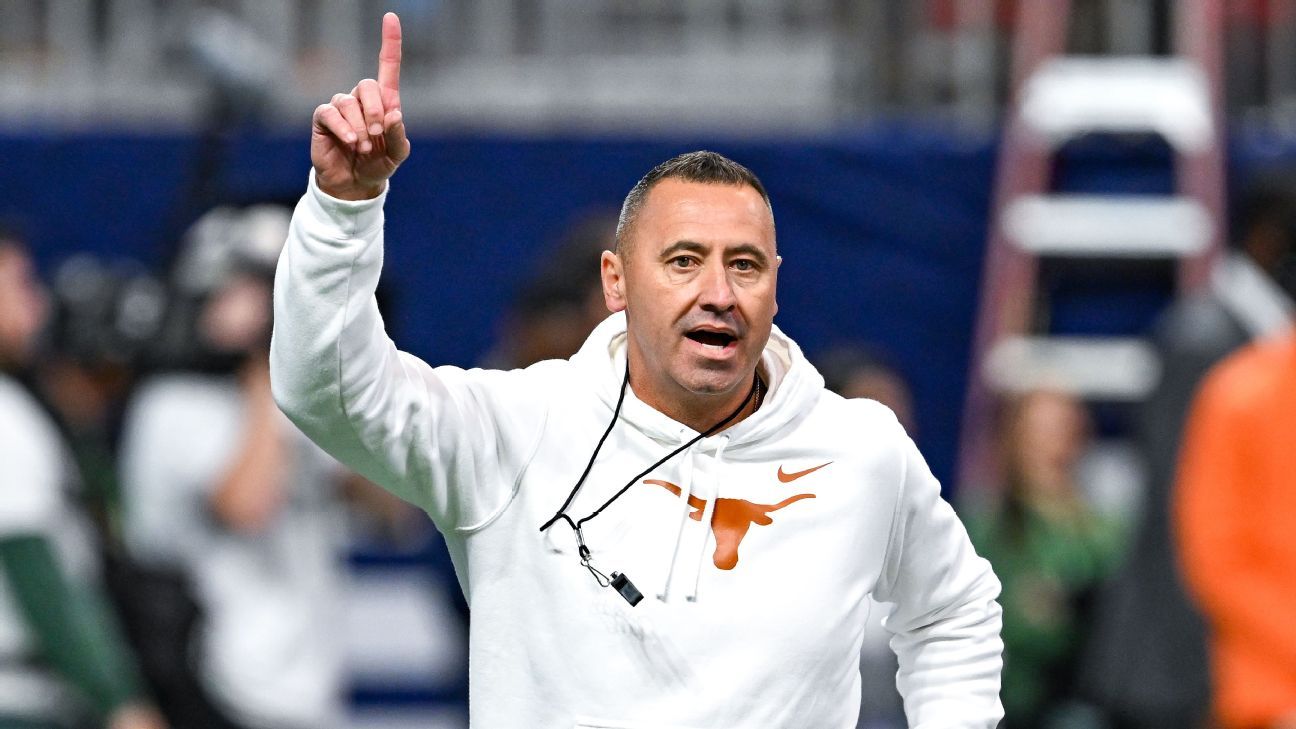
College football’s early signing period opened Wednesday with much of the 2026 recruiting class committed. That added some extra drama for those teams chasing last-minute additions and flips.
Coaching changes weighed heavily on the end of this cycle with Virginia Tech adding eight commitments since James Franklin’s hiring. Auburn and Arkansas each saw movement in their classes following their coach hirings Sunday.
Here’s a look at the winners, the programs that missed out Wednesday and the questions that still loom over the 2026 cycle after more than 12 months of recruiting played out in the span of 12 hours:
Jump to: Texas’ haul | Carousel impact
CFP boost | Who has overachieved | Impact QBs
Texas’ five-star haul is impressive

A few teams landed multiple five-star prospects, but none has more than the Longhorns. The class fills needs but also has extremely talented players at impact positions.
On defense, linebacker Tyler Atkinson (No. 17 overall) has a combination of skills and production that can’t be ignored. He recorded 550 tackles in his prep career and had three double-digit sack seasons. He’s a versatile and explosive defender whether he’s rushing off the edge or in coverage. He is joined by defensive end Richard Wesley, No. 8 overall. After the Longhorns leaned some on the transfer portal this past offseason to retool their defensive line, Wesley will be a key player who projects to be versatile within their front, with the strength and heavy hands to set the edge and the ability to slide inside and expose mismatches with his quickness.
Offensively, QB Dia Bell, the sixth overall prospect, might be the most well-rounded, having been a multiyear starter and consistently playing at a high level of competition. While he is not a true dual threat, he can create second chances and be effective when asked to run. As a passer, his basketball background has helped develop his pocket movement and he has good touch on his deep ball. In running back Derrek Cooper, Texas has its future replacement for Quintrevion Wisner. Cooper’s initial impact could be limited but he brings similar attributes, with the ability to be a 1,000-yard rushing threat and rank among UT’s most productive pass catchers. Again, Texas has set itself up to replace a productive player with a prospect with arguably even greater impact ability. — Craig Haubert
Coaching changes hurt Auburn, Penn State and Oklahoma State
Traditionally, in-season firings tend to be the first domino to a class implosion. Such moves didn’t burn Florida and LSU on the 2026 recruiting trail. But amid a historic coaching carousel, the recruiting classes at Auburn, Penn State and Oklahoma State were among those that felt the fullest force of their school’s respective coaching changes in recent months.
Auburn’s latest class held firm in the weeks after the Tigers fired Hugh Freeze on Nov. 2. In fact, four of the program’s five decommitments since then occurred only after Auburn hired Alex Golesh from South Florida on Sunday. But the departures themselves were significant. Four-star safety Bralan Womack (No. 39 overall), the Tigers’ top-ranked 2026 commit, and quarterback Peyton Falzone (No. 225) each pulled their pledges on Monday. And while signatures from four-star wide receiver Jase Mathews (No. 258 overall) and a trio of ESPN 300 linebackers still give Auburn a foundation of 2026 talent, the Tigers’ incoming class lacks starpower.
Defensive tackle Danny Beale (No. 108 overall) and running back Kaydin Jones (No. 25 RB) marked Oklahoma State’s star additions in a surprisingly strong start to the 2026 cycle. Both left the Cowboys’ class between Mike Gundy’s September departure and the arrival of North Texas coach Eric Morris on Nov. 25. Following another series of decommittments over the past week-and-a-half, Morris is set to begin his rebuild in Stillwater with a thin class of early signees.
The fall recruiting misfortunes of Auburn and Oklahoma State, however, look tame next to the developments that have unfolded around Penn State’s 2026 class since mid-October.
As of Wednesday morning, only two commits remained in a Nittany Lions class that ranked 17th nationally when the school fired coach James Franklin on Oct. 12. Among the high-profile departures from Penn State since then: offensive tackle Kevin Brown (No. 78), wide receiver Davion Brown (No. 109), running back Messiah Mickens (No. 141) and longtime quarterback pledge Troy Huhn (No. 198). To add insult to injury, 10 of the Nittany Lions’ 21 total decommitments ultimately landed with Franklin at Virginia Tech, all signing with a surging Hokies 2026 Wednesday while Penn State’s coaching job still sits vacant in early December. — Eli Lederman
Which teams improved their CFP chances?

35 commitments
ESPN 300 commits: 18, two five-stars
USC is getting close and just lost a game at Oregon that would have likely thrust it into the CFP in 2025. The class is loaded top to bottom, even including juco prospects. To take the next step, though, the Trojans must continue to beef up the trenches. They pulled four-star defensive tackle Jaimeon Winfield out of Texas, landed in-state defensive end Simote Katoanga and traveled to Utah to snag offensive lineman Esun Tafa. To further bolster the offensive line, the Trojans landed Keenyi Pepe out of IMG Academy. He has great size at 6-foot-7 and 320 pounds but is light on his feet as well as physical and can become a standout tackle. Five-star cornerback Elbert Hill headlines the skill-position players. Hill possesses elite speed, having been measured at over 22 mph in game play.

25 commitments
ESPN 300 commits: 12, one five-star
Michigan has quietly put together a very successful season, winning five games in a row prior to a loss to Ohio State despite multiple offensive injuries at running back and a true freshman QB in Bryce Underwood. This class features six players who rank in the top 10 at their respective position. Michigan bolstered its backfield by landing No. 2 running back Savion Hiter, a runner with a nice blend of size (6 feet, 200 pounds), power and speed who can also catch the ball out of the backfield. After losing two defensive linemen in the first round of the NFL draft, Michigan added several to this class, including four-stars Titan Davis, McHale Blade and Tariq Boney. Michigan has also received a commitment from five-star Carter Meadows, a rangy edge defender who can affect the QB. — Tom Luginbill
Which teams have overachieved?

18 commitments: one five-star, 17 three-stars
Coach Willie Fritz has made huge strides in his second season at Houston and recruiting has picked up as a result.
The class has been headlined for several months by five-star quarterback Keisean Henderson, the No. 1 dual-threat QB in the country. Henderson could become a program-defining prospect that thrusts the Cougars into Big 12 championship contenders for years to come. Henderson has also been a loyal commitment throughout the process despite obvious overtures by other bigger programs to flip him. He’s dynamic as a runner and a gamer as a passer.
UH’s class also features the sixth-ranked tight end in the country in Jaivion Martin. The 250-pounder is a well-rounded blocker and receiver who can play as an inline in the run game. He also competes in track and field. The Cougars have also nabbed a top-25 athlete in Paris Melvin, who could project at cornerback or wide receiver and is a dangerous return man who ran a 10.86 100m in the spring of 2025. One of the more underrated running back prospects in the class is John Hebert, a Ryan Switzer-type scatback/utility weapon. He ran a 4.54 40-yard laser timed in the spring and has posted a max speed of 21.3 mph.
This class is full of high-end three-star prospects, and perhaps no coach in the country has a better track record of developing prospects than Fritz.

21 commitments: six four-stars
SMU is now running with the big dogs not only on the field, but in recruiting circles as well. The Mustangs have added several offensive linemen, no bigger than Sam Utu, an ESPN 300 player with tackle athleticism and guard power. The Mustangs also picked up Evan Goodwin, a massive presence at 6-7 and 320 pounds, Evan Goodwin, a massive presence at 6-7 and 320 pounds, and in-state guard Drew Evers, a thickly built and strong blocker who can latch on and control defenders. Rhett Lashley knows the trenches are what’s going to elevate the program.
Capitalizing on the rich talent base in Texas, SMU has added several in-state prospects, including SC Next 300 back Christian Rhodes. Rhodes, an explosive runner who has been recorded hitting better than 21 mph max speed in game play, also brings a physical running style at 6-1, 200 pounds. High three-star Aljour Miles II, a lengthy receiver who has good quickness and body control, is another nice in-state addition. Another receiving target with big-play potential, Jakai Anderson, was pulled out of Louisiana. Not quite as big a target, he brings a good blend of speed and elusiveness and could also be productive in the return game.
On defense, defensive end Hudson Woods shows some savvy as a pass rusher, with active hands and good bend. Linebacker Kenneth Goodwin out of California is a versatile, physical defender who can rush the passer.

12 commitments: six ESPN 300 prospects, eight total four-stars
Despite the firing of coach Hugh Freeze and some late defectors, this class still has major talent upgrades committed, particularly on defense. The class is not large, but it is stacked with overall top-end talent. There are four players ranked within the top 11 players in the country at their respective position and two within the top three.
Adam Balogoun-Ali is the country’s No. 1 inside linebacker and also happens to have significant growth upside with his lengthy frame. He can play inside and on the outside as an edge rusher and excels in space due to his speed and agility. The Tigers also have a commitment from the No. 3 inside linebacker in the class, Shadarius Toodle. Toodle is just a step behind Balogoun-Ali in terms of overall speed and is a downhill gap plugger in the middle of the field.
New head coach Alex Golesh has a good foundation to head into the dead period with and attack the transfer portal in January for more additions. — Luginbill
These 2026 QBs could start early

Jake Fette, Arizona State Sun Devils: Assuming Sam Leavitt goes in the portal, Fette, the No. 4-ranked dual threat, brings a lot of great traits to the Sun Devils offense. He’s super athletic and mobile, with the field vision to keep his eyes downfield while on the move. Fette is very similar to Leavitt in stressing defenses with his arms and legs. Fette also has good touch and anticipation on short to midrange throws. Coach Kenny Dillingham will challenge defenses schematically with a lot of shifts, motions and backfield action that will maximize Fette’s dynamic skill set in and outside the pocket.

Oscar Rios, Arizona Wildcats: Rios is the Wildcats’ highest-rated pocket passer signee in the ESPN 300 era. How immediate the impact depends on whether Noah Fifita returns for the 2026 season. If Fifita chooses to return, Rios could redshirt as a true freshman and be the favorite to become the starter in 2027. Rios’ quick release and great arm strength should lead to big numbers under coordinator Seth Doege in Tucson. — Billy Tucker

-
Mark Schlabach
OXFORD, Miss. — Last month, as some of the biggest college football brands pursued Ole Miss’ Lane Kiffin, a staff member polled the team’s assistant coaches about where they wanted to be in the 2026 season.
The coaches discussed four options: Remain at Ole Miss, where they had built a legitimate College Football Playoff contender; leave for SEC rivals Florida or LSU; or take over Florida State, which according to people with knowledge of the search, was making a stealth move to poach Kiffin.
The entire defensive coaching staff, led by coordinator Pete Golding, preferred to stay at Ole Miss, which was on the verge of its first 11-win regular season and CFP appearance, two sources told ESPN.
All but one offensive assistant wanted to leave for either Florida or LSU, which historically had enjoyed more success than Ole Miss but had fired their coaches after their teams struggled this season.
That meeting was indicative of the divided loyalties and uncertainty that defined one of the most compelling coaching searches in college football history, which threatened to not only derail the Rebels’ historic season but also captivated fans on three SEC campuses and around the country.
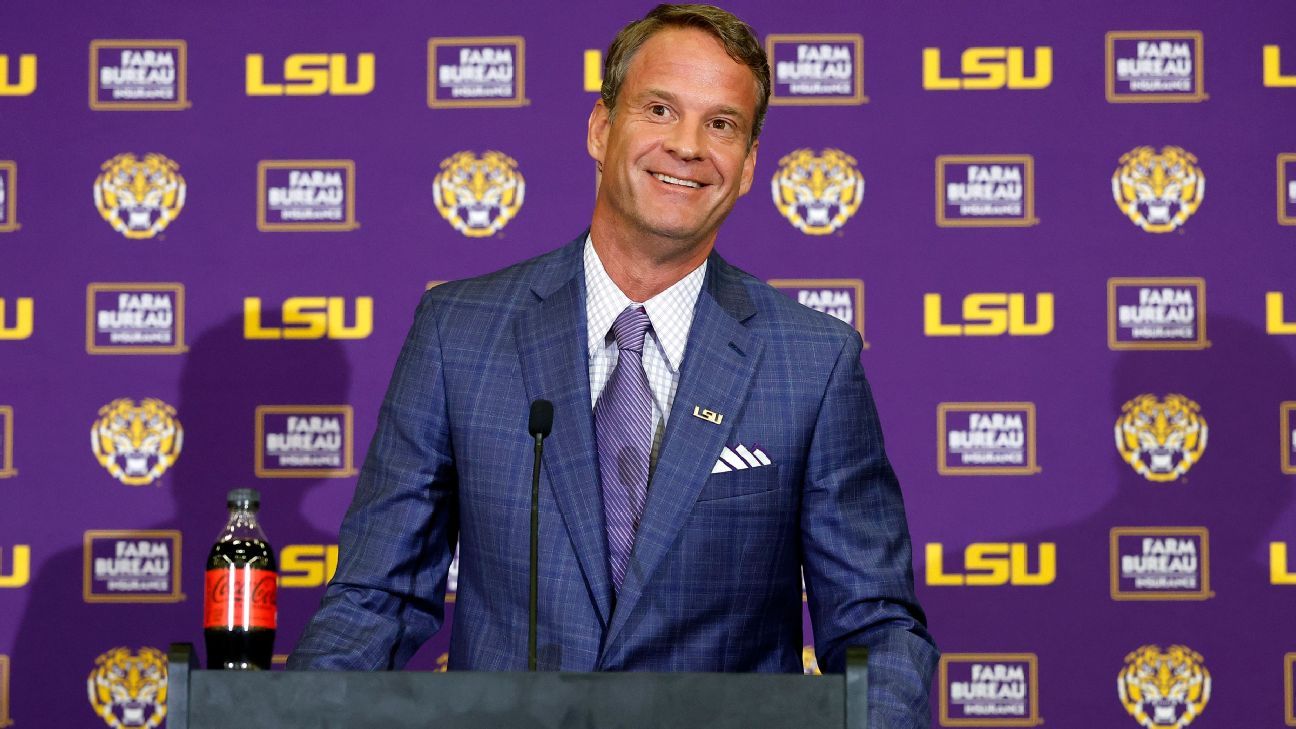
On Sunday, after days of mounting tension and uncertainty, Kiffin finally agreed to become LSU’s coach, abandoning an Ole Miss team that is 11-1 and holds the No. 6 spot in the CFP selection committee’s latest rankings.
Even worse for many Ole Miss fans, Kiffin departed for a program they consider its fiercest rival in the SEC.
“You’re not leaving to coach the Giants or the Dolphins or the Buckeyes,” a source familiar with the situation told ESPN. “You’re talking about going to a place that we will play [each of the next four seasons].”
BY THE TIME the Rebels traveled to play rival Mississippi State in the Egg Bowl on Friday, a pall had settled over the Ole Miss program.
Florida and LSU had ramped up their courtships of Kiffin, who had transformed Ole Miss from a midtier SEC program to one of the best in the FBS. The Rebels had gone 54-19 under Kiffin, winning 10 or more games in four of the past five seasons. Only blue bloods Alabama and Georgia had more success in the league since Kiffin arrived.
Florida athletic director Scott Stricklin interviewed Kiffin in Oxford in early November — a bold move behind enemy lines to get an edge on the most coveted candidate in the coaching carousel, two Florida sources told ESPN. Gators fans, who had watched their team limp to losing records in four of the past five seasons, clearly favored Kiffin.
Years ago, Kiffin wanted Florida, but Stricklin hired Billy Napier, then the coach at Louisiana, in November 2021. Kiffin’s off-field behavior made Napier the safer option, despite the Rebels’ 10-3 campaign that season, in which they defeated nationally ranked Arkansas and Texas A&M.
The Gators went 22-23 in three-plus seasons under Napier, and he was fired Oct. 19 after they struggled to a 3-4 start.
It wasn’t the first time Kiffin had been rebuffed by the Gators. After Kiffin was fired as USC‘s coach five games into the 2013 season — the Trojans dismissed him in a private terminal at Los Angeles International Airport following an ugly 62-41 loss at Arizona State — then-Florida coach Will Muschamp sought to hire Kiffin as his offensive coordinator the next season. However, Muschamp was told by UF officials that the SEC office wouldn’t allow him to bring in Kiffin, according to two people familiar with the situation, and Alabama’s Nick Saban hired Kiffin a couple of weeks later.
Early on, Ole Miss officials believed Florida might be the biggest threat to lure Kiffin away because of his family’s connection to the Gators. His ex-wife, Layla, had moved to Oxford earlier this year to be closer to two of her children: Knox, a sophomore at Oxford High School, and Landry, a junior at Ole Miss. Layla Kiffin’s father, John Reaves, was a star quarterback for the Gators from 1969 to 1971 and was later an assistant under legendary coach Steve Spurrier.
However, the Florida opening became Kiffin’s second choice, sources close to him told ESPN, once LSU fired Brian Kelly on Oct. 26, a day after the Tigers lost to Texas A&M 49-25 at home. While Kiffin was reportedly turned off by Stricklin’s involvement in the Florida program, he didn’t seem overly concerned about the political environment at LSU.
Louisiana Gov. Jeff Landry was highly critical of athletic director Scott Woodward for leaving LSU on the hook for a $54 million buyout when Kelly was fired. Woodward resigned under pressure Oct. 30 and was replaced by longtime LSU administrator Verge Ausberry.
During his introductory news conference Monday, Kiffin revealed he had a “unique, great call with Governor Landry” during LSU’s recruitment of him.
“I could feel his passion and energy for the state of Louisiana and for LSU football,” Kiffin said.
LSU became more attractive to Kiffin once Ausberry was promoted, sources told ESPN. Saban, who guided the Tigers to the 2003 national championship and helped Kiffin resurrect his career when he brought him on as Alabama’s offensive coordinator from 2014 to 2016, was complementary of Ausberry.
LSU brass interviewed Kiffin sometime in mid-November. On Monday, Ausberry said the initial interview with Kiffin lasted less than 90 minutes. When Ausberry called other LSU officials to pick him up, they were like, “Y’all finish, already?”
“It wasn’t a three- or four-hour meeting,” Ausberry said. “[Former LSU baseball coach and athletic director] Skip Bertman taught me that. Nick Saban taught me that you don’t ask great coaches, ‘What you gonna do on third-and-8? Tell me about your offensive game plan, tell me about your defense, tell me about who you’re gonna hire.’
“Here, it’s like, ‘What do you need to be successful? We want you to be our coach here. What do you expect from me as athletic director? What do you expect from LSU, and do you want to be at LSU?’ And that was pretty much the conversation.”
Ausberry recalled working under Bertman when the Tigers hired Oklahoma State‘s Les Miles before the 2005 football season. Bertman’s teams won five College World Series titles and seven SEC championships during his 18 seasons as coach from 1984 to 2001.
“Hiring the football coach at LSU is the biggest thing in the state of Louisiana,” Ausberry told Bertman. “It’s the biggest job. I said, ‘If you hire the wrong one, Coach Bertman, all your national championships, all your great baseball programs, that’s going to be your legacy.’
“So, I thought that this would be my legacy at LSU, and that I have to get the right person to be the head coach of LSU.”
At the same time, Florida State athletic director Michael Alford also was wooing Kiffin behind the scenes, sources familiar with the search told ESPN. Kiffin and Alford had worked together at USC — Alford as the Trojans’ associate AD from 2000 to 2003 and Kiffin as Pete Carroll’s tight ends/wide receivers coach from 2001 to 2003. But Florida State hadn’t fired embattled coach Mike Norvell, whose program had slipped dramatically after going 13-1 and winning an ACC title in 2023. The Seminoles cratered last season, going 2-10, followed by a 5-7 mark this year.
The Seminoles would have owed Norvell about $54 million if they fired him without cause, plus another $18 million to pay off his assistants.
Hiring Kiffin, the hottest coach on the market, might have allowed Alford to justify spending $72 million to dismiss Norvell and his staff. The Seminoles’ recruitment of Kiffin continued into the middle of November, according to the sources. But after it became clear Kiffin wasn’t coming, FSU announced Nov. 23 that Norvell would return for a seventh season.
Ausberry said he worked tirelessly to keep LSU’s courtship of Kiffin under wraps, even though there was plenty of speculation that the Tigers wanted him.
On Nov. 17, fans using online flight trackers discovered that LSU had flown a jet to Oxford and back. Layla Kiffin and other family members visited Baton Rouge that day. She visited Gainesville, Florida, the day before with her son and Lane’s brother Chris’ son.
“They had to really see Baton Rouge,” Ausberry said. “That was one of the big things, because her father was an All-American at the University of Florida, and a coach [and] great NFL player, and those are things that we were a little afraid of. That’s that pull of Gainesville, and then she came to Baton Rouge.”
Kiffin’s family visits to rival SEC campuses — and the fact that they became so public — were like a slap in the face to many Ole Miss fans, who believed their coach was trolling them.
Kiffin was upset about what Rebels fans were saying about him, but an Ole Miss source described the development as a “self-inflicted wound.”
“What do you expect when your family flies to visit two of our competitors?” the Ole Miss source said.
A WEEK BEFORE the Egg Bowl, Kiffin met with Ole Miss athletic director Keith Carter and chancellor Glenn Boyce, as pressure was reaching a tipping point between the sides. Carter and Boyce wanted Kiffin to make a decision and sign a lengthy contract extension that would have made him one of the highest-paid coaches in the sport.
Ole Miss officials had assured Kiffin it could match anything Florida and LSU were offering in terms of revenue sharing and NIL, at least under current NCAA rules.
Kiffin wasn’t ready to commit, however, and informed Boyce and Carter that he hadn’t made up his mind. Kiffin didn’t think it was fair that he had to decide at that point because Ole Miss hadn’t even finished the regular season, sources close to the coach told ESPN.
“This is what’s wrong with the whole system,” a source close to Kiffin told ESPN. “Because this is another example of how nobody’s been in charge of anything in college football. Because if it was the NFL, you couldn’t talk to anybody until after the playoffs. It’s a horrible system.”
Boyce and Carter explored potential ways to keep him from coaching in the Egg Bowl — and they made it clear that he wouldn’t coach in the CFP if he accepted a job at Florida or LSU, Ole Miss sources told ESPN.
Cooler heads prevailed, and the sides agreed that the Rebels needed to focus on beating Mississippi State and potentially securing a CFP first-round home game, which would be lucrative for both Ole Miss and Oxford.
“[Kiffin] was looking for a reason to leave,” an Ole Miss source told ESPN. “When Keith kind of put him on the clock, I think that kind of changed the narrative, changed the landscape a little bit.”
Carter released a statement Nov. 21 saying he’d had “many pointed and positive conversations” with Kiffin regarding his future at Ole Miss and that he expected a decision from his coach the day after the Egg Bowl.
By that point, many Ole Miss fans were fed up with the drama. One prominent booster told ESPN this week he’d already informed the athletic department that if Kiffin returned, he wouldn’t continue contributing money to the program.
“The fan base went from wanting to build a statue for him to wanting to run him out of town,” the booster said.
WHEN THE EGG BOWL finally arrived Friday, there was an overwhelming sense that Kiffin was coaching his last game at Ole Miss. There was plenty of drama off the field, as well.
Before kickoff in Starkville, Kiffin told ESPN that Mississippi State students broke into the Rebels locker room at Davis Wade Stadium, stealing the jerseys of quarterback Trinidad Chambliss and other players.
Mississippi State officials had promised to put security guards outside the locker room but failed to do so, and the thieves broke in again, Kiffin said. The Rebels had captured the thefts on hidden cameras and turned the video over to police.
The Rebels ran away from the Bulldogs in the second half of a 38-19 victory. As Kiffin celebrated with players for the last time, Mississippi State officials blared the hit song from The Clash, “Should I Stay or Should I Go,” over the stadium speakers.
As Kiffin walked off the field, he embraced Boyce. Then he turned his attention to Ben Garrett, a reporter for On3. Kiffin confronted Garrett for using lyrics from a rap song to describe his unwillingness to commit to Ole Miss during a podcast: “Can’t turn a h- into a housewife. H-s don’t act right.”
Their argument continued in Kiffin’s postgame news conference, with Kiffin calling Garrett’s actions “bush league.”
“I don’t even know your name,” Kiffin told the reporter, a tactic he sometimes uses with staff members when he’s upset.
Garrett told ESPN that Kiffin called him the next day to apologize — and called him by his name. A few hours later, Kiffin texted Garrett a meme of Kiffin wearing a yellow-and-purple hat with the word “h-” on it.
AS COLLEGE FOOTBALL fans turned their attention to Saturday’s rivalry games, the Ole Miss campus was mostly quiet. Students were away for the Thanksgiving break, and Kiffin spent the morning with his family at a hot yoga class.
At one point, he assembled his coaching staff at the Manning Center to review film of Georgia, in case Alabama lost to Auburn in the Iron Bowl, which would have put the Rebels in the SEC championship game.
Around 6 p.m. ET, Kiffin met with Carter at the chancellor’s home on campus. During the nearly two-hour meeting, Kiffin broke the news that he was leaving for LSU. However, Kiffin continued to lobby his AD to allow him to coach the Rebels in the CFP.
“[Kiffin] had an opportunity to coach in the playoff, and that would have been to stay at Ole Miss, and he chose not to do that,” Carter told ESPN. “That’s his choice, and I respect that choice. But then we had to make a choice, and talking with the team and spending time with them, I think they know they need coaches to make a playoff run.
“I think they were very concerned about their position coaches and those types of things. But I think they understood when someone takes a job at another place — and not only another place but one of our rivals and a team that will be playing in our stadium next year — I think that that’s something that nobody feels comfortable with.”
Carter told ESPN that he’d been weighing whether to allow Kiffin to coach in the SEC championship game because of the short turnaround. When it became apparent that Boyce and Carter weren’t going to budge on their position about the CFP, according to Ole Miss sources, Kiffin threatened to take his entire offensive coaching staff with him to LSU.
It was his last leverage chip in a tense standoff to coach in the postseason. Ole Miss staff members confirmed to ESPN that Kiffin told his assistants that if they didn’t go to LSU with him on Sunday, they wouldn’t have a job with him in the future.
By the time LSU administrators landed in Baton Rouge following the Tigers’ 17-13 loss at Oklahoma on Saturday, Kiffin’s agent, Jimmy Sexton, had been frantically trying to reach Ausberry. When the men finally connected, Sexton delivered the news that Kiffin was ready to take the LSU job.
The outcome of the Iron Bowl might have determined whether the Tigers would have to wait another week to introduce their new coach. Auburn rallied to tie the score late in the fourth quarter, but Alabama went ahead 27-20 with 3:50 to play.
After Alabama recovered a fumble at its 20-yard line with 33 seconds left, Kiffin’s tenure at Ole Miss was over.
“It’s a tough situation,” Ausberry said. “He loved that place. We were thinking about that timeline. Also, I got kind of nervous the night when Auburn tied Alabama in that game. Now, it might push us back a week, but we were comfortable.”
In fact, Ausberry said LSU didn’t have a problem with Kiffin coaching the Rebels in the CFP, as long as he signed his contract with the Tigers. Kiffin said in a statement announcing his departure that Carter wouldn’t allow him to coach, and he added that he was willing to put guardrails in place to protect Ole Miss but didn’t specify what they would be.
“It’s great,” Ausberry said. “It’s great publicity for our institution. You have a coach, coaching out there, coaching [in the] playoff, playing for a national championship, and being the next coach of LSU, so we had no problems with that.”
0:54
Lane Kiffin respects Ole Miss’ decision to not have him coach in CFP
New LSU coach Lane Kiffin reflects on the process that led to Ole Miss not allowing him to coach the Rebels in the College Football Playoff.
That was exactly the situation Ole Miss officials wanted to avoid — its historic CFP run becoming a monthlong infomercial for LSU’s next coach. They also didn’t want Kiffin coaching their players once he left. The transfer portal opens Jan. 2, and it would have given Kiffin more time to potentially recruit the Rebels’ best players.
“The players were concerned about commitment and those types of things,” Carter said. “[With] this playoff run, we plan on this being a four-, five-, six-week thing. There’s just no way that that’s possible. I know that the scheduling and the timing and all that stuff is a part of the equation. But I’m just not sure there was any plan that was going to work that would allow the head coach of a rival school to be in your building and coaching your guys. We had to stand up for our program and what we thought was best.”
Late Saturday night, ESPN reported that Kiffin was signing a seven-year contract with LSU. A team meeting was scheduled for 10 a.m. ET Sunday, when Kiffin would address the Rebels for the final time.
ON SUNDAY, the meeting was pushed back to 2 p.m. ET, as Ole Miss officials scrambled to figure out which assistants were leaving and staying. The Rebels also were working to name an interim coach. Pete Golding would end up being hired as Kiffin’s permanent replacement before the team meeting.
“I got back to the office and said, ‘You know what? We’ve got a great solution to all this. Somebody that’s right here under our nose, that’s going to be the next great coach. He can help us hold this staff together,'” Carter said.
Kiffin encouraged Carter to meet with the team’s leadership council, according to Ole Miss sources, telling him that he wasn’t going to like what he would hear. But instead of telling Carter the team wanted Kiffin to coach in the CFP, the players said they were more worried about their position coaches staying and had grown tired of the drama surrounding Kiffin.
After the 30-minute meeting with Carter, the leadership council also met with Kiffin, Ole Miss sources told ESPN.
In response to the statement Kiffin issued announcing his decision, in which he claimed the players wanted him “to keep coaching them,” Rebels starting center Brycen Sanders, a member of the leadership council, posted on X on Tuesday: “I think everyone that was in that room would disagree.”
Linebacker Suntarine Perkins, another member of the council, added on X: “That was not the message you said in the meeting room. Everybody that was in there can vouch on this.”
Meanwhile, Layla Kiffin drove a white Mercedes into the parking lot behind the building about an hour before the scheduled team meeting. Golding paced on a sidewalk, talking on a cellphone for more than 15 minutes.
Lane Kiffin was escorted out of the Manning Center 10 minutes before Ole Miss players met with Carter, Boyce and Golding.
There were a few dozen fans and reporters gathered outside the building. Officers in three police cruisers were parked nearby, in case things got out of hand, as they did when Kiffin left Tennessee after only one season in January 2010. UT students burned couches and nearly rioted the night of his stunning departure.
As Kiffin and his son drove out of the parking lot around 1:45 p.m. ET, an Ole Miss student approached his black SUV and made an obscene gesture. It wasn’t the last one Kiffin would see that day.
A few minutes later, Ole Miss players started to file out of the Manning Center. One of them yelled, “It’s the Pete Golding era!”
By then, two planes owned by an LSU booster had been dispatched to pick up Kiffin, his family and the staff members who were joining him in Baton Rouge. The original rendezvous point was Tupelo, Mississippi, which is more than 50 miles from the Ole Miss campus.
On the way to Mississippi, someone told Ausberry that the flight was being diverted to Oxford’s airport.
“We’re going where? Oxford?” Ausberry said. “They’ll be shooting missiles at us.”
A few hundred Ole Miss fans lined the fences of the runway of University-Oxford Airport when the two planes landed. They booed the pilots, who could only laugh and wave. When someone asked Ausberry if he needed to use the restroom in the airport terminal, he said, “That’s OK, I’ll hold it.”
One by one, the Ole Miss assistants who were joining Kiffin arrived at the airport and were escorted to the planes in a black SUV. The fans booed their disapproval at offensive coordinator Charlie Weis Jr., passing game coordinator/receivers coach George McDonald and co-offensive coordinator/tight ends coach Joe Cox, among others. (LSU announced Tuesday that Weis will return to Ole Miss for the CFP.)
Layla Kiffin was booed loudly when she drove her Mercedes onto the runway.
“He is what we thought he was,” said Ole Miss graduate Taylor Cauthen, who stood along the fence. “He was gonna win, and we knew how he was gonna leave. I mean, it’s not surprising to anybody with any sense. He was gonna win games, and he was gonna leave, and it was gonna be bad.”
Cauthen, who moved back to Oxford in July, said Kiffin hijacked the Rebels’ historic season and turned it into a soap opera about him.
“He’s taken it from us,” Cauthen said. “He made it all about him. I think he wakes up every morning, looks at himself in the mirror, and tells himself he loves him. I think that’s who he cares about most. I think he cares about himself more than anything on this earth, including his family.”
Joe Ignatius, an Ole Miss baseball player from 1992 to 1996, watched in disbelief as Kiffin and his assistants left Oxford like diplomats fleeing a foreign country.
“I feel naive thinking it wouldn’t happen to us,” Ignatius said. “It just didn’t have to go this way. It could have been six great years going your way, thanks for what you did. But leopards don’t change their spots. And I got fooled, so not what I expected.”
Ignatius said he felt the worst for his son, Bodacious, an eight-grader, who grew to love the Ole Miss football team.
Kiffin, along with his son, was the last person to arrive at the airport. By then, police were turning away fans because the parking lots were full. Kiffin used an auxiliary entrance, which had fire trucks and firefighters blocking the road to keep fans away. He was escorted down the runway by a state trooper and another emergency vehicle.
Once Kiffin pulled his SUV next to the plane, the Ole Miss fans gave him a full-throated sendoff. He was embraced by Ausberry, who was wearing a purple shirt, and climbed the jet’s stairs. There was no farewell wave to the fans.
“He got on that plane and was like, ‘Let’s go. I’m ready,'” Ausberry said.
Only a few hours later, defensive tackle Lamar Brown of Baton Rouge, an LSU commit and the No. 1 player in the 2026 class according to ESPN’s recruiting rankings, posted a photo with Kiffin on X with the caption, “Welcome home.”
During a news conference at LSU on Monday, Kiffin said he wasn’t surprised by the reaction of Ole Miss fans when he left.
“They ain’t going to the airport and driving from all over, OK, to say those things and yell those things and try to run you off the road if you were doing bad,” Kiffin said. “Time heals a lot of things, and having gone through this in this conference before, I sure hope that happens.”
Kiffin won’t have to wait long to find out. The Tigers are scheduled to open SEC play at Ole Miss next season.
On Monday at the Po-Boy Express in Baton Rouge, LSU fan Remi Brignac, his son Beau and their friend Jay Olinde were discussing the program’s future with Kiffin.
“We’re optimistic for change,” Remi said. “Finally got an offensive mind.”
Olinde, meanwhile, isn’t expecting a long-term marriage.
“I believe that he will bring the program back to where we expect it to be in Baton Rouge,” Olinde said. “But I also believe that as soon as he gets that done, he’ll leave for the NFL, coaching the Dallas Cowboys.”
ESPN’s Dave Wilson contributed to this report
-
 Sports2 years ago
Story injured on diving stop, exits Red Sox game
-
 Sports3 years ago
‘Storybook stuff’: Inside the night Bryce Harper sent the Phillies to the World Series
-
 Sports2 years ago
Game 1 of WS least-watched in recorded history
-
 Sports3 years ago
Button battles heat exhaustion in NASCAR debut
-
 Sports3 years ago
MLB Rank 2023: Ranking baseball’s top 100 players
-
Sports4 years ago
Team Europe easily wins 4th straight Laver Cup
-
 Environment3 years ago
Japan and South Korea have a lot at stake in a free and open South China Sea
-
 Environment1 year ago
Here are the best electric bikes you can buy at every price level in October 2024