
Connect with us

Published

on

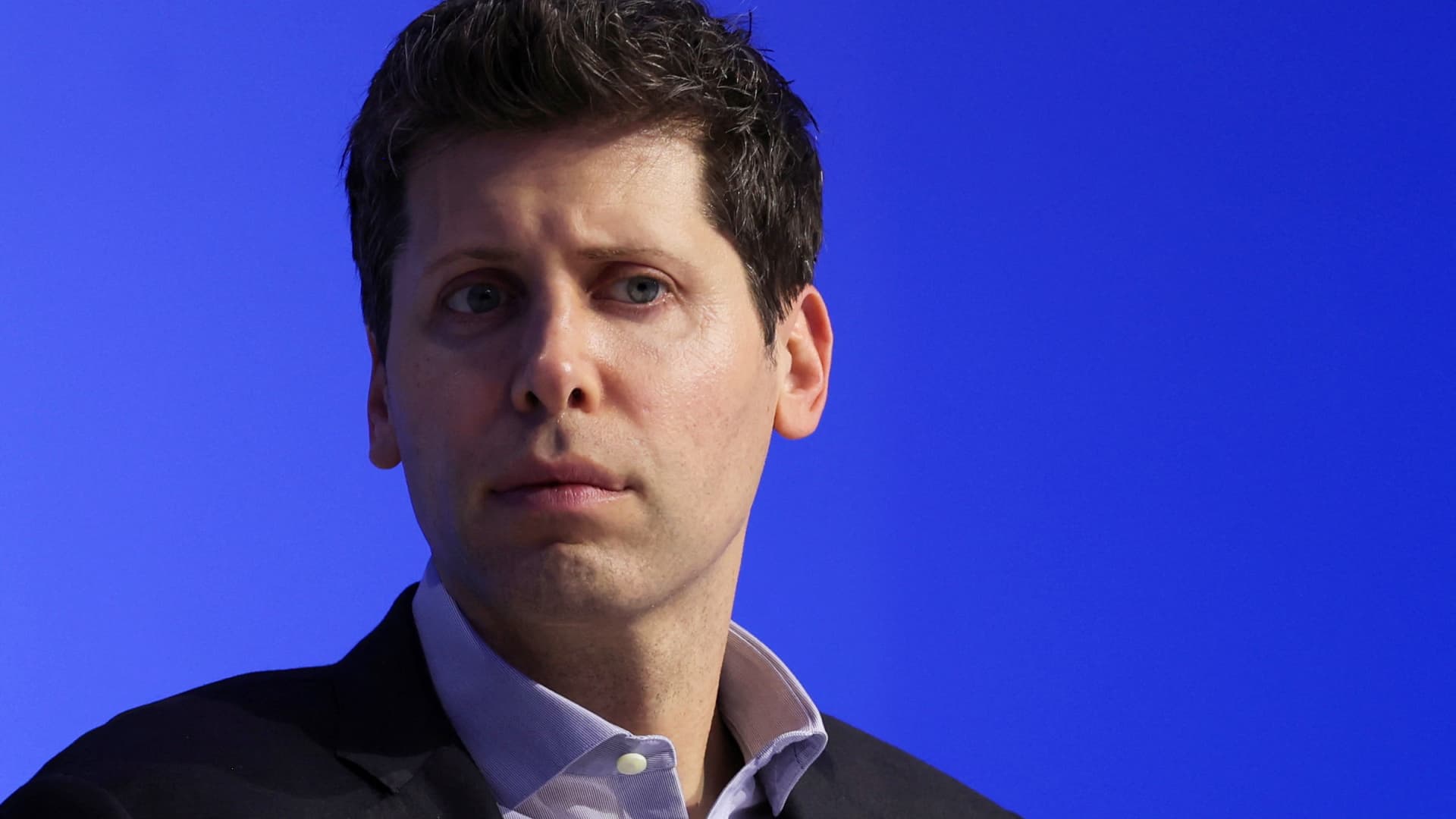
Sam Altman, CEO of OpenAI, attends the Asia-Pacific Economic Cooperation (APEC) CEO Summit in San Francisco, California, U.S. November 16, 2023.

Carlos Barria | Reuters

Former OpenAI CEO Sam Altman will be joining Microsoft to lead a new advanced AI research team, according to Microsoft CEO Satya Nadella.

Nadella said on social media platform X that Altman and former OpenAI President and Board Chair Greg Brockman, alongside other colleagues, will be joining Microsoft to lead a new advanced AI research team.

Tech giant Microsoft has invested billions of dollars in OpenAI and has a close technology partnership with the company.

“We look forward to moving quickly to provide them with the resources needed for their success,” Nadella said.

“We remain committed to our partnership with OpenAI and have confidence in our product roadmap, our ability to continue to innovate with everything we announced at Microsoft Ignite, and in continuing to support our customers and partners.”

Altman had been leading the company since 2019. OpenAI’s board announced late Friday that it was removing Altman and replacing him on an interim basis with technology chief Mira Murati. The post said that Altman “was not consistently candid in his communications with the board.”

This did not dissuade a group of OpenAI investors, who were pushing to bring Altman back as CEO over the weekend. Late Sunday night, OpenAI said it was bringing on board former Twitch CEO Emmett Shear to run the artificial intelligence company. Just hours after, Nadella announced that Altman and Brockman — who was removed from his role at chairman on Friday alongside Altman, and later quit the company altogether — would be absorbed in-house into the Microsoft team.

OpenAI, which was reportedly in talks as recently as last month to sell employee shares to investors at an $86 billion valuation, emerged as a household name this year after releasing its ChatGPT chatbot in late 2022. ChatGPT allows users to type in simple text queries and retrieve answers that can lead to more in-depth conversations.

— CNBC’s Ari Levy and Jordan Novet contributed to this report.

Continue Reading

Technology

CNBC Daily Open: Investors find cheer amid Fed’s hawkish cut

Published

on

By

CNBC Daily Open: Investors find cheer amid Fed's hawkish cut

Federal Reserve Chair Jerome Powell reacts while speaking during a press conference following the Federal Open Markets Committee meeting at the Federal Reserve on Dec. 10, 2025 in Washington, DC.

Chip Somodevilla | Getty Images

It ended up being a “hawkish cut,” as expected. Still, investors managed to find a few gifts tucked between the lumps of coal.

Even though the U.S. Federal Reserve lowered interest rates on Wednesday stateside, two regional bank presidents — Jeffrey Schmid of Kansas City and Austan Goolsbee of Chicago — wanted rates to stand pat.

Their cautioned was echoed in the Fed’s “dot plot” of rate projection, which showed officials penciling in just one cut in 2026 and another for 2027.

Even the Fed’s rate statement was repurposed from the December 2024 meeting, which ushered in a nine-month period without cuts until September this year.

Why, then, did U.S. markets rise after the meeting?

The biggest surprise was the Fed’s announcement that it would begin purchasing $40 billion in Treasury bills, starting Friday. That move increases the money supply in the economy. In other words, it’s a stealthy way to ease conditions, which helps support financial markets.

Next, Chair Jerome Powell dismissed speculation about future hikes.

“I don’t think that a rate hike … is anybody’s base case at this point,” Powell said. “I’m not hearing that.”

Fed officials also see the U.S economy as remaining resilient. Collectively, they increased their forecast for economic expansion in 2026 to 2.3% from an earlier estimate of 1.8% in September.

“We have an extraordinary economy,” said Powell.

And the markets may be setting up for an extraordinary finish to the year.

“The last interest rate decision of 2025 has essentially paved the way for a Santa Claus rally to end the year, and the S&P 500 is poised to exceed the 7,000 milestone in the next few weeks,” said José Torres, senior economist at Interactive Brokers.

For investors, that would count as a very decent Christmas surprise.

— CNBC’s Jeff Cox contributed to this report.

What you need to know today

And finally…

U.S. President Donald Trump delivers remarks on the U.S. economy and affordability at the Mount Airy Casino Resort in Mount Pocono, Pennsylvania, U.S. Dec. 9, 2025.

Jonathan Ernst | Reuters

Trump slams European leaders as ‘weak’ — just as they’re trying to impress him

U.S. President Donald Trump has once again provoked outrage among his European allies, describing them as “weak” in an interview with Politico published Tuesday. Criticizing the region’s response to the war in Ukraine, Trump said: “I think they don’t know what to do.”

That comment will be jarring for Europe after its efforts to support Ukraine — efforts which Trump has frequently downplayed. Instead, Europe has had to watch on as U.S. officials have held talks with their Russian and Ukrainian counterparts on a draft peace plan for Ukraine, without a seat at the table. 

— Holly Ellyatt

Continue Reading

Technology

Night owl bitcoin traders: Soon there’ll be an ETF just for you

Published

on

By

Night owl bitcoin traders: Soon there'll be an ETF just for you

Cheng Xin | Getty Images

A newly proposed exchange-traded fund would offer exposure to bitcoin, much like other popular ETFs tracking the world’s oldest cryptocurrency. But, there’s a twist: The fund would trade bitcoin-linked assets while Wall Street sleeps. 

The Nicholas Bitcoin and Treasuries AfterDark ETF aims to purchase bitcoin-linked financial instruments after the U.S. financial markets close, and exit those positions shortly after the U.S. market re-opens each day, according to a December 9 filing to the Securities and Exchange Commission.

The fund would not hold bitcoin directly. Instead, the AfterDark ETF would use at least 80% of the value of its assets to trade bitcoin futures contracts, bitcoin exchange-traded products and ETFs, and options on those ETFs and ETPs. 

The offering would capitalize on bitcoin’s outsized gains in off-hours trading.

Hypothetically, an investor who had been buying shares of the iShares Bitcoin Trust ETF (IBIT) when U.S. markets formally close, and selling them at the next day’s open, would have scored a 222% gain since January 2024, data from wealth manager Bespoke Investment Group shows. But an investor that had bought IBIT shares at the open and sold them at the close would have lost 40.5% in the same time.

Bitcoin was last trading at $92,320, down nearly 1% on the day. The leading cryptocurrency is down about 12% over the past month and little changed since the beginning of the year. 

The proposed ETF underscores jockeying among sponsors to launch ETFs tracking all kinds of cryptocurrencies, from altcoins like Aptos and Sui to memecoins such as Bonk and Dogecoin. The contest has only accelerated under President Donald Trump, who has pushed the SEC and Commodity Futures Trading Commission to soften their stances on token issuers and digital asset exchanges. 

Since being approved under the prior administration in January 2024, more than 30 bitcoin ETFs have begun trading in the U.S., according to data from ETF.com.

Continue Reading

Technology

Cisco’s stock closes at record for first time since dot-com peak in 2000

Published

on

By

Cisco's stock closes at record for first time since dot-com peak in 2000

Chuck Robbins, chief executive officer of Cisco, participates in a Bloomberg interview at the World Economic Forum in Davos, Switzerland, on Jan. 17, 2024.

Stefan Wermuth | Bloomberg | Getty Images

Few companies were as hot in early 2000 as Cisco, whose networking equipment served as the backbone of the internet boom.

On Wednesday, Cisco’s stock surpassed its dot-com peak for the first time. The shares rose almost 1% to $80.25, topping their prior split-adjusted record or $80.06 reached on March 27, 2000. That’s the same day that Cisco passed Microsoft to become the most valuable publicly traded company in the world.

Back then, investors saw Cisco as a way to bet on the growth of the web, as companies that wanted to get online relied upon the hardware maker’s switches and routers. But following a half-decade boom, the dot-com bubble burst just after Cisco reached its zenith, a collapse that wiped out more than three-quarters of the Nasdaq’s value by October 2002.

While the market swoon eliminated scores of internet highflyers, Cisco survived the upheaval. Eventually it started to grow and expand, diversifying through a series of acquisitions like set-top box maker Scientific- Atlanta in 2006, followed by software companies including Webex, AppDynamics, Duo and Splunk.

With its gains on Wednesday, Cisco’s market cap sits at $317 billion, making it only the 13th most valuable U.S. tech company. In recent years, the stock has badly trailed tech’s megacaps, which have been at the center of the new boom surrounding artificial intelligence.

The AI market has reached a level of euphoria that many analysts have compared to the dot-com era. Instead of Cisco, the modern infrastructure winner is Nvidia, whose AI chips are at the heart of model development and are relied up by the other major tech companies that are all building out AI-focused data centers. Nvidia has a market cap of $4.5 trillion, roughly 14 times Cisco’s current value.

But Cisco is angling to benefit from the AI craze, with CEO Chuck Robbins in November touting $1.3 billion in quarterly AI infrastructure orders from large web companies. Total revenue approached $15 billion, which was up 7.5% year over year, compared with 66% growth in 2000.

Shares of Cisco are up about 36% so far in 2025, outperforming the Nasdaq, which has gained about 22% over the same period.

WATCH: Cisco CEO on latest quarter: AI demand from hyperscalers is accelerating

Cisco CEO on latest quarter: AI demand from hyperscalers is accelerating

Continue Reading

Trending





