
Connect with us

Published

on

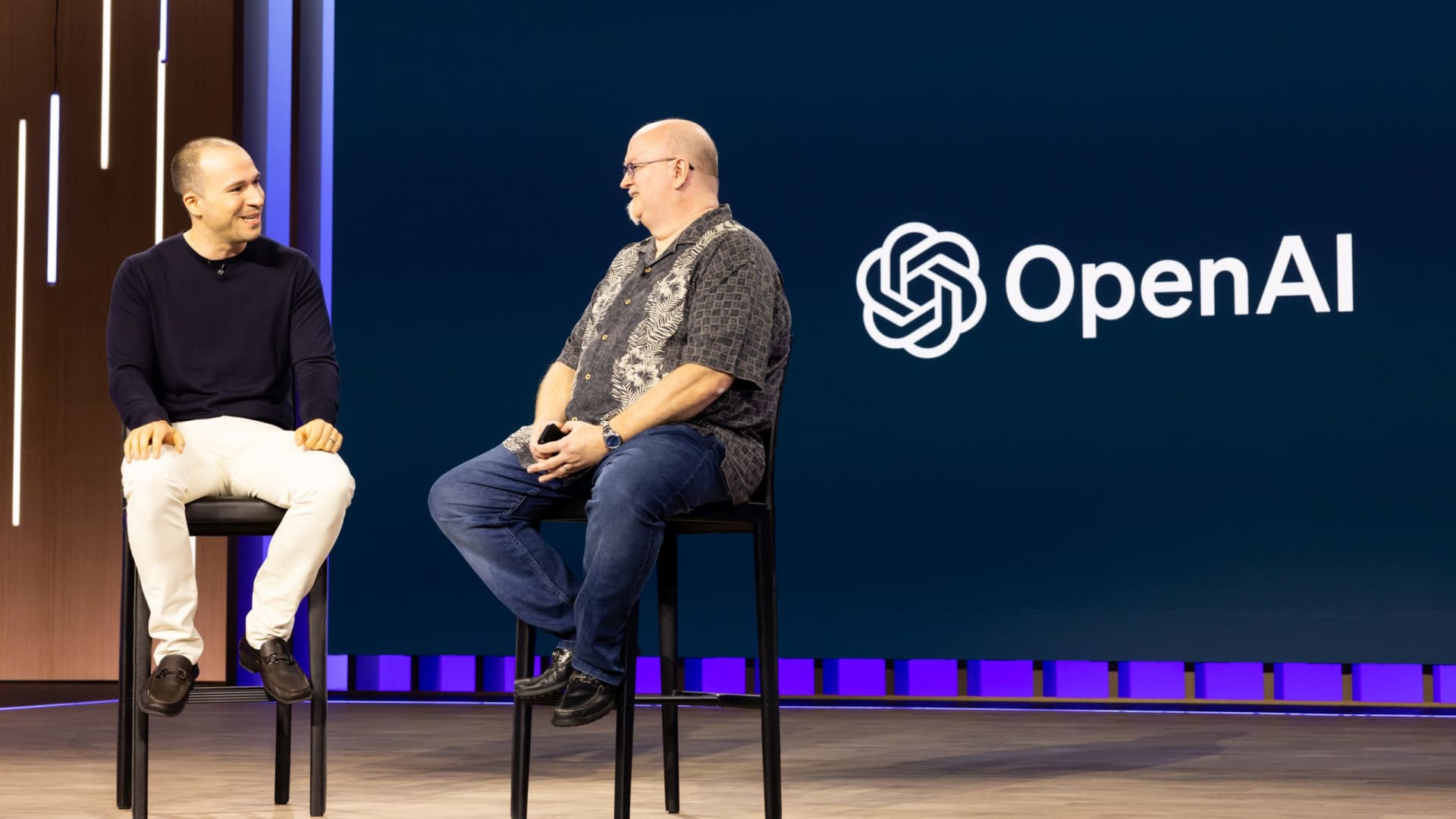
Greg Brockman, OpenAI president and co-founder, and Kevin Scott, Microsoft chief technology officer, speak onstage at Microsoft’s Build conference in Seattle on May 23, 2023.

Dan DeLong | Microsoft

Microsoft CTO Kevin Scott on Tuesday offered to match compensation for the hundreds of employees at OpenAI who are threatening to resign following Sam Altman’s sudden ouster as CEO.

“To my partners at OpenAI: We have seen your petition and appreciate your desire potentially to join Sam Altman at Microsoft’s new AI Research Lab,” Scott said Tuesday in a post on X, formerly known as Twitter. “Know that if needed, you have a role at Microsoft that matches your compensation and advances our collective mission.”

It is not immediately known if the offer is contingent on Altman’s employment at Microsoft. Scott did not respond to CNBC’s request for comment on X. But, the comment gives some clarity to what Microsoft is willing to pay employees and how many it would hire.

The future of OpenAI is still uncertain and it remains unclear where Altman will work.

Early Monday morning, Microsoft CEO Satya Nadella said that Altman, Greg Brockman, who resigned as OpenAI’s president, and their colleagues would join Microsoft as part of a new AI research group. More than 600 OpenAI employees then signed a letter to the company’s board and threatened to join their former boss at Microsoft unless the members resigned.

In his first press interview since Altman’s ouster, Microsoft CEO Satya Nadella told CNBC on Monday, “At this point, I think it’s very clear that something has to change around the governance” at OpenAI. Nadella did not say for certain during the interview that Altman and Brockman were joining Microsoft, showing the situation had changed from statements made earlier in the day.

“We chose to explicitly partner with OpenAI, and we want to continue to do so,” Nadella told CNBC. “Obviously that depends on the people of OpenAI staying there or coming to Microsoft. So I’m open to both options, but one thing I will not do is stop innovating.”

OpenAI’s board fired Altman Friday after determining he was “not consistently candid in his communications” with them, according to a statement. After a long weekend of negotiations that looked to possibly reinstate Altman at the company, ex-Twitch CEO Emmett Shear announced he had been appointed interim head.

OpenAI’s board is now made up of just four people: OpenAI’s chief scientist Ilya Sutskever — who signed the letter threatening to leave — Adam D’Angelo, Tasha McCauley and Helen Toner. They have not elaborated on the reasoning behind Altman’s ouster. Sutskever expressed deep “regret” for his participation in the board’s decision in a post on X Monday.

–CNBC’s Jordan Novet contributed to this report.

Continue Reading

Technology

China’s AI wearables market is already booming: From the practical to peculiar

Published

on

By

China's AI wearables market is already booming: From the practical to peculiar

China Lens: Beijing betting big on AI devices

China’s artificial intelligence device market is already booming, and in the advanced technology race against the U.S., the country’s expertise in hardware could give it an edge.

“The advantage comes from the fundamental root that China is a nation of manufacturing,” Dr. Kai-Fu Lee, CEO of 01.AI and chairman of Sinovation Ventures, told CNBC. “Today, the competition is on the software, the models, the agents, the applications. But soon it will move to devices.”

Meta has sold millions of its smart glasses since introducing the specs in 2023, and the Chinese have caught on, with more than 70 Chinese companies creating competing products in the space.

Eyewear from companies such as Inmo and Rokid are sold worldwide. Xiaomi and Alibaba‘s are found only in China and are embedded with the tech giants’ own AI.

Alibaba’s DingTalk, a messaging platform for the workplace, this year released a credit card-sized AI gizmo meant for note-taking on the job.

The DingTalk A1 can record, transcribe, summarize and analyze speech from as far as 8 meters (26 feet) away, about the length of a large boardroom.

The device is similar to the Plaud Note, which is available in the U.S.

The device experimentation in China spans from the practical to the unconventional.

Chinese startup Le Le Gaoshang Education Technology released a “Native Language Star” brand translating gadget aimed at Chinese parents with limited English to teach English to their own children.

Read more CNBC tech news

The contraption, which is looped around the back of a user’s neck like a travel neck pillow and comes down toward the chest, has a sort of muzzle unit that goes over the mouth and mutes the user’s own voice.

The unit is embedded with Tencent and iFlyTek AI and is billed as a way to turn an English-speaking Chinese parent into a “laowai,” or foreigner. It retails for $420.

Having so many hardware touchpoints helps with adoption and with getting people used to the technology. It’s also a boost for companies to gather a war chest of data compared to other countries, analysts say.

“When you still hear people outside of China talking about what the future of the AI device might be, the market is full of AI devices here already,” tech consultant Tom van Dillen of Greenkern said at his office in Beijing. “This creates this feedback loop again to make the AI even better.”

Yet an edge in hardware is far from a guarantee to win the AI race, especially if China’s AI lacks appeal with global customers due to privacy or other issues, or if it falls well behind its counterparts in the U.S. or elsewhere.

“You really have to be that Apple iPhone to reap the most of the reward,” Lee cautioned, referencing late entrepreneur Steve Jobs’ invention that is often seen as one of the most transformative consumer products ever. “I think the China advantage for building the Apple iPhone for the AI age is that the capabilities are there — engineers and entrepreneurs, and so on. But it will still be a race.”

U.S. Commerce Department to allow exports of Nvidia H200 chips to China

Continue Reading

Technology

Trump greenlights Nvidia H200 AI chip sales to China if U.S. gets 25% cut, says Xi responded positively

Published

on

By

Trump greenlights Nvidia H200 AI chip sales to China if U.S. gets 25% cut, says Xi responded positively

Pres. Trump: Will allow Nvidia to ship H200 products to approved customers in China, U.S. to get 25%

President Donald Trump on Monday said Nvidia will be allowed to ship its H200 artificial intelligence chips to “approved customers” in China and elsewhere, on the condition that the U.S. gets a 25% cut.

Chinese President Xi Jinping “responded positively” to the proposal, Trump wrote in a Truth Social post.

The policy “will support American Jobs, strengthen U.S. Manufacturing, and benefit American Taxpayers,” Trump wrote.

“The Department of Commerce is finalizing the details, and the same approach will apply to AMD, Intel, and other GREAT American Companies,” he added in the post.

Both Nvidia and chip rival AMD, short for Advanced Micro Devices, agreed in August to share 15% of the revenue from China chip sales with the U.S. government. But around that same time, China reportedly warned companies against using the H20 AI chip that Nvidia designed especially for the country.

The H200 is a higher-grade chip than the H20, but not the company’s top-of-the-line product.

Nvidia shares climbed earlier Monday on news that the Commerce Department was set to approve the China sales, but later pared those gains. The stock rose about 2% after hours.

Stock Chart IconStock chart icon

hide content

Nvidia (NVDA) and Advanced Micro Devices (AMD) stock prices

“We applaud President Trump’s decision to allow America’s chip industry to compete to support high paying jobs and manufacturing in America,” a spokesman from Nvidia told CNBC in a statement.

“Offering H200 to approved commercial customers, vetted by the Department of Commerce, strikes a thoughtful balance that is great for America,” the spokesman said.

Semiconductors, which are key components in nearly every category of electronics, are at the center of the AI race between the U.S. and China.

They have also played a role in the tumultuous trade relationship between the two economic superpowers.

Read more CNBC tech news

When Beijing imposed export controls on rare-earth minerals, which are used in the production of some high-end chips, the Trump administration threatened to massively increase tariffs on U.S. imports from China.

After meeting in South Korea in late October, Trump and Xi struck a tentative trade truce in which China committed to end “retaliation” against U.S. chipmakers, according to the White House.

Trump said after that meeting that he discussed the export of Nvidia chips with Xi.

CNBC’s Kristina Partsinevelos and Kif Leswing contributed to this report.

Continue Reading

Technology

Broadcom is firing on all cylinders, and Wall Street can’t get enough of the stock

Published

on

By

Broadcom is firing on all cylinders, and Wall Street can't get enough of the stock

Continue Reading

Trending





