
How Meta could benefit from the OpenAI shakeup

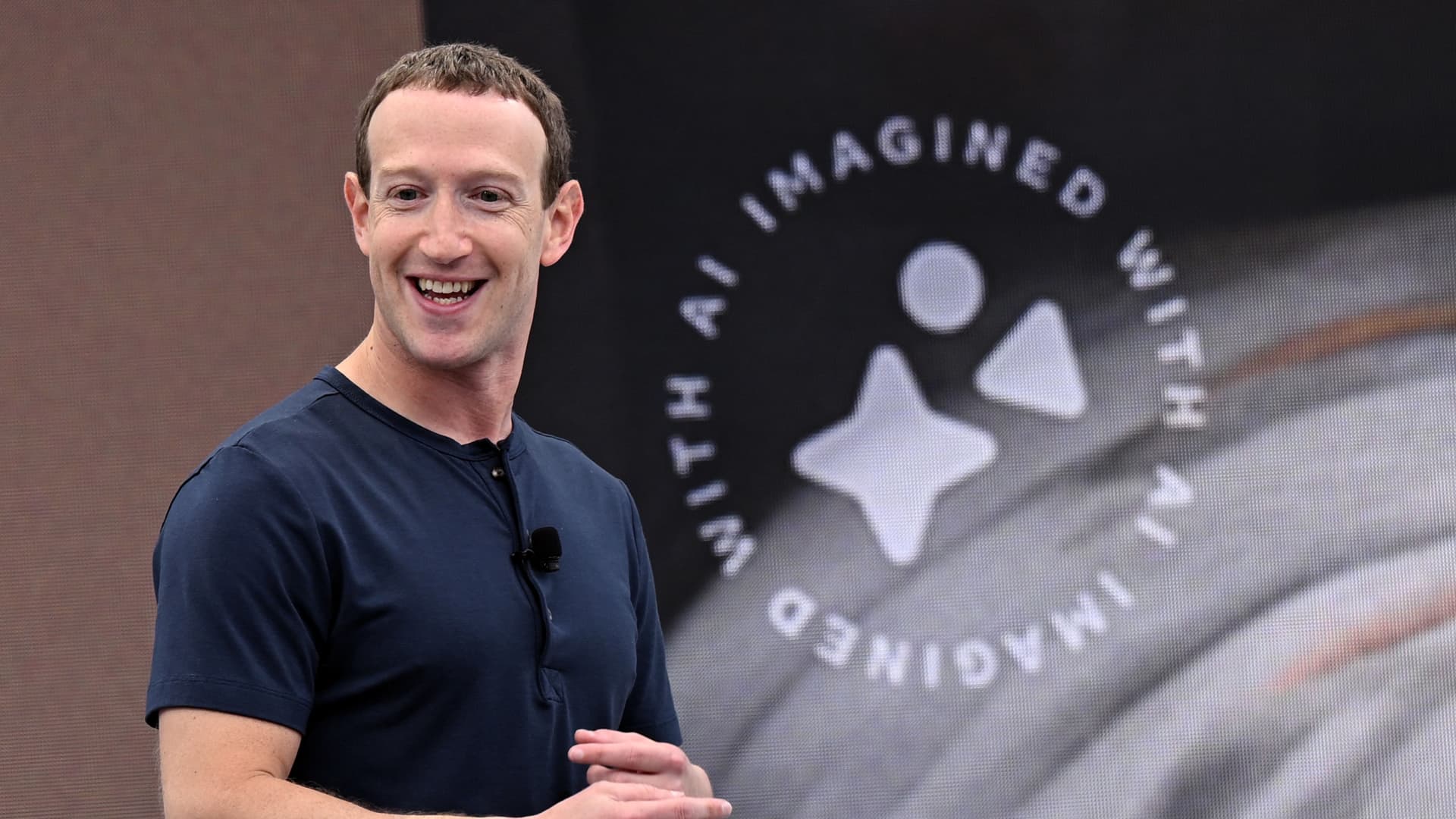
Meta founder and CEO Mark Zuckerberg speaks during Meta Connect event at Meta headquarters in Menlo Park, California on September 27, 2023.
Josh Edelson | AFP | Getty Images
Meta CEO Mark Zuckerberg may not have been directly involved with the drama surrounding Sam Altman’s tumultuous departure from, then return to, OpenAI, but the social networking executive and his company could benefit from the drama.
There’s been much debate over the “winners” of the OpenAI executive saga, with some experts believing Microsoft and its CEO Satya Nadella proved victorious while the OpenAI board members who kicked off the debacle by firing Altman last Friday were the losers.
Microsoft, OpenAI’s largest financial backer, has been positioning the high-profile startup as a cornerstone cloud computing partner, promoting Altman and his team throughout the year at numerous events. It created a public association between itself and the high-flying maker of ChatGPT. But that backfired somewhat when critics questioned how the boardroom shenanigans could have escaped Nadella and his company’s watch.
Meanwhile, Meta and Zuckerberg had the luxury of watching the corporate circus from the sidelines. It could help Meta boost its open-source Llama AI initiatives, as some companies look to diversify away from relying on a single company’s large language model. And it may even help with recruiting.
Meta continues to invest heavily in the kinds of generative AI and related large language models that helped spawn OpenAI’s ChatGPT. Its AI research team is considered, with Alphabet’s DeepMind, one of the most esteemed groups in the tech industry.
Technologists looking to work in the private sector may find comfort in stability at Meta and its AI research lab following the seemingly near collapse of one of the industry’s leading AI startups.
As one user on Meta’s Twitter-like Threads service posted on Wednesday: “Everyone is saying MSFT is the big winner of [the] OpenAI fiasco. But I can easily see META being the big winner in the end.”
“If you’re an AI researcher and you’re going to work at big tech, it might as well be the company with the largest open source and public research presence,” the user said in the Threads post.
Yann LeCun, Meta’s AI chief, responded to the post with a curt “Yup.”
Then there are the potential business opportunities.
The OpenAI fiasco raised concerns among the startup’s customers and other corporate leaders about whether they should only rely on one kind of LLM as part of their AI business strategies. Multiple technologists told CNBC that the OpenAI ordeal jumpstarted a push from businesses to lessen their reliance on OpenAI’s GPT family of LLMs to incorporate others from startups like Anthropic and Cohere.
Meta could benefit if companies continue to seek multiple AI vendors, much like firms now rely on multiple cloud providers. The company has heavily touted its Llama-branded family of generative AI software, which is available for free via an open-source model. Llama is attractive because developers can access and customize the LLM to their specific needs without being tethered to a particular vendor.
The more developers access and improve Llama, the more Meta can potentially lower its overall operating and technology research costs, among other benefits.
Finally, despite Llama’s licensing concerns and other potential issues, more companies and developers may choose to build apps with Meta’s AI software without fear that the social networking giant could collapse in a matter of days.


Oracle CEOs Clay Magouyrk and Mike Sicilia sit down with CNBC’s David Faber on Oct. 13, 2025.
CNBC
It’s been a rollercoaster year for Oracle investors, as they try to assess the strength of the software giant’s position in the artificial intelligence boom.
The stock is up more than 30% for the year even after a 23% plunge in October, which was its worst month since 2001. It’s recovered a bit in November, climbing almost 10% for the month as of Tuesday.
Heading into the company’s fiscal second-quarter earnings report on Wednesday, pressure is building on management — and newly installed CEOs Clay Magouyrk and Mike Sicilia — to show that Oracle can continue to finance the company’s aggressive infrastructure plans while simultaneously convincing Wall Street that the AI-fueled hypergrowth story remains intact.
In recent months, Oracle has emerged as a more central player in AI, largely due to a $300 billion deal with OpenAI, which came to light in September, an agreement that involves the AI startup buying computing power over about five years, starting in 2027.
Funding Oracle’s compute buildout is going to require mounds of debt. In late September, Oracle raised $18 billion in a jumbo bond sale, one of the largest debt issuances on record in the tech industry, and the company is now the biggest issuer of investment grade debt among non-financial firms, according to Citi.
“There is something inherently uncomfortable as a credit investor about the transformation of the sort we’re facing that is going to require an enormous amount of capital,” Daniel Sorid, head of U.S. investment grade credit strategy at Citi, said on a video call to investors on Friday, a replay of which was provided to reporters.
Oracle has secured billions of dollars of construction loans through a consortium of banks tied to data centers in New Mexico and Wisconsin. Citi analyst Tyler Radke estimates Oracle will raise roughly $20 billion to $30 billion in debt every year for the next three years.
As of August, the company’s combined short-term and long-term debt, which includes lease obligations, sat at $111.6 billion, up from $84.5 billion a year earlier, according to FactSet, while cash and equivalents slipped over that stretch to $10.45 billion from $10.6 billion.
As Oracle aims to build out sufficient capacity to meet the rising demand its seeing from customers like OpenAI, the street is questioning whether company will tap sources other than the debt market.
“Oracle will be looking at all options out there — off-balance sheet facilities, raising debt, issuing equity or perhaps exploring interest from a foreign investor, i.e. a sovereign wealth fund,” said Rishi Jaluria, a software analyst at RBC Capital Markets, in an interview. Jaluria recommends holding the stock.
A credit investor who spoke to CNBC highlighted Meta’s $27 billion deal with Blue Owl Capital, a joint venture between the two entities, as one type of financing arrangement being used for AI data center development.
The market is also debating whether Oracle can use vendor financing options to reduce the amount of upfront capital required to stand up data centers, including securing favorable financing terms with suppliers like Nvidia, a credit investor told CNBC. However in that scenario, Nvidia’s chips would be used as collateral, raisings concerns around GPU depreciation.
An Oracle spokesperson declined to comment.
Growing skepticism
The discomfort that Sorid referenced has driven Oracle’s 5-year credit default swaps to new multi-year highs. Credit default swaps are like insurance for investors, with buyers paying for protection in case the borrower can’t repay its debt. Bond investors told CNBC that they’ve become a popular way to hedge the risk tied to the AI trade.
Credit analysts at Barclays and Morgan Stanley are recommending clients buy Oracle’s 5-year CDS. Andrew Keches, an analyst at Barclays, told analysts in a note last month that he didn’t see an avenue for Oracle’s credit trajectory to improve. And in late November, Morgan Stanley analysts said Oracle’s CDS had attracted not just typical credit investors but “tourists” who have less experience with this type of financial instrument.
Spools of electrical wires outside a series of assembly tents during a media tour of the Stargate AI data center in Abilene, Texas, US, on Tuesday, Sept. 23, 2025. Stargate is a collaboration of OpenAI, Oracle and SoftBank, with promotional support from President Donald Trump, to build data centers and other infrastructure for artificial intelligence throughout the US.
Kyle Grillot | Bloomberg | Getty Images
Oracle’s revenue growth and backlog of business will be closely monitored as investors try to gauge whether the company’s spending plans are justified. Analysts expect to see revenue growth in the latest quarter of 15% to $16.2 billion, according to StreetAccount.
Remaining performance obligations, a measure of contracted revenue that hasn’t yet been recognized, are expected to surpass $500 billion, StreetAccount says, which would mark a more than fivefold increase from a year earlier. Oracle’s disclosure in September that RPOs jumped 359% to $455 billion sent the company’s stock up 36%, its best single-day performance since 1992.
Since then, the stock has wiped out all of those gains and then some.
Gil Luria, an analyst at D.A. Davidson, said that beyond infrastructure, he’ll be closely watching Oracle’s core database business, which is a source of much higher margins. That will help determine how much flexibility the company has in going to the capital markets, he said.
“Oracle can handle the debt load,” said Luria, who recommends holding the stock. “But they need more cash flow to raise more capital from here.”

Technology
Teachers’ union AFT slams crypto market bill, warns of ‘profound risks’ for America’s retirement plans


The American Federation of Teachers, the powerful labor union that represents 1.8 million members, is urging the Senate Banking Committee to reconsider its crypto market structure bill, the Responsible Financial Innovation Act, calling the proposed legislation “as irresponsible as it is reckless” in a letter exclusively obtained by CNBC.
In the letter that AFT president Randi Weingarten sent to Senate Banking Committee Chairman Tim Scott (R-SC) and Ranking Member Elizabeth Warren (D-Mass.), she wrote the union opposes the bill based on the “profound risks to the pensions of working families and the overall stability of the economy.”
“The legislation on crypto we have seen weighed by the committee over the last few months gives us deep concern,” Weingarten added.
The AFT is concerned that in passing crypto legislation, the government will open the floodgates to widespread fraud and unethical practices across retirement plans including AFT pensions.
“This legislation pretends that crypto assets are stable and mainstream, and they are not. Rather than just being silent on crypto, this bill strips the few safeguards that exist for crypto and erodes many protections for traditional securities. If passed, it will undercut the safety of many assets and cause problems across retirement investments,” Weingarten wrote.
A specific issue the AFT cited with the proposed legislation it allowing non-crypto companies to put their stock on the blockchain and evade existing securities regulatory framework. Wall Street has become interested in the idea of “tokenization” of all financial assets, with Larry Fink, CEO of BlackRock, the largest asset manager in the world, a leader evangelist for the concept.
“This loophole and the erosion of traditional securities law will have disastrous consequences: Pensions and 401(k) plans will end up having unsafe assets even if they were invested in traditional securities,” Weingarten wrote.
She argued that the legislation being considered by the committee also does little to curb fraud, illegal activity and corruption that continues to be prevalent in crypto markets. Weingarten called the legislation “irresponsible” and “reckless.”
“We believe that if enacted, this bill has the potential to lay the groundwork for the next financial crisis,” she wrote.
NEW YORK, NEW YORK – AUGUST 28: Randi Weingarten, president of the American Federation of Teachers (AFT), speaks during the March on Wall Street on August 28, 2025 in New York City.
Michael M. Santiago | Getty Images News | Getty Images
The AFL-CIO, the nation’s largest labor union, stated its opposition to the Senate Banking Committee over a draft of the crypto bill in October.
CNBC also confirmed that on Thursday, the CEOs of Bank of America, Citi and Wells Fargo, will be meeting with lawmakers to discuss the crypto market structure proposals.
The currently proposed legislation, which builds on a bill that passed the House of Representatives over the summer, is co-sponsored by key crypto backer Senator Cynthia Lummis (R-Wyoming) and Senator Bernie Moreno (R-Ohio), alongside Chairman Scott. It aims to create structure for regulating digital assets, but also raises questions about tokenized securities that are not specifically cryptocurrencies.
Tokenization has been a key concern as the bill has gained momentum on Capitol Hill, and a hurdle to getting the support from Democrats that will be needed for passage. Previous CNBC reporting indicates that the Senate backers will need to attract votes from at least seven Democrats for the legislation to pass. At last week’s CNBC CFO Council Summit in Washington, D.C., Senator Mark Warner (D-Va.) told attendees, “I’m in crypto hell at this moment trying to get the market structure bill done.”
Warner is among a group of Democratic senators who met on Monday to review the Senate Banking draft and consider counter-offers, according to Politico.
Many Democrats, including Warren, have also been concerned about the balance of crypto regulatory oversight between the CFTC and the Securities and Exchange Commission. States, meanwhile, worry that their laws may be preempted by a new federal law, and the states left powerless to protect residents from fraud, a concern outlined by Massachusetts’ Secretary of State William Galvin in a letter to Senate Banking, writing that the “sweeping provisions that will exclude significant portions of the financial industry from state oversight. This is a recipe for disaster for millions of savers.”
Progress on the Senate’s version of a crypto market structure bill was stalled for weeks due to the longest government shutdown in U.S. history. Speaking on Tuesday morning at The Blockchain Association Policy Summit in Washington, D.C., Senator Lummis provided some insight into when the Senate’s version of a crypto market structure bill could be expected. She said her goal is to share a draft by the end of the week, then let the crypto industry as well as Republicans and Democrats vet it and proceed to markup next week.


Slack CEO Denise Dresser during TechCrunch Disrupt in San Francisco, Oct. 29, 2024.
David Paul Morris | Bloomberg | Getty Images
OpenAI on Tuesday announced that it’s tapped Slack CEO Denise Dresser as its new chief revenue officer.
Dresser will oversee the artificial intelligence startup’s global revenue strategy across both customer success and enterprise, OpenAI said in a release.
After spending more than a decade as an executive at Salesforce, Dresser was named Slack’s chief executive in 2023. Salesforce acquired the messaging company for more than $27 billion in 2020.
“I’ve spent my career helping scale category-defining platforms, and I’m looking forward to bringing that experience to OpenAI as it enters its next phase of enterprise transformation,” Dresser said in a statement.
OpenAI kickstarted the generative AI boom with the launch of its chatbot ChatGPT three years ago, and it’s quickly ballooned into one of the fastest-growing commercial entities on the planet.
The startup said in November that it is on track to reach more than $20 billion in annualized revenue run rate this year, with plans to grow to hundreds of billions in sales by 2030.
But as competition heats up from rivals like Google and Anthropic, OpenAI is facing pressure to deliver. The company has made more $1.4 trillion in infrastructure commitments as it works to scale up its technology, and the immense sum has raised eyebrows and sparked concerns about a potential AI bubble.
More than 800 million people use ChatGPT every week, and OpenAI supports more than 1 million business customers.
Dresser will help more companies integrate AI into their daily operations, OpenAI said.
“We’re on a path to put AI tools into the hands of millions of workers, across every industry,” Fidji Simo, OpenAI’s CEO of Applications said in a statement. “Denise has led that kind of shift before, and her experience will help us make AI useful, reliable, and accessible for businesses everywhere.”
WATCH: Sam Altman hits reset at OpenAI, pausing side bets to defend ChatGPT’s AI lead
-
 Sports2 years ago
Story injured on diving stop, exits Red Sox game
-
 Sports3 years ago
‘Storybook stuff’: Inside the night Bryce Harper sent the Phillies to the World Series
-
 Sports2 years ago
Game 1 of WS least-watched in recorded history
-
 Sports3 years ago
Button battles heat exhaustion in NASCAR debut
-
 Sports3 years ago
MLB Rank 2023: Ranking baseball’s top 100 players
-
Sports4 years ago
Team Europe easily wins 4th straight Laver Cup
-
 Environment3 years ago
Japan and South Korea have a lot at stake in a free and open South China Sea
-
 Environment1 year ago
Here are the best electric bikes you can buy at every price level in October 2024