

ETaker’s M2000 Power Station is lighter, quieter, and more versatile than its competitors

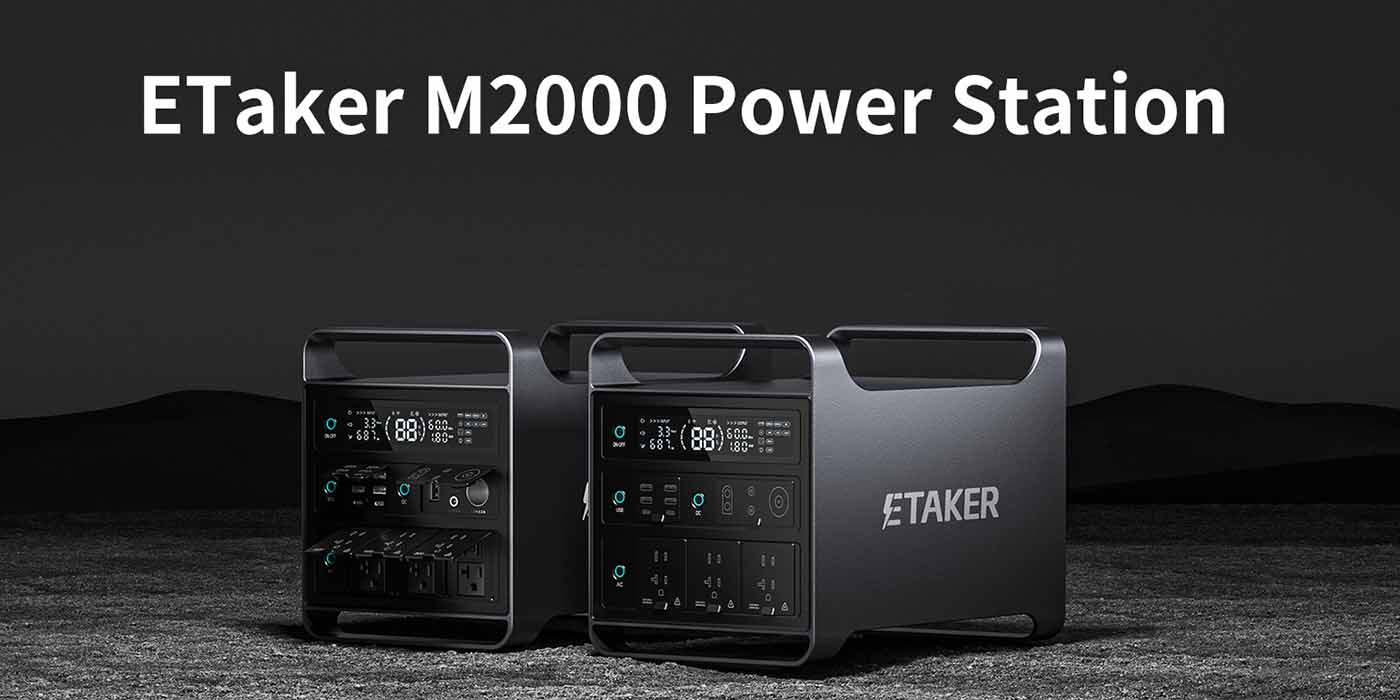
Renewable energy solutions specialist ETaker has introduced its new M2000 Power Station – a modular, versatile portable energy provider that uses cutting edge technology like semi-solid-state batteries and Gallium Nitride to deliver all your power needs more efficiently. For a limited time you can get the M2000 Power Station for early bird launch price of $1099 before it increases to its $2199 retail price. Head below for a closer look.
Table of contents
ETaker joins the market with a winning flagship product
ETaker may be a new name on the portable power station scene, but the company is deeply rooted in green technologies, particularly solar energy.
To date, the ETaker has achieved 45 invention patents and 25 design patents, earning 13 different accolades around the globe, including a prestigious 2023 Red Dot Design Award, as well as an International Design Excellence award.
The company was built upon the goal of providing the world with more renewable energy solutions to help alleviate the dependency on traditional power sources, like local grids.
To achieve this goal, ETaker has researched and developed cutting-edge industry technologies to not only deliver leading system performance, but also expand renewable energy usage throughout the green community.
Much of that technology is on display in ETaker’s flagship power station, the M2000. Complete with quiet, durable, and energy dense technology, this renewable energy solution is designed for support anywhere and everywhere – from power on the go, to home backup storage, and beyond.
Introducing the M2000 Power Station from ETaker
The M2000 recently made its debut as ETaker’s first energy storage product and the company came out swinging with this one. It’s smaller, lighter, and more versatile than many of the competitors it will go up against in the marker and ETaker has accessories in the pipeline to further set itself apart in providing renewable energy solutions.
For example, ETaker states it is the first company to use GaN (Gallium Nitride) in a solar generator. GaN is a new semiconductor material that offers several advantages over traditional silicon materials, offering better efficiency at higher power and frequencies, all in a smaller footprint.
The result is up to 96% inverting efficiency and 50% less heat dissipation in a power station that is 30% smaller, yet even more powerful. That power comes from a second key factor in the M2000’s performance – ETaker’s semi-solid-state lithium-ion batteries.
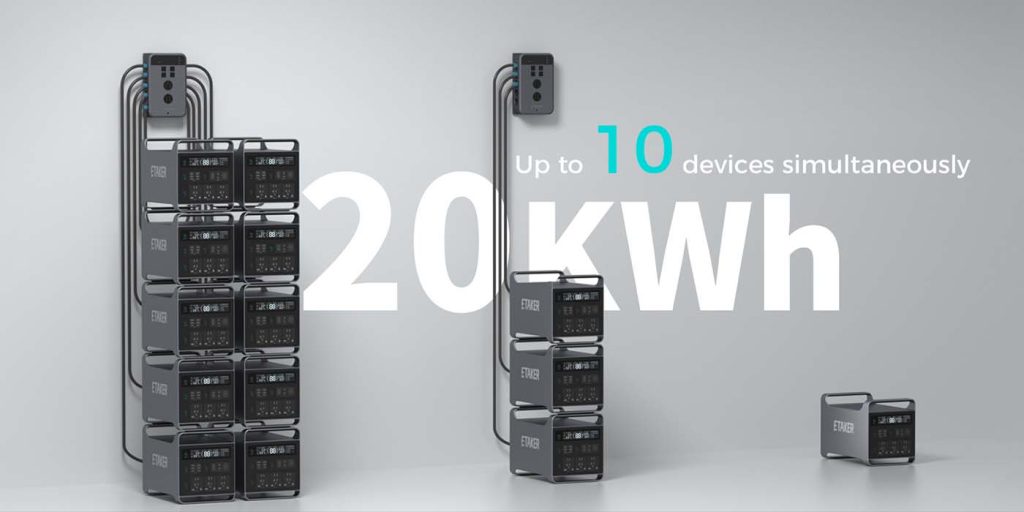
Each power station delivers 2 kWh of energy storage, with the modular capability to combine up to ten units for a whopping 20 kWh. At dimensions of 11.22 x 8.5 x 4 inches (25.8 x 21.6 x 35.5 cm) and a total weight of 37.5 pounds (17 kg) this power station offers the same capacity as many of its competitors, but in a smaller, lighter, and more energy dense (30-50% higher) package.
As a result, ETaker has declared the M2000 as the smallest and lightest 2 kWh power station in the world. There’s plenty more to unfold here, so let’s dig into the M2000’s specs.
Performance specs
In addition to combining 10 units for 20 kWh of power capacity, the M2000 can also deliver up to 16 kWh of AC power output. Furthermore, its simultaneous usage functions and support of 120V and 240V devices meets nearly all portable power needs in any scenario – whether its powering a home office off the grid, or providing home backup power during a weather emergency. Here’s all the plugs available:
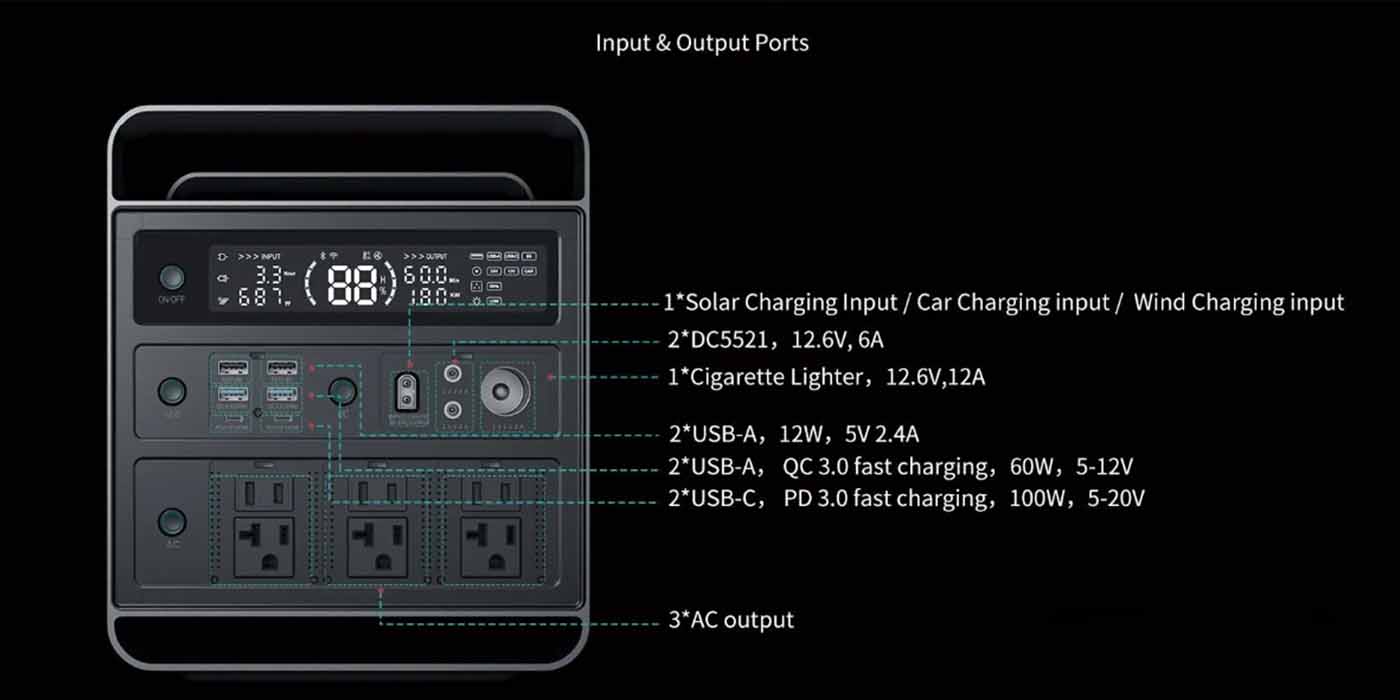
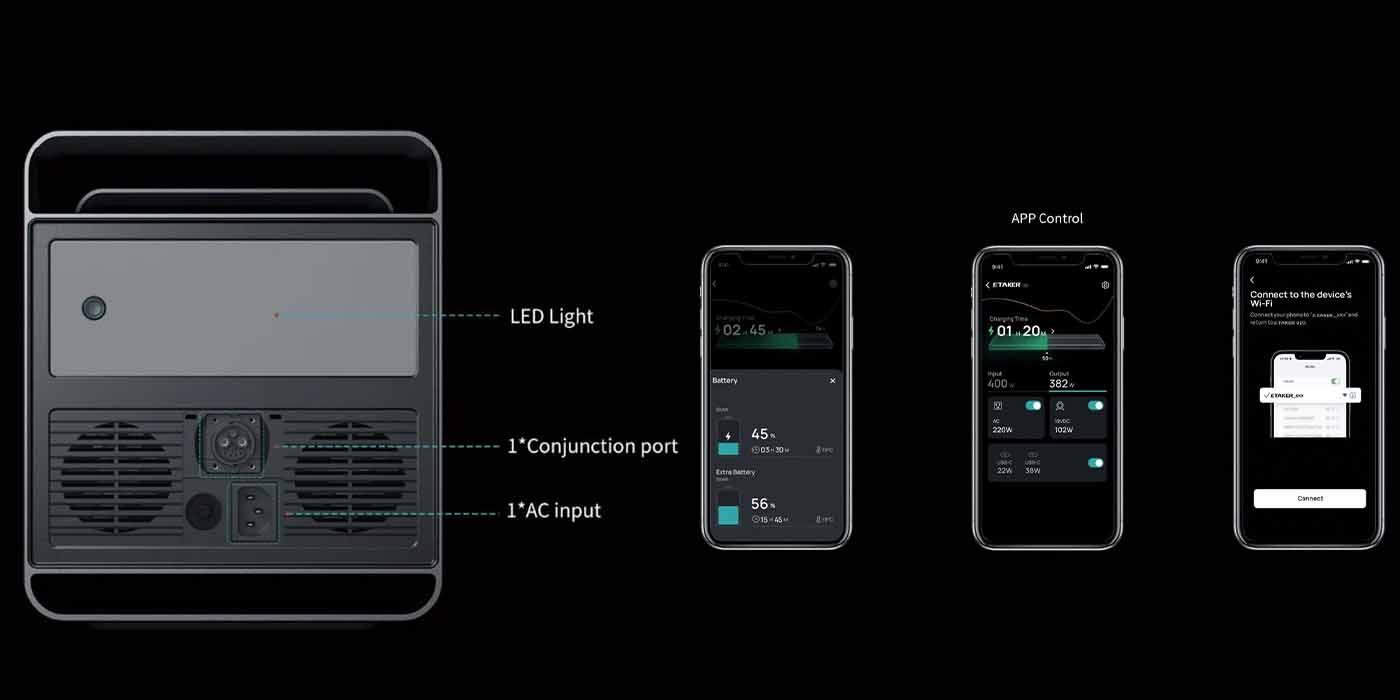
With an interface complete with various inputs and dependable power to boot, the M2000 supports EV charging up to 500W and photovoltaic fast charging up to 1kW, meaning whether your gas car needs a jump, or your EV needs a top off, this power station has you covered. Trying to charge at night? No problem, the system doubles as an emergency light to illuminate your surroundings.
Thanks to its lighter weight, it is also much easier for a single person to transport and deploy a number of ETaker power stations in a given situation, compared to conventional large-scale power solutions – especially when getting the power back on is of the essence.
While the M2000’s GaN technology already offers lower heat generation, ETaker’s power station is further cooled by fans and a body made from six-series alloy material (the highest grade available to civilians) that passively helps cool the device.
Even when temperatures drop, the ETaker Power Station can continue to function as normal, charging and discharging in conditions as low as -22℉. Such exterior protection also provides the M2000 with an IP63 resistance rating from water and dust that can better withstand damage due to bumps or falls.
In addition to being extra durable, the M2000’s exterior shell and GaN technology provide less working noise – 60% lower than similar products according to ETaker. The company states the M2000 will operate at nearly 0 decibels when the power station is working within 1,000-watts. Even at higher power levels, noise remains 50% lower than its competitors – ideal for RVs and enclosed spaces where noise pollution is a concern. Here are some additional specs:
- Capacity: 2,008Wh
- Max Expansion Capacity: 12,048Wh
- Total AC Output: 2000-watts (4,000W Surge)
- Total Output (AC + DC): 2,400W
- DC Outputs:
- USB-C: 2x 100W (5-20V)
- USB-A: 2x 12W (5V, 2.4A) and 2x 60W (5-12V)
- Car Power
- Wireless Charger
- AC Output:
- 3x AC plugs
Renewables are a key feature in the M2000’s versatility
Alright, we’ve saved the best for last. You’ve seen the advanced technologies that went into the M2000 from ETaker, plus its modularity and performance perks, but what about its charging capabilities?
Accepting AC, car, and even solar charging has become pretty standard across power stations these days, but ETaker’s M2000 can also replenish itself using wind. Combining AC power with wind or solar, the M2000 Power Station can recharge to 100% in just 1.5 hours. Here’s how all the recharging inputs break down:
- AC Charging:
- Max 1,200W input
- 1 hour to charge to 60-80%
- 2 hours to charge to 100%
- Solar Charging:
- Max 1,000W input
- 2.5 hours to charge to 100% (using solar panel with voltage between 20-50V)
- Wind Charging:
- Max 1,000W input
- 2.5 hours to charge to 100% (requires ETaker Wind Turbine which will launch soon)
- Car Charging:
- 100-300W input
- 7-20 hours to charge to 100%
- EV Charging:
- Max 1,200W input
- 1 hour to charge to 60-80%
- 2 hours to charge to 100%

ETaker M2000 Power Station pricing and availability
Interested in trying out ETaker’s M2000 Power Station for yourself?
Be one of the early adopters by pledging to its Kickstarter campaign, running now through December 23, 2023. $1,099 currently gets you one of the 100 first M2000s – that’s 50% off retail price.
A number of add-ons and bundles that include ETaker’s solar panels are also available.
Products are expected to be delivered in December 2023 or January 2024, depending on which package you select. Learn more here and be sure to take advantage of early pricing for this promising young power station developer.
FTC: We use income earning auto affiliate links. More.
Environment
Archer Aviation is planning an air taxi network around the Miami metro area including airports


Archer Aviation has announced partnerships in the Miami metropolitan area to establish a new air taxi network to support travelers around several key areas in Southern Florida, including local airports.
As you probably alrready know at this point. Archer Aviation ($ACHR) is a California-based developer of eVTOL and eCTOL aircraft that it continues to work toward implementing into commercial air taxi rides in the future. The plans for its network of sustainable aircraft have expanded to cities like New York and Chicago, as well as other countries like Japan and the United Arab Emirates.
In California, south of its headquarters, Archer intends to take to the skies above Los Angeles with a proposed air taxi network announced in August 2024. Building upon that network, Archer shared earlier this year that it had become the exclusive air taxi provider of the 2028 Olympic Games in Los Angeles.
On the other southern coast of the United States, Archer is planning another exciting air taxi network that includes the option of quiet, sustainable air travel around Miami, Fort Lauderdale, and several other key landmarks.
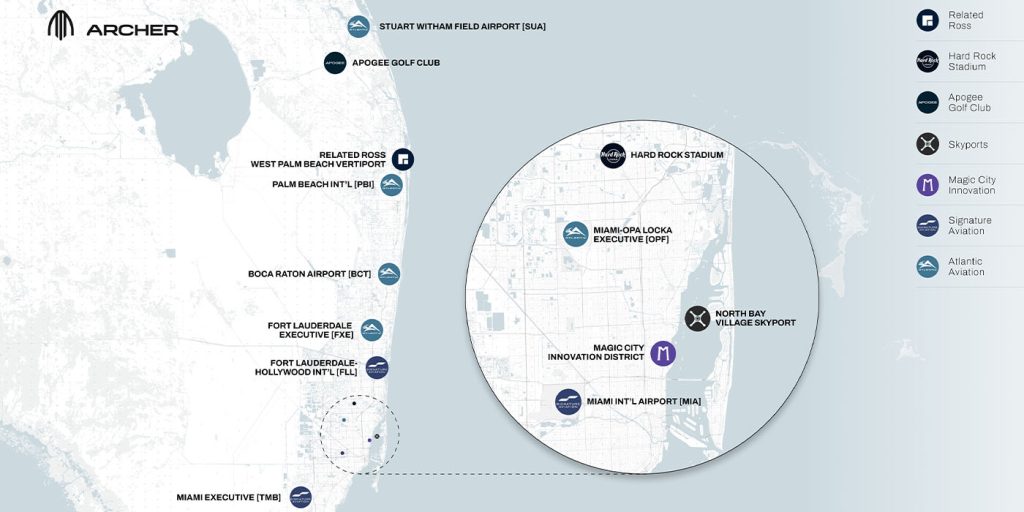
Archer partners up to establish Miami air taxi network
Archer Aviation shared details of its new air taxi network plans for Miami in a press release early this morning. If and when it comes to friuition, the proposed air taxi network will be a result of several new partnerships established by Archer in the Miami metropolitan area.
Some of those partnerships include real estate company Related Ross, Apogee Golf Club, Hard Rock Stadium – where existing heliports will be configured for eVTOLs and/or new air taxi vertiports will be erected. Stephen Ross, CEO and Chairman of Related Ross and Owner of the Miami Dolphins:
Our partnership with Archer marks a pivotal step in expanding South Florida’s regional connectivity through cutting-edge technology. We are integrating Archer’s electric vertical takeoff and landing aircraft into our flagship locations across South Florida, including the Hard Rock Stadium in Miami, Related Ross developments in West Palm Beach, and Apogee Club in Hobe Sound. We’re excited to embrace a forward-thinking vision that transforms how people and businesses move across the region.
According to Archer, the new air taxi network will connect passengers to populated areas around Miami Fort Lauderdale, Boca Raton and West Palm Beach, offering 10 to 20 minute flights. Plans also include easier travel to major airports around Southern Florida, including Miami International Airport (MIA), Fort Lauderdale–Hollywood International Airport (FLL), and Palm Beach International Airport (PBI), plus several general aviation airports. Miami Mayor, Francis Suarez, also spoke:
Miami has never been afraid to bet on the future. We’re a city that attracts visionaries, embraces breakthrough technology, and turns bold ideas into real impact. For years, I’ve worked with Archer as they’ve advanced a vision for an air-taxi network that will elevate Miami’s position as a global capital for innovation and mobility. What they’re building isn’t just transformational transportation, it embodies the Miami mindset: we lead, we innovate, and we redefine what’s possible.
Archer did not share a timeline on when this air taxi network may be operational around Miami, but we’d wager it’s still at least a couple of years away given the need for additional eVTOl development and FAA certifications in order to begin commercial operations in the US.


FTC: We use income earning auto affiliate links. More.

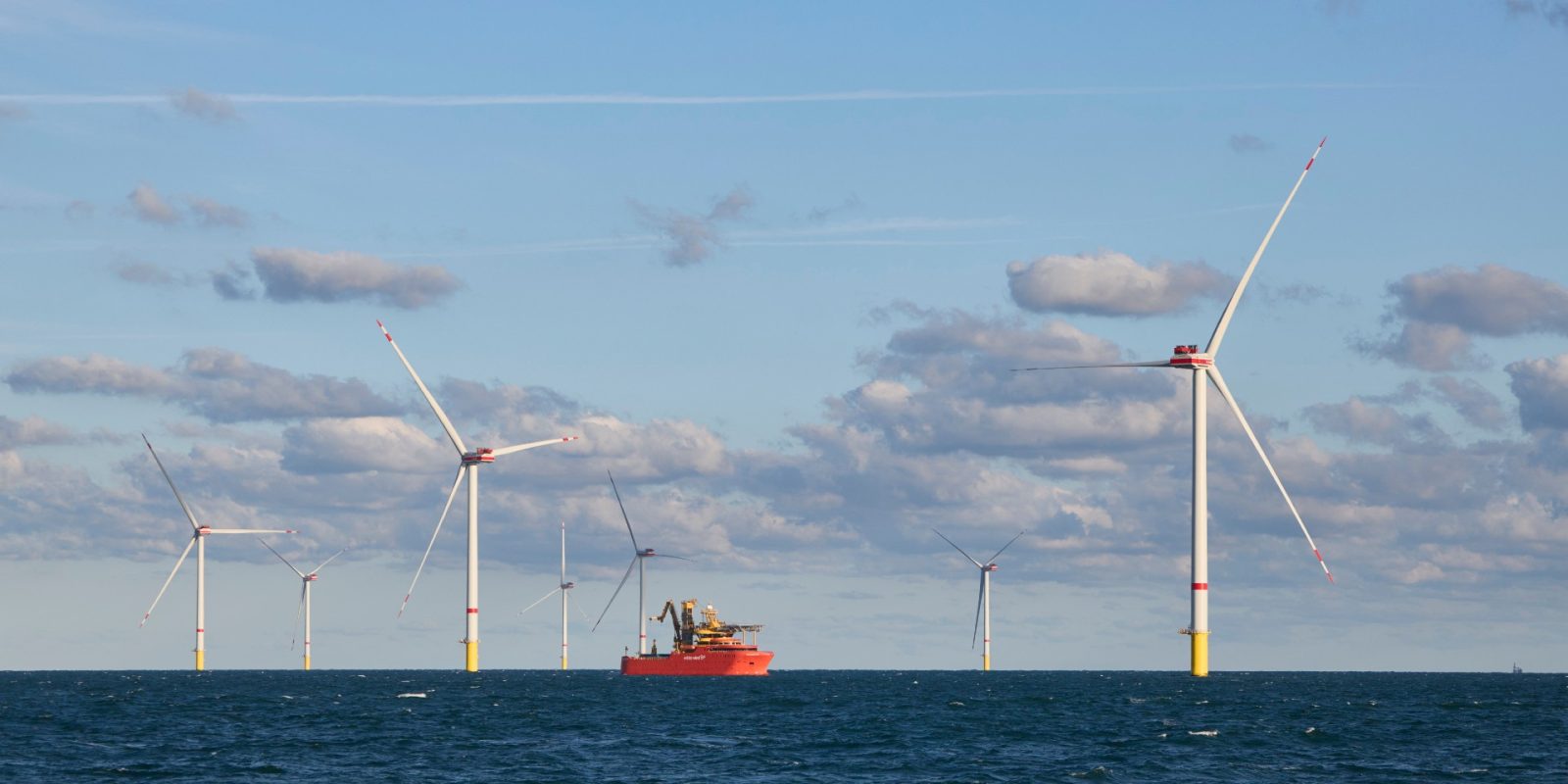
Germany’s largest offshore wind farm hit a big milestone: The first turbine at EnBW’s He Dreiht project has produced its first kilowatt-hour of electricity and sent it into the grid.
More turbines are expected to come online over the coming weeks. European energy provider EnBW has already installed 27 of the wind farm’s 64 turbines, all of which are scheduled to be commissioned by summer 2026.
Peter Heydecker, EnBW board member for Sustainable Generation Infrastructure, described the November 25 milestone as a “significant moment for EnBW.” With 960 megawatts (MW) of total capacity, He Dreiht is now Germany’s largest offshore wind farm.
Vestas supplied the 15 MW turbines, marking their world debut. Nils de Baar, president of Vestas Northern and Central Europe, said the giant turbine’s technology sets a new standard for offshore wind. “Its efficiency and performance enable a significant increase in energy yield per turbine.”
Just one rotation of the 15 MW turbine’s rotor can power the equivalent of four households for a day. The hub stands 142 meters (466 feet) tall, and the rotor’s 236-meter (774-foot) diameter sweeps a 43,742-square-meter (10.8-acre) area — roughly the size of six football fields. To put the scale into perspective, EnBW’s first offshore project, Baltic 1 in 2010, used 2.3 MW turbines.
EnBW wrapped up the wind farm’s internal cabling in August. Those lines connect all the turbines and feed into a converter platform operated by transmission system operator TenneT. That’s where the power is collected, converted from AC to DC, and sent to shore through two high-voltage DC cables.
Once complete, He Dreiht will generate enough electricity to power about 1.1 million households. The project is being built without state funding and sits roughly 85 kilometers (53 miles) northwest of Borkum and 110 kilometers (68 miles) west of Heligoland. EnBW’s offshore office in Hamburg is coordinating the build.
A partner group made up of Allianz Capital Partners, AIP, and Norges Bank Investment Management owns 49.9% of the project. Total investment comes in at around €2.4 billion.
Read more: China’s surge pushes global wind toward fastest growth ever

If you’re looking to replace your old HVAC equipment, it’s always a good idea to get quotes from a few installers. To make sure you’re finding a trusted, reliable HVAC installer near you that offers competitive pricing on heat pumps, check out EnergySage. EnergySage is a free service that makes it easy for you to get a heat pump. They have pre-vetted heat pump installers competing for your business, ensuring you get high quality solutions. Plus, it’s free to use!
Your personalized heat pump quotes are easy to compare online and you’ll get access to unbiased Energy Advisors to help you every step of the way. Get started here. – *ad
FTC: We use income earning auto affiliate links. More.
Environment
BYD tried crushing its $180K luxury SUV with a 2-ton tree and it barely left a mark [Video]
![BYD tried crushing its $180K luxury SUV with a 2-ton tree and it barely left a mark [Video]](https://i0.wp.com/electrek.co/wp-content/uploads/sites/3/2025/07/BYD-ultra-luxury-EV-Europe.jpeg?resize=1200,628&quality=82&strip=all&ssl=1)

The Yangwang U8L is among the most expensive Chinese vehicles, starting at about $180,000. To prove it’s built for just about anything, BYD dropped a 2-ton tree on it, three times, and the ultra-luxury pretty much brushed it off.
BYD drops a tree on its ultra-luxury SUV during testing
BYD launched the Yangwang U8L in September, a long-wheelbase version of the U8 off-road SUV. The U8 was first introduced in September 2023 as the first vehicle from BYD’s ultra-luxury sub-brand, Yangwang.
Yangwang is a new energy vehicle (NEV) brand that sells high-end plug-in hybrids (PHEVs) and 100% battery electric (BEV) vehicles as BYD expands into new segments.
The U8L is Yangwang’s fourth vehicle, following the U8, U9, and U7. It’s available in China with a quad-motor extended-range electric vehicle (EREV) system, delivering a CLTC range of 200 km (124 miles) on battery power alone.
A 2.0-liter turbocharged gasoline engine serves as a generator, delivering a combined CLTC range of 1,160 km (720 miles).
Measuring 5,400 mm in length, 2,049 mm in width, and 1,921 mm in height, the Yangwang U8L is even bigger than the Rolls-Royce Cullinan and Range Rover Long Wheelbase.

BYD’s ultra-luxury SUV is priced from 1.28 million yuan ($180,000), making it one of the most expensive models from a Chinese brand.
It may look pretty, but the Yangwang U8L is built for far more than just good looks. Like the U8, the long-wheelbase version is equipped with advanced features such as emergency float mode, which allows it to float on water for up to 30 minutes, tank turns, crab walking, and more.
To prove its durability, BYD engineers put the luxury SUV through the paces, dropping a massive 2-ton tree on it, not once, but three times.
During the final drop, the company said the maximum impact energy reached 50.4 kJ, or about 37,200 lb-ft. After three consecutive drops, the Yangwang U8L barely even got a scratch. The body structure remained intact, the door still opened, the columns didn’t bend, and the vehicle could even drive like normal.
FTC: We use income earning auto affiliate links. More.
-
 Sports2 years ago
Story injured on diving stop, exits Red Sox game
-
 Sports3 years ago
‘Storybook stuff’: Inside the night Bryce Harper sent the Phillies to the World Series
-
 Sports2 years ago
Game 1 of WS least-watched in recorded history
-
 Sports3 years ago
Button battles heat exhaustion in NASCAR debut
-
 Sports3 years ago
MLB Rank 2023: Ranking baseball’s top 100 players
-
Sports4 years ago
Team Europe easily wins 4th straight Laver Cup
-
 Environment3 years ago
Japan and South Korea have a lot at stake in a free and open South China Sea
-
 Environment1 year ago
Here are the best electric bikes you can buy at every price level in October 2024