

Car dealers falsely claim to be ‘voice of customers’ in push for slower electric car adoption


Almost 4,000 car dealerships in the US banded together in a new lobbying effort to ask the government to slow down the adoption of electric vehicles.
They even falsely claim to be “the voice of customers” in this Luddite effort.
A coalition representing 3,882 dealerships in the US has signed a letter sent to President Biden to lobby for a slower electric vehicle mandate.
The letter starts out like this:
“We are auto dealers from across the country who collectively sell every major brand in the U.S. We are small businesses employing thousands of Americans. We are deeply committed to the customers we serve and the communities where we operate, which is why we are asking you to slow down your proposed regulations mandating battery electric vehicle (BEV) production and distribution.”
It doesn’t start very well since there’s a lie in the very first sentence. These auto dealers don’t represent “every major brand in the U.S”.
Tesla is undoubtedly a “major” auto brand in the US, and it happens to sell more electric vehicles than all others combined.
Their argument is that BEV inventory is pilling up at their dealerships and they are having issues selling the vehicles:
“Last year, there was a lot of hope and hype about EVs. Early adopters formed an initial line and were ready to buy these vehicles as soon as we had them to sell. But that enthusiasm has stalled. Today, the supply of unsold BEVs is surging, as they are not selling nearly as fast as they are arriving at our dealerships — even with deep price cuts, manufacturer incentives, and generous government incentives.”
However, what those dealers are leaving out of their argument is that BEVs are not the only vehicles sitting unsold on their lots.
In fact, new-vehicle inventory is at a two-year high, according to Cox Automotive research.
As of the start of November, new-vehicle inventory volume in the US was sitting at a record 2.4 million units. It is safe to say that those are mostly gasoline-powered vehicles since the inventory level is currently higher than the number of EVs that the US will produce all year.
The truth is that the current interest rates have affected all automotive sales, EVs or otherwise.
It’s true some of those people who placed reservations for EVs last year are reconsidering their purchases now, as highlighted by the group of dealers, but that’s not because they are not interested in EVs anymore. It’s because they can’t afford the several hundred dollars more for the monthly payments now thanks to high interest rates.
It makes it so much more frustrating that these dealers are making this false argument while claiming that they are the “voice of customers”:
Mr. President, no government agency, no think tank, and no polling firm knows more about the automobile customer than us. We talk to customers every day. As retail automotive dealerships, we are agnostic as to what we sell. Our business is to provide customers with vehicles that meet the needs of their budgets and lifestyles.
The dealers are asking for President Biden to “tap the brakes on the unrealistic government electric vehicle mandate”.
Electrek’s Take
If anything, this should be a clear sign to legacy automakers who are committed to electric vehicles that their dealerships are going to be a problem in the EV transition.
Now, when trash-talking dealers, I always want to make it clear that even though I’m not a fan of the third-party car dealer model, I know there are plenty of good car dealerships.
For example, about 4,000 dealers signed this letter, but there are more than 18,000 car dealers in the US.
But yes, in general, dealers have caused more trouble than helped with EV adoption in the US.
When the demand is strong for EVs, they mark up the prices – taking advantage of demand generated by the manufacturers at launch, and when macroeconomics affects EV demand negatively, they misrepresent the situation to lobby against EVs.
Anyone taking the current demand situation with EVs as an excuse to slow down the transition is being completely short-sighted.
Norway is at almost 100% of new car sales being BEVs. Yet, these dealers believe we can’t catch up to even two-thirds of that by 2032? That’s basically admitting that the US is more than a decade behind the Scandinavian country. I thought the US was always number 1?
FTC: We use income earning auto affiliate links. More.

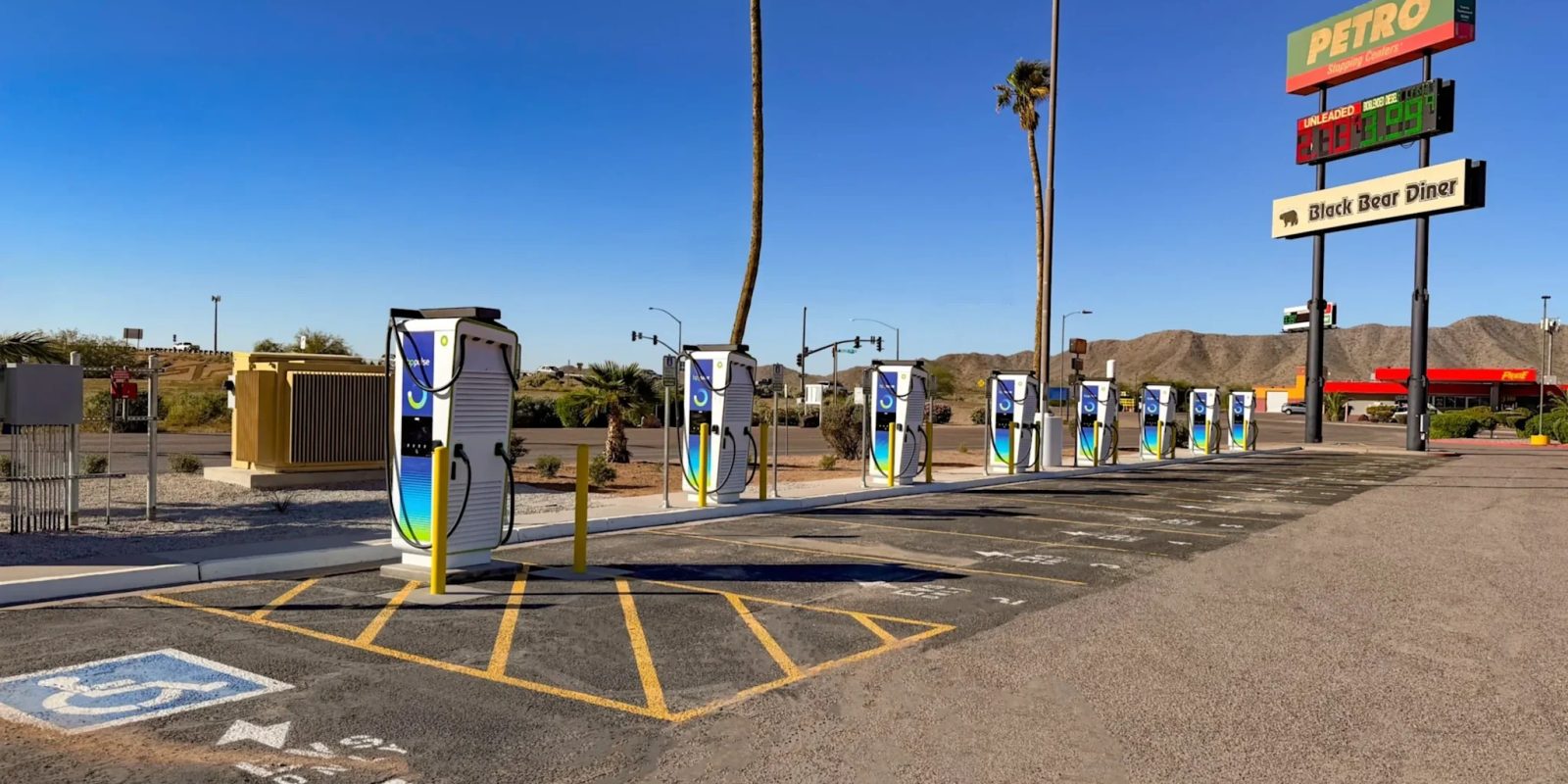
bp pulse is continuing to roll out public DC fast charging across the US, and the company has opened its first-ever site in Arizona, along with new fast-charging locations in Texas, Florida, and Ohio.
In Arizona, bp pulse’s first site is now online at the Petro Travel Center in Eloy, just off Interstate 10 at Exit 200 (pictured). The location features 16 charging bays delivering up to 400 kilowatts, with both CCS and NACS connectors available. While charging, drivers can take advantage of the travel center’s onsite diner, convenience store, ATM, barber shop, and restrooms.
In South Florida, bp pulse’s new fast-charging site is at 2400 Miami Road in Fort Lauderdale, about three miles from Fort Lauderdale–Hollywood International Airport. The site features 16 charging bays, offering a mix of 150 kW and 400 kW speeds, with both CCS and NACS connectors. Its proximity to the airport makes it a handy stop for ride-hail drivers, EV rental returns, and airport pickups and drop-offs, with hotels, restaurants, and convenience stores nearby.
Texas is also getting more high-power charging, with a new bp pulse site at the Petro Travel Center in El Paso, located off Interstate 10 at Exit 37. This location offers 12 charging bays capable of delivering up to 400 kW, again with both CCS and NACS connectors. Drivers can take advantage of the diner, convenience store, barber shop, and restrooms while they charge.
In Ohio, bp pulse has opened a smaller but still high-powered site at a TravelCenters of America location in Hebron, just off Interstate 70 at Exit 126. The site includes six 400 kW charging bays with CCS and NACS connectors, along with access to a convenience store, fast-food options, and restrooms.
These openings are part of bp pulse’s broader plan to build out EV charging across bp’s retail footprint, including bp, Amoco, ampm, Thorntons, and TravelCenters of America locations. Many of those sites are designed to combine fast charging with food, restrooms, and other travel amenities. bp has also said it plans to begin adding EV chargers at Waffle House locations starting in 2026.
Read more: bp pulse opens a huge airport EV fast charging hub in Houston
If you’re looking to replace your old HVAC equipment, it’s always a good idea to get quotes from a few installers. To make sure you’re finding a trusted, reliable HVAC installer near you that offers competitive pricing on heat pumps, check out EnergySage. EnergySage is a free service that makes it easy for you to get a heat pump. They have pre-vetted heat pump installers competing for your business, ensuring you get high quality solutions. Plus, it’s free to use!
Your personalized heat pump quotes are easy to compare online and you’ll get access to unbiased Energy Advisors to help you every step of the way. Get started here. – *ad


FTC: We use income earning auto affiliate links. More.

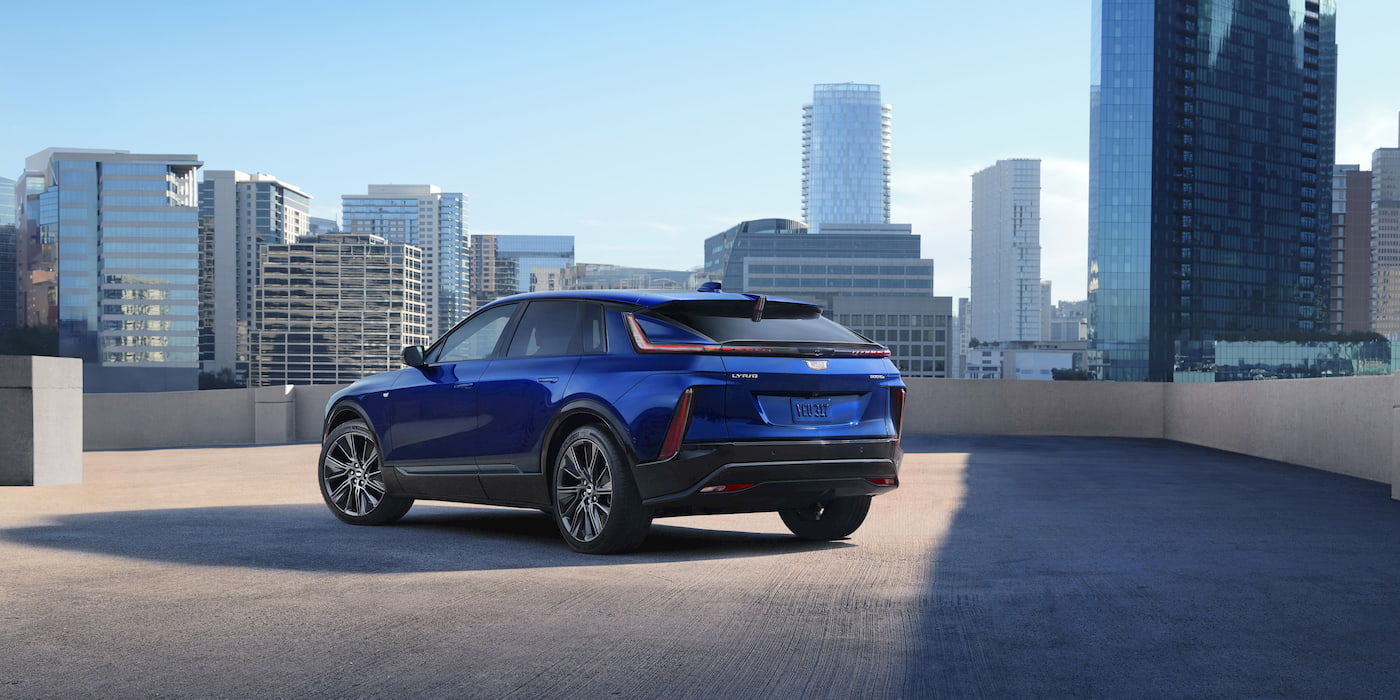
The Cadillac Lyriq and Chevy Blazer EV were among the vehicles that saw the biggest lease price drops in December.
Cadillac and Chevy EV lease prices drop in December
With the $7,500 federal EV tax credit now gone, automakers are filling the gap with their own incentives. Some are passing on the savings as bonus cash, conquest cash, lease discounts, and more.
Two General Motors electric SUVs, the Chevy Blazer EV and the Cadillac Lyriq, had some of the largest lease price drops of any vehicle in December.
The 2026 Cadillac Lyriq AWD Luxury model is now listed at $439 per month for 24 months. With $4,979 due at signing, the effective rate is $646, or $28 less per month than in November.
That’s after the Lyriq already saw prices drop by $115 a month from October. However, the December deal includes a $2,000 competitive bonus for owners and lessees of a 2011 model year or newer non-GM vehicle.
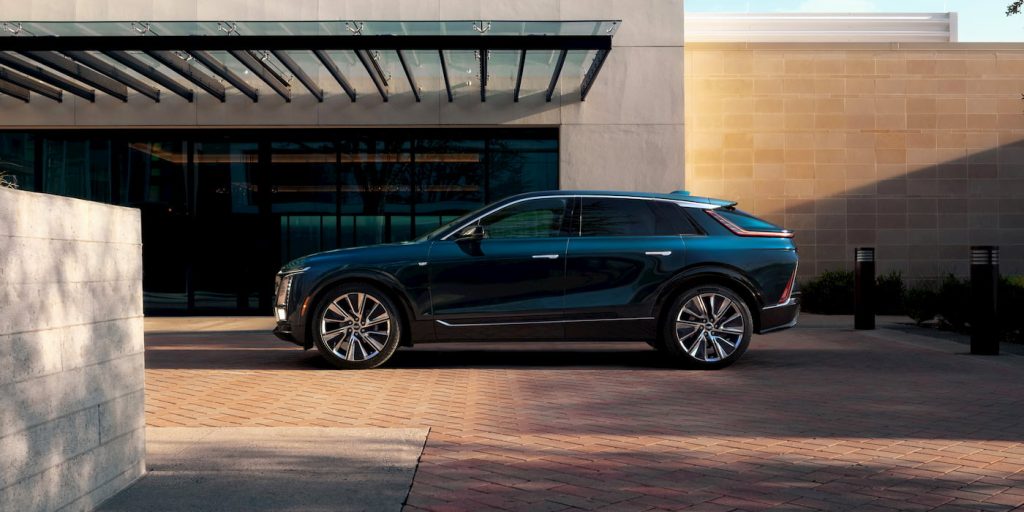
The 2026 Chevy Blazer EV FWD LT is now available to lease for as low as $319 a month for 24 months. With $6,039 due at signing, the effective rate is $571 per month, about $60 less than in November. The deal includes a $750 competitive bonus and $1,000 customer cash allowance.
Chevy and Cadillac are offering discounts across their entire EV lineup. All 2025 Chevy electric vehicles, including the Blazer EV, Equinox EV, and Silverado EV, are available with 0% APR financing for 60 months.


Intestingly, the 2026 Chevy Equinox EV is also available with 0% APR financing, while the 2026 Blazer EV is listed with 1.9% APR for 36 months.
Cadillac is offering a $2,000 conquest or loyalty bonus for the 2026 Cadillac Vistiq and select 2025/2026 Optiq and Lyriq models, plus 2.9% APR for 60 months.
The 2026 Cadillac Optiq is available to lease for as low as $319 per month for 24 months, while the 2026 Vistiq is available to lease for $619 per month for 24 months.
Want to try one out? We’ve got you covered. Check out the links below to see what Cadillac and Chevy EVs are nearby.
FTC: We use income earning auto affiliate links. More.

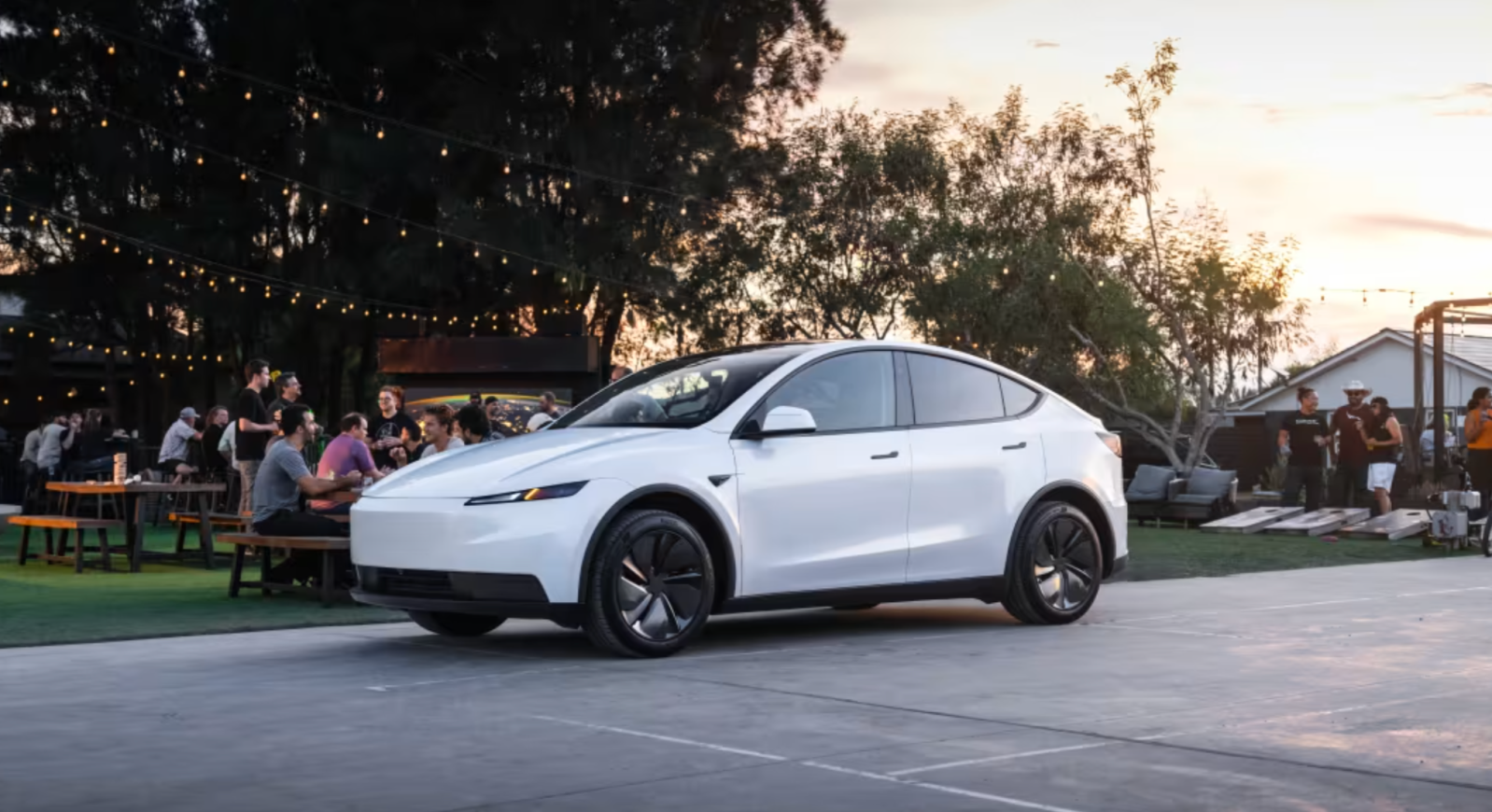
Electric vehicle prices edged lower and incentives jumped in November, but the month still saw a sales slowdown as the US EV market continues to hunt for a new normal.
Initial estimates from Kelley Blue Book show that EV sales came in at just over 70,000 units in November, more than 40% lower than a year ago and about 5% below October’s level.
The average transaction price (ATP) for a new EV in November was $58,638. That’s up 3.7% year-over-year but down 0.8% from October. Incentives told a different story: Discounts averaged 13.3% of ATP, which is lower than in November 2024 but jumped 20.1% compared to October.
Tesla continued to feel the pressure. The automaker’s ATP was $54,310 in November – down 1.7% from the same period a year ago but up 1.5% month-over-month. Sales declined for the second straight month and were down 22.7% year-over-year, mainly because of a drop in Model 3 demand.
Model 3 sales slid 42.1% compared to November 2024 and fell 11.9% from October. Meanwhile, the Model Y, still the best‑selling EV in the US, saw prices increase 0.9% year-over-year and month-over-month. Model Y sales were slightly lower than last November, down 0.5%, but rose 2.5% compared to October.
The Tesla Cybertruck showed signs of cooling. Once the best‑selling vehicle priced above $100,000, Cybertruck sales fell to 1,194 units in November, the lowest monthly total of 2025 so far. Its average price was $94,254, higher both year-over-year and compared to October.
Taken together, the numbers paint a picture of an EV market in transition: prices are easing, incentives are rising, but buyers are still holding back as the industry tries to settle into its next phase.
Cox Automotive executive analyst Erin Keating said, “It’s important to remember that the KBB ATP is a measure of what is bought, not what is available. Nearly half of new-vehicle buyers are over the age of 55 and in their peak earning years. These buyers are more likely shopping for a high-end SUV, not something cheap and cheerful. In November, the over-$75,000 price point saw more volume than under-$30,000.”
Read more: October EV sales slid, but deals and rebates are still in play

If you’re looking to replace your old HVAC equipment, it’s always a good idea to get quotes from a few installers. To make sure you’re finding a trusted, reliable HVAC installer near you that offers competitive pricing on heat pumps, check out EnergySage. EnergySage is a free service that makes it easy for you to get a heat pump. They have pre-vetted heat pump installers competing for your business, ensuring you get high quality solutions. Plus, it’s free to use!
Your personalized heat pump quotes are easy to compare online and you’ll get access to unbiased Energy Advisors to help you every step of the way. Get started here. – *ad
FTC: We use income earning auto affiliate links. More.
-
 Sports2 years ago
Story injured on diving stop, exits Red Sox game
-
 Sports3 years ago
‘Storybook stuff’: Inside the night Bryce Harper sent the Phillies to the World Series
-
 Sports2 years ago
Game 1 of WS least-watched in recorded history
-
 Sports3 years ago
Button battles heat exhaustion in NASCAR debut
-
 Sports3 years ago
MLB Rank 2023: Ranking baseball’s top 100 players
-
Sports4 years ago
Team Europe easily wins 4th straight Laver Cup
-
 Environment3 years ago
Japan and South Korea have a lot at stake in a free and open South China Sea
-
 Environment1 year ago
Here are the best electric bikes you can buy at every price level in October 2024