



Shares in The Magnum Ice Cream Company (TMICC) have fallen slightly on debut after the completion of its spin-off from Unilever amid a continuing civil war with one of its best-known brands.
Shares in the Netherlands-based company are trading for the first time following the demerger.
It creates the world’s biggest ice cream company, controlling around one fifth of the global market.
Primary Magnum shares, in Amsterdam, opened at €12.20 – down on the €12.80 reference price set by the EuroNext exchange, though they later settled just above that level, implying a market value of €7.9bn – just below £7bn.
The company is also listed in London and New York.
Money latest: The cheapest days to travel by plane
Unilever stock was down 3.1% on the FTSE 100 in the wake of the spin off.
The demerger allows London-headquartered Unilever to concentrate on its wider stable of consumer brands, including Marmite, Dove soap and Domestos.
The decision to hive off the ice cream division, made in early 2024, gives a greater focus on a market that is tipped to grow by up to 4% each year until 2029.
Ben & Jerry’s accounts for a greater volume of group revenue now under TMICC. Pic: Reuters
But it has been dogged by a long-running spat with the co-founders of Ben & Jerry’s, which now falls under the TMICC umbrella and accounts for 14% of group revenue.
Unilever bought the US brand in 2000, but the relationship has been sour since, despite the creation of an independent board at that time aimed at protecting the brand’s social mission.
The most high-profile spat came in 2021 when Ben & Jerry’s took the decision not to sell ice cream in Israeli-occupied Palestinian territories on the grounds that sales would be “inconsistent” with its values.
Unilever responded by selling the business to its licensee in Israel.
A series of rows have followed akin to a tug of war, with Magnum refusing repeated demands by the co-founders of Ben & Jerry’s to sell the brand back.
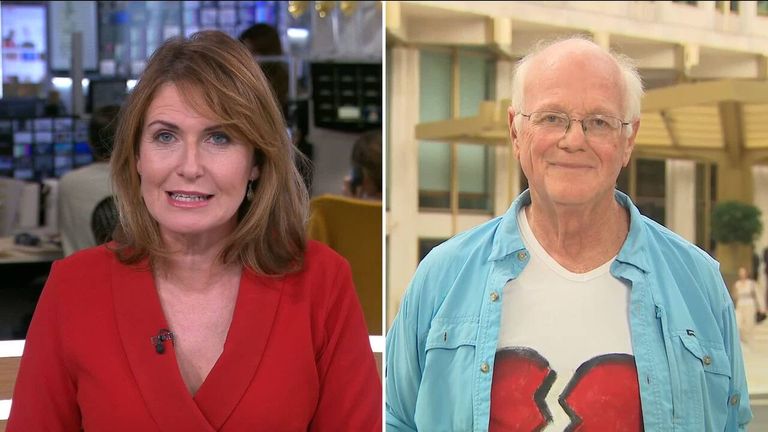
Sept: ‘Free Ben & Jerry’s’
Magnum and Unilever argue its mission has strayed beyond what was acceptable back in 2000, with the brand evolving into one-sided advocacy on polarising topics that risk reputational and business damage.
TMICC is currently trying to remove the chair of Ben & Jerry’s independent board.
It said last month that Anuradha Mittal “no longer meets the criteria” to serve after internal investigations.
An audit of the separate Ben & Jerry’s Foundation, where she is also a trustee, found deficiencies in financial controls and governance. Magnum said the charitable arm risked having funding removed unless the alleged problems were addressed.
The Reuters news agency has since reported that Ms Mittal has no plans to quit her roles, and accused Magnum of attempts to “discredit” her and undermine the authority of the independent board.
Magnum boss Peter ter Kulve said on Monday: “Today is a proud milestone for everyone associated with TMICC. We became the global leader in ice cream as part of the Unilever family. Now, as an independent listed company, we will be more agile, more focused, and more ambitious than ever.”
Commenting on the demerger, Hargreaves Lansdown equity analyst Aarin Chiekrie said: “TMICC is already free cash flow positive, and profitable in its own right. The balance sheet is in decent shape, but dividends are off the cards until 2027 as the group finds its footing as a standalone business.
“That could cause some downward pressure on the share price in the near term, as dividend-focussed investment funds that hold Unilever will be handed TMICC shares, the latter of which they may be forced to sell to abide by their investment mandate.”


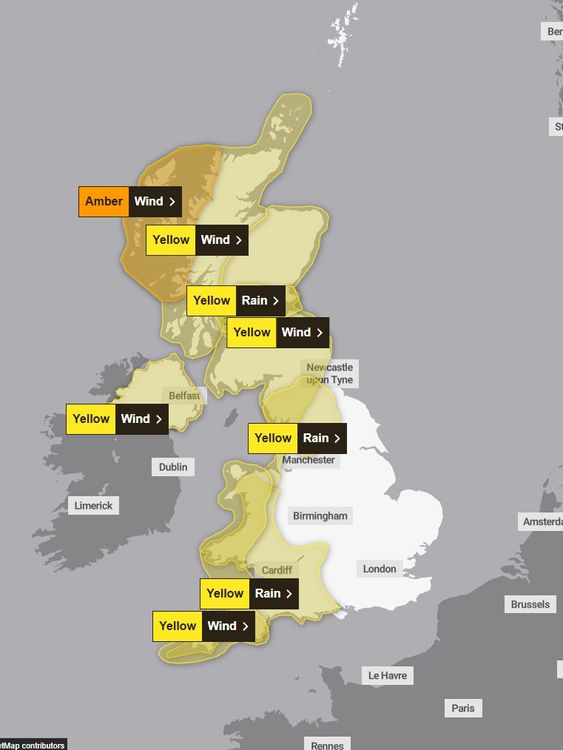
Storm Bram has been named by the Irish weather service – with warnings for strong winds and heavy rain issued for parts of the UK and Ireland.
More than half a month’s rainfall could hit some parts of the UK in just a 24-hour period, the Met Office has warned.
Yellow and orange warnings are in place across Ireland today and tomorrow, with “very strong to gale force” winds forecast on Tuesday.
Check the weather forecast where you are
The Met Office said strong winds forecast from Monday evening through until Wednesday could cause disruption, with gusts of 50-60mph predicted widely and 70-80mph in some places.
A yellow weather warning for rain comes into effect from 6pm on Monday, and will be in place for 24 hours, covering parts of southwest England and Wales, and stretching to parts of Herefordshire and Hampshire.
The Met Office has also issued a yellow warning for high winds from Dorset to Cornwall and up to north Wales, in place from 10pm on Monday until 4pm on Tuesday.
It said transport networks could face disruption, with delays for high-sided vehicles on exposed routes and bridges, and coastal roads and seafronts affected by spray and large waves. Power outages are also possible.
For 24 hours from 6pm on Monday, up to 40mm of rain could fall in some areas, with 60-80mm of rain over Dartmoor and high ground in South Wales, which would amount to more than half the average monthly rainfall in December.
The predicted rainfall across southwest England and South Wales is expected to hit already saturated ground and could lead to difficult travel conditions.
An amber warning for wind has been issued for northwest Scotland on Tuesday.
Flying debris “could result in a danger to life” – and there could be damage to buildings and homes along with the risk of roofs being “blown off” due to the “very strong and disruptive winds”, the Met Office warned.
Forecasters added there was the potential for large waves and beach material “being thrown” across sea fronts, roads and properties.
There are also yellow warnings for wind and rain on Tuesday across Northern Ireland, Scotland, Wales and northern and southwest England.
Weather warnings issued for Tuesday. Pic: Met Office
Yellow warnings for wind have been issued for Scotland and parts of northern England on Wednesday.
The Met Office’s deputy chief meteorologist, Steven Keates, said: “A deepening area of low pressure will approach the UK from the southwest later on Monday, bringing with it heavy rain and strong winds, which are likely to affect the UK between late Monday and early Wednesday.
“The exact track, depth and timings of this low are uncertain, which makes it harder to determine where will be most impacted by strong winds and/or heavy rain.
“This system has the potential to cause disruption, and severe weather warnings are likely to be issued over the weekend as details become clearer. We therefore urge people to keep up-to-date with the latest Met Office forecast.”
The Met Office said the rest of the month remained unsettled, with further periods of low pressure predicted.
It also said it is too early to provide an accurate forecast for the Christmas period.
-
 Sports2 years ago
Story injured on diving stop, exits Red Sox game
-
 Sports3 years ago
‘Storybook stuff’: Inside the night Bryce Harper sent the Phillies to the World Series
-
 Sports2 years ago
Game 1 of WS least-watched in recorded history
-
 Sports3 years ago
Button battles heat exhaustion in NASCAR debut
-
 Sports3 years ago
MLB Rank 2023: Ranking baseball’s top 100 players
-
Sports4 years ago
Team Europe easily wins 4th straight Laver Cup
-
 Environment3 years ago
Japan and South Korea have a lot at stake in a free and open South China Sea
-
 Environment1 year ago
Here are the best electric bikes you can buy at every price level in October 2024