


-
David Hale
COLLEGE STATION, Texas — Rueben Bain rolled his eyes, smiled, then held up his cell phone, the lock screen glowing with a photo of Texas A&M offensive lineman Trey Zuhn III. Bain had anticipated the question. He was looking forward to it.
In the run-up to Saturday’s College Football Playoff game between Miami and Texas A&M, Zuhn had delivered the bulletin-board material, when he told reporters he didn’t think Bain “would be a threat that we need to worry about too much.”
Big mistake.
“We don’t take kindly to disrespect,” Bain said. “Some people said some things they shouldn’t have said.”
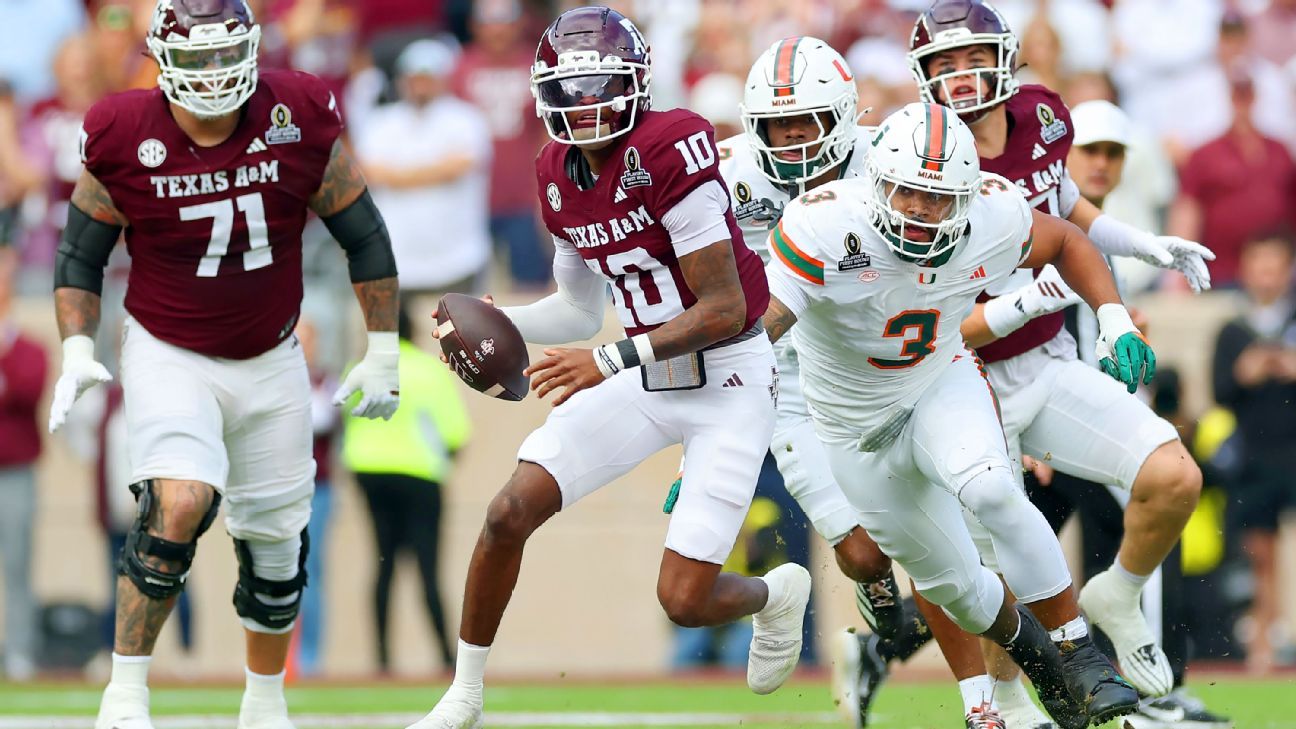
Bain and the Miami defense were dominant in a 10-3 win over the Aggies, ending a once-promising Texas A&M season and sending the Hurricanes on to the Goodyear Cotton Bowl, where they’ll face off against Ohio State.
Bain finished with five tackles — four for a loss — and three sacks, while also blocking a field goal in the first half.
The rest of the defense followed his lead, racking up nine tackles for loss and creating three takeaways, including a game-sealing interception in the back of the end zone with 24 seconds to play by freshman Bryce Fitzgerald.
In the aftermath, defensive end Akheem Mesidor was running through his rolodex of players who’d stepped up against the Aggies — defensive line, defensive backs, linebackers — then mentioned Fitzgerald.
“Bryce!” Bain and cornerback Keionte Scott both shouted in unison, laughing.
Fitzgerald arrived on campus in June, but quickly made his presence felt, and his role on Miami’s defense has grown as the season progressed. On Saturday, he was a star, intercepting Aggies quarterback Marcel Reed twice. The latter came on a third-and-goal at the 5 after the Aggies had marched down the field in an effort to tie it, but Fitzgerald stepped in front of a pass intended for Melin Ohrstrom and the celebration began.
“He’s a quick study,” Miami coach Mario Cristobal said. “He’s never flinched. He spends every waking minute studying, but when the lights come on, some guys just kind of have ‘it.’ He’s that guy. He just knows what to do and how to do it.”
A year ago, this Miami defense was the fly in the ointment that kept the Hurricanes from the playoff. With future No. 1 NFL draft pick Cam Ward working magic on offense, Miami’s battered secondary created a chain reaction that led to a complete defensive meltdown in the season’s stretch run. Miami lost two of its final three games to fall from No. 4 in the rankings to out of the playoff.
Cristobal responded by making a change at coordinator, bringing in Corey Hetherman — now a Broyles Award finalist — and putting a focus on rebuilding the back end of the defense. Fitzgerald and Scott, along with transfer Xavier Lucas, were keys to the turnaround. With the secondary secure, the defensive front was free to wreak havoc, and Mesidor and Bain did exactly that against the Aggies.
“We sat in the locker room for like 15 minutes [after the game],” Bain said, “just saying how crazy it was for us to win this game in this kind of way.”
Hetherman said the focus for Miami’s defense was actually more about patience and keeping Reed inside the pocket. The A&M quarterback did have a handful of scrambles that extended plays to find open receivers or picked up yards on the ground. But Hetherman said he prioritized showing Reed a host of different coverage schemes to keep him off balance, and eventually that allowed the Miami defensive front to get home.
Miami’s seven sacks against Texas A&M tied for the most by a ‘Canes defense in the last six seasons. And while there’d been concern about how Miami’s offensive line would handle the crowd noise at Kyle Field, where more than 104,000 fans provided a stifling soundtrack, it was actually the Aggies O-line that was flagged for multiple penalties.
“We lost the game of the line of scrimmage, and I think it got worse in the second half,” Aggies coach Mike Elko said. “We just couldn’t keep them off of us. We couldn’t get the run game established. We became one-dimensional. Once we became one-dimensional, they were able to tee off.”
Overall, Miami held the Aggies to just 326 yards of offense and just 89 on the ground — just 50 from A&M’s trio of tailbacks, Le’Veon Moss, Rueben Owens and EJ Smith.
And when Miami’s back was against the wall, the defense was at its best. A&M’s three red-zone trips amounted to just three total points, and when Miami receiver Malachi Toney fumbled near midfield late in the game, the Hurricanes defense followed with a quick three-and-out.
“A year ago, we had a tough time stopping people on defense,” Cristobal said. “This was one of those games where we felt like we were holding good and knocking them back. The confidence that [the defense] brings is off the charts, and they were the difference today.”


-
Dave Wilson
COLLEGE STATION, Texas — Texas A&M‘s historic season ended with a gut punch, as quarterback Marcel Reed, who had driven the Aggies to the Miami 5-yard line with 27 seconds left, threw an interception in the back of the end zone in a 10-3 loss at Kyle Field.
The loss Saturday in front of 104,122, the second-biggest crowd in CFP history, ended the Aggies’ season at 11-2, tying A&M’s 1939, 1998 and 2012 teams for the second-most wins in program history, behind the 1992 squad that finished 12-1.
Mike Elko, the Aggies’ second-year head coach, said that the loss will sting but that it shouldn’t discount what the team accomplished. When he took over before last season, he said that this was not an elite program ready to compete for a national championship. In his first season, the Aggies finished 8-5 after a 7-1 start and went into the offseason vowing to put an emphasis on finishing games. They did that all year and started 11-0 but lost their final two games: to Texas in Austin and then to the Hurricanes, their first defeat at home this season.
“We weren’t able to tilt the margins in our favor the last two games,” Elko said. “That’s going to be a killer. One to not go to Atlanta [to the SEC championship], one to not go to the quarterfinals. So that’s a killer, but you’ve got to swallow it and you’ve got to move forward just like we did last year.”
Elko said he and his staff believed this team had “fairly small margins” to be successful in each game, and that’s exactly how the season played out. He said that as a grown man he can handle the disappointment but that he is hurting for his players. Still, he emphasized that he didn’t want to discount what his players had done to help turn the tide for the Aggies.
“I said to the seniors who just played their last game, they left a mark on elevating this program that will never go away. From where this program was two years ago to where it is now, I don’t think that can be lost on people,” Elko said. “I said to the guys coming back, there’s still another major step we have to take as a program to finish. I think the last two games showed that.”
Elko said his offense had become one-dimensional, and he credited Miami’s defense for preventing the Aggies from being able to run the ball, enabling the Canes to tee off on Reed.
“Marcel Reed can’t be our leading rusher,” Elko said of his sophomore quarterback who had 15 carries for 27 yards, 6 more than running back Rueben Owens II. “He can’t have the most carries. It just can’t happen that way.”
Reed sat devastated on the bench as the game ended following the interception, a towel draped over his head. Reed’s offensive coordinator, Collin Klein, is headed to Kansas State, his alma mater, as the Wildcats’ new coach. The two spoke about how close their relationship is after the game, with Reed saying Klein is like a father figure for him.
“It didn’t really feel real,” Reed said. “I don’t want the season to end. A lot of changes are going to be made after the season, so I really didn’t want it to end. It sucked.”
Taurean York, the Aggies’ all-SEC linebacker, said he’s proud of the steps the team took and called the season a “foundation-setter,” saying A&M finally got to the big stage and has plans to keep building.
“We’re really just scratching the surface of who we’re going to become in the future,” he said.
The Aggies traded defensive blows with Miami all day, but Carson Beck‘s shovel pass to Malachi Toney with 1:44 left broke the game open. The Aggies’ offense responded, driving with a chance to tie the game before Bryce Fitzgerald‘s second interception of Reed on the day ended A&M’s season and crushed the Kyle Field faithful.
“We came up 5 yards short and that’s something we’ll have to live with throughout the off season,” Elko said. “But [I’m] still proud of this team, proud of what they accomplished, proud of what they did.”
![Maximizing fleet efficiency and ROI with telematics integration [update]](https://i0.wp.com/electrek.co/wp-content/uploads/sites/3/2023/11/Daimler-North-America-semi-electric-trucks.jpg?resize=1200,628&quality=82&strip=all&ssl=1)
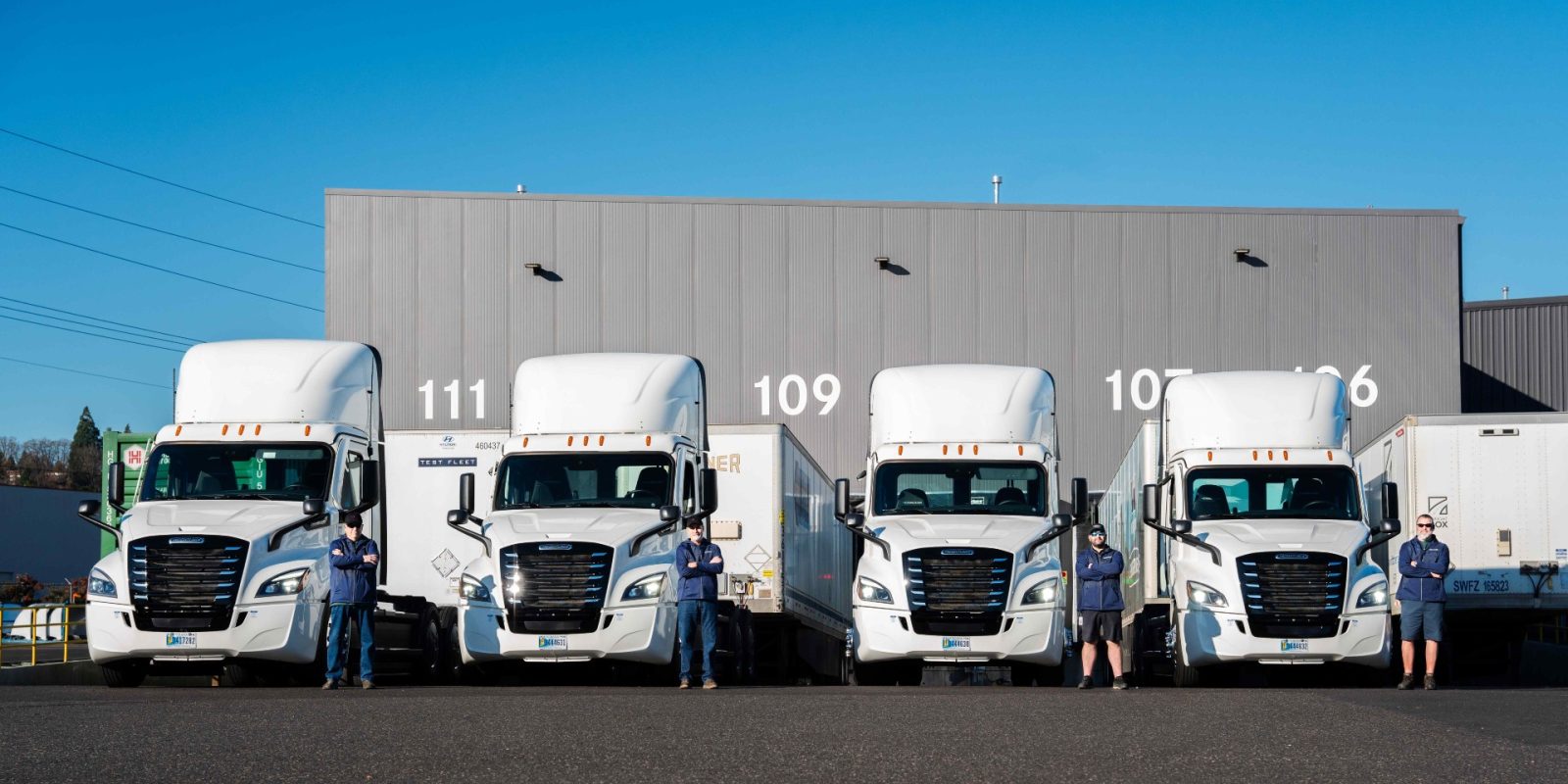
Even without clean fleet tax credits and cash-on-the-hood incentives, fleet managers are working hard to maximize their ROI on vehicle assets and reduce their total cost of ownership – and they’re increasingly turning to data‑driven telematics solutions to help.
Telematics use data gathered from sensors embedded in a vehicle to monitor its operations. When collected and interpreted correctly, that data can be used to improve fleet safety, boost operational efficiency, and enable predictive maintenance that reduces (if not eliminates) unexpected downtime. Those are real benefits, with some analysts showing up to 30% savings in repair costs even before you factor in the fuel savings from EVs that, according to MAN CEO Alexander Vlaskamp, will cover the added cost of a BEV in less than three years.
As you can imagine, that’s a big business – and the global market for vehicle telematic platforms is projected to reach an impressive $127 billion in the next decade, and the rush is on to get OEMs like Ford (through Ford Pro) and Volvo (who has a deal with Geotab) to integrate digital solutions into their vehicles.
We originally covered these topics back in February, ahead of the ACT Expo. You can read that original article, below, and let us know what you think of the OEMs’ telematics’
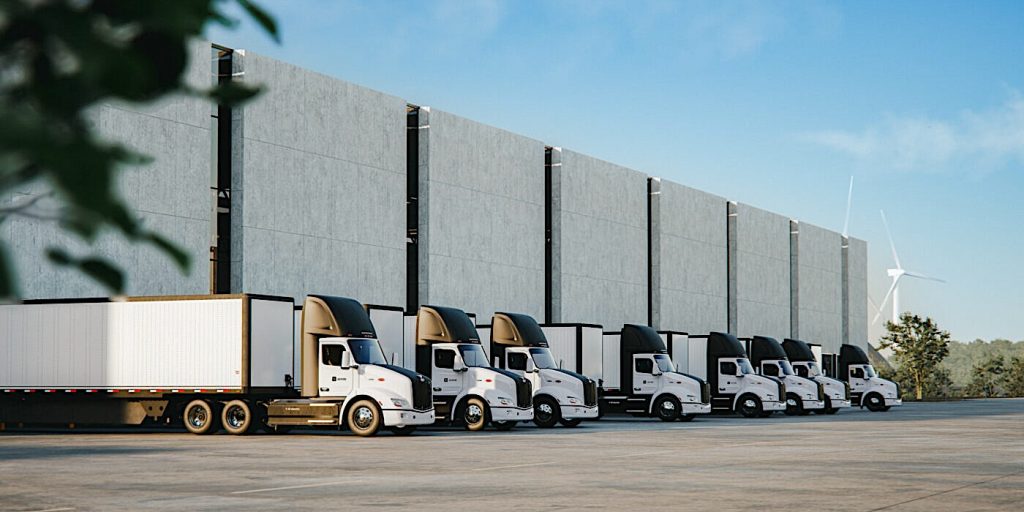
Last month, Geotab signed a deal with Volvo Group to integrate the manufacturer’s vehicle data API into Geotab’s telematics platform. It’s the latest in a recent onslaught of such deals between telematics providers and OEMs that begs the question: what’s in it for the OEMs?
Almost all modern cars and trucks are “connected” in some way. Ford, for example, began fitting the FordPass Connect modem on all its vehicles in the 2020 model year, and the vehicle (and driver) data gathered powers the Ford Pro fleet management platform and enables offerings like the company’s E-Switch Assist, which enables Ford fleet managers to identify which of its ICE-powered F-150 and Transit assets are ready to make the switch to EV.
“Smart tools informed by data like E-Switch Assist are opening up many new conversations with our commercial customers large and small about EV readiness; we’re already using E-Switch Assist regularly in consultations to help organizations determine if electric trucks and vans are right for them,” says Nate McDonald, EV strategy and cross vehicle brand manager at Ford Pro. “The importance of these tools and technologies goes beyond selling a customer a new vehicle—it changes mindsets about whether electric vehicles will work for their business while potentially saving them time and money.”
So, it makes sense for manufacturers to build that connectivity into their vehicles and makes even more sense to use that data connection to populate a fleet management dashboard that makes it painless for fleet managers to monitor their assets within a trusted ecosystem. Think Android vs. iPhone, and the pain that would go into switching from one to the other after a decade or so of constant interaction – because that’s how the OEMs are looking at it.
Why, then, would an OEM open up that data stream to a third party like Geotab?
The answer, presumably, is that that data sharing is a two-way street: the manufacturer’s are opening up their APIs to Geotab, and Geotab is sharing at least some of the data from other manufacturers with their industry partners.
And Geotab has a lot of partners:
- In 2019, Geotab began working with Ford to integrate Ford’s telematics data into its fleet management platform
- In 2020, Geotab began integrating with GM and its OnStar telematics in North American markets
- In 2022, Geotab began partnering with Stellantis’ Free2move car sharing brand, providing full telematics integration into the MyGeotab platform in North America
- In April of 2024, Geotab partnered with Mobilisights to integrate data from Stellantis’ European brands, including Opel, Fiat, Alfa Romeo, Citroën, and Peugeot
- In September of 2024, Geotab announced a new partnership with VW Group Info Services aimed at improving the company’s data integration across its brands
- A deal with Rivian, VW’s partner in a $5 billion joint software venture, followed soon after
All of those players are convinced that the data coming from their vehicles can produce enough value to seriously impact fleet ROI.
Fleet managers seem convinced, too. In a recent McKinsey survey, nearly 57% of EV buyers said they were willing to switch brands in order to get better connectivity features. And, if you’ve ever worked in “a Ford shop” or “a Chevy shop” you already know what a huge that deal that number might be to an OEM.
McKinsey connectivity survey

In that point of view, working with a trusted, universal platform like Geotab who doesn’t have a dog in the vehicle sales fight makes sense. If the Ford Transit the fleet buyer is looking at plays well with their fleet auditing software and systems and the Nissan NV doesn’t – well, it doesn’t really matter if Nissan’s fleetail guy is giving you a better deal at that point. It’s just too painful to operate a second dashboard for one subset of assets.
The man-hours saved with a universal and brand agnostic fleet management platform may not be the easiest to trace all the way to the bottom line, but they’re there.
Additionally, the Geotab dashboard can be configured to collect and even analyze data that’s specifically relevant to EVs. Information like charging history, and regenerative braking efficiency, and overall battery health – data that, over thousands of vehicles, can give fleet managers real insight into how long the new electric vehicles they’re considering will last compared to the gas and diesel vehicles they have experience with.
Geotab research shows that EV batteries could last 20 years or more if they degrade at an average rate of 1.8% per year, as we have observed.
According to our data, the simple answer is that the vast majority of batteries will outlast the usable life of the vehicle and will never need to be replaced. If an average EV battery degrades at 1.8% per year, it will still have over 80% state of health after 12 years, generally beyond the usual life of a fleet vehicle.
Telematics integrations can also help optimize a fleet’s charging schedules, both by scheduling EV charging for lower priced, off-peak hours and by identifying the most dependable high-speed charging stations along regular routes to minimize down time for both vehicles and drivers.
Finally, these data-driven platforms can provide fleet managers tools for tracking and reporting things like carbon emissions and overall energy consumption, which can streamline ESG reporting processes and make it easier for the worker bees to get regulators, administrators, and managers the sort of charts, tables, and graphs they love.
Something like that, anyway.
You can check out my Quick Charge with Nate McDonald, EV strategy and cross vehicle brand manager at Ford Pro, who explores how Ford’s in-house telematics can help fleet managers decarbonize, and head over to Geotab to find out more about their brand agnostic fleet management dashboard, below. Enjoy!
EV or gas – which is right for you?
SOURCES: Fleet Europe, Ford Pro, Geotab, McKinsey; add’l links in article.

If you’re considering going solar, it’s always a good idea to get quotes from a few installers. To make sure you find a trusted, reliable solar installer near you that offers competitive pricing, check out EnergySage, a free service that makes it easy for you to go solar. It has hundreds of pre-vetted solar installers competing for your business, ensuring you get high-quality solutions and save 20-30% compared to going it alone. Plus, it’s free to use, and you won’t get sales calls until you select an installer and share your phone number with them.
Your personalized solar quotes are easy to compare online and you’ll get access to unbiased Energy Advisors to help you every step of the way. Get started here.


FTC: We use income earning auto affiliate links. More.
-
 Sports2 years ago
Story injured on diving stop, exits Red Sox game
-
 Sports3 years ago
‘Storybook stuff’: Inside the night Bryce Harper sent the Phillies to the World Series
-
 Sports2 years ago
Game 1 of WS least-watched in recorded history
-
 Sports3 years ago
Button battles heat exhaustion in NASCAR debut
-
 Sports3 years ago
MLB Rank 2023: Ranking baseball’s top 100 players
-
Sports4 years ago
Team Europe easily wins 4th straight Laver Cup
-
 Environment3 years ago
Japan and South Korea have a lot at stake in a free and open South China Sea
-
 Environment1 year ago
Here are the best electric bikes you can buy at every price level in October 2024