
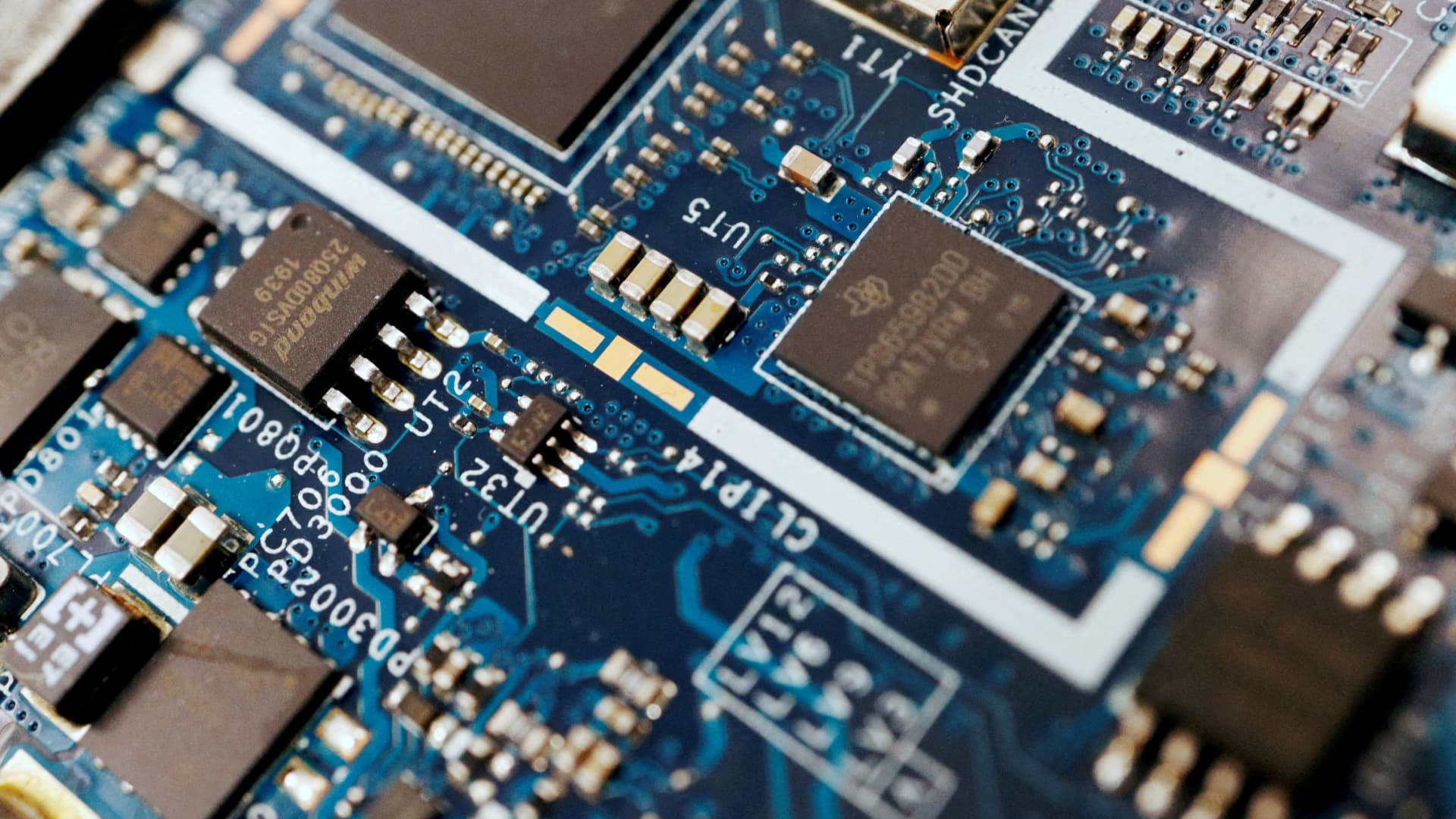
Samsung and ASML to invest $760 million to build an advanced chip plant in South Korea

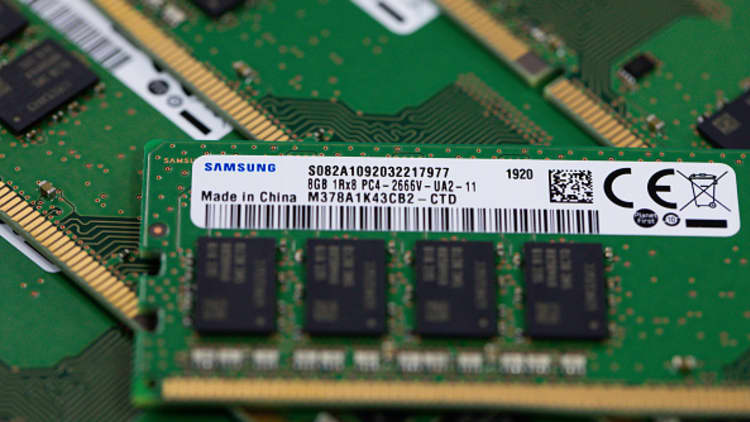
Florence Lo | Reuters
Dutch manufacturer of chip-making equipment ASML will jointly invest 1 trillion South Korean won ($760 million) with South Korean chipmaker Samsung Electronics to build a plant that develops cutting-edge semiconductor processing technology in South Korea.
The announcement came as South Korean President Yoon Suk-yeol is in the Netherlands for a four-day visit which seeks to forge a “semiconductor alliance” between the two countries.
ASML is the world’s only maker of extreme ultraviolet (EUV) lithography machines that are required to manufacture the most advanced chips such as those in the latest Apple iPhones which are manufactured by Taiwan’s TSMC.
“The technological innovation led by ASML is becoming a powerful driving force of the Fourth Industrial Revolution around the world, and Dutch semiconductor companies such as ASML and ASM are building new facilities for production, R&D, and talent training in Korea,” South Korea’s presidential office said Tuesday.
Yoon visited the headquarters of ASML on Tuesday with King Willem-Alexander of the Netherlands, and toured the production site of next-generation EUV machines.
‘Turning point’ for Korea-Netherlands ties
Samsung is the world’s largest maker for dynamic random-access memory chips, which are used in consumer devices such as smartphones and computers. South Korean chipmakers rely on ASML’s EUV machines to produce faster and more efficient chips than competitors.
The statement also said ASML will collaborate with South Korean chip giant SK Hynix, the world’s second-largest DRAM chipmaker, to reduce power usage and costs for EUVs through hydrogen gas recycling technology.
Ahead of his visit to the Netherlands, Yoon told media outlet AFP that semiconductors are “the linchpin of Korea-Netherlands cooperation.”
“The Netherlands is home to ASML, which produces the lithography equipment that makes semiconductors, and for years the two countries have worked together ‘in an exemplary manner,” the president said at that time.
“[This] will mark a crucial turning point for the Korea-Netherlands semiconductor alliance.”
He said this visit to the Netherlands will help both countries “establish a well-organized institutional framework that will intensively address global semiconductor supply chains,” even as semiconductors emerge as strategic assets and geopolitical risks surrounding global supply chains grow.
Technology
SoftBank leads decline in Japanese tech stocks as worries over AI spending spill over to Asia


TOKYO, JAPAN – FEBRUARY 03: SoftBank Group CEO Masayoshi Son delivers a speech during an event titled “Transforming Business through AI” in Tokyo, Japan, on February 03, 2025. SoftBank and OpenAI announced that they have agreed a partnership to set up a joint venture for artificial intelligence services in Japan.
Tomohiro Ohsumi | Getty Images News | Getty Images
Japanese tech stocks took a tumble on Thursday as AI infrastructure spending worries on Wall Street crossed the ocean into the Asian markets, with AI-related stocks declining.
Softbank Group Corp was among the top losers in the benchmark Nikkei 225, falling as much as 7.25%, with the index leading losses in Asia, down 1.23%. The group pared some losses and was last trading 3% lower.
This decline comes as the tech-heavy Nasdaq Composite fell 1.81% overnight, dragged by losses in Oracle, Broadcom, Nvidia and other AI plays.
The losses in Oracle came after the Financial Times reported on Wednesday that Blue Owl Capital’s plans to finance the cloud infrastructure company’s $10 billion Michigan data center had stalled. The company last week had refuted a report that said it had delayed some projects for AI major OpenAI to 2028.
Tech-focused SoftBank has seen sharp volatility in its stock over the past month as fears over AI-related spending have gripped the market.
At the start of the year, the group had revealed plans to invest $500 billion in AI infrastructure in the U.S. along with OpenAI, Oracle and other partners, and in September it announced five new U.S. AI data center sites under Stargate, OpenAI’s overarching AI infrastructure platform.
Other Japanese tech stocks also fell. Semiconductor equipment supplier Advantest, dropped as much as 5%. Counterparts Lasertec, Renesas Electronics and Tokyo Electron declined between 3% and 4%.
Jesper Koll, expert director at Tokyo-based financial services firm Monex Group, said much of what goes into data centers, power centers, and AI hardware enablers is “Made in Japan, and can only be made in Japan.” That makes Japanese tech, especially AI-related stocks more vulnerable to any worries around U.S. tech spending.
On Wednesday, Japan’s trade numbers showed that exports of electrical machinery jumped 7.4%, and semiconductor-related exports surged 13% year on year. Koll said the U.S.-led boom in tech spending was translating into growing exports of specialized machinery and equipment.
Losses were less pronounced in South Korean chip heavyweight Samsung Electronics at 0.93%, while SK Hynix reversed course to gain 0.73%. Taiwan’s TSMC, the world’s largest contract chip manufacturer, was marginally down.


MetaX booth at the Shanghai New Expo Center in Shanghai, China, on July 26, 2025. (Photo by Ying Tang/NurPhoto via Getty Images)
Nurphoto | Nurphoto | Getty Images
It felt like déjà vu when shares of chipmaker MetaX Integrated Circuits soared 700% in its Shanghai market debut on Wednesday. Moore Threads surged over 400% on its first day of trading just two weeks earlier.
They’re the latest Chinese AI chip companies the country’s investors are ploughing money into, as it races to develop its own semiconductors and challenge Nvidia’s dominance in the face of U.S. export curbs.
Both are developing graphics processing units (GPUs), the type of chip manufactured by Nvidia and used for advanced AI.
Investor enthusiasm around Chinese AI-chip IPOs is partly shaped by longer-term expectations that China will build a self-sufficient semiconductor ecosystem as tensions with the U.S. continue, Macquarie’s equity analyst Eugene Hsiao told CNBC.
Washington has barred sales of Nvidia’s most advanced semiconductors to the country. While U.S. President Donald Trump relaxed export curbs for some Nvidia chips, regulators in the country were planning to limit access to the company’s processors, the Financial Times reported earlier this month, as it looks to wean itself off overseas tech in the AI race.
None of China’s AI chipmakers — which include a cohort of tech giants like Huawei, Alibaba and Baidu — have been able to develop processors comparable to Nvidia’s most advanced so far.
But while significant barriers remain in overcoming export control restrictions in some areas of its chip supply chain, like equipment, it’s made significant strides in others, such as memory.
Here’s how the market of China’s AI chip Nvidia rivals is shaping up.
Huawei
Privately-owned tech giant Huawei develops the Ascend series of chips, with its next-generation model, the 950, to be launched in 2026. Nvidia told CNBC that “competition has undeniably arrived” when the new systems were announced.
While its previous Ascend models have not been considered competitive with Nvidia’s on a chip-by-chip basis, Huawei has been able to build high-performance “clusters” to rival the US chipmaker’s most advanced systems by linking more of its processors.
“This strategy relies on high-speed, potentially optical interconnects to move data quickly across large clusters – a setup that doesn’t require top-end chips and therefore suits China’s current strengths,” Brady Wang, associate director at Counterpoint Research, told CNBC in November.

Baidu
China’s biggest search platform, Baidu, has increasingly funneled more resources into AI and is a majority shareholder in chip designer Kunlunxin. In November, the company unveiled a five-year roadmap for its Kunlun AI chips, unveiling new processors in 2026 and 2027.
Baidu, which is traded on the Nasdaq, uses a combination of self-developed chips and Nvidia products in its data centers to run its in-house AI models. The company has looked to position itself as a “full-stack” provider, producing chips, servers, data centers, and AI models and applications.
“Kunlunxin has emerged as a leading domestic AI chip developer, focusing on high-performance AI chips for large language model (LLM) training and inference, cloud computing, and telecom and enterprise workloads,” analysts at Deutsche Bank said in a note in November.
JPMorgan said in a November note that it viewed the Kunlun AI chip as one of the “best-positioned” as Chinese hyperscalers increasingly source from local solution providers.
Alibaba
E-commerce giant Alibaba — which is sometimes compared with Amazon as it is one of the biggest cloud providers locally — began developing AI chips in the late 2010s. It was developing a new AI chip in August, CNBC reported, specifically designed for inference rather than training.
Alibaba’s share rose in September after reports that the company had secured a major customer for its AI chips.
“Improved performance of its self-developed chip” was one of the factors that supported revenue growth in the cloud division at Alibaba, Morningstar analyst Chelsey Tam said in September.
Cambricon
Cambricon, which is developing chips for AI training and inference, posted record profits in the first half of 2025 as revenue surged. The chipmaker, founded in 2016, said revenue rose more than 4,000% year-on-year to 2.88 billion Chinese yuan ($402.7 million) and net profit hit a record 1.04 billion yuan.
“We view Cambricon as the most plausible winner in China’s AI accelerator market, which is still at its early stage when compared to the US market on chip accessibility issue,” Jamie Mills O’Brien, investment director at investment group Aberdeen, told CNBC by email.
“We see multiple roadblocks being digested in next 1-2 years, including fab maturity, client acceptance, and ecosystem formation, which is likely to set Cambricon a ‘good enough’ alternative to Nvidia’s downgraded chips in China.”
An illustration photo shows Moore Threads logo in a smartphone in Suqian, Jiangsu Province, China on October 30, 2025.
Cfoto | Future Publishing | Getty Images
Other AI chip companies
MetaX raised nearly $600 million in its initial public offering on Wednesday, five years on from its founding by former AMD executive Chen Weiliang.
Founded in 2020 by a former general manager of Nvidia’s Chinese arm, Moore Threads is sometimes referred to as “China’s Nvidia.”
It’s set to launch its latest GPU architecture at a Beijing developer conference later this week, according to a report in the South China Morning Post.
The company said in its listing that IPO proceeds were needed to accelerate core research and development initiatives, including producing new self-developed AI training and inference GPU chips.
Enflame was founded by former AMD employees in 2018 and designs chips for data centers focused on AI training and processes.
Biren Technology, founded in 2019, is designing high-performance GPUs and was approved for an IPO by the Chinese regulator on Tuesday, according to reports from Reuters and the South China Morning Post.
-
 Sports2 years ago
Story injured on diving stop, exits Red Sox game
-
 Sports3 years ago
‘Storybook stuff’: Inside the night Bryce Harper sent the Phillies to the World Series
-
 Sports2 years ago
Game 1 of WS least-watched in recorded history
-
 Sports3 years ago
Button battles heat exhaustion in NASCAR debut
-
 Sports3 years ago
MLB Rank 2023: Ranking baseball’s top 100 players
-
Sports4 years ago
Team Europe easily wins 4th straight Laver Cup
-
 Environment3 years ago
Japan and South Korea have a lot at stake in a free and open South China Sea
-
 Environment1 year ago
Here are the best electric bikes you can buy at every price level in October 2024