
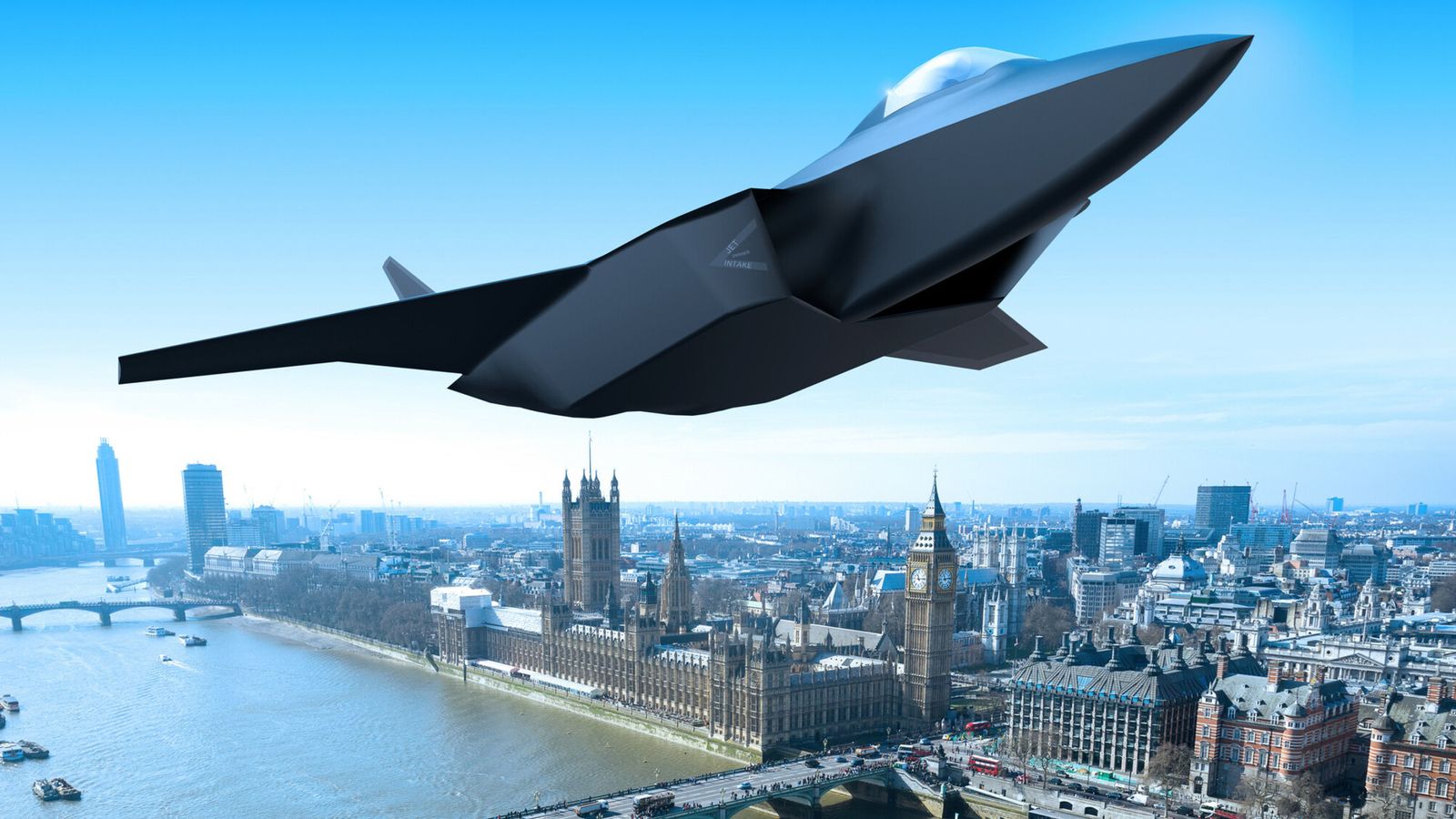
UK signs deal with Japan and Italy to build next generation fighter jets in Britain


The UK has signed an international treaty with Japan and Italy to build the next generation of stealth fighter jet.
The deal will see the headquarters for the Global Combat Air Programme (GCAP), the defence partnership between the three nations, based in Britain.
Prime Minister Rishi Sunak announced the collaborative international effort to build military planes with supersonic capability and cutting-edge technology a year ago.
Called Tempest in the UK, the ambition is for them to take to the skies by 2035 and serve as a successor to the RAF Typhoon.
The Ministry of Defence (MOD) said the signing of the treaty in Tokyo on Thursday marked a “key stage” in the development of the aircraft.
Pilots will be able to use virtual reality in the aircraft’s digital cockpit
Defence Secretary Grant Shapps was in the Japanese capital to sign the document alongside his Italian and Japanese counterparts, Guido Crosetto and Minoru Kihara.
He said: “Our world-leading combat aircraft programme aims to be crucial to global security and we continue to make hugely positive progress toward delivery of the new jets to our respective air forces in 2035.
“The UK-based headquarters will also see us make important decisions collaboratively and at pace, working with our close partners Italy and Japan, and our impressive defence industries, to deliver an outstanding aircraft.”
When complete, the Tempest will boast a powerful radar that can provide 10,000 times more data than current systems, the MOD said.
Pilots will be able to use virtual reality in the aircraft’s digital cockpit, with vital information displayed directly in front of them.
The on-board weapons system will deploy artificial intelligence and machine learning to “maximise the effect” its arsenal can deliver, the department said.
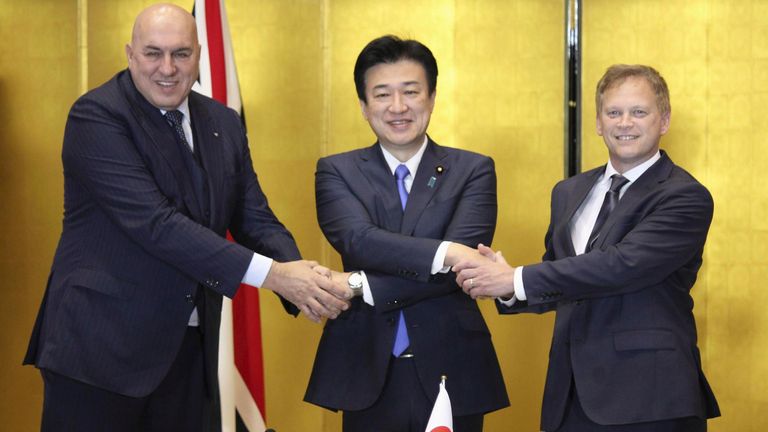
Grant Shapps (R) with the Italian and Japanese defence ministers Guido Crosetto (R) and Minoru Kihara at the treaty signing ceremony Pic: AP
Read more:
Photograph captures moment RAF jets appear to have a near miss
Defence cuts will affect UK’s ability to fight from the air
Some £2bn has been committed to the project by the UK Government up to 2025, with the investment announced in 2021 before the partnership with the other two nations on GCAP was confirmed.
The MOD awarded the contract to BAE Systems, in collaboration with Leonardo UK, missile maker MBDA UK and Rolls-Royce, as well as industry partners from Japan and Italy.
Joint development of the aircraft is due to start in 2025.
The treaty confirms that the UK will host the joint GCAP government headquarters, with a Japanese chief executive at the helm at the outset.
Locations for the government HQ and a separate industry base, which will also be in the UK and led by an Italian, are to be announced in “due course”, the MOD said, along with a timeline for opening.
The department said the offices will support UK jobs and facilitate close working with Japanese and Italian colleagues.
The next step is for the treaty signed by the allies on Thursday to be sent to all three national parliaments for ratification.



The first-ever Capture case has been delayed at the Court of Appeal as the Post Office asks for an extension to respond, Sky News has learned.
Pat Owen, a former sub postmistress who has since passed away, was convicted of stealing in 1998 based on evidence from computer software.
The system, known as Capture, was used in up to 2,500 branches in the 1990s, before the infamous Horizon system was introduced.
Hundreds of sub-postmasters were wrongfully convicted between 1999 and 2015 as part of the Horizon scandal.
Earlier this year, Sky News unearthed a 1998 report showing the Capture software was also faulty.
That report, commissioned by the solicitors acting for Mrs Owen in 1998, was served on the Post Office and may never have been seen by the jury in her case.
‘All we want is her name cleared’
Ms Owen was given a suspended prison sentence and fought to clear her name subsequently – but died in 2003.
Her case was referred by the Criminal Cases Review Commission (CCRC) to the Court of Appeal in October.
The Post Office had until 5 December to respond to papers put forward by Mrs Owen’s defence team but they have now asked for an extension until 30 January.
Ms Owen’s daughter, Juliet Shardlow, described the family’s suffering at the lengthening wait.
“I need to emphasise the profound impact the ongoing delay is having on our family,” she said.
“The continuous uncertainty only compounds our heartache, stress, and anxiety.
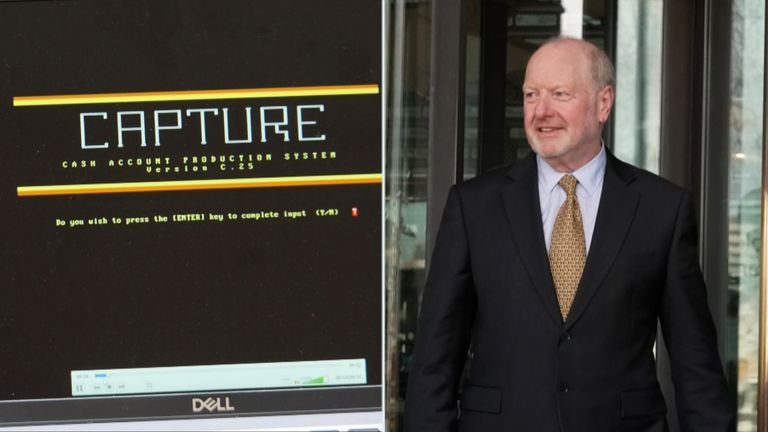
Alan Bates: New redress scheme ‘half-baked’
“It has become the last thing I think about before I go to sleep and the first thing when I wake up.
“We have waited 27 years for justice, and this additional wait feels never-ending.”
Ms Owen’s case is the first time a conviction based on Capture has reached the Court of Appeal since the scandal was exposed.
Read more from Sky News:
Corporate manslaughter charges considered in Post Office scandal
21 ‘Capture’ cases investigated for miscarriages of justice
Lawyers have said that if Ms Owen is exonerated posthumously, it may “speed up” the handling of others.
CCRC chair Dame Vera Baird also told Sky News in the summer it could be a “touchstone case” for other victims.
The CCRC is also continuing to investigate around 30 other “pre-Horizon” convictions.
A Post Office spokesperson said: “We have sought an extension of time to fully consider and respond to the CCRC’s Statement of Reasons in Ms Owen’s case.
“We deeply regret the impact our request for further time will have on Ms Owen’s family.
“We have a duty to carefully consider the evidence presented in the Statement of Reasons submitted by the CCRC and do everything we can to fully assist the Court when it considers this conviction.”
Meanwhile, the first-ever redress scheme for victims of the Post Office Capture IT scandal was launched this autumn.
The Capture Redress Scheme will provide payments of up to £300,000, and more in “exceptional” cases, to former postmasters who suffered financial losses.

-
 Sports2 years ago
Story injured on diving stop, exits Red Sox game
-
 Sports3 years ago
‘Storybook stuff’: Inside the night Bryce Harper sent the Phillies to the World Series
-
 Sports2 years ago
Game 1 of WS least-watched in recorded history
-
 Sports3 years ago
Button battles heat exhaustion in NASCAR debut
-
 Sports3 years ago
MLB Rank 2023: Ranking baseball’s top 100 players
-
Sports4 years ago
Team Europe easily wins 4th straight Laver Cup
-
 Environment3 years ago
Japan and South Korea have a lot at stake in a free and open South China Sea
-
 Environment1 year ago
Here are the best electric bikes you can buy at every price level in October 2024