
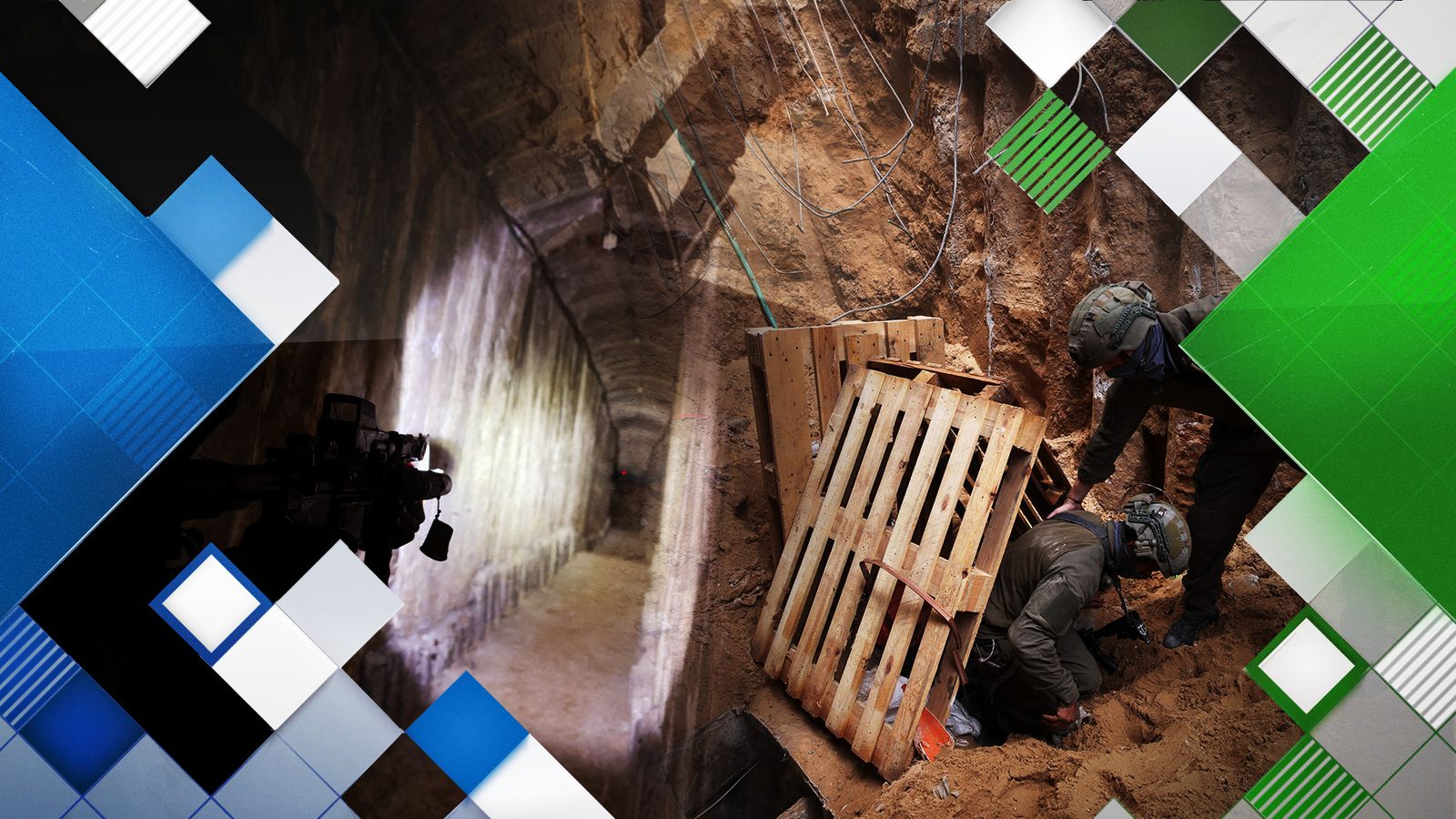
If Hamas planned to attract eyes of the world on Gaza for two-state solution, history might judge it a prudent strategy

On 7 October 2023, Hamas attacked Israel, killing 1200 people, seizing over 230 hostages, and committing a series of atrocities. The appalling act of violence shocked the world and led to Israel declaring war on the militant group.
Hamas – despite military support from Iran – would have known that it was no match militarily for Israel, yet its vast network of tunnels has provided the fighters with an asymmetric advantage in this war.
Do the tunnels represent a flagrant misuse of financial resources intended to provide aid to Palestinians, or are they a very astute investment by Hamas on behalf of the Palestinian people?
Nothing can justify the atrocities committed by Hamas on that fateful October day; however, this was no “spur of the moment” attack – it was well planned, over several years, with a specific aim in mind.
‘Gaza a graveyard for children’
Over many decades, traditional political dialogue and negotiation to establish a way for Palestinians and Israelis to co-exist peacefully has failed. Meanwhile, Israel has increasingly exploited its military dominance to ramp up pressure on Palestinians living in Gaza and the West Bank.
Palestinian residents of Gaza have seen unemployment soar to 50%, standards of living decline consistently, and in the absence of any tangible political progress to address this cycle of decline, Hamas capitalised.
Hamas offered hope. When conventional politics fails, a fresh approach is required. Israelis and Palestinians are no longer capable of seeing beyond the red mist of conflict, so an enduring peace will only be achieved through external international engagement – specifically the US and Saudi Arabia.
But what would be the catalyst to provoke international engagement in such an intractable issue?
Click to subscribe to the Sky News Daily wherever you get your podcasts
Hamas would have known that its 7 October attacks would incur the wrath of Israel and precipitate a major conflict that it could not win.
But it would also know that US intervention had ended previous conflicts, so by initiating a major conflict Hamas would shine a spotlight on the region and perhaps kick-start progress towards an enduring two-state solution.
Read more:
UN Security Council agrees resolution to speed up Gaza aid
Sky News witnesses chaos of Israeli drone strike – as dead child pulled from rubble
British destroyer to join international task force protecting the Red Sea
However, Hamas also knew that Israel would be determined to destroy the group, so it needed to find a way to survive against a vastly superior military force. The answer lay in the tunnel network.
Experience had shown that a well-designed network with power, comms, security and protection, could provide Hamas with an asymmetric advantage, and they invested accordingly.
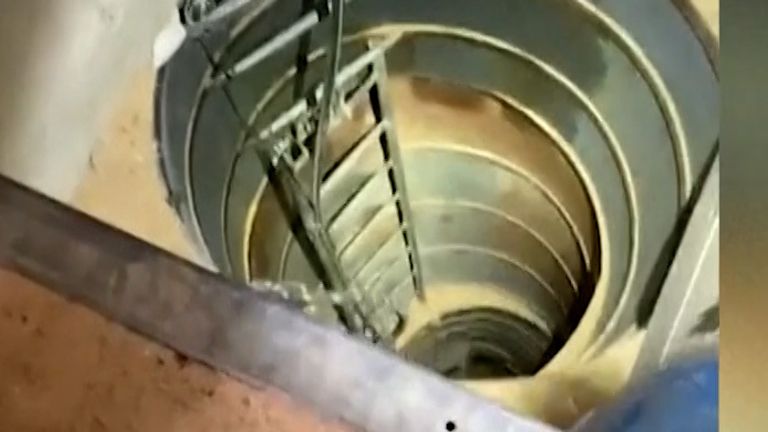
Israel military destroys Gaza tunnels
In 2014 alone it is estimated that Hamas spent up to $90m (£70m) and poured 600,000 tonnes of concrete on developing the tunnel network. The strategy has succeeded in creating a subterranean stronghold for Hamas.
But the war provoked by Hamas has resulted in huge casualties – over 20,000 Palestinians (including Hamas fighters) killed and over 50,000 injured. Would Palestinians believe this was a price worth paying?
Despite the IDF’s military response to the 7 October attacks, Hamas has increased in popularity from 38 to 42% of Gaza residents. And although Hamas does not control the West Bank, decades of growing Israeli pressure on Palestinians living in the region has led to a surge in popularity for Hamas from 12% to 44%. Why?
‘Senior Hamas operative driven in tunnel’
The war has led to Israel admitting that it has no intention of pursuing a two-state solution. If Hamas had not acted, would Israel’s undeclared end-state have eventually denied Palestinians their right to self-determination and peaceful co-existence?
In contrast, Hamas’s stated intent to destroy the Israeli state is widely condemned as extremism; however, away from the extremist rhetoric, is Israel’s pursuit of a one-state solution any more palatable?
Hamas’s investment in the tunnel network might have diverted from the aid budget for Gaza, but if its intent was to attract international attention to ensure a more sustainable long-term solution for the region, history might judge that a prudent strategy.
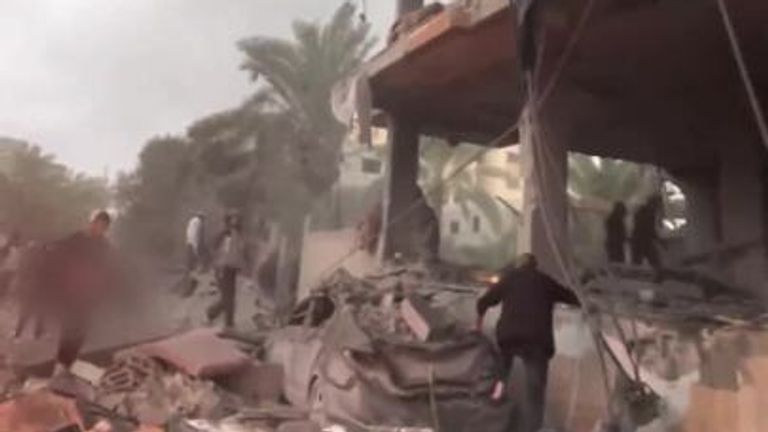
‘Safe’ Gaza areas hit
This in no way justifies Hamas’s brutal atrocities on 7 October.
However, if an enduring solution is to be found, the international community must look beyond the polarising acerbic rhetoric and recognise the huge weight of responsibility on its shoulders. If the Palestinian “cry for help” goes unheeded, the cycle of violence looks destined to continue.
Hope must replace despair, with opportunity inspiring a new generation. Failure – or indeed just “doing nothing” – will perpetuate the decades of violence, provide a recruiting ground for extremism, and risk the very future of Palestinians in the region.
This is not about taking sides. It is about placing humanity as the primary focus, and changing the narrative from one of conflict, anger and hatred, to one of compromise, accommodation and hope.
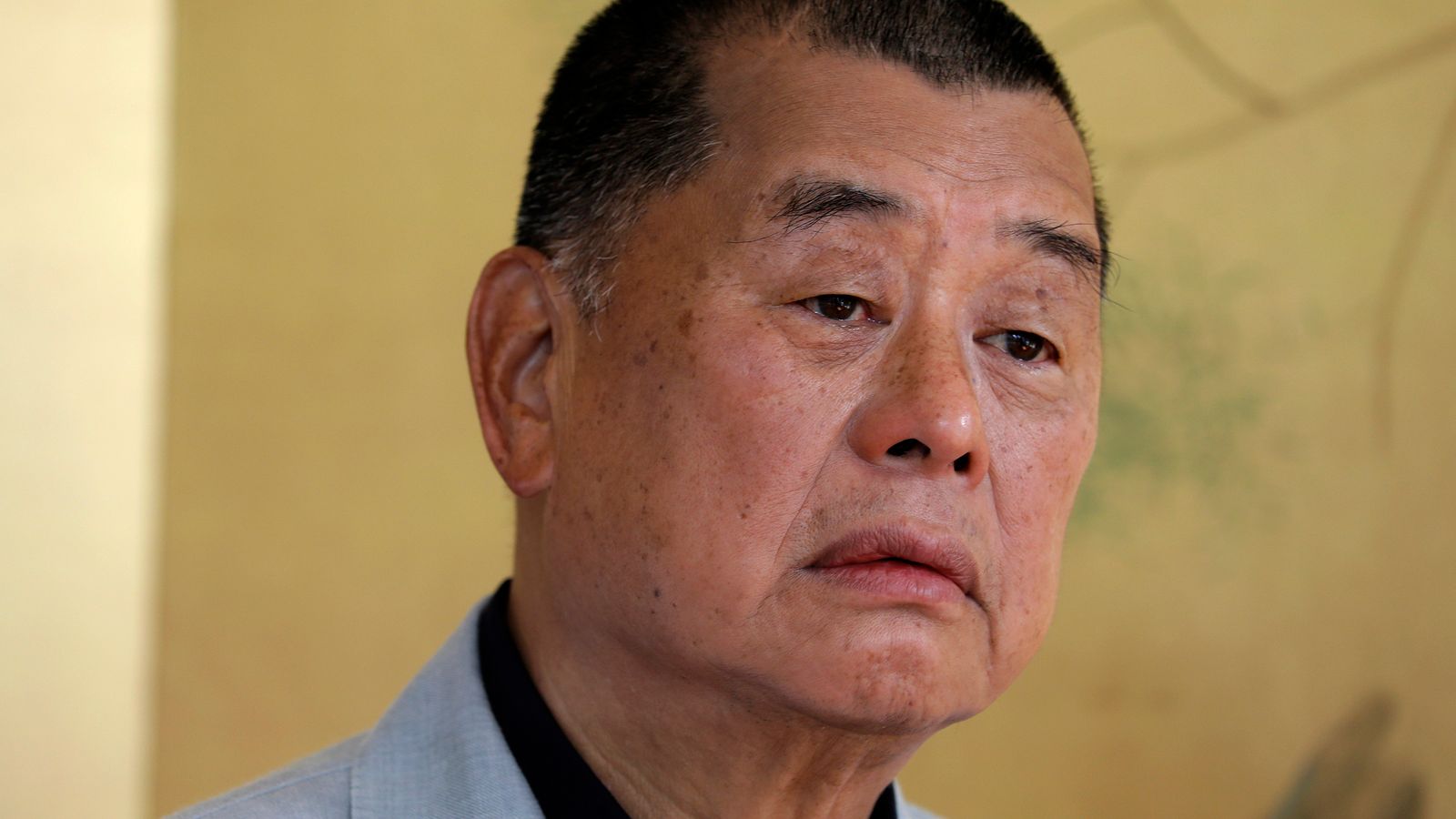
Pro-democracy campaigner Jimmy Lai has been found guilty of national security offences in Hong Kong.
The media tycoon and British citizen, 78, was arrested in August 2020 after China imposed a national security law following massive anti-government protests in Hong Kong.
Sky News’ Asia correspondent Helen-Ann Smith, who is at West Kowloon Law Courts Building, said Mr Lai looked “drawn and thin” as he listened to the verdict being delivered.
He had previously been sentenced for several lesser offences during his five years in prison.
Mr Lai, who founded the now-defunct pro-democracy newspaper Apple Daily, was charged with two counts of conspiracy to commit collusion with foreign forces to endanger national security, as well as one count of conspiracy to distribute seditious publications.
He has been found guilty of all three charges.
His trial, heard by three judges approved by the government without a jury present, has been closely monitored by the UK, the US, the European Union and political observers as a barometer of media freedom and judicial independence in the former British colony, which returned to Chinese rule in 1997.
Mr Lai has spent more than 1,800 days in solitary confinement. His family say his health has worsened as a result and that he suffers from diabetes, high blood pressure and heart palpitations.
In August, Mr Lai’s son, Sebastien, told Sky News that unless the British government (of which Mr Lai is a citizen) intervenes, his father “is most likely going to die in jail”.
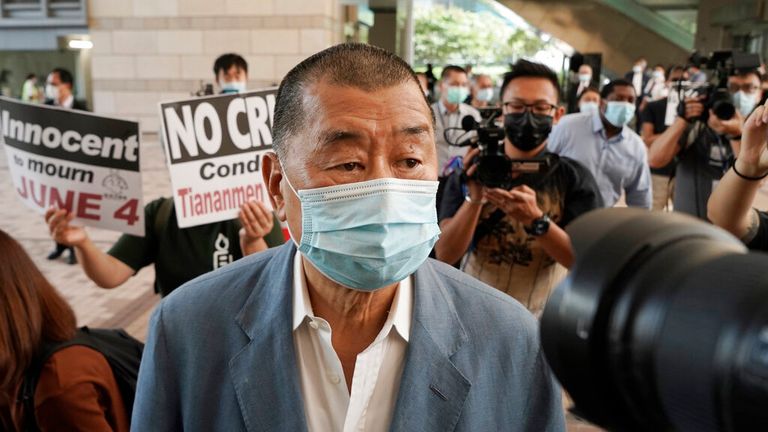
Lai arriving at court in 2020. Pic: AP
Sebastien said his father’s death would not just be a personal tragedy, but a huge problem for both the Hong Kong authorities and Beijing’s government.
“You can’t tell the world you have the rule of law, the free press and all these values that are instrumental to a financial centre and still have my father in jail,” he told Sky News.
“And if he dies, that’s it, that’s a comma on Hong Kong as a financial centre.”
This breaking news story is being updated and more details will be published shortly.
Please refresh the page for the latest version.

Listen to The World with Richard Engel and Yalda Hakim every Wednesday
You can receive breaking news alerts on a smartphone or tablet via the Sky News app. You can also follow us on WhatsApp and subscribe to our YouTube channel to keep up with the latest news.
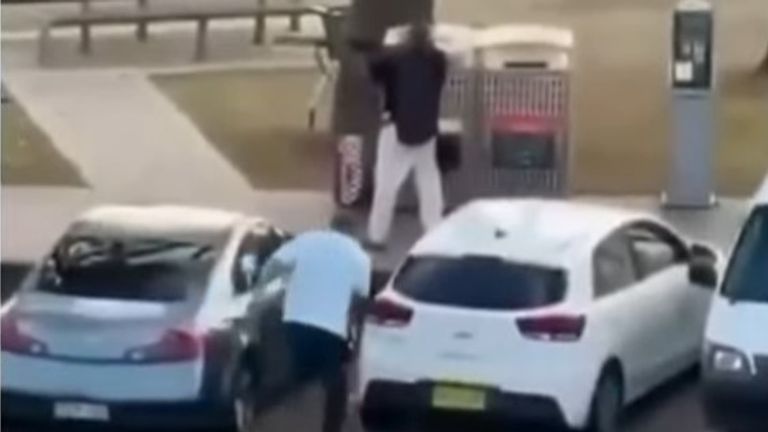
A bystander hailed a hero after he tackled and disarmed one of the gunmen in the Bondi Beach shooting is a shop owner.
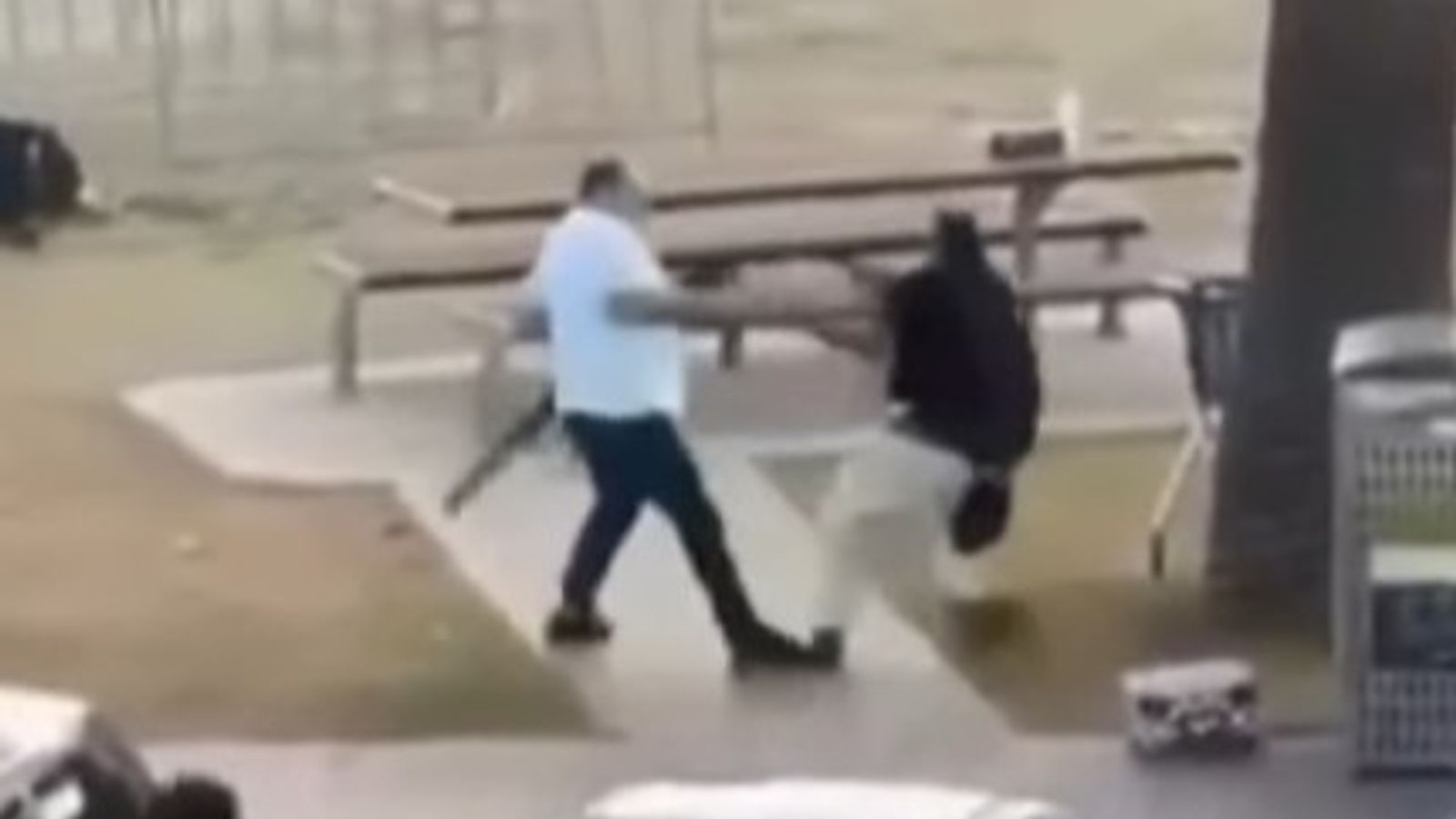
The man, named by a relative as 43-year-old Ahmed al Ahmed, was seen in a video running up to the attacker from behind and then grabbing the shotgun from his hands before pointing the weapon back at him.
The footage then showed the terrorist heading towards a bridge where another gunman was located, while the bystander placed the gun beside a tree.
Ahmed al Ahmed (in a white T-shirt) is seen in a video running up to a gunman from behind
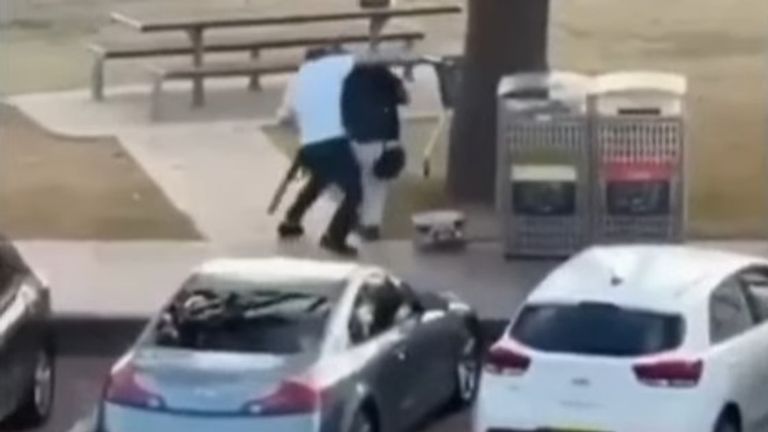
Mr Ahmed then wrestles with the attacker
Live updates on Sydney shooting
Mr Ahmed, who was wearing a white T-shirt, was shot twice in the incident and was due to have surgery, his cousin, Mustafa, has revealed.
In a video on 7News, Mr Ahmed appeared to have a bloodied arm and hand, and was helped by other people near the scene in the Australian city.
At least 11 people were killed and 29 others injured in the attack when two gunmen opened fire from a bridge on crowds at a Jewish event around 6pm local time on Sunday evening.
More than 1,000 people had been at the gathering which was celebrating the festival of Hanukkah.
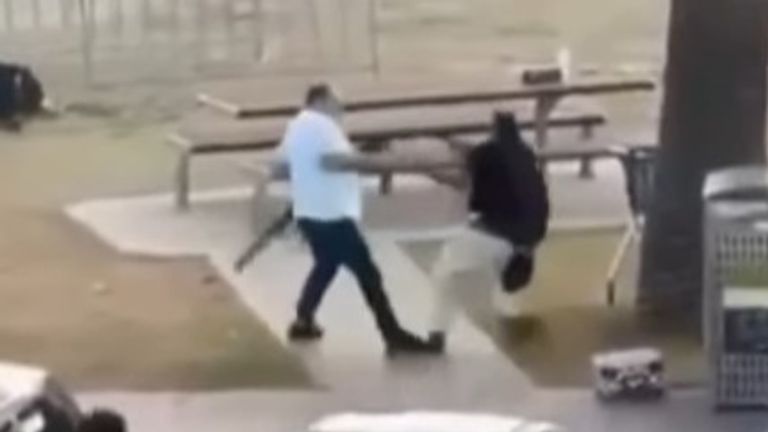
Mr Ahmed manages to get the gun off the terrorist
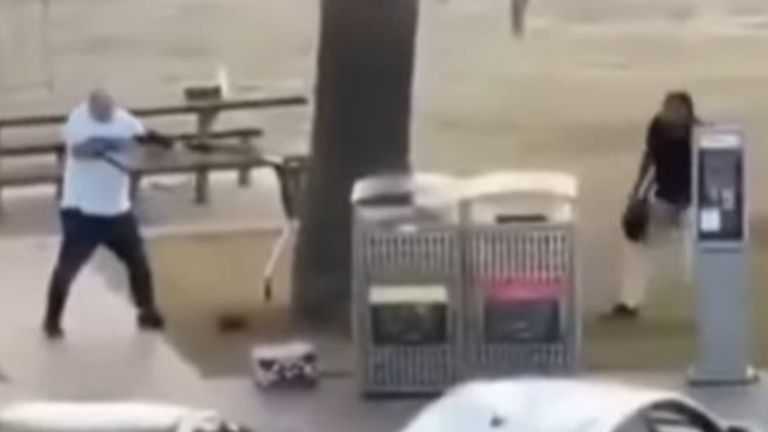
The bystander then points the weapon at the attacker who moves away towards a bridge
A gunman was killed and another was in a critical condition following the shooting.
One of the suspects was 24-year-old Naveed Akram.
His driver’s licence says he lives in Bonnyrigg, a suburb of Sydney. The identity of the other suspected attacker is not known.
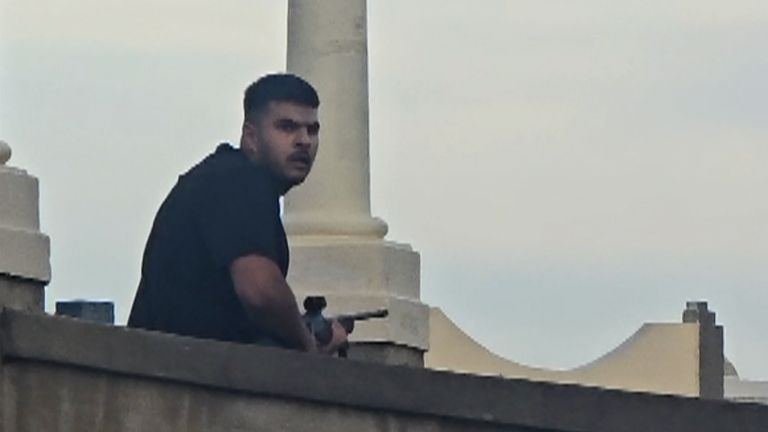
Naveed Akram, 24, was one of the suspects
Mustafa said father-of-two Mr Ahmed, who owns a fruit shop in the Sydney suburb of Sutherland, did not have any experience with guns but was just walking past when he decided to step in.
He told 7News: “He’s in hospital and we don’t know exactly what’s going on inside.
“We do hope he will be fine. He’s a hero, 100%.”
Read more:
What we know about mass shooting
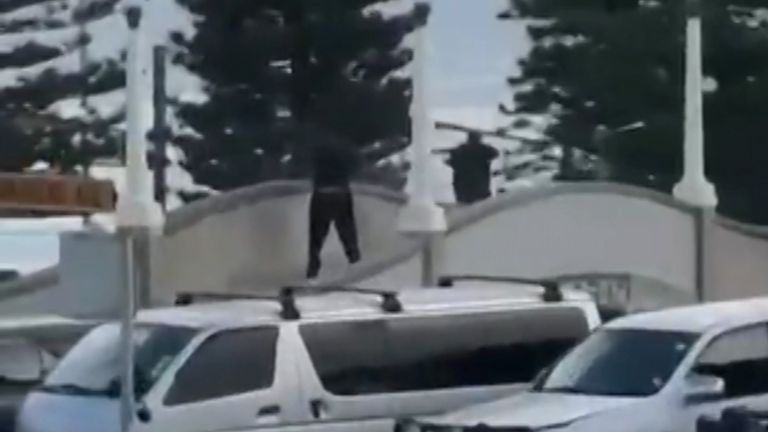
One of the suspected gunmen has been named as 24-year-old Naveed Akram.
The footage of the bystander’s actions spread quickly on social media as people praised the man for his bravery, saying his actions had potentially saved many lives.
“Australian hero (random civilian) wrestles gun off attacker and disarms him. Some people are brave and then some people are… whatever this is,” one person said on X, sharing the video.
“This Australian man saved countless lives by stripping the gun off one of the terrorists at Bondi beach. HERO,” another said.
Chris Minns, the premier of New South Wales state, where Sydney is located, said it was the “most unbelievable scene I’ve ever seen”.
“A man walking up to a gunman who had fired on the community and single-handedly disarming him, putting his own life at risk to save the lives of countless other people.”
“That man is a genuine hero, and I’ve got no doubt that there are many, many people alive tonight as a result of his bravery,” he added.
The country’s prime minister Anthony Albanese praised the actions of Australians who had “run towards danger in order to help others”.
“These Australians are heroes and their bravery has saved lives,” he told a news conference.
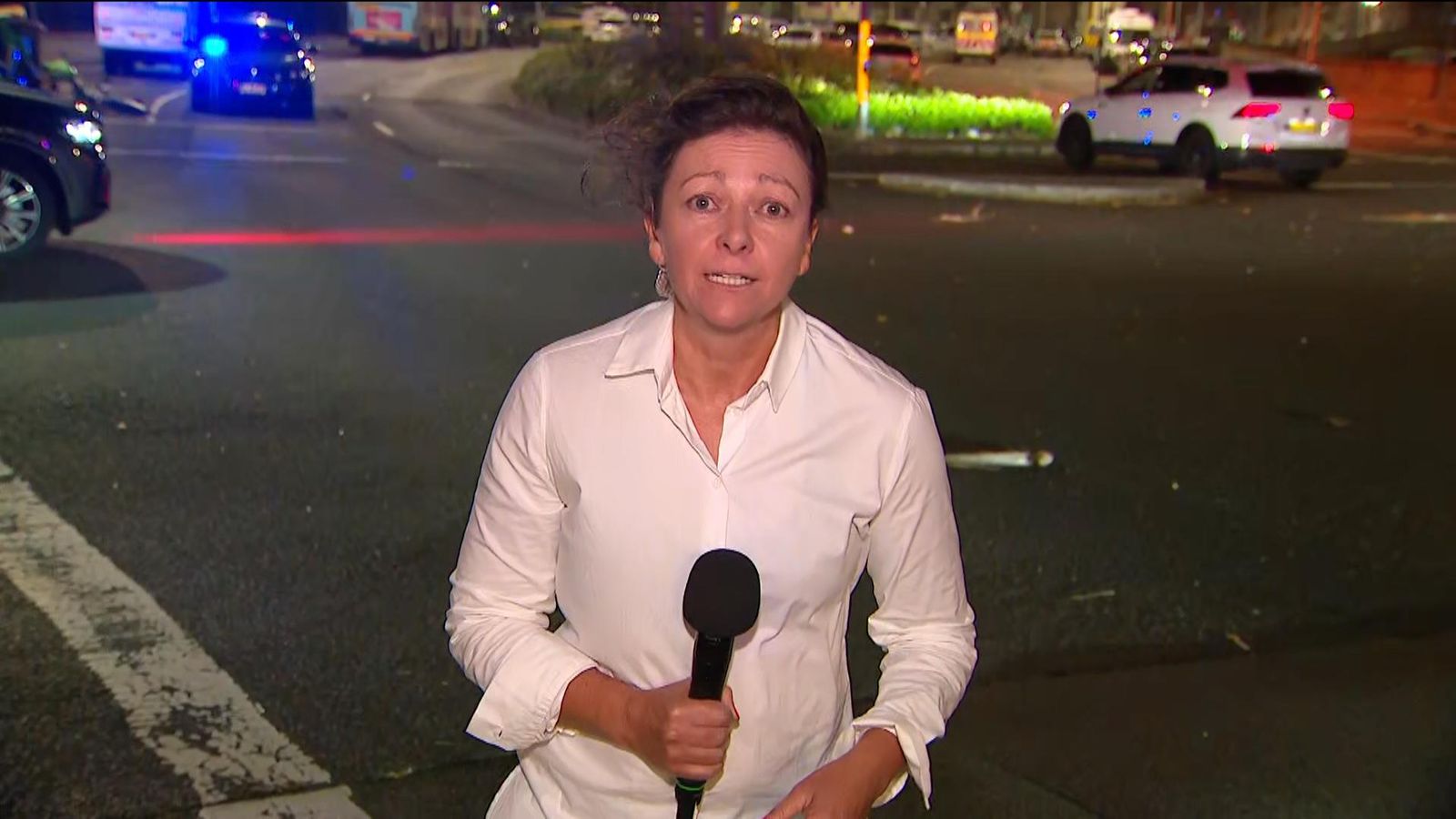
Messages were sweeping across Sydney within minutes of the attack at Bondi Beach.
Parents messaged their children and teenagers, who had been enjoying a late afternoon swim at Bondi.
Witnesses said police were on the scene quickly, and the streets of Sydney’s eastern suburbs were full of police cars and ambulances on their way to Bondi.
Follow live: 11 people killed at event celebrating Hanukkah
When we arrived, there were still dozens of people processing what had happened, and everywhere – shock.
Witnesses told us that when the gunfire started some people took cover in the North Bondi Surf Life Saving Club. Once the threat was over, lifeguards helped the injured and used surfboards to carry them out.
Witnesses tell Sky’s Nicole Johnston of Bondi ‘warzone’
Some people were clearly traumatised and provided graphic detail of witnessing the shooting and seeing people killed in front of them.
A photographer, Danny, was covering the Jewish holiday event.
Read more: What we know so far
He said he “locked eyes” with one of the gunmen, who then fired towards him. Danny said he was grazed by a bullet. He kept filming during the shooting, while taking cover.
Sam, from France, was working at Bondi. He went to the scene of the attack and saw almost a dozen people lying on the ground covered in blood. Sam described it as like a “war zone”.
Rabbi Lei Wolff, from Central Synagogue in Sydney, went to Bondi as soon as he heard about the mass shooting. A dear friend of his, Rabbi Eli Schlanger, was killed in the attack.
Rabbi Wolff has called on people around the world to stand with Australia’s Jewish community against terrorism.
-
 Sports2 years ago
Story injured on diving stop, exits Red Sox game
-
 Sports3 years ago
‘Storybook stuff’: Inside the night Bryce Harper sent the Phillies to the World Series
-
 Sports2 years ago
Game 1 of WS least-watched in recorded history
-
 Sports3 years ago
Button battles heat exhaustion in NASCAR debut
-
 Sports3 years ago
MLB Rank 2023: Ranking baseball’s top 100 players
-
Sports4 years ago
Team Europe easily wins 4th straight Laver Cup
-
 Environment3 years ago
Japan and South Korea have a lot at stake in a free and open South China Sea
-
 Environment1 year ago
Here are the best electric bikes you can buy at every price level in October 2024