
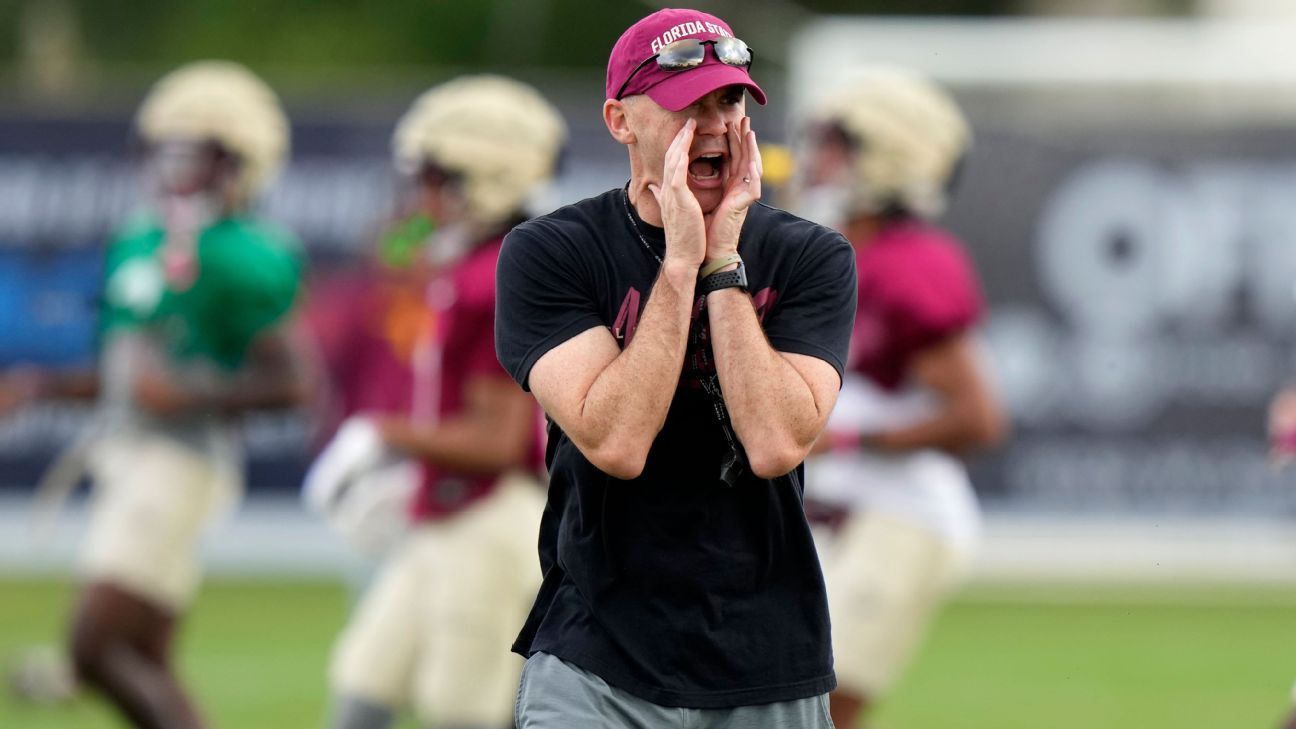
How Mike Norvell keeps Florida State moving forward after a stunning CFP snub


-
David Hale, ESPN Staff Writer
DANIA BEACH, Fla. — There’s a moment, a split second, really, just as the weight of the College Playoff Committee’s verdict takes hold for the rest of the Florida State team, that it seems as if the impenetrable wall of optimism and enthusiasm that is Seminoles head coach Mike Norvell might finally collapse.
In the video from the team’s watch party Dec. 3, which was broadcast on national TV following the committee’s most controversial decision in its 10-year history, Norvell is seated center frame, surrounded by his players, including injured QB Jordan Travis just a few feet away. The announcement is made. Groans echo through the room. Travis covers his face with a towel. Players turn to each other in disbelief. Norvell is still.
He taps the tips of his fingers together. He tilts his head downward. It’s instantly obvious he was completely unprepared for this eventuality, and it’s not hard to imagine a war of will roiling in his mind between the entirely reasonable furor that must’ve been his natural response and the measured determination that has become his stock-in-trade through four years leading this program.
This is the moment it should come — the eruption, the anger, the outrage, the flurry of epithets directed at a faraway group of people who upended his worldview, the worldview he’d sold to this team for years, the one that had carried Florida State to 19 straight wins and an undefeated season.
But Norvell catches himself.
He says nothing. He turns and looks at his players. He is still and silent for nearly 10 seconds, though it feels so much longer.
And then he stands up, and he addresses his players.
“This has been the most challenging couple of weeks of coaching I’ve ever had,” Norvell would say 17 days later, the emotion still raw in his voice.
The challenge got bigger after that moment. Nearly two dozen key contributors from this season have opted out, entered the transfer portal or been sidelined with an injury. Florida State won’t play for a national championship, but it will play the two-time defending champs in Georgia in the Capital One Orange Bowl (4 p.m. ET on ESPN) with a third-string QB and a host of new faces at the offensive skill positions. Moreover, Florida State will take the next step — the final step of the 2023 season — knowing the ethos that was the foundation of this year’s 12-0 season was dismantled in a single moment.
And yet, for those who remain at Florida State, the motivation to move forward came in those 10 seconds of silence when Norvell decided to meet the most difficult moment of his coaching career not with anger but with resolve.
In the aftermath of the lowest point of his coaching career, Norvell is doubling down on what he’s always preached.
“I haven’t seen Mike blink at all,” defensive coordinator Adam Fuller said.
HE’S STILL ANGRY. He’ll always be angry, he said.
But before FSU’s title hopes were dashed, Norvell started every day with a boisterous “Good morning!” and, more often than not, ended it the same way — a tongue-in-cheek “Good morning!” at 11 p.m., an in-joke to illustrate just how consistent he is.
So even if he’s still seething over the committee’s decision, each new day at FSU begins the same way.
“You get the ‘Good morning!’ because he’s the same Coach Norvell every day,” linebacker Kalen DeLoach said. “That’s him, 365 days a year.”
There are other quirks of the Norvell experience that have been repeated to the point of obsession over the past few years at Florida State.
There’s the “CLIMB” mantra — an acronym for commitment, little things, intensity, mental toughness, brotherhood — which is etched over a photo of a mountain’s peak that hangs in his office. It’s about growth and progress, with the implication that today’s improvement is more important than the place where yesterday ended.
There’s the tagline he’s applied all season — “for years, actually,” offensive lineman Maurice Smith said — that “all we got is all we need.” In the early days at Florida State, it was an insistence that Florida State was good enough to win, in spite of overwhelming evidence to the contrary on the field, but it’s evolved as the Seminoles have crept ever higher on their journey, and it now serves as a badge of defiance, less about convincing the guys inside the locker room that they’re enough and more about insisting to the world outside that it’s overlooked something essential.
And there’s the old trope about controlling what you can control. There’s probably not a coach in the country who hasn’t said it, but Norvell lives it. He didn’t rage against COVID restrictions that kept him from meeting with his team for the vast majority of his first seven months on the job, and he didn’t throw up his hands in disgust when FSU blew a coverage on a Hail Mary throw to lose to FCS Jacksonville State, and he even laughed off a viral “Fire Mike Norvell” social media campaign after he lost top recruit Travis Hunter to Deion Sanders and Jackson State.
That’s what made his silence in the aftermath of the committee’s announcement so significant. It’s as close as he’s ever come to letting his emotions win out, he said, but if he’d done that, it would be evidence that some things outside his reach could still dictate his actions, and he refuses to allow that to happen.
“There’s opportunity, and that provides choice,” Norvell said. “The thing we continue to hammer with our guys through this journey is this could be a defining moment for you. Focus on your improvement and being better than what you’ve been. It’s hard. A lot of them were hurt. But I believe we’re going to continue to build through our experiences.”
It all would seem like a convenient set of gimmicks to bolster a wounded team after the nadir of its season, except that Norvell has been preaching the same things every day all season long.
“Leadership is not about making a speech,” Norvell said. “It’s about what you do on the field and in meeting rooms and how you approach every single day. You can talk, but if your actions don’t back that up, then nobody’s going to listen.”
WHEN BRADEN FISKE first arrived at Florida State last spring, a highly regarded but unproven transfer from Western Michigan, he was nursing an injury and couldn’t practice fully. But each day before practice, his head coach would sprint the length of the field at FSU’s indoor facility. Occasionally other players would join in, racing Norvell — 20 years their senior — into the end zone. Fiske figured he’d give it a try.
“Fiske can run, man,” receiver Keon Coleman said. “He’s got these little legs he gets going and — it’s funny.”
If Fiske’s sprints were good for a laugh, they also turned heads. It was during those runs folks around FSU realized they might have a star in Fiske. But it was also when Fiske realized how much different his coach at Florida State really was.
“He never misses a race,” Fiske said. “I miss a couple every now and then, depending on how the hamstrings feel, but he never misses a race, and that’s just the person he is and the coach he is.”
Fiske’s racing days are over, he said. He’s got a boot on his foot now as he prepares for Saturday’s Orange Bowl. But he’s still playing, still driven to win, and that’s due, in large part, to his coach.
“You can’t lack motivation when [Norvell] is walking through the building,” Fiske said. “People on the outside only see snippets but if you’re in the program and around it every day, it’s different. It’s different being with a man like Coach Norvell. When I first got here I thought for sure he was going to crack. It never happens. He’s the same man every day no matter what’s going on in his life or his program. That’s why we’re headed where we’re going.”
It’s hard to know exactly what this game means for Florida State now. Is it the final chapter of 2023’s magical season? Is it the first chance to turn the page on the committee’s decision and move forward toward something new? Is it some strange purgatory that is neither an end nor a beginning, but rather a placeholder, a rote exercise that exists on its own timeline?
The oddsmakers certainly don’t think Florida State has much of a chance to win. Norvell and AD Michael Alford have downplayed any interest in celebrating a de facto championship even if the Seminoles do claim victory in the Orange Bowl. And either way, when the calendar turns to 2024 and Norvell surveys what remains of his roster, he will find little similarity to the team that marched off the field in Charlotte with an ACC title and assurances that they’d done enough to earn something more.
“The worst part about it is that [watch party] was the last time that this team — players, coaches, staff — that we’ll all be together in one setting,” Fiske said.
And that’s the true significance of Norvell’s restraint in that moment. What the world will remember is the immense disappointment on the faces of every player in the room, the sadness at Travis’ tweet in which he wished he’d been injured sooner, the outrage that followed from FSU officials apoplectic at being passed over.
But what Norvell hopes the men in that room will remember is that, in one of their last moments together as a team, their head coach was the same guy he’d been in all the other moments they were together.
“We’re still at the beginning of where we’re going,” Norvell said. “There are great days ahead for this program. It still doesn’t give it back for the guys who’ve played their last game here at Florida State, but ultimately we’re excited for our opportunity.
“There’s going to be times in life where things don’t go the right way. What you’ve earned, you don’t always receive the reward for that. But you control your response — what you do with it, the attitude you bring — and that’s what’s going to define your identity.”

-
Greg Wyshynski
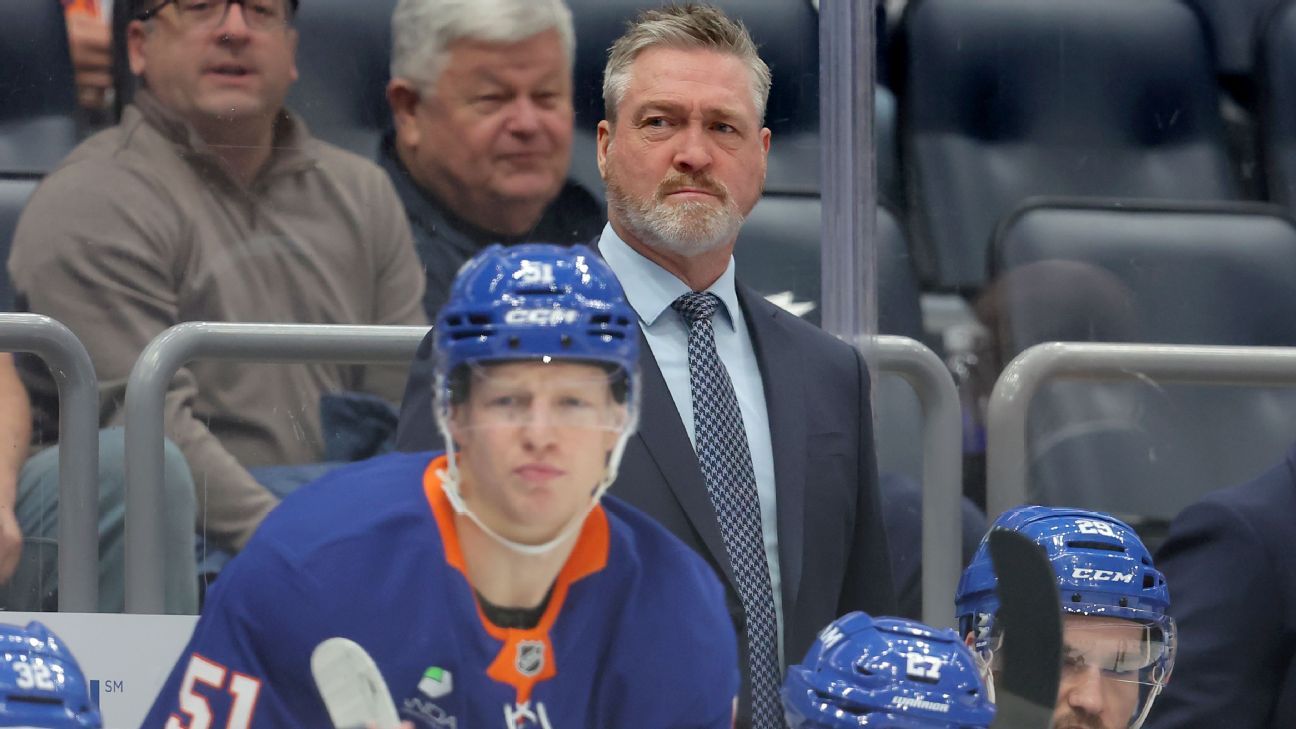
ELMONT, N.Y. — The Colorado Avalanche entered Thursday night’s game at the New York Islanders as a juggernaut, having lost just once in regulation in 26 games. Islanders coach Patrick Roy’s message to his team before that game: “If there’s a team that could surprise them, it’s us and the way we’ve been playing.”
St. Patrick was prophetic: Roy’s team defeated the mighty Avalanche 6-3 to snap Colorado’s 17-game point streak in a statement win for the Islanders (15-10-3).
The Islanders built a 4-0 lead against Colorado and responded every time the Avalanche crept back into the game. That included a late third-period penalty kill, as the Avalanche pulled goalie Mackenzie Blackwood for a 6-on-4 advantage. Forward Casey Cizikas iced the win with an empty-netter.
“That’s a really good hockey team over there,” Cizikas said. “They’ve proved it all season. They’re never out of a game, so you’ve got to complete it.”
Even after the loss, Colorado remained the NHL’s top team in points percentage (.815), goal differential (plus-47), offense (4.04 goals per game) and defense (2.19 goals against per game). The Avalanche have the NHL’s leading scorer in center Nathan MacKinnon (46 points) and the leading scorer among defenseman in Cale Makar (33 points).
But Islanders forward Mathew Barzal said New York’s 4-1 loss in Denver on Nov. 16 gave his teammates confidence they could hang with the NHL’s best.
“We feel like when we played them in Colorado, we probably should have won,” said Barzal, who had a goal and two assists in the win. “As a group, too, we know who we’re playing and that always makes a difference. Against Colorado, if we don’t show up, it could be ugly.”
The Islanders showed up on the scoresheet at 5:56 in the first period, on a controversial goal by forward Kyle MacLean. His shot sailed into the top corner of the net with Blackwood (36 saves) flat on the ice. Replays showed that after a scramble in the crease, the stick of Islanders center Marc Gatcomb had become wedged in Blackwood’s pads as Blackwood attempted to defend the net.
Colorado coach Jared Bednar challenged the goal. The NHL Situation Room cited Rule 69.7 in upholding the goal, which states that “in a rebound situation, or where a goalkeeper and attacking player(s) are simultaneously attempting to play a loose puck, whether inside or outside the crease, incidental contact with the goalkeeper will be permitted, and any goal that is scored as a result thereof will be allowed.”
Bednar disagreed with that assessment.
“Listen, I think goalie interference is a joke. If that’s not goalie interference, I don’t know what is. You can’t just shove the goalie’s pads out of the way to create a loose puck,” said Bednar. “I’m not going to challenge unless it’s obvious. And I thought that was obvious.”
On the other end of the ice, Islanders goalie Ilya Sorokin was great when he needed to be in making 35 saves against the high-octane Avalanche. Roy cited one save in the second period where Sorokin stopped Artturi Lehkonen on a 2-on-1 before Barzal increased their lead to 5-2 with a power-play goal.
“I think that gave us the confidence. Ilya made the key save at the right time,” said the coach.
The Islanders’ win over the Avalanche came on a poignant night at UBS Arena for the players. Their fathers and mentors were in attendance, ahead of their road trip to Florida. The game also marked the return of former Islanders star Brock Nelson, who was sent to Colorado at last season’s trade deadline. He received a standing ovation from Islanders fans after a video tribute.
It was just the second loss for the Avalanche (19-2-6) in the past 14 games.
“It’s closer than you think, but it still wasn’t good enough,” Bednar said. “We’ll refocus on the things that we need to do to make us successful.”
-
 Sports2 years ago
Story injured on diving stop, exits Red Sox game
-
 Sports3 years ago
‘Storybook stuff’: Inside the night Bryce Harper sent the Phillies to the World Series
-
 Sports2 years ago
Game 1 of WS least-watched in recorded history
-
 Sports3 years ago
Button battles heat exhaustion in NASCAR debut
-
 Sports3 years ago
MLB Rank 2023: Ranking baseball’s top 100 players
-
Sports4 years ago
Team Europe easily wins 4th straight Laver Cup
-
 Environment3 years ago
Japan and South Korea have a lot at stake in a free and open South China Sea
-
 Environment1 year ago
Here are the best electric bikes you can buy at every price level in October 2024