Connect with us

Published

on

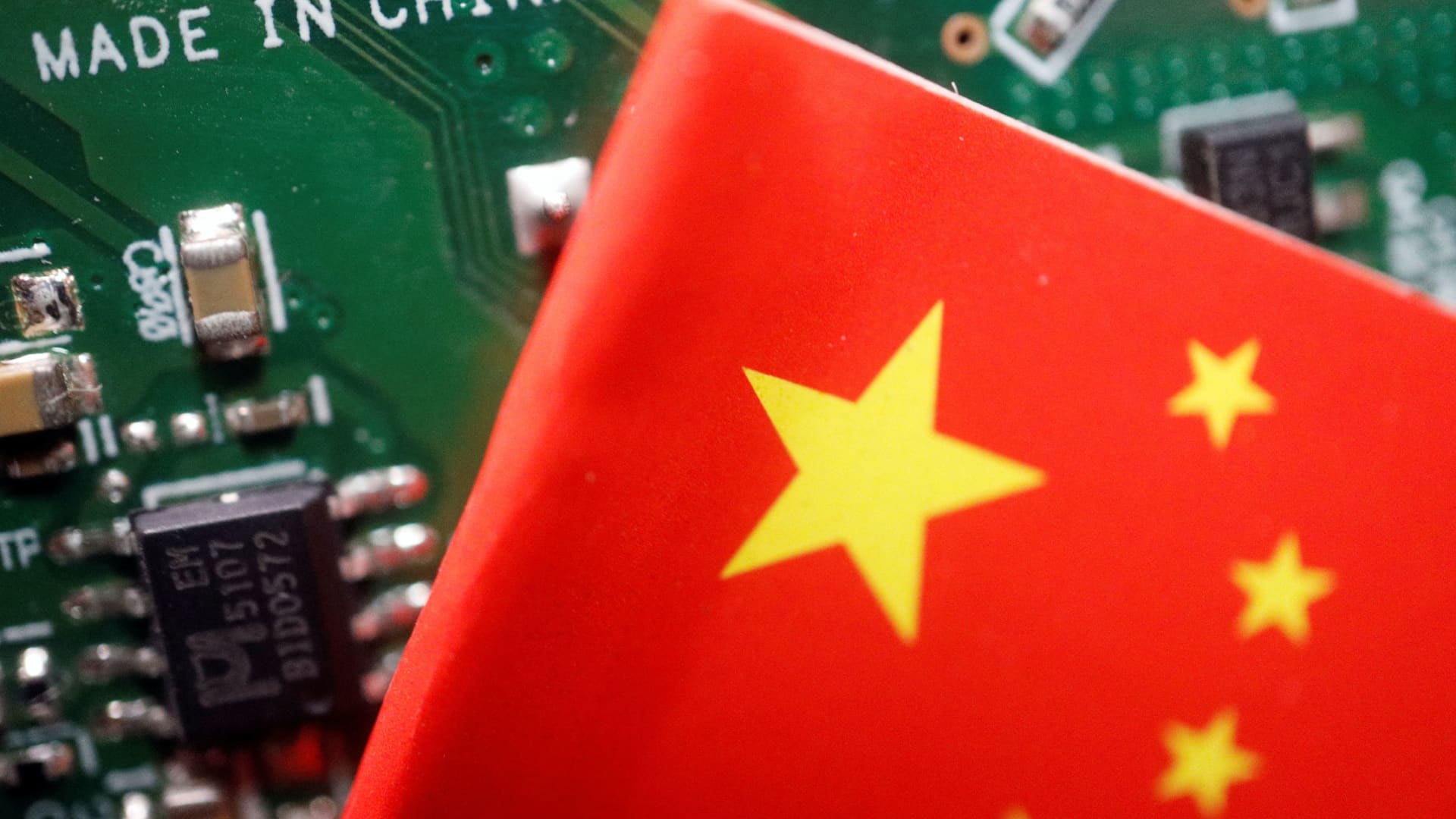
A Chinese flag is displayed next to a “Made in China” sign seen on a printed circuit board with semiconductor chips, in this illustration picture taken February 17, 2023. 

Florence Lo | Reuters

China could face more semiconductor export curbs from the likes of the U.S. and the Netherlands to contain the Asian powerhouse’s chip tech, analysts told CNBC.

Earlier this year, the Netherlands blocked Dutch semiconductor equipment maker ASML from exporting some of its deep ultraviolet lithography systems to China. ASML sells lithography machines that are key to manufacturing advanced chips.

It came after the U.S. tightened export controls on advanced semiconductors and chipmaking tools to China in October last year, building on previous rules. Washington is concerned that Beijing could use these advanced chips in artificial intelligence and military applications.

“I wouldn’t be surprised if there’s more [U.S. restrictions] coming just because we’re still in the middle of this tit-for-tat. And there’s a lot of hawks in the U.S. that are really concerned about China’s military buildup,” said Dan Hutcheson, vice chair and senior research fellow at TechInsights, on CNBC’s “Squawk Box Asia” Tuesday.

Beijing slammed the Dutch government’s move, urging the Netherlands to “uphold an objective and fair position and market principles.”

China’s Ministry of Commerce said last week that the U.S. is weaponizing export controls as a tool, adding that it is “highly concerned about the U.S.’s direct intervention” in the issue of high-tech exports by Dutch companies to China.

Analyst says he wouldn't be surprised if there are more U.S. chip export controls on China

“It’s further evidence that not just the U.S. government, but also other Western countries like the Dutch government, are going to keep ratcheting up some of the restrictions that we’ve seen around both chipmaking equipment and also advanced semiconductors,” Chris Miller, author of “Chip War” told CNBC’s “Squawk Box Asia” in early January.

In October, the U.S. banned the sales of the A800 and H800 chips that Nvidia specifically manufactured for the Chinese market.

Nvidia’s less powerful A800 and H800 chips were developed after the U.S. government banned shipments of the A100 and H100 chips — which are advanced graphics processing units sold to businesses — to China in August 2022.

With [U.S.] elections impending and political tension continuing to exist in the Taiwan Strait, it’s hard to envision a meaningful pull back on restrictions. If anything, I see further tightening.

Daniel Newman

Principal analyst, Futurum Research

This led Nvidia to launch even less powerful chips in China in December to comply with U.S. export restrictions.

“The U.S. government has signaled that they’re planning to roll out new export controls that do close loopholes on a regular basis,” said Miller.

China’s imports of integrated circuits in 2023 plunged amid U.S. curbs, falling 15.4% year-on-year to $349.4 billion in 2023, according to customs data released on Friday (Jan. 12). Shipment volume also declined by 10.8%, the data showed.

“With [U.S.] elections impending and political tension continuing to exist in the Taiwan Strait, it’s hard to envision a meaningful pull back on restrictions. If anything, I see further tightening,” Daniel Newman, principal analyst at Futurum Research, told CNBC last week.

China opposes Taiwan independence and has urged the U.S. to “stop arming Taiwan,” according to a readout on Jan. 10.

China seeks self-reliance

Western efforts to contain China’s high-tech progress have pushed the economic giant to look to its domestic firms to be self-reliant.

Since 2019, the U.S. has slapped sanctions on Chinese tech firms such as Huawei and China’s largest chipmaker SMIC, forcing Beijing to boost its domestic industry.

Revenue of China’s top 10 chip-equipment makers surged 39% in the first half of 2023 compared to a year earlier, according to Shanghai-based CINNO Research.

“I do think the short-term provides an advantage to the West, but China will do everything in its power to be sure it isn’t left out of the chip race,” said Futurum’s Newman.

China has traditionally been dependent on foreign firms for critical components.

After the Dutch government revoked the export license of ASML, Beijing no longer has access to some of the most advanced chipmaking tools in the world.

China has also been barred from importing ASML’s extreme ultraviolet lithography machines, which companies like Taiwan’s TSMC need to make the smallest and most sophisticated chips.

Continue Reading

Technology

CNBC Daily Open: Everyone’s watching the Netflix deal

Published

on

By

CNBC Daily Open: Everyone's watching the Netflix deal

The Netflix logo is pictured at the company’s offices on Vine in Los Angeles, California on Dec. 5, 2025.

Patrick T. Fallon | AFP | Getty Images

“Who’s watching?” Netflix asks whenever someone accesses its site. On Friday, it was probably everyone with an interest in business, markets and television.

The key characters that had people hooked were Netflix and Warner Bros. Discovery, which jointly announced that the streaming giant will acquire the latter’s film studio and streaming service, HBO Max. The equity deal value is pegged at $72 billion.

Netflix investors did not seem too jazzed about the deal, with shares dropping 2.89% on the sheer size of the transaction.

“Look, the math is going to hurt Netflix for a while. There’s no doubt,” Rich Greenfield, co-founder of LightShed Partners, told CNBC. “This is expensive,” he added.

But if one side is paying a lot, that means the other is receiving a bounty. Indeed, investors cheered the potential Warner Bros. Discovery windfall, sending the stock up 6.3% on the news.

It is not a done deal yet, and faces regulatory scrutiny. U.S. President Donald Trump said he would be involved in the decision, Reuters reported Monday, after a senior official from the Trump administration told CNBC’s Eamon Javers on Friday that they viewed the deal with “heavy scepticism.”

Despite this initial show of resistance, stranger things have happened in this administration, and the transaction might eventually go through. Should we get ready for Netflix’s next blockbuster: “The K-Pop Demon Hunters’ Song of Ice and Fire”?

What you need to know today

U.S. stocks had a positive Friday. The S&P 500 had its ninth winning session in 10 and rose 0.3% for the week. Europe’s regional Stoxx 600 closed flat. Separately, third-quarter euro zone economic growth was revised upward to 0.3%.

Netflix to buy Warner Bros. Discovery’s film and streaming businesses. The total equity value of the deal is $72 billion, announced the two companies Friday. But the transaction could run into regulatory hurdles.

Core inflation in the U.S. cools down. September’s core personal consumption expenditures price index was 2.8% on an annual basis, 0.1 percentage point lower than expectations and August’s figure. Other numbers were in line with expectations.

A Ukraine peace deal is ‘really close.’ That’s according to Keith Kellogg, the U.S. special envoy for Ukraine, who reportedly said Saturday that there were two key outstanding issues: the future of Ukraine’s Donbas region and its Zaporizhzhia nuclear power plant.

[PRO] Goldman Sachs unveils its top five global stocks. The picks are from China, Taiwan, India, Germany and the U.K. — and all offer an upside of at least 70%, according to the bank.

And finally…

The Sizewell A and B nuclear power stations, operated by Electricite de France SA (EDF), in Sizewell, UK, on Friday, Jan. 26, 2024. Photographer: Chris Ratcliffe/Bloomberg via Getty Images

Bloomberg | Bloomberg | Getty Images

The history of nuclear energy lies on British soil – does its future?

The U.K. once had more nuclear power stations than the U.S., USSR and France combined. It was a global producer until 1970 but hasn’t completed a new reactor since Sizewell B in 1995.

There is ambition to change that. Authorities want a quarter of the U.K.’s power to come from nuclear by 2050. The country is spreading its bets across tried-and-tested large nuclear projects and smaller, next-generation reactors known as small module reactors.

— Tasmin Lockwood

Continue Reading

Technology

Married millennials, here comes the crypto divorce cliff

Published

on

By

Married millennials, here comes the crypto divorce cliff

Fizkes | Istock | Getty Images

Divorce always raises thorny questions of how to divide marital property. In most cases, the remedy is pretty straightforward, requiring a surgical split between the two parties’ assets — although you can’t do that with the family dog or aquarium. But if you thought deciding who gets the dog was complicated, here comes cryptocurrency.

With the crypto wealth accumulation phase still new within many households, and the recent sharp decline in digital assets including bitcoin and ether dinging the confidence of investors who had just seen record highs, the path forward is murky. But for many married Americans, the current price of crypto doesn’t even register as an issue. That’s because the assets are easily squirreled away from an unsuspecting spouse.

“In divorce cases, crypto is creating the same headaches we’ve long seen with offshore accounts, except now the assets can be moved instantly and invisibly,” said Mark Grabowski, professor of cyber law and digital ethics at Adelphi University and author of several books about cryptocurrencies. He added that the problem is that ownership isn’t determined by a name on an account — it’s determined by who holds the private keys.

“If one spouse controls the wallet, they effectively control the assets,” Grabowski said.

Lawyers now have to subpoena exchanges, trace transactions on the blockchain, and determine whether coins were purchased before or during the marriage.

“Without that transparency and given the lack of reporting standards, it’s easy for one spouse to hide or underreport holdings. Courts are still catching up,” Grabowski said.

In theory, though, a crypto divorce should work like any other. Renee Bauer, a divorce attorney who has dealt with crypto splits, says the biggest question couples fight about is simple on the surface: who gets the wallet?

“That question opens the door to a mess of complications that traditional property division never had to deal with,” Bauer said.

The first challenge is figuring out what actually exists.

“A retirement account comes with statements. A house has an address. Crypto may be sitting in an online exchange or in a hardware wallet that one spouse conveniently forgot to mention,” Bauer said.

Tracing it then becomes part detective work and part digital forensics. Once the digital asset is authenticated, hashing out custody comes next.

“Some spouses want to keep the digital wallet intact, especially if they are the one who managed it during the marriage, while others want a clean monetary split,” Bauer said.

Courts are still figuring out the best way to handle this.

“There is also the security piece. If one spouse hands over private keys, they are effectively turning over total control. If they refuse, the court has to decide how to enforce access,” Bauer said.

She recounts seeing one lawyer who didn’t know much about crypto try to give the other spouse credit for the value of the bitcoin in another asset, not recognizing it’s not so simple, nor fair.

“Many divorce lawyers are slow to catch up and don’t even ask for disclosure. In my state of Connecticut, there isn’t a spot for crypto specifically on the financial affidavits. And for some, that could mean missing a valuable asset if they aren’t looking for it,” Bauer said.

Crypto hunters, PIs of digital asset divorce era

One of the few companies that can help locate a missing asset is BlockSquared Forensics. Ryan Settles, founder and CEO of the Texas-based company, says that the need for his services has increased exponentially since he founded his company in 2023. BlockSquared is dedicated exclusively to the crypto aspects of family law and divorce.

If a spouse (generally women, Settles says) suspects their partner is hiding crypto, their attorney may call in BlockSquared, which does anything from simple asset verification to deep investigations, tracing crypto across continents and into the murky world of wallets and exchanges. Settles’ company will then present the spouse with a “storyboard” that traces and timestamps the movement of cryptocurrencies.

Investigating whether one spouse has crypto is becoming increasingly common, he says, “especially folks involved in high-net-worth divorces and individuals with high net worth.”

Ryan Settles, founder and CEO of the Texas-based company BlockSquared Forensics, which offers services from simple asset verifications to deep investigations, often for women going through divorces who were unaware of spouses’ crypto holdings.

Ryan Settles

Ferreting out crypto in a divorce is only going to become more common. Settles noted that millennials hold the highest amount of crypto, and over the next six months, this age group will be approaching peak divorce years, converging with increased crypto holdings.

Another aspect Settles looks at is tax liability for the spouse, making sure that gets addressed during the divorce.

“There are a significant number of tax issues that most people, even attorneys, are not even familiar with,” Settles says, adding that the number of taxable events and reporting requirements from even a single transaction can come as a surprise to even the most seasoned litigators.

“Most attorneys don’t understand it, don’t understand the terminology. There is a whole lot of trust without verification going on,” Settles said.

Many of his cases involve wives who were not only unaware of their husband’s crypto dabbling, but when the assets are finally split, can be socked with a massive tax bill from capital gains.

“Unlike a savings account, the value of crypto can swing wildly in a single day,” Bauer said. “Selling crypto to divide proceeds can trigger capital gains. Holding it can trigger new arguments when value changes,” Bauer added.

Relatively relaxed Internal Revenue Service reporting requirements for crypto have not helped, though they are set to get stricter starting with the 2025 tax year.

“There are so many pieces. There are a lot of attorneys doing nod and smile and pretend to understand,” Settles said.

But companies like his are usually brought in only when there is a good suspicion of a spouse hiding significant crypto assets, he said. With a retainer fee of $9,000 and investigations that can cost $50,000, Settles says his services often cost more than an attorney.

Hard questions about crypto property splits

Roman Beck, a professor at Bentley University, where he directs the Crypto Ledger Lab, says that because this is a relatively new area, it’s best to look at it as courts not dividing the digital wallet but instead the assets the wallet controls.

“The law treats crypto much less exotically than people think. The starting point is simple: for tax and most property-law purposes, cryptocurrency is treated as property, not as money,” Beck said.

In divorce, that means bitcoin, ether, stablecoins, and NFTs acquired during the marriage are usually part of the marital estate, just like a brokerage account or a second home, with how that property is split depending on the state.

“Courts don’t split wallets, they split value,” Beck said.

The real legal question is not “Who gets the wallet?” he said, but ‘How do we allocate the economic value the wallet represents, and who is trusted with technical custody afterward?”

This leaves courts and lawyers to do one of three things: split the holdings on-chain, sell and split fiat, or offset with other assets.

“From a technical point of view, a wallet is just a set of private keys, often spread across hardware devices, mobile apps, or even seed phrases on a piece of paper. You cannot safely ‘share’ a hardware wallet or a private key after divorce,” Beck said.

Another wrinkle in a crypto divorce is the volatility of the underlying asset, with price swings in the currency making it more difficult for couples to agree on timing of a split, both as a couple and for the digital assets. In the past two months alone, bitcoin fell from a high over $126,000 to the low $80,000s, a 35% decline, and saw its year-to-date gains wiped out, with plenty of wild daily swings.

If couples are thinking rationally and not emotionally, among the simplest solutions would be splitting the wallet on a chain to create two wallets for each of the divorced partners so they can continue holding their share of cryptos, or drawing up a legal agreement that gives shares of a wallet to each party.

“They would not have to sell immediately,” Beck said.

However, often one party is not familiar with holding a wallet and thus not comfortable with that solution.

Similar to a house jointly owned which a divorcing couple may not want to bring to the market at a bad time, a couple could also agree to turn over crypto holdings to trusted third party to act as agent on behalf of both and to sell the crypto once the market has improved — once a certain agreed upon minimum value has been reached.

But Beck added that while from an economic and technical point of view there is no barrier preventing a divorcing couple from keeping crypto assets using any of these methods to allocate a legal percentage to each partner and delay liquidation until market conditions improved, both parties need to agree, and “most just want to be done,” he said.

Blockchain ledger transparency and the courts

One positive it that despite crypto’s reputation as a haven of anonymity, other aspects of digital assets work well for divorce proceedings.

“Public blockchains like bitcoin and ethereum are transparent ledgers. Every transaction is recorded forever. In other words, on-ledger data analytics turns the blockchain into a very patient financial witness,” Beck said. “That leaves a perfect audit trail if you know how to read the chain. … The real frontier isn’t the law, it’s the forensics,” he added.

Crypto’s adoption by many Americans — surveys in recent years from Gallup and Pew Research estimate that 14% to 17% of U.S. adults have owned cryptocurrency — is forcing family law to become more data-driven.

“The combination of transparent ledgers and powerful analytics gives lawyers and judges better tools to reconstruct financial behavior than they ever had with cash. The policy question going forward is not whether we can trace, but how far courts will go in requiring that level of scrutiny in everyday divorces,” Beck said.

Still, that doesn’t mean people won’t keep trying to hide assets. Settles says that often within 20 minutes he’ll see movement on the ledgers.

“They’ll start scrambling their assets, moving things, hiding things, moving them to tumblers. It’s quite fascinating,” Settles said.

And traceable.

Continue Reading

Technology

Week in review: Stocks rise, Meta gets real on metaverse, and Salesforce bounces

Published

on

By

Week in review: Stocks rise, Meta gets real on metaverse, and Salesforce bounces

Continue Reading

Trending