
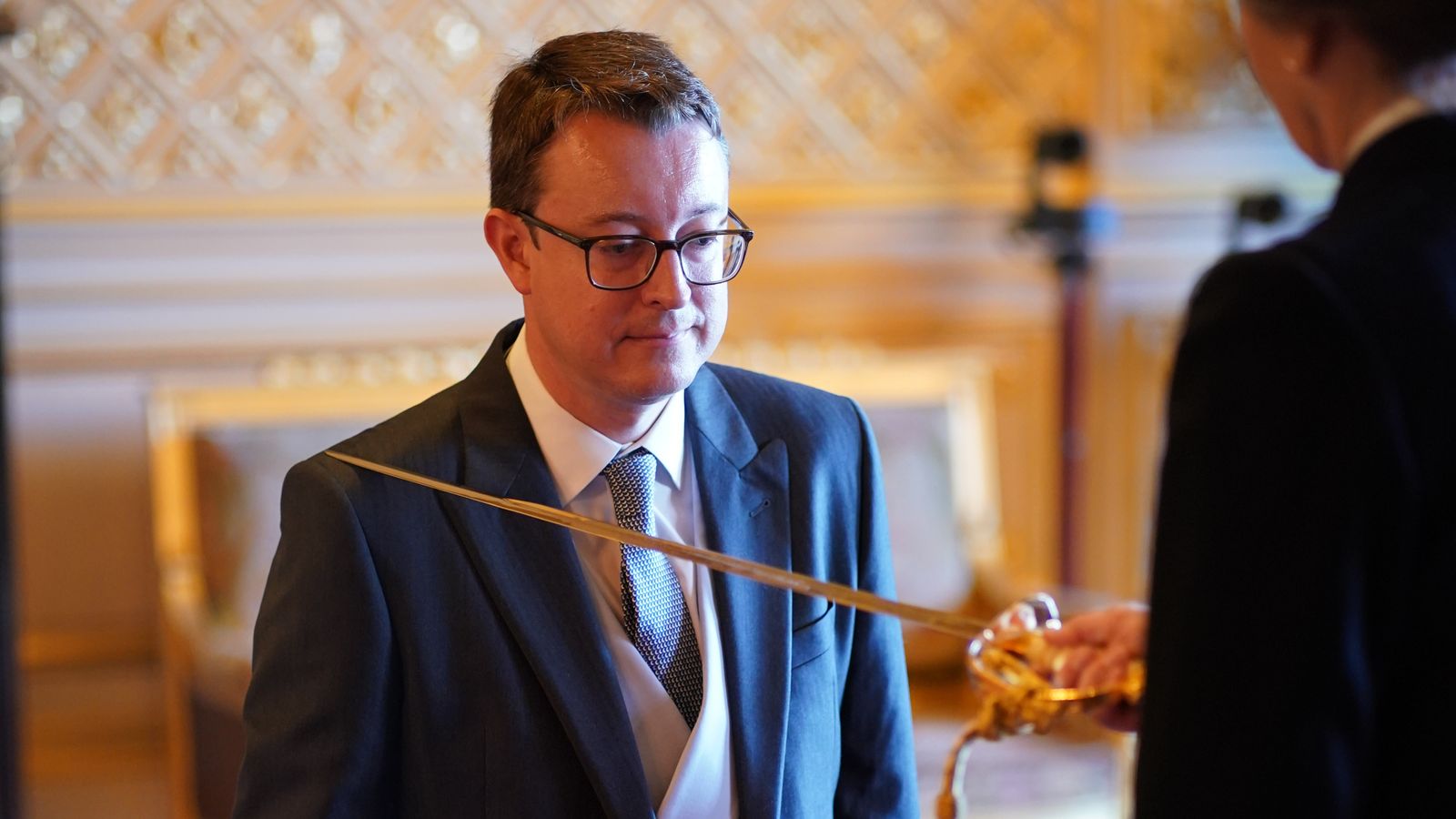
Sir Simon Clarke’s attack on Rishi Sunak is more kamikaze than mutiny… for now



Stablecoin issuer Circle has secured regulatory approval to operate as a financial service provider in the Abu Dhabi International Financial Center, deepening its push into the United Arab Emirates.
In an announcement Tuesday, Circle Internet Group said it received a Financial Services Permission license from the Financial Services Regulatory Authority of the Abu Dhabi Global Market (ADGM), the International Financial Centre of Abu Dhabi. This allows the stablecoin issuer to operate as a Money Services Provider in the IFC.
The USDC (USDC) issuer also appointed Saeeda Jaffar as its managing director for Circle Middle East and Africa. The new executive also serves as a senior vice president and group country manager for the Gulf Operation Council at Visa and will be tasked with developing the stablecoin issuer’s regional strategy and partnerships.
Circle co-founder, chairman and CEO Jeremy Allaire said that the relevant regulatory framework “sets a high bar for transparency, risk management, and consumer protection,” adding that those standards are needed if “trusted stablecoins” are going to support payments and finance at scale.

Related: Abu Dhabi Investment Council triples stake in Bitcoin ETF in Q3: Report
Abu Dhabi awards a wave of licenses
The ADGM has recently awarded licenses for financial operations to a wave of crypto companies. Earlier this week, Tether’s USDt (USDT) — the largest stablecoin by circulation and Circle’s top competitor — secured a regulatory milestone in Abu Dhabi’s international financial center, as did Ripple’s dollar-pegged stablecoin Ripple USD at the end of November.
On Monday, crypto exchange Binance was granted three separate licenses from Abu Dhabi’s financial regulator, allowing it to operate its exchange, clearing house and broker-dealer services. This followed its competitor Bybit receiving regulatory approval in the UAE in early October.
Related: HSBC to bring tokenized deposits to US and UAE as stablecoin race heats up
UAE bets on crypto
The Central Bank of the UAE has been actively reviewing its cryptocurrency regulations. In November, it introduced rules for decentralized finance (DeFi) and the broader Web3 industry.
The newly introduced Federal Decree Law No. 6 of 2025 brings DeFi platforms, related services and infrastructure providers under the scope of regulations if they enable payments, exchange, lending, custody, or investment services, with licenses now required. Local crypto lawyer Irina Heaver said that “DeFi projects can no longer avoid regulation by claiming they are just code.”
Heaver told Cointelegraph at the end of 2024 that during that year the country cemented its status as a global crypto hub.
In October 2024, the UAE exempted cryptocurrency transfers and conversions from value-added tax, just a month after Dubai’s digital asset regulator announced stricter rules on crypto marketing. Around the same time, local free economic zone Ras Al Khaimah Digital Assets Oasis was also working to introduce a legal framework for decentralized autonomous organizations.
Local regulators were not shy about enforcing the rules, with Dubai’s Virtual Assets Regulatory Authority cracking down on seven unlicensed crypto businesses, issuing fines and cease-and-desist orders.
Magazine: Review: The Devil Takes Bitcoin, a wild history of Mt. Gox and Silk Road

Crypto companies seeking a US federal bank charter should be treated no differently than other financial institutions, says Jonathan Gould, the head of the Office of the Comptroller of the Currency (OCC).
Gould told a blockchain conference on Monday that some new charter applicants in the digital or fintech spaces could be seen as offering novel activities for a national trust bank, but noted “custody and safekeeping services have been happening electronically for decades.”
“There is simply no justification for considering digital assets differently,” he added. “Additionally, it is important that we do not confine banks, including current national trust banks, to the technologies or businesses of the past.”
The OCC regulates national banks and has previously seen crypto companies as a risk to the banking system. Only two crypto banks are OCC-licensed: Anchorage Digital, which has held a charter since 2021, and Erebor, which got a preliminary banking charter in October.
Crypto “should have” a way to supervision
Gould said that the banking system has the “capacity to evolve from the telegraph to the blockchain.”
He added that the OCC had received 14 applications to start a new bank so far this year, “including some from entities engaged in novel or digital asset activities,” which was nearly equal to the number of similar applications that the OCC received over the last four years.

“Chartering helps ensure that the banking system continues to keep pace with the evolution of finance and supports our modern economy,” he added. “That is why entities that engage in activities involving digital assets and other novel technologies should have a pathway to become federally supervised banks.”
Gould brushes off banks’ concerns
Gould noted that banks and financial trade groups had raised concerns about crypto companies getting banking charters and the OCC’s ability to oversee them.
Related: Argentina weighs letting traditional banks trade crypto: Report
“Such concerns risk reversing innovations that would better serve bank customers and support local economies,” he said. “The OCC has also had years of experience supervising a crypto-native national trust bank.”
Gould said the regulator was “hearing from existing national banks, on a near daily basis, about their own initiatives for exciting and innovative products and services.”
“All of this reinforces my confidence in the OCC’s ability to effectively supervise new entrants as well as new activities of existing banks in a fair and even-handed manner,” he added.
Legal Panel: Crypto wanted to overthrow banks, now it’s becoming them in stablecoin fight
-
 Sports2 years ago
Story injured on diving stop, exits Red Sox game
-
 Sports3 years ago
‘Storybook stuff’: Inside the night Bryce Harper sent the Phillies to the World Series
-
 Sports2 years ago
Game 1 of WS least-watched in recorded history
-
 Sports3 years ago
Button battles heat exhaustion in NASCAR debut
-
 Sports3 years ago
MLB Rank 2023: Ranking baseball’s top 100 players
-
Sports4 years ago
Team Europe easily wins 4th straight Laver Cup
-
 Environment3 years ago
Japan and South Korea have a lot at stake in a free and open South China Sea
-
 Environment1 year ago
Here are the best electric bikes you can buy at every price level in October 2024